Needing reliable water off-grid but confused by the pump options?
You want a system that is efficient, durable, and cost-effective.
This guide helps you choose the right pump for your customers.
The best solar submersible pump depends entirely on your application's needs. Key factors include well depth (head), required water volume (flow rate), and water quality. This guide compares solar screw pumps, plastic impeller pumps, and stainless steel impeller pumps to help you make an informed decision.
Choosing the right solar water pump is critical for success in off-grid water supply.
Solar pumps are vital in regions from Africa to the Americas, providing water without relying on grid power.
This makes them environmentally friendly and reduces long-term operating costs.
We will explore the three main types of solar submersible pumps: the solar screw pump, the solar plastic impeller pump, and the solar stainless steel impeller pump.
All are powered by high-efficiency brushless DC (BLDC) motors, but each serves a distinct purpose.
Understanding their differences in performance, application, and cost is key to selecting the optimal solution for any water pumping challenge.
Let's dive into the details to see which pump best fits your specific requirements.
Things to Know About Types of Solar Water Pumps
Choosing the right solar water pump can be challenging.
There are many different types available for various needs.
This guide will help you understand the options to make a smart choice.
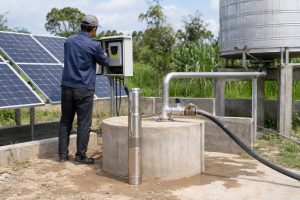
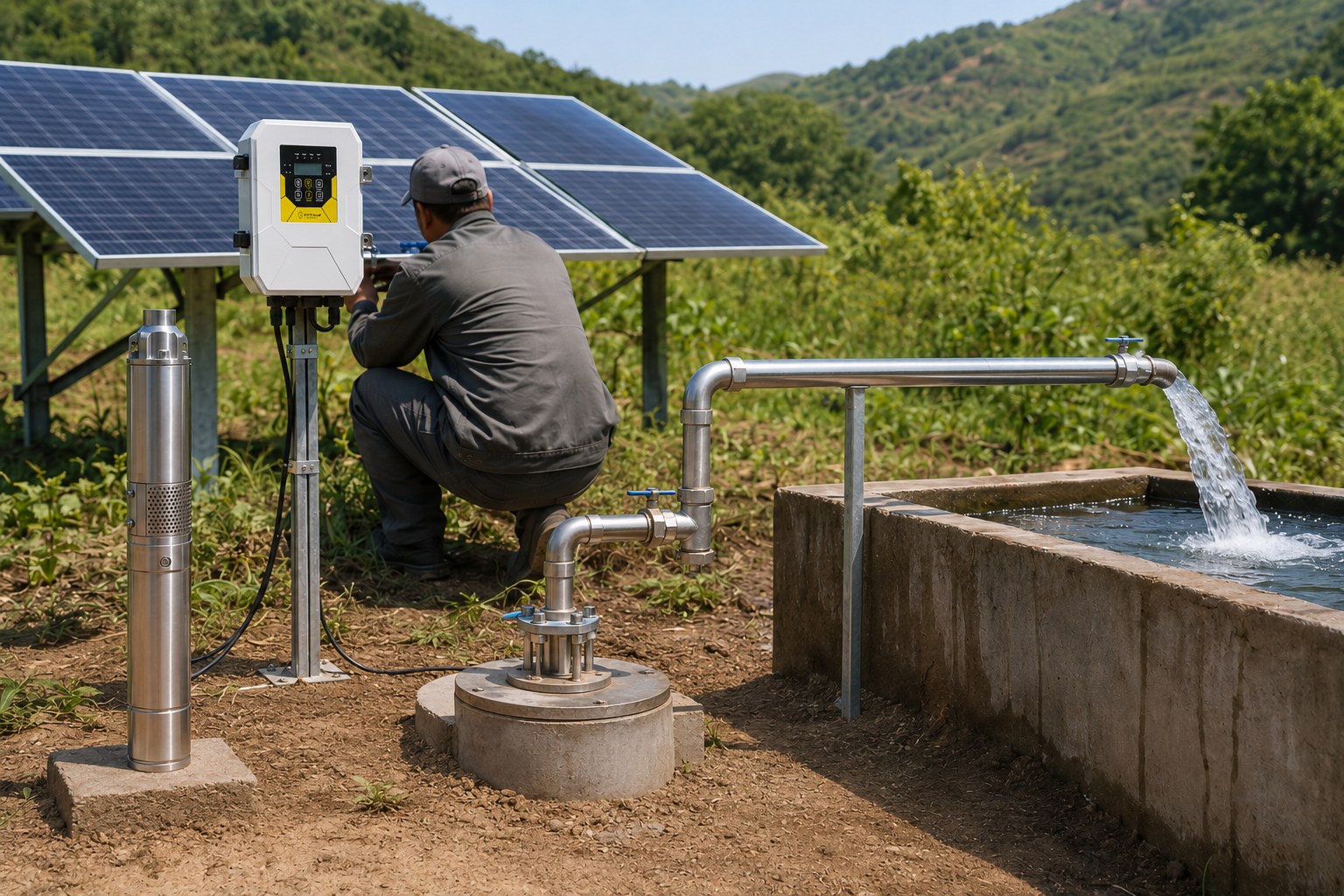
The main components of a solar water pump system are the solar panels, a pump controller, and the pump itself. Panels convert sunlight to DC electricity, the controller manages power flow, and the pump moves water from the source. A backup battery or storage tank ensures water is available anytime.
Solar water pumps have become a popular choice for their eco-friendly and cost-effective operation.
They offer a great alternative to pumps that depend on grid electricity or fuel.
However, the variety of pumps can make the selection process feel overwhelming.
Whether you need a pump for livestock, irrigation, or residential use, it's important to understand the fundamentals.
A complete solar pumping system has three core parts.
First, the solar panels capture sunlight and transform it into electrical energy.
This DC power is the lifeblood of the system.
Second, the pump controller acts as the brain.
It regulates the power sent to the pump.
This protects the motor from voltage spikes or drops, ensuring a longer lifespan and peak efficiency.
The pump controller often incorporates Maximum Power Point Tracking (MPPT) technology.
MPPT optimizes the output from the solar panels, increasing water flow by up to 30% compared to systems without it.
Third, the water pump itself is designed to run on DC or AC power.
It draws water from a well, borehole, or surface source like a river or pond.
Many systems also include optional components for enhanced reliability.
A water storage tank can hold a reserve for cloudy days or nighttime use.
This is often more cost-effective than a battery system.
A backup battery system stores excess energy generated during the day.
This allows the pump to operate when there is no sunlight, providing a 24/7 water supply.
How Solar Pumps Work
The process is simple yet effective.
Solar panels generate DC electricity from sunlight.
This electricity flows to the pump controller.
The controller manages the power, ensuring the pump motor receives the optimal voltage and current.
This intelligent management prevents damage and maximizes the amount of water pumped per watt of power.
The pump, submerged in the water source, then activates.
It draws water up and pushes it to its destination.
This could be an irrigation system, a livestock trough, or a storage tank.
Understanding Pump Specifications
When selecting a pump, two key metrics are crucial:
- Total Dynamic Head (TDH): This is the total height the pump must lift the water, including the vertical distance from the water source to the outlet, plus any friction loss from the pipes. A pump for a 100-foot deep well with a tank 30 feet above ground needs to overcome at least 130 feet of head, plus friction.
- Flow Rate: Measured in gallons per minute (GPM) or gallons per hour (GPH), this tells you how much water the pump can move. An irrigation system for a one-acre farm might require 10-20 GPM, while a single home may only need 5 GPM.
| Feature | Description | Importance |
|---|---|---|
| System Components | Solar Panels, Pump Controller, DC/AC Pump | Each part is essential for a functioning system. |
| Optional Add-ons | Storage Tank, Backup Battery | Provide water during low sunlight or at night. |
| Key Metrics | Total Dynamic Head (TDH), Flow Rate (GPM/GPH) | Determine the pump's suitability for a specific job. |
| Controller Tech | MPPT (Maximum Power Point Tracking) | Boosts water output by up to 30%. |
By understanding these basics, you can better evaluate the different types of solar submersible pumps and choose one that delivers reliable, efficient performance for years to come.
Solar Screw Pump: Low Flow, High Head
Need to pump water from a very deep well?
A solar screw pump might be your answer.
This type of pump excels at lifting water from great depths.
A solar screw pump, also known as a progressing cavity pump, uses a stainless steel helical rotor inside a rubber stator. This design creates sealed cavities that move water upward with high pressure, making it ideal for deep wells with low flow requirements and high sand content.
The solar screw pump is a specialized tool for challenging water situations.
Its unique design makes it a top choice for specific applications, particularly in regions like Africa and Latin America where deep boreholes are common.
It is a type of positive displacement pump.
This means it moves a fixed amount of water with each rotation of the screw.
The core of the pump is a helical rotor, usually made of stainless steel for durability.
This rotor turns inside a flexible rubber stator.
As the rotor spins, it forms a series of sealed pockets, or cavities, between itself and the stator.
Water is trapped in these cavities and is "pushed" or "progressed" up the pump column.
This mechanism allows the pump to generate very high pressure.
It can overcome the immense head pressure of deep wells, often exceeding 200 meters (650 feet).
Performance and Applications
The defining characteristic of a screw pump is its performance curve: high head and low flow.
While it can't move large volumes of water quickly, it excels at lifting water from depths that would challenge or stop a centrifugal pump.
- High Head Capability: Screw pumps are designed to push water to extreme heights. This makes them perfect for deep boreholes found in arid regions. For example, a standard 3-inch screw pump might deliver water from a depth of 150 meters, whereas a similarly sized centrifugal pump might top out at 80 meters.
- Low Flow Rate: The trade-off for high head is a lower flow rate. A typical solar screw pump might produce 2 to 10 gallons per minute (GPM), depending on the head. This is sufficient for domestic water supply, filling a small tank for livestock, or micro-irrigation, but not for large-scale agriculture.
- Sand Resistance: This is a major advantage. The flexible rubber stator and the design of the sealed cavities allow the pump to handle water with a higher concentration of sand and silt without sustaining significant damage. Many models can tolerate sand content up to 5%, far more than the 0.5% limit of most centrifugal pumps.
Advantages and Limitations
Understanding the pros and cons is crucial for distributors and end-users.
| Feature | Advantage | Limitation |
|---|---|---|
| Pumping Mechanism | Positive displacement, high pressure. | Lower efficiency compared to centrifugal pumps in low-head scenarios. |
| Head Performance | Excellent for deep wells (e.g., >100m). | Not efficient for shallow wells or surface water. |
| Flow Performance | Steady, reliable flow regardless of head fluctuations. | Low volume (2-10 GPM), not for high-demand irrigation. |
| Durability | High resistance to sand and abrasive particles. | The rubber stator is a wearable part and will eventually need replacement. |
| Cost | Often cost-effective for very deep well applications. | Higher cost per gallon pumped compared to high-flow pumps. |
A solar screw pump is the ideal choice when the primary challenge is lifting water from a deep, and possibly sandy, well.
It provides a reliable water source for homes and small farms in off-grid areas.
For a distributor, offering a robust screw pump option fills a critical niche in the market for customers with challenging borehole conditions.
It's not a one-size-fits-all solution, but for the right job, it's unbeatable.
Solar Plastic Impeller Pump: High Flow, Wear-Resistant
Need to move a lot of water for your farm or garden?
A plastic impeller pump offers a cost-effective solution.
It is designed for high-volume water delivery.
A solar plastic impeller pump is a multi-stage centrifugal pump that uses durable, engineered plastic impellers. It is designed to deliver high flow rates at medium head, making it an excellent choice for farm irrigation, livestock watering, and residential water supply where water quality is good.
When the goal is to maximize water output, the solar plastic impeller pump is a popular and economical choice.
This type of pump is widely used across the Americas and Africa for agricultural and residential applications.
It uses the principle of centrifugal force to move water.
Inside the pump, one or more impellers spin at high speed, driven by the motor.
Water enters the center of the spinning impeller and is thrown outward by the centrifugal force.
This action increases the water's velocity and pressure.
The water is then guided by a diffuser into the next stage or out of the pump.
A multi-stage pump has several impeller-diffuser sets stacked on top of each other to build higher pressure.
The key feature here is the use of engineered plastic for the impellers.
Modern pumps use high-strength, wear-resistant polymers like Noryl or polycarbonate.
These materials offer a great balance of performance, durability, and cost.
Performance and Applications
The plastic impeller pump shines in applications that require high flow rates at moderate depths.
- High Flow Rate: These pumps are built for volume. A 4-inch model can deliver flow rates from 20 to over 100 GPM, depending on the head and motor power. This makes them ideal for irrigating crops, filling large livestock troughs, or supplying water to a community. For example, a pump delivering 50 GPM can supply 3,000 gallons of water in just one hour of peak sunlight.
- Medium Head Capability: While not designed for extremely deep wells like screw pumps, they perform well at depths up to 80-100 meters (260-330 feet). This covers the majority of wells used for agriculture and residential purposes.
- Fine Sand Resistance: The engineered plastic impellers often have a "floating" design. This allows them to move slightly, enabling small, non-abrasive sand particles to pass through without causing a jam or significant wear. They can typically handle water with up to 1.5% fine sand content, making them more resilient than stainless steel impellers in certain sandy conditions.
Economic and Practical Advantages
For many users, the plastic impeller pump hits the sweet spot of performance and price.
| Feature | Advantage | Limitation |
|---|---|---|
| Material | Engineered plastic impellers are lightweight and low-cost. | Less durable than stainless steel in highly abrasive or corrosive water. |
| Performance | High flow rate, ideal for irrigation and high-demand uses. | Performance can degrade if used in wells deeper than its design limit. |
| Durability | Good resistance to fine sand due to floating impeller design. | Not suitable for water with high levels of corrosive minerals or very coarse sand. |
| Cost | Generally the most economical option for high-flow solar pumps. | May have a shorter service life than stainless steel models, requiring more frequent replacement. |
| Weight | Lighter than stainless steel pumps, making installation easier and cheaper. | The lighter construction may be perceived as less robust. |
The solar plastic impeller pump is the workhorse of the solar pumping world.
It provides a reliable and affordable way to move large volumes of water for farms, ranches, and homes.
Its lightweight design simplifies installation, reducing labor costs.
For distributors, this pump represents a high-volume, competitive product that meets the needs of a broad customer base.
While it's not the best choice for corrosive water or extremely deep wells, its combination of high flow, decent sand resistance, and low cost makes it an essential part of any solar pump portfolio.
Solar Stainless Steel Impeller Pump: Premium Quality, Corrosion Resistance
Dealing with acidic or alkaline water?
A stainless steel impeller pump offers superior durability.
It is built to withstand harsh water conditions.
This premium pump uses impellers and a pump body made from SS304 or SS316 stainless steel. It delivers high flow and medium-to-high head while offering exceptional resistance to corrosion, making it perfect for demanding applications and ensuring a long service life.
When longevity and reliability in challenging water environments are the top priorities, the solar stainless steel impeller pump is the ultimate choice.
This model is engineered for durability, targeting high-end residential, commercial, and agricultural markets where water quality could compromise lesser pumps.
Like the plastic impeller model, this is a multi-stage centrifugal pump.
The operational principle is the same: spinning impellers use centrifugal force to pressurize and move water.
The critical difference is the material.
The impellers, diffusers, and pump housing are all constructed from high-grade stainless steel, typically SS304.
For even more aggressive water, SS316, which includes molybdenum, offers enhanced corrosion resistance, particularly against chlorides.
This robust construction makes the pump highly resistant to both corrosion and abrasion from suspended solids.
Performance in Demanding Environments
The stainless steel pump is designed for high performance and a long lifespan, even under stress.
- Superior Corrosion Resistance: This is the pump's main selling point. It is ideal for regions with acidic or alkaline water (low or high pH), or high mineral content. For example, in the alkaline soils of Australia or certain parts of the Americas, a plastic impeller pump might degrade within a few years, while a stainless steel pump can last for a decade or more. Its corrosion resistance is rated to be over 5 times better than standard plastic impellers in water with a pH of 6.0.
- High Flow and Head: These pumps offer excellent hydraulic performance, providing high flow rates comparable to plastic impeller models but often capable of achieving higher head pressures due to the rigidity and precise manufacturing of the steel components. A 4-inch model can efficiently pump 50 GPM against a head of 100 meters.
- Durability and Reliability: The stainless steel construction ensures the pump maintains its hydraulic efficiency over a longer period. The impellers are less susceptible to wear from abrasive particles than plastic, leading to a more consistent performance and longer service intervals. This high reliability is crucial for critical applications like supplying water to high-value livestock or luxury remote homes.
Market Positioning and Trade-offs
This is a premium product with a specific target market.
| Feature | Advantage | Limitation |
|---|---|---|
| Material | SS304/SS316 stainless steel offers maximum corrosion and abrasion resistance. | Higher material cost results in a more expensive pump. |
| Service Life | Extremely long lifespan, often 2-3 times that of a plastic impeller pump. | The higher initial investment can be a barrier for some customers. |
| Performance | Maintains high efficiency for longer; can achieve higher pressures. | The "fixed" impeller design can be less tolerant of large sand particles than "floating" plastic impellers. |
| Weight | Robust, heavy-duty construction. | Heavier weight can make installation more difficult and costly. |
| Application | Ideal for high-end homes, commercial use, and special water conditions. | May be over-specified and too expensive for standard agricultural use with good water quality. |
The solar stainless steel impeller pump is an investment in peace of mind.
It is the best choice for customers who prioritize long-term reliability and are dealing with water that would quickly destroy other pumps.
For a distributor, this pump represents a high-margin, premium offering.
It allows you to cater to discerning customers and solve problems that standard pumps cannot.
While its higher cost and weight are considerations, the extended service life and superior durability provide excellent long-term value in the right applications.
BLDC Motor: The Core of High Efficiency
What makes modern solar pumps so effective?
The answer lies in the motor.
A high-efficiency motor is the heart of the entire system.
All three pump types—screw, plastic, and stainless steel—are powered by a Brushless DC (BLDC) permanent magnet motor. With efficiencies over 90%, this advanced motor is the key to maximizing water output while minimizing solar panel requirements and overall system cost.
The pump head (screw or impeller type) determines how the water is moved, but the motor determines how efficiently that work is done.
The shift to Brushless DC (BLDC) permanent magnet motors has revolutionized the solar pumping industry.
This technology is the single most important factor in the performance and competitiveness of modern solar water pumps.
A BLDC motor operates without the mechanical brushes and commutator found in traditional DC motors.
Instead, an electronic controller switches the power to the motor's windings.
The rotor is made of powerful permanent magnets, typically high-grade Neodymium Iron Boron (NdFeB), like 40SH grade magnets.
This design eliminates the friction and energy loss associated with brushes, leading to significant gains in efficiency, reliability, and lifespan.
Technical and Market Advantages
The benefits of using a BLDC motor are substantial and impact every aspect of the solar pumping system.
- Exceptional Efficiency: BLDC motors regularly achieve efficiencies of 90% or higher. In contrast, traditional brushed DC motors hover around 75-80%, and AC induction motors used in some solar systems (requiring an inverter) are often in the 80-85% range. This 10-15% efficiency gain means that for every 100 watts of solar power, a BLDC motor delivers 10-15 more watts of pumping power to the shaft.
- Reduced System Cost: Higher motor efficiency directly translates to lower overall system costs. Because the motor gets more work done with less power, a smaller solar array is needed to achieve the same water flow. Solar panels can account for 40-50% of the total system cost, so a 25% reduction in panel size (e.g., using three 300W panels instead of four) can save hundreds of dollars.
- Compact and Lightweight Design: The high power density of permanent magnets allows BLDC motors to be smaller and lighter than other motor types of the same power rating. A BLDC motor can be up to 47% smaller and 39% lighter than an equivalent AC motor. This makes the entire pump unit easier to handle, transport, and install, further reducing labor costs.
- High Reliability and Long Lifespan: With no brushes to wear out, BLDC motors are virtually maintenance-free. Their lifespan is limited only by the bearings, which can last for tens of thousands of hours. This is a critical advantage for pumps installed in remote, hard-to-reach locations.
- Superior Performance: BLDC motors offer high starting torque, which is essential for getting the pump running, especially for positive displacement screw pumps. They also provide a wide, stable speed range, allowing the pump controller to precisely match the pump's speed to the available solar power, maximizing water delivery throughout the day.
The Strategic Role of the Motor
The motor is not just a component; it is the core technology that drives the system's value proposition.
| Motor Technology Comparison | BLDC Permanent Magnet | Brushed DC | AC Induction (with Inverter) |
|---|---|---|---|
| Efficiency | >90% | 75-80% | 80-85% (plus inverter loss) |
| Lifespan | Very Long (no brushes) | Limited by brush wear | Long, but inverter is a failure point |
| Maintenance | Virtually none | Regular brush replacement | None for motor, inverter may need service |
| Size/Weight | Compact & Lightweight | Bulky | Heaviest |
| Control | Precise electronic speed control | Simple, less precise | Complex, requires VFD in inverter |
| System Cost Impact | Reduces panel size and cost | Requires larger panel array | Requires expensive VFD inverter |
By pairing a high-efficiency BLDC motor with an intelligent MPPT controller, manufacturers create a solar pumping system that extracts the maximum amount of energy from the sun and converts it into pumped water.
For distributors and end-users, this means a more powerful, reliable, and cost-effective water solution.
The choice of motor technology is a defining factor in a pump's market competitiveness.
AC/DC Hybrid: The All-Weather Solution
What happens on cloudy days or at night?
Running out of water is not an option.
A hybrid system ensures a constant water supply.
An AC/DC hybrid solar pump system provides ultimate flexibility. It primarily uses free DC power from solar panels but can automatically switch to an AC power source (grid or generator) when sunlight is insufficient. This guarantees a reliable 24/7 water supply.
While DC-only solar pumps are fantastic for many applications, their reliance on sunlight can be a limitation.
For critical uses like community water supply, large-scale irrigation, or industrial processes, a 24-hour water guarantee is essential.
This is where AC/DC hybrid technology comes in.
A hybrid system uses a special controller that can accept and manage power from two different sources simultaneously.
The primary input is always DC power from the solar panels.
The secondary input is AC power, which can come from the local utility grid or a backup generator.
The controller is the smart part of this setup.
It constantly monitors the power available from the solar panels.
How Hybrid Controllers Work
The intelligence of the system lies in its power management logic.
- Solar Priority: During the day, the controller will always prioritize using the free energy from the sun. If the solar panels are producing enough power to run the pump at the required speed, the AC input is ignored. This maximizes cost savings.
- Power Blending (Hybrid Function): When sunlight fades due to clouds or the time of day, the solar panel output drops. If the solar power is not enough to meet the pump's demand, the controller doesn't just switch off. Instead, it intelligently "blends" the available DC power with just enough AC power to make up the difference. This feature ensures the pump continues to run smoothly while still using as much free solar energy as possible. For example, if the pump needs 1000W and the sun is providing 600W, the controller will draw the remaining 400W from the AC source.
- Automatic Switchover: When the sun goes down completely, or if the solar panels are covered in snow, the controller will automatically switch over to run the pump entirely on the AC power source. When the sun returns, it will automatically switch back to solar priority. This process is seamless and requires no manual intervention.
The Benefits of a Hybrid System
A hybrid system offers the best of both worlds: the cost savings of solar and the reliability of the grid.
| Feature | DC-Only System | AC/DC Hybrid System |
|---|---|---|
| Operation Time | Daylight hours only. | 24/7, all-weather operation. |
| Reliability | Dependent on weather; may need large storage tanks. | Extremely high reliability; less reliance on storage. |
| System Cost | Lower initial controller cost. | Higher controller cost, but may reduce the need for oversized tanks or batteries. |
| Energy Source | Solar only. | Solar, Grid, Generator. |
| Best Application | Livestock watering, non-critical irrigation where a tank can buffer supply. | Critical irrigation, domestic water for homes with grid access, community water supply. |
The ability to connect to both photovoltaic and AC power simultaneously ensures you have worry-free water access around the clock.
The controller's ability to automatically identify the power source and prioritize solar energy keeps operating costs to an absolute minimum.
When photovoltaic power is insufficient, the blending function maximizes the use of every available ray of sunlight.
When there's no solar input at all, it seamlessly transitions to the AC supply.
This level of intelligent control provides unmatched reliability, making the AC/DC hybrid system an ideal solution for users who cannot afford any interruption in their water supply.
It's a premium feature that adds significant value for residential, agricultural, and commercial clients alike.
Conclusion
Choosing the best solar pump means matching the pump type to the head, flow, and water quality, all powered by an efficient BLDC motor and smart controller for optimal performance.
FAQs
Q. How deep can a solar water pump go?
A. It depends on the pump type. Solar screw pumps can lift water from over 200 meters (650 feet), while centrifugal pumps are typically used for depths up to 100 meters.
Q. How long do solar water pumps last?
A. A well-maintained system can last 15-20 years. The BLDC motor often lasts over 10 years, while solar panels have a 25-year performance warranty. Pump ends may need servicing sooner depending on water quality.
Q. Can a solar pump work on cloudy days?
A. Yes, but at a reduced flow rate. They produce the most water in direct sunlight. For consistent water, a storage tank or an AC/DC hybrid system is recommended.
Q. How much water can a solar pump move?
A. This varies greatly. Small pumps for birdbaths move a few gallons per hour, while large agricultural pumps can move over 100 gallons per minute (6,000 GPH) under full sun.
Q. Do I need batteries with my solar water pump?
A. Not necessarily. It's often more cost-effective to pump water into a storage tank during the day and use gravity-fed water at night. Batteries are an option for 24/7 pumping without a tank.
Q. What size solar pump do I need?
A. You need to calculate your Total Dynamic Head (TDH) and daily water requirement (Gallons Per Day). Use these figures to consult pump performance charts to find a model that meets your needs.
Q. Are solar water pumps expensive?
A. The initial cost is higher than a conventional pump, from $2,000 to $10,000. However, with zero fuel costs and low maintenance, they often have a lower total cost of ownership over their lifespan.