Choosing a water pump feels overwhelming.
The wrong choice costs you money and leaves you without water when you need it most.
This guide simplifies the process.
A 0.5 horsepower (HP) water pump is often sufficient for a small to medium-sized home with a shallow well (under 250 feet total depth) and moderate water needs. However, your specific well depth, required flow rate, and water pressure will ultimately determine if it's the right choice.
Deciding between a 0.5 HP pump and a larger one can be confusing.
It feels like a technical decision with high stakes.
You worry about buying a pump that's too weak, or wasting money on one that's too powerful.
This article breaks down the key differences and factors you need to consider.
We will help you understand the real-world power consumption, performance capabilities, and crucial details like startup wattage.
By the end, you will be able to confidently choose the right pump size for your home.
You will have the knowledge to ensure a reliable water supply without overspending on energy or equipment.
What is the difference between a 1HP and a 0.5HP water pump?
Struggling to see the real difference between horsepower ratings?
You see the numbers but don't know what they mean for your well, your water pressure, or your electricity bill.
It's a common point of confusion.
A 1HP pump uses a larger motor that consumes about twice the power of a 0.5HP pump. This allows it to pump water from much deeper wells (up to 500 feet) and deliver higher flow rates, while a 0.5HP pump is best for depths up to 250 feet.
The horsepower (HP) number on a water pump directly relates to the power of its motor.
Think of it as the engine size.
A bigger engine can do more work.
A 1HP pump has a more powerful motor than a 0.5HP pump.
This fundamental difference impacts every aspect of its performance, from how deep it can reach to how much water it can deliver.
Understanding this trade-off between power and cost is the first step in selecting the right pump.
Power Consumption and Cost
A key difference is electrical usage.
The relationship is simple.
A 1HP motor is rated at 746 watts, while a 0.5HP motor is 373 watts.
This means a 1HP pump has the potential to use double the electricity.
Over time, this adds up to a higher electricity bill.
Choosing an oversized pump means you are paying for power you don't need every time the pump turns on.
| Pump Size | Theoretical Power | Estimated Real-World Power | Impact on Bills |
|---|---|---|---|
| 0.5 HP | 373 Watts | 650 - 900 Watts | Lower Cost |
| 1.0 HP | 746 Watts | 1,000 - 1,400 Watts | Higher Cost |
Performance: Depth and Flow Rate
The real job of a pump is to move water.
Power determines how well it does that job.
The primary measure of a pump's task is Total Dynamic Head (TDH).
TDH is the total equivalent height that a fluid is to be pumped, taking into account friction losses in the pipe.
TDH = Well Depth + Vertical Lift + Frictional Loss + Pressure Tank Head
A more powerful motor can overcome more resistance.
- A 0.5HP pump is generally suited for situations with a Total Dynamic Head up to 250 feet. This makes it ideal for many residential homes with shallower wells.
- A 1HP pump can handle a TDH of up to 500 feet. This makes it necessary for deeper wells or applications requiring higher pressure.
At any given depth, a 1HP pump will also deliver a higher flow rate (Gallons Per Minute, or GPM) than a 0.5HP pump.
If your home has many bathrooms or you plan to run irrigation, that higher flow rate can be essential.
For example, a 0.5HP pump might produce 8 GPM at 100 feet of head, while a 1HP pump from the same series could produce 12 GPM at the same head.
Why the same horsepower can show different wattage
You've compared two pumps with the same horsepower.
You notice they have different electrical ratings in watts or amps.
This is confusing and seems like a contradiction.
Horsepower rates the motor's mechanical output, not its electrical input. The actual wattage a pump draws from the wall depends on the motor's efficiency, the pump's design, the voltage, and the workload (head and flow), which is why two 1HP pumps can have different power draws.
The "horsepower" rating is a standard for the work the motor can perform.
It is not a measure of the electricity it consumes to do that work.
No motor is 100% efficient.
A significant portion of electrical energy is lost as heat.
This inefficiency is why a 1HP pump, theoretically 746 watts, often draws over 1,000 watts in reality.
Several factors contribute to this difference.
Motor and Pump Efficiency
This is the biggest reason for the discrepancy.
Motor efficiency is the ratio of mechanical power output to electrical power input.
A motor with 80% efficiency will need 933 watts of input to produce 746 watts (1HP) of output.
A motor with a lower efficiency of 65% would need over 1,140 watts for the same 1HP output.
Modern motors, like Brushless DC (BLDC) permanent magnet motors, can achieve efficiencies over 90%.
This significantly reduces the electricity needed, saving costs and making them ideal for solar power applications where every watt counts.
Pump Design and Application
The type of pump mechanism also changes the load on the motor.
Different designs are built for different jobs.
- Screw Pumps: These use a rotor and stator to push water. They are excellent for creating very high pressure (high head) but at a lower flow rate. They are also highly resistant to sand.
- Centrifugal Pumps (with Impellers): These use spinning impellers to move water. They are designed for high flow rates but may offer less head. The material of the impeller (e.g., plastic vs. stainless steel) also affects performance and durability in different water conditions.
A 1HP motor on a high-pressure screw pump will have a different load profile and wattage draw than a 1HP motor on a high-flow centrifugal pump.
Voltage Changes the Amps
You will often see pumps rated for either 115V or 230V.
The total power (watts) drawn will be roughly the same, but how it gets there is different.
Power (Watts) = Voltage (Volts) x Current (Amps).
A pump running on 230V will draw half the amperage of the same pump running on 115V.
| Pump Example | Voltage | Full Load Amps | Power Check (V x A) |
|---|---|---|---|
| 1 HP Pump | 115V | 10.4 Amps | ~1,200 Watts |
| 1 HP Pump | 230V | 5.2 Amps | ~1,200 Watts |
Lower amperage on 230V circuits allows for smaller-gauge wiring, but the total power consumption remains the same.
When planning for backup power, the total wattage is the most important figure.
Running watts vs startup watts
You've sized your generator or backup battery perfectly for your pump's running watts.
But when the pump kicks on, the breaker trips immediately.
You're left confused and in the dark.
A water pump requires a massive surge of power for a split second just to start, known as startup or inrush current. This can be 2 to 5 times its normal running wattage. Backup power systems must be able to handle this peak load, not just the continuous running load.
This is one of the most common and frustrating failures in backup power planning.
An electric motor is like a sprinter at the starting block.
It needs a huge burst of energy to overcome inertia and get the pump mechanism moving from a dead stop.
Once it's spinning, it requires much less energy to maintain its speed.
This initial burst is the "startup wattage" or "surge wattage."
The power it uses afterward is the "running wattage."
Why Startup Surge Matters
Ignoring startup surge is a recipe for failure.
A 1HP pump might run comfortably at 1,200 watts.
However, its startup surge could easily hit 3,000 watts or more.
If your generator or battery power station is only rated for 2,000 watts, it will be overloaded and will shut down or trip its breaker to protect itself.
You must size your power source for the peak demand, not the average demand.
The table below shows real-world examples from a leading motor manufacturer.
| Pump Type Example | Running Amps | Starting Amps | Surge Multiplier |
|---|---|---|---|
| 0.5 HP Effluent Pump (115V) | 10 A | 18 A | 1.8x |
| 1 HP Grinder Pump (115V) | 12.5 A | 65 A | 5.2x |
| 2 HP High-Head Grinder (230V) | 16 A | 73 A | 4.6x |
As you can see, certain pump types, like grinder pumps, are notoriously "hard-starting" and have extreme surge requirements.
Planning for the Surge
When selecting a generator or a portable power station, look for two numbers:
- Rated/Running Watts: The continuous power it can supply.
- Peak/Surge Watts: The maximum power it can supply for a few seconds.
The "Peak Watts" number must be higher than your pump's startup wattage requirement.
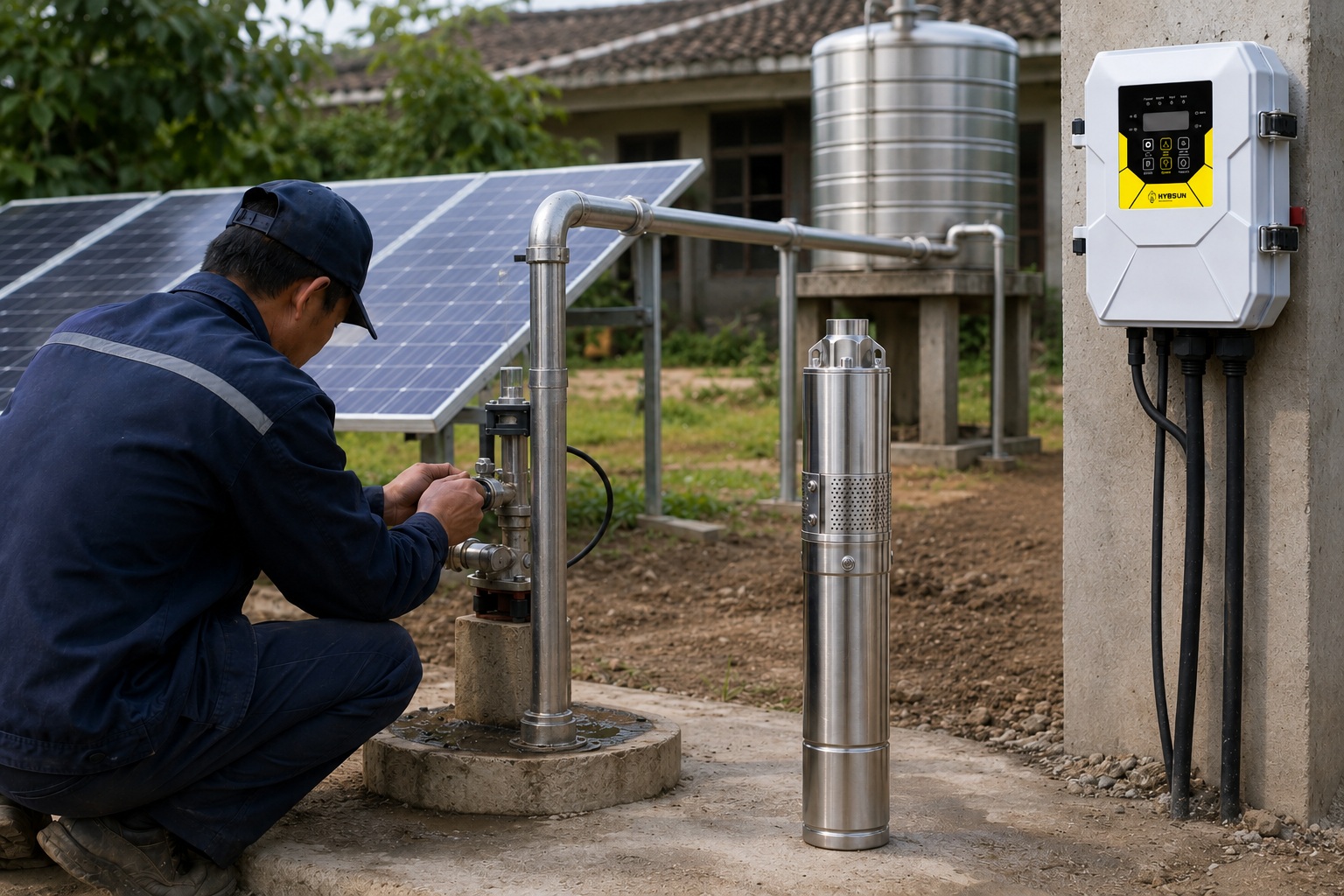
For solar-powered systems, this is where a high-quality controller is essential.
An advanced MPPT (Maximum Power Point Tracking) controller can manage this startup surge effectively.
Some controllers even feature a "soft-start" function, which ramps up the motor speed gradually.
This dramatically reduces the initial power spike, allowing the pump to run on a smaller solar array or battery bank, saving significant cost.
Choosing the Right Pump for Your Needs
You feel stuck in a sea of technical specifications.
You just want to know which pump is right for your home, farm, or property without getting a degree in engineering.
The process feels risky.
Choosing the right pump is a four-step process: calculate your water demand, determine your total depth and pressure needs, consider your water quality, and evaluate your power source. Matching the pump to these four factors ensures a reliable, efficient, and long-lasting system.
A water pump is not a one-size-fits-all product.
The perfect pump for your neighbor might be completely wrong for you.
By breaking the decision down into logical steps, you can move from confusion to clarity.
This systematic approach ensures you don't overlook a critical factor that could cause problems down the road.
Let's walk through it step-by-step.
Step 1: Calculate Your Water Needs (Flow Rate)
First, figure out how much water you need at peak times.
This is your required flow rate, measured in Gallons Per Minute (GPM).
Make a list of all water fixtures and appliances that could be running at the same time in a worst-case scenario.
- Standard Shower: 2.5 GPM
- Kitchen Faucet: 2.0 GPM
- Toilet Flush: 1.6 GPM
- Washing Machine: 2.0 GPM
- Garden Hose: 5.0 GPM
Add them up.
If you have two showers and a dishwasher running, you'll need at least 7 GPM to maintain pressure.
An undersized pump will lead to a frustrating drop in water pressure when multiple taps are open.
Step 2: Determine Your Total Dynamic Head (TDH)
We covered this before, but it's critical.
You must calculate the total pressure the pump has to fight against.
A shallow well of 50 feet might only require a 0.5HP or 0.75HP pump.
A deep well of 800 feet will demand a much more powerful 3HP or 5HP pump just to get the water to the surface, before even considering pressure for the house.
Don't guess this number.
Use your well report or measure it accurately.
Step 3: Consider Your Water Quality
Water is not always pure.
Sand, silt, or minerals can destroy a pump not designed for them.
- For Sandy or Gritty Water: A solar screw pump is the best choice. Its design is highly resistant to abrasion from sand and can operate in harsh conditions, making it perfect for new wells or areas with poor water quality.
- For General Use with Fine Sand: A solar plastic impeller pump offers a great balance. It delivers high flow and is wear-resistant against fine particles, making it an economical choice for farm and home use.
- For Corrosive or "Hard" Water: If your water is acidic or has high mineral content, you need a solar stainless steel impeller pump. The SS304 stainless steel resists corrosion, ensuring a much longer service life and protecting the quality of your water.
Step 4: Evaluate Your Power Source
Finally, how will you power your pump?
- Grid Power: The most common option, but vulnerable to outages.
- Solar Power: Provides water independence and eliminates electricity bills. This is ideal for off-grid locations and as a sustainable solution anywhere. High-efficiency BLDC motors are key here, as they require up to 47% less space for solar panels compared to older motor types.
- AC/DC Hybrid Power: The ultimate solution for 24/7 reliability. These systems use an intelligent controller that prioritizes free solar power during the day. If solar is insufficient (on cloudy days or at night), it automatically blends in or switches to AC grid or generator power. This guarantees you have water whenever you need it, without compromise.
Conclusion
A 0.5 HP pump is enough for many homes.
But "enough" depends on a smart choice.
Consider your well depth, water needs, quality, and power source to find the perfect fit.
FAQs
How many gallons per minute can a 1/2 HP well pump?
A 1/2 HP pump typically delivers between 5 to 10 gallons per minute (GPM), depending on the well depth and pressure.
How deep can a 1/2 HP submersible pump go?
A 1/2 HP submersible pump is generally effective for total depths (including pressure head) up to about 250 feet.
Is a 1/2 HP pump strong enough for a sprinkler system?
It can be, but only for a small system with one or two sprinkler heads. Most irrigation systems require the higher flow and pressure of a 1 HP pump or larger.
How much does it cost to run a 1/2 HP well pump?
A 1/2 HP pump uses about 650-900 watts. The cost depends on your local electricity rate and how many hours it runs per day.
Can a 1/2 HP pump run a house?
Yes, a 1/2 HP pump can adequately supply water for a small to average-sized house with 1-2 bathrooms and moderate water usage.
What size pressure tank for 1/2 HP well pump?
A 20-gallon pressure tank is a common and effective size for a 1/2 HP well pump, providing a good balance of pump cycle time and space.
How many solar panels do I need for a 1/2 HP pump?
For a modern, high-efficiency 1/2 HP (approx. 700W) solar pump, you would typically need about 900 to 1,000 watts of solar panels to ensure reliable performance.