Finding the right water pump feels overwhelming.
You need reliable water pressure, but the options are confusing.
The best pump is the one designed for your specific needs.
The best 0.5 HP water pump is one that perfectly matches your application's Total Dynamic Head (TDH), flow rate requirements, and water source. For deep domestic wells, a solar screw pump is often best. For small-scale irrigation with moderate depth, a solar plastic impeller pump excels.
Choosing a water pump involves more than just picking a horsepower rating.
The motor's power is just one piece of a larger puzzle.
To find the truly "best" option, you need to understand how power translates into performance for your unique situation.
This guide will break down the key factors, from power consumption to pump types, helping you select a pump that delivers reliable, efficient performance for years.
Let's explore what makes a water pump the right choice for you.
What is the difference between a 1HP and a 0.5HP water pump?
Struggling to decide between a 0.5 HP and a 1 HP pump?
This common question can leave you feeling stuck.
The wrong choice could mean weak water flow or a high electricity bill.
The main difference lies in power and performance. A 1 HP pump has a larger motor, consumes twice the power (746 watts vs. 373 watts), and can pump water from deeper wells and at higher flow rates compared to a 0.5 HP pump.
To make an informed decision, it is crucial to look beyond the horsepower number and understand the technical details.
The horsepower (HP) rating directly corresponds to the motor's ability to do work.
A larger motor can generate more pressure and move more water.
However, more power is not always better.
Oversizing a pump can lead to wasted energy and unnecessary costs, while undersizing it will result in poor performance.
The key is to match the pump's capabilities to your specific requirements, particularly the Total Dynamic Head (TDH).
Power Consumption and Operational Cost
A pump's horsepower rating is a direct indicator of its energy usage.
A 1 HP motor is defined as having the power to perform 746 watts of work.
Consequently, a 0.5 HP motor performs half of that, equivalent to 373 watts.
This 50% reduction in power consumption directly translates to lower electricity bills.
For off-grid solar applications, this is even more critical.
A 0.5 HP pump requires approximately half the number of solar panels compared to a 1 HP pump for the same run time, significantly reducing the initial system investment.
Performance Metrics: Head and Flow Rate
The primary job of a well pump is to lift water and create pressure.
This capability is measured by Total Dynamic Head (TDH) and flow rate (GPM or LPH).
A 0.5 HP pump is generally suitable for applications with a TDH up to 250 feet.
In contrast, a 1 HP pump can handle a TDH of up to 500 feet.
This means a 1 HP pump can lift water from much deeper wells or push it to a higher elevation.
The flow rate also increases with horsepower.
At any given head level, a 1 HP pump will deliver more gallons per minute than its 0.5 HP counterpart from the same model line.
| Feature | 0.5 HP Pump | 1 HP Pump |
|---|---|---|
| Power Consumption | ~373 Watts | ~746 Watts |
| Max. Total Dynamic Head (TDH) | ~250 feet (76 meters) | ~500 feet (152 meters) |
| Ideal Application | Shallow wells, home water supply, small gardens | Deep wells, light irrigation, multi-story buildings |
| Relative Cost | Lower initial and operational cost | Higher initial and operational cost |
Understanding Total Dynamic Head (TDH)
Total Dynamic Head is the most critical calculation for sizing a pump correctly.
It represents the total equivalent height that water must be lifted, considering all sources of pressure loss in the system.
The formula is:
TDH = Well Depth + Vertical Lift + Frictional Loss + Pressure Tank Head
- Well Depth: The distance from the ground surface to the water level in the well.
- Vertical Lift: The height from the ground to the highest point of discharge (e.g., the top of a storage tank).
- Frictional Loss: Pressure lost due to water rubbing against the inside of the pipes. This increases with pipe length, smaller pipe diameter, and higher flow rates.
- Pressure Tank Head: If a pressure tank is used, its pre-charge pressure must be converted to feet of head (1 PSI ≈ 2.31 feet of head).
Accurately calculating your TDH ensures you choose a pump that can not only lift the water but also deliver it at your desired pressure.
How to choose the best water pump in 2025?
Choosing a pump feels like a high-stakes decision.
Pick the wrong one, and you could face weak showers or a failing irrigation system.
The solution is a systematic approach to match the pump to the job.
To choose the best water pump, first identify your application (home, farm, industry). Then, analyze your water source (surface or well), calculate the required head and flow rate, and finally, evaluate the pump's materials for durability based on your water quality.
The ideal water pump is a perfect blend of performance, efficiency, and durability tailored to your environment.
A pump that is perfect for a shallow well at a small home will fail miserably in a deep borewell for agriculture.
Instead of focusing only on brand names or horsepower, a successful selection process involves a step-by-step evaluation of your specific needs.
By breaking down the decision into clear stages, you can confidently select a pump that provides reliable water for years.
This method eliminates guesswork and ensures you invest in a solution that truly works.
Step 1: Define Your Application
The first step is to clarify the primary use of the water pump.
Different applications have vastly different demands for flow rate and pressure.
- Domestic Use: For bungalows, small homes, and filling overhead tanks, a 0.5 HP to 1 HP self-priming monoblock pump is typically sufficient. They provide consistent pressure for daily household needs.
- Agriculture: For farm irrigation, sprinkler systems, or livestock watering, higher flow rates are essential. Submersible or centrifugal pumps with 1.5 HP or more are often required to move large volumes of water efficiently.
- Industrial/Commercial: High-rise buildings, water treatment plants, or industrial processes demand continuous operation and high pressure. Horizontal multistage pumps are designed for these heavy-duty, high-pressure applications.
Step 2: Analyze Your Water Source
The location of your water dictates the type of pump you need.
Pumps are designed specifically for either surface or groundwater sources.
- Surface Water: For sources like lakes, rivers, ponds, or shallow tanks, a surface-mounted pump is ideal. This includes monoblock, centrifugal, and some jet pumps. They are installed on dry land and pull water through a suction pipe.
- Groundwater (Wells/Borewells): To lift water from underground, you need a pump that can handle significant depths. Submersible pumps are placed directly inside the well, pushing water up to the surface. They are highly efficient for deep wells. Jet pumps can also be used for shallow to medium-depth wells.
Step 3: Calculate Head and Discharge Needs
This is the most technical but most important step.
"Head" is the vertical distance in feet or meters that the pump must lift the water.
"Discharge" (or flow rate) is the volume of water delivered over a period, measured in gallons per minute (GPM) or liters per hour (LPH).
You must choose a pump whose performance chart shows it can deliver your required discharge at your calculated Total Dynamic Head (TDH).
For example, if your home needs 10 GPM and your TDH is 150 feet, you must select a pump that meets or exceeds this point on its curve.
Failing to do so will result in low pressure and insufficient water supply.
Step 4: Evaluate Material and Durability
The pump's construction material determines its lifespan, especially in harsh conditions.
Water chemistry and the presence of sand or silt are major factors.
| Material | Best For | Corrosion Resistance | Sand Handling | Lifespan |
|---|---|---|---|---|
| Cast Iron | General use, agriculture | Good | Good | Very Long |
| Plastic Impellers | Clean to slightly sandy water | Excellent | Excellent (fine sand) | Good |
| Brass Impellers | Clean water, residential | Very Good | Fair | Long |
| Stainless Steel | Corrosive water (acidic/alkaline) | Superior | Good | Very Long |
For example, a pump with a stainless steel body and impellers is the best choice for water with low pH or high salinity.
For wells with a high concentration of sand, a pump specifically designed with sand-resistant components, like certain screw pumps or pumps with durable plastic impellers, is essential to prevent premature wear and failure.
What are the best types of 0.5 hp solar pumps for deep wells?
You need water from a deep well but have no reliable grid power.
Traditional pumps are not an option, leaving you without a solution.
Solar-powered deep well pumps offer an independent, cost-effective, and reliable answer.
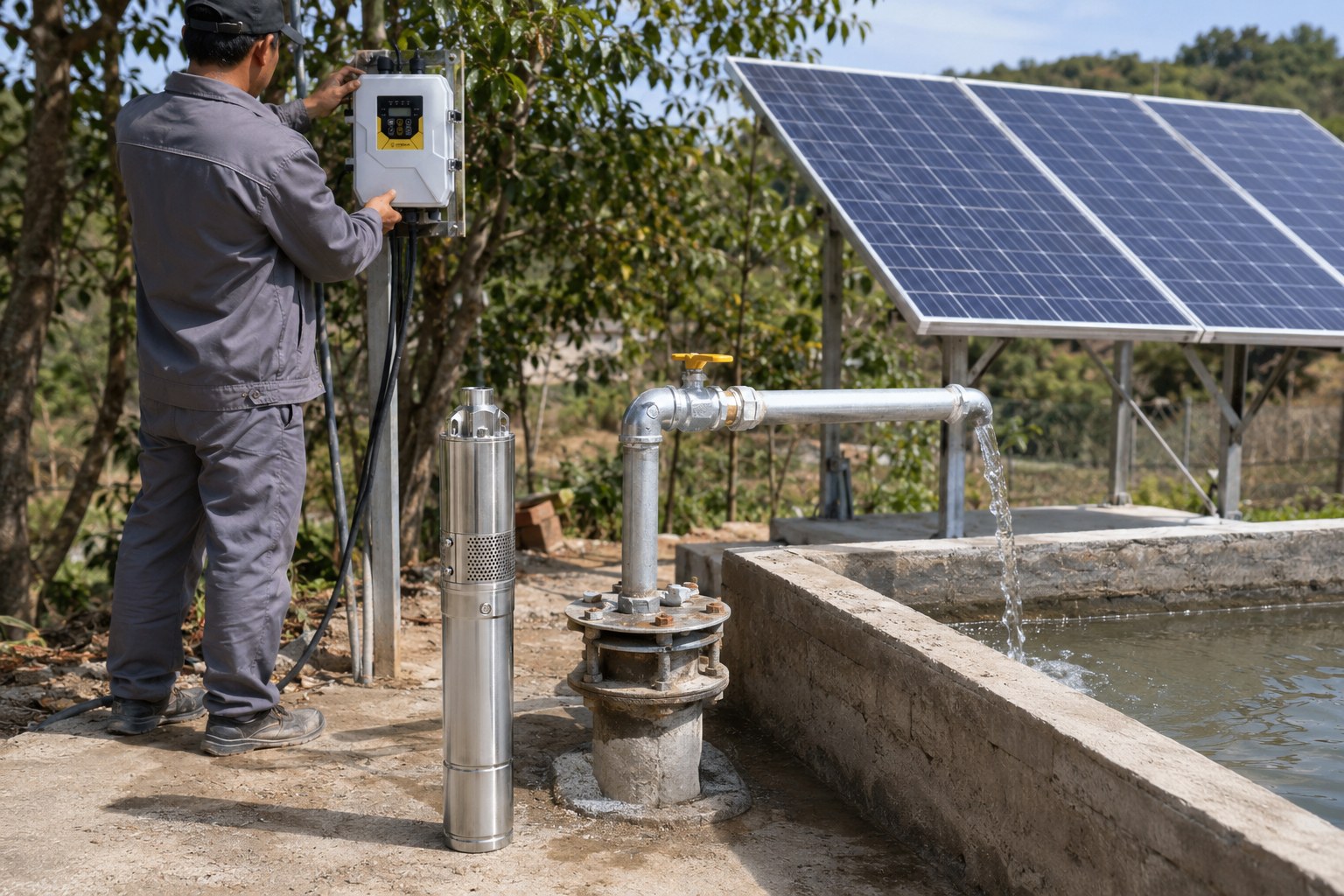
The best 0.5 HP solar pumps for deep wells are specialized models like screw pumps for high head, plastic impeller pumps for high flow in sandy conditions, and stainless steel impeller pumps for corrosive water. Each is driven by a high-efficiency brushless motor.
With the global shift towards sustainable solutions, solar water pumps have become a cornerstone technology for agriculture, livestock, and domestic water supply in off-grid areas.
Unlike standard pumps, solar pumps are designed as a complete system, pairing a specific pump end with an ultra-efficient motor.
This system approach ensures maximum water output from a minimal number of solar panels.
For a 0.5 HP rating, three distinct pump designs have emerged to cover nearly any deep well scenario, providing a versatile and competitive product portfolio for distributors and a reliable solution for end-users.
Understanding the strengths of each type is key to selecting the perfect pump.
Solar Screw Pumps: The High-Head Specialist
Solar screw pumps, also known as progressive cavity pumps, are engineered for one primary purpose: lifting water from extreme depths.
They operate using a single helical stainless steel screw rotating inside a rubber stator.
This action creates sealed cavities that move water upward with each rotation, generating very high pressure.
This design makes them ideal for deep, narrow borewells where traditional centrifugal pumps would fail.
- Key Advantage: Unmatched performance in high-head, low-flow applications. They can efficiently pump water from depths exceeding 300-400 feet, even with a small 0.5 HP motor.
- Sand Resistance: The screw mechanism can handle water with a higher concentration of sand and silt without clogging or rapid wear, a common issue in many borewells.
| Feature | Performance | Best Application |
|---|---|---|
| Flow Rate | Low (e.g., 1-5 GPM) | Deep well domestic water supply |
| Head Capacity | Very High (e.g., up to 450 feet) | Livestock watering from deep boreholes |
| Sand Handling | Excellent | Small-scale drip irrigation |
Solar Plastic Impeller Pumps: The High-Flow Workhorse
When the priority is water volume rather than extreme depth, the multi-stage plastic impeller pump is the go-to choice.
These centrifugal pumps use a series of stacked impellers to build pressure and flow.
The impellers are made from high-strength, wear-resistant engineering plastics.
This material choice offers an excellent balance of performance, durability, and cost-effectiveness.
- Key Advantage: Delivers high flow rates at medium head levels, making it perfect for irrigation, pond filling, and supplying water to larger households or livestock operations.
- Cost-Effectiveness: The use of plastic impellers makes these pumps lighter and more affordable than their all-metal counterparts, reducing both initial cost and shipping expenses. They are also highly resistant to abrasion from fine sand.
Solar Stainless Steel Impeller Pumps: The Premium Durability Option
For the most demanding environments, the stainless steel impeller pump offers superior longevity and reliability.
In these models, the impellers, diffusers, and pump housing are all constructed from SS304 or SS316 stainless steel.
This construction makes the pump highly resistant to corrosion from acidic or alkaline water, as well as abrasion.
- Key Advantage: Exceptional durability in harsh water conditions. This is critical in regions with aggressive groundwater chemistry, preventing premature failure and ensuring a clean water supply.
- Long-Term Value: While the initial cost is higher, the extended service life and reduced maintenance needs provide a lower total cost of ownership in corrosive environments, making it a wise long-term investment for high-end homes, ranches, or critical water supply systems.
What motor makes a solar pump truly efficient?
You see many solar pumps, but their performance varies wildly.
You suspect there's a hidden component that makes all the difference.
The secret lies in the motor technology driving the pump.
A Brushless DC (BLDC) permanent magnet motor makes a solar pump exceptionally efficient. With efficiency rates exceeding 90%, these motors convert more solar energy into water-pumping power, reducing panel costs and improving reliability compared to older motor types.
The pump end—whether it's a screw, centrifugal, or other type—is only half of the system.
The motor is the heart of any solar water pump.
It is responsible for converting electrical energy from the solar panels into the mechanical rotation that drives the pump.
The efficiency of this conversion is the single most important factor determining the overall performance and economic viability of the entire system.
Advanced solar pump systems have standardized on BLDC permanent magnet motor technology, as it offers a quantum leap in performance over traditional brushed DC or AC motors.
Why BLDC Motors Dominate Solar Pumping
Brushless DC (BLDC) motors operate without the physical "brushes" used in conventional motors to transfer power to the rotor.
Instead, they use an electronic controller to switch the motor's electromagnets.
This design eliminates friction, wear, and energy loss associated with brushes.
The rotor itself is made from high-strength permanent magnets, such as Neodymium Iron Boron (NdFeB).
This combination results in several game-changing advantages.
Key Advantages of High-Efficiency BLDC Motors
The technical superiority of BLDC motors translates directly into practical and financial benefits for the end-user.
| Feature | BLDC Permanent Magnet Motor | Traditional Brushed DC Motor | Standard AC Motor |
|---|---|---|---|
| Efficiency | > 90% | 60-75% | 70-80% |
| Lifespan | Very Long (no brushes to wear out) | Limited by brush wear | Long |
| Maintenance | Virtually Maintenance-Free | Requires brush replacement | Low Maintenance |
| Size & Weight | Compact & Lightweight | Bulky | Bulky |
| Starting Torque | High | Moderate | Low (single phase) |
- Superior Efficiency: BLDC motors convert over 90% of electrical energy into mechanical power. In contrast, older brushed motors often waste 25-40% of energy as heat and friction. This high efficiency means you can pump more water with the same number of solar panels, or use fewer panels to achieve the desired flow rate. This can reduce the initial system cost by up to 25%.
- Enhanced Durability and Lifespan: With no brushes to wear out, BLDC motors are exceptionally reliable and have a much longer service life. They are sealed units, making them impervious to dust, moisture, and insects, which is crucial for pumps installed in harsh, remote environments.
- Compact and Lightweight Design: The high power density of permanent magnets allows BLDC motors to be significantly smaller and lighter than traditional motors of the same power rating. A BLDC motor can be up to 47% smaller and 39% lighter, which simplifies installation—often allowing one person to install a pump—and reduces shipping costs for distributors.
- High Starting Torque: BLDC motors deliver high torque from a standstill. This is critical for starting a pump under load, especially for positive displacement pumps like screw pumps, ensuring reliable operation every time the sun shines.
How can you get water 24/7 from a solar pump system?
Solar pumps are great, but what happens on cloudy days or at night?
The fear of running out of water when the sun isn't shining is a major concern.
A hybrid controller provides the ultimate solution for uninterrupted water supply.
You can get water 24/7 by using a solar pump system with a hybrid AC/DC controller. This intelligent device automatically switches between solar power, grid electricity (AC), and a generator, ensuring the pump runs in any weather condition, day or night.
The primary limitation of a standard solar-powered system is its dependence on sunlight.
While battery storage is an option, it adds significant cost, complexity, and maintenance requirements to the system.
A far more practical and increasingly popular solution is the hybrid AC/DC pump controller.
This technology bridges the gap between off-grid independence and on-grid reliability.
It creates a seamless, intelligent power management system that prioritizes free solar energy while guaranteeing water on demand, 24 hours a day.
This makes solar pumping a viable solution not just for remote off-grid locations, but for any application where water security is paramount.
Understanding Hybrid AC/DC Controller Logic
A hybrid controller is designed with dual power inputs: one for DC power from the solar panels and another for AC power from the utility grid or a backup generator.
The controller's internal microprocessor continuously monitors the available solar power and operates based on a clear, pre-programmed logic to maximize efficiency and ensure reliability.
The Three Modes of Hybrid Operation
The system functions autonomously across three primary modes, requiring no user intervention.
- Full Sun Operation (Solar Priority): When there is sufficient sunlight, the controller powers the pump exclusively with DC power from the solar array. The system leverages its Maximum Power Point Tracking (MPPT) function to optimize the voltage and current, extracting up to 30% more power from the panels compared to non-MPPT systems. In this mode, your water is pumped for free.
- Low Sun Operation (Hybrid Blending): On overcast days or during early morning and late evening, solar power may be insufficient to run the pump at full speed. Instead of shutting down, the hybrid controller intelligently supplements the available solar energy with just enough AC power from the grid to meet the pump's demand. This maximizes the use of free solar energy before drawing on paid electricity.
- No Sun Operation (AC Priority): At night or during extended periods of heavy cloud cover, the controller detects no photovoltaic input. It then automatically and seamlessly switches over to the AC power source, running the pump as a conventional grid-powered pump. This guarantees that you can get water whenever you need it, regardless of the weather or time of day.
The Strategic Benefits of a Hybrid System
Implementing a hybrid controller offers compelling advantages for both end-users and distributors.
- 24/7 Water Security: It completely eliminates the intermittency problem of solar power, providing the peace of mind that comes with a constant, reliable water supply.
- Maximized Return on Investment (ROI): The system ensures that every possible watt of solar power is utilized first, significantly reducing electricity bills for grid-connected users.
- System Simplicity: It removes the need for expensive, high-maintenance battery banks, simplifying the system design and lowering the total cost of ownership.
- Total Flexibility: A hybrid system is the ultimate all-in-one solution. It can operate fully off-grid, fully on-grid, or as a blended system, making it adaptable to any location or future changes in power availability.
Conclusion
The "best" 0.5 HP pump is not a single model.
It is a system perfectly matched to your well depth, water needs, and power source, built with a high-efficiency motor.
FAQs
What is the best HP for a well pump?
The best HP depends on your Total Dynamic Head (TDH) and flow needs. A 0.5 HP pump is great for shallow wells (under 250 ft TDH), while deeper wells need 1 HP or more.
How many gallons per minute does a 1/2 hp well pump?
A 0.5 HP pump's flow rate varies with depth. It can range from over 20 GPM in very shallow applications to around 5 GPM at a depth of 200 feet.
How deep can a 1/2 hp submersible pump go?
A typical 0.5 HP submersible pump is effective up to a total depth (TDH) of about 250 feet. For greater depths, a higher horsepower pump is recommended.
How many solar panels does it take to run a 1/2 hp well pump?
A 0.5 HP (373W) pump typically requires about 400-500 watts of solar panels to run effectively. This usually means two standard-sized solar panels are sufficient.
Can a 0.5 HP pump be used for agriculture?
Yes, a 0.5 HP pump can be used for small-scale agriculture, such as drip irrigation for a large garden or watering a few head of livestock, especially if flow demand is low.
What is the lifespan of a 0.5 HP water pump?
A quality 0.5 HP pump can last 10-15 years or more. Lifespan depends heavily on the pump's material, water quality, and the use of a high-efficiency brushless motor.
Is a submersible pump better than a jet pump?
For deep wells (over 25 feet), a submersible pump is more efficient because it pushes water up. A jet pump, which pulls water, is better suited for shallow wells.
How do I choose between a plastic and stainless steel impeller pump?
Choose a plastic impeller pump for general use with fine sand, as it's cost-effective and wear-resistant. Choose a stainless steel impeller for corrosive or acidic water to ensure long-term durability.