Struggling with high energy bills or unreliable water access in off-grid locations?
The constant cost of fuel and grid power can drain your resources and limit your operational freedom.
Yes, solar pumps are absolutely worth it for a wide range of applications, especially in areas without reliable grid access.
They offer significant long-term savings by eliminating fuel costs, require minimal maintenance, and provide a dependable water source powered by free, renewable energy from the sun.
Investing in water infrastructure is a major decision.
You need a solution that is not only effective today but also sustainable and cost-efficient for years to come.
While the initial cost of a solar pump system can seem high, it's crucial to look beyond the sticker price.
Let's explore the real value and breakdown whether this technology is the right investment for your home, farm, or business.
The Financial Case: A Deep Dive into Pros and Cons
Tired of unpredictable fuel prices and electricity bills for your water pump?
These recurring expenses can make budgeting a nightmare and eat into your profits every single month.
The primary financial benefit of a solar pump is the near-zero operating cost, leading to a rapid return on investment.
While the upfront cost is higher than traditional pumps, the savings on fuel and grid electricity often pay for the system within just a few years.
To make an informed decision, you must analyze the total cost of ownership (TCO) over the pump's lifespan, not just the initial purchase price.
A solar pump system's value becomes incredibly clear when you compare it directly against diesel or grid-powered alternatives over a 5- or 10-year period.
Let's break down the numbers.
The Major Pro: Eliminating Energy Costs
The most compelling advantage of a solar water pump is the complete removal of day-to-day energy expenses.
Once the system is installed, the sun provides all the power you need for free.
This is a massive benefit compared to the alternatives.
Diesel generators require a constant supply of fuel, and prices have seen dramatic inflation, making operational costs unpredictable and high.
A 2-horsepower diesel pump running just 4 hours a day can consume over $3,000 in fuel annually.
Grid-powered pumps, while often cheaper to run than diesel, still contribute significantly to your monthly electricity bill, with costs easily exceeding $800 per year for similar usage.
A solar pump's fuel cost is always zero.
This financial independence protects you from market volatility and ever-increasing utility rates.
The Initial Con: Upfront Investment
The main hesitation for many buyers is the upfront cost.
A complete solar water pump system, including panels, controller, and pump, can be more expensive than a conventional AC pump or a diesel generator setup.
However, this perspective is shortsighted.
Think of it as pre-paying for a decade or more of energy.
The long life of modern solar pump components means you save money on replacements and repairs over time as well.
High-quality systems come with warranties and are built to last, unlike many AC pumps or windmills that require frequent and costly maintenance.
Comparing Total Cost of Ownership (TCO)
To truly understand the value, let's look at a hypothetical 5-year TCO comparison for a pump moving a moderate amount of water daily.
| Cost Factor | Solar Pump System | Diesel Generator Pump | Grid-Powered Pump |
|---|---|---|---|
| Upfront Cost | $4,500 | $1,500 | $1,000 + Grid Extension ($5,000+) |
| Year 1 Fuel/Energy | $0 | $3,285 (@ $4.50/hr for 2hrs/day) | $730 (@ $0.25/kWh for 4kW/day) |
| Year 1 Maintenance | $50 (panel cleaning) | $400 (oil, filters, service) | $50 |
| 5-Year Energy Cost | $0 | $16,425 | $3,650 |
| 5-Year Maintenance | $250 | $2,000 | $250 |
| Total 5-Year Cost | $4,750 | $19,925 | $4,900 + Extension Cost |
As the data clearly shows, the solar pump system becomes the most economical choice in less than two years compared to a diesel pump.
It even outcompetes a grid-powered pump when the often-prohibitive cost of running new power lines to a remote well is factored in.
The Practical Application: When Should You Use a Solar Well Pump?
Worried a solar pump won't work when you need it most, like on cloudy days or at night?
The fear of an unreliable water supply can prevent you from considering this off-grid solution.
Solar pumps are perfect for daytime-heavy uses like irrigation and livestock watering.
For 24/7 household needs, reliability is achieved by pairing the system with a water storage tank or a hybrid controller that can switch to grid or generator power as a backup.
The question isn't just if a solar pump is worth it, but where and how it should be used.
The suitability of a solar pump depends entirely on the application's criticality and water demand patterns.
A system for filling a cattle trough in a remote pasture has very different requirements than one supplying water to a home.
Ideal Scenarios for Solar Pumps
Solar pumps excel in specific situations where their benefits shine brightest.
- Remote Locations: Their greatest strength is providing water far from any electrical grid.
The cost to run power lines several hundred feet or more can easily exceed $10,000, making solar the only financially viable option for remote wells, pastures, and cabins. - Livestock Watering: Cattle and other livestock drink most during daylight hours when the sun is out and the pump is most productive.
This perfect alignment of supply and demand makes solar an incredibly efficient and reliable solution for agriculture. - Irrigation: Similar to livestock, crops need water during the day.
A solar pump can run all day, filling reservoirs or directly watering fields, without incurring any energy costs, which is a major boost for a farm's profitability.
Addressing the Limitations: Household and 24/7 Use
For critical applications like supplying a primary residence, reliability is non-negotiable.
You need water 24/7, not just when the sun is shining.
This is where some basic solar pump kits fall short.
However, this challenge is easily overcome with proper system design.
-
Solution 1: Water Storage (The Standard Method)
The most common and effective solution is to pump water into a large storage tank during peak sun hours.
A system can be sized to pump more than a day's worth of water in just 5-6 hours of good sunlight.
You can then use gravity or a small, on-demand pressure pump to supply water to the house from the tank at any time, day or night, regardless of the weather.
This creates a reliable, pressurized water buffer. -
Solution 2: Hybrid AC/DC Systems
For ultimate peace of mind, advanced solar pump controllers offer hybrid functionality.
These smart controllers can be connected to both solar panels and an AC power source (grid or generator) simultaneously.
The system will prioritize using free solar power.
If solar production drops due to heavy clouds or at night, the controller automatically supplements with or switches to the AC source to ensure the pump can run whenever needed.
This guarantees a completely uninterrupted water supply.
Kits vs. Component-Built Systems
The market offers both pre-packaged kits and custom systems built from individual components.
-
Turnkey Kits: Often marketed to DIY users, these kits can have a lower initial cost.
However, they often use proprietary parts, which can lock you into a single brand.
If the manufacturer goes out of business or a part fails, finding a replacement can be impossible, forcing a complete system replacement.
Their batteries and panels may not be built for long-term, harsh-environment reliability. -
Component-Built Systems: A more robust approach involves selecting proven, standardized components from reputable brands.
You can choose a durable pump, high-quality panels, a reliable controller, and maintenance-free batteries that are designed for longevity.
This provides flexibility for future upgrades and ensures parts are easily replaceable, leading to a much lower total cost of ownership and greater long-term reliability.
The Technology Explained: How Do Solar Pumps Work?
Confused by the technical jargon like "PV panels," "inverters," and "MPPT controllers"?
Understanding the components can feel overwhelming, making it hard to feel confident in your purchasing decision.
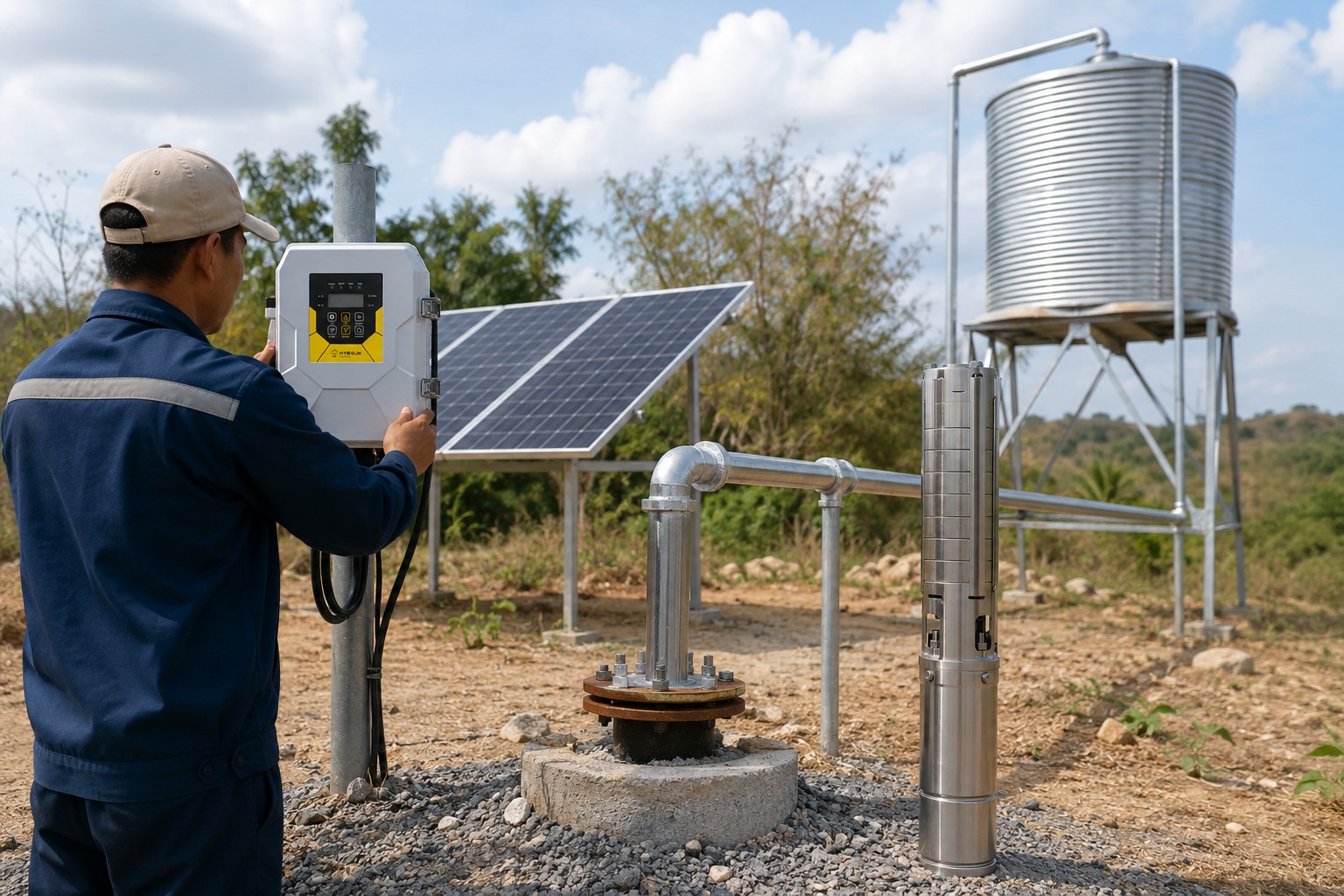
A solar pump system works by using solar panels to convert sunlight into DC electricity.
This power is managed by a controller, which feeds it to an electric motor.
The motor then drives the pump, moving water from your source to where you need it.
At its core, a solar water pumping system is surprisingly simple and elegant.
It consists of just a few key components working together to harness the sun's energy.
There are no complex engines, no fuel tanks, and very few moving parts to worry about.
Let's demystify each part of the system.
Solar Photovoltaic (PV) Panels
This is the power source.
Solar panels are made up of many solar cells.
When sunlight (photons) strikes these cells, it creates an electrical current.
This process, known as the photovoltaic effect, produces Direct Current (DC) electricity.
The number and size of the panels determine how much power the system can generate, which in turn dictates how much water can be pumped.
Modern panels are highly efficient and durable, often with performance warranties lasting 25 years.
The Pump Controller
The controller is the brain of the system.
It is a crucial electronic device that sits between the solar panels and the pump motor.
It serves several vital functions:
- Power Optimization: Most modern controllers use Maximum Power Point Tracking (MPPT) technology.
This technology constantly adjusts the electrical load to extract the maximum amount of power possible from the solar panels as sunlight conditions change throughout the day.
An MPPT controller can boost water output by up to 30% compared to connecting a pump directly to panels. - Motor Protection: The controller protects the pump motor from damage by regulating voltage and current.
It provides features like soft starting to reduce mechanical stress and will shut the pump down if the water source runs dry (dry-run protection), preventing the motor from burning out. - AC/DC Conversion: If you are using a standard AC pump, an inverter (which can be part of the controller) is needed to convert the DC electricity from the panels into the Alternating Current (AC) that the pump requires.
However, most dedicated solar pump systems use highly efficient DC motors, eliminating the need for a separate large inverter.
The Water Pump and Motor
This is the heart of the system, responsible for doing the actual work of moving water.
A solar water pump is essentially an electric motor coupled to a pump end.
The most efficient and common type used in modern systems is the Brushless DC (BLDC) motor.
These motors are highly reliable, efficient, and require no maintenance as they have no brushes to wear out.
The motor drives the pump, which can be a surface pump for drawing water from ponds or a submersible pump for pulling water from deep wells.
Choosing the Right Pump: A Portfolio for Every Need
Unsure which type of solar pump is right for your well?
Choosing the wrong pump can lead to poor performance, insufficient water, or premature failure, wasting your entire investment.
The best solar pump depends on your specific needs for flow rate, pressure (head), and water quality.
Screw pumps are for deep wells with low flow, plastic impeller pumps are for high-flow irrigation, and stainless steel impeller pumps are for corrosive water conditions.
A one-size-fits-all approach does not work for water pumping.
A successful solar water system depends on perfectly matching the pump's capabilities to the well's depth, the required water volume, and the water's characteristics.
A product portfolio with distinct pump types allows distributors and end-users to select the ideal tool for the job, ensuring efficiency and longevity.
Let's compare the three most competitive solar deep well pump technologies.
The Deep Well Specialist: Solar Screw Pump
This pump type is a positive displacement pump, often called a progressive cavity pump.
It uses a single helical stainless steel screw (rotor) that turns inside a rubber housing (stator).
This action creates sealed cavities that move water upward with each rotation.
- Key Characteristics: Low Flow, Very High Head.
- Best Applications: Deep wells (over 100 meters / 330 feet), domestic water supply for homes, livestock drinking water in arid regions.
- Advantages: Its major advantage is the ability to generate very high pressure, making it ideal for pushing water up from great depths.
It is also highly resistant to sand and sediment, which would quickly destroy other pump types. - Limitations: The trade-off for its high-head capability is a relatively low flow rate.
It is not suitable for applications requiring large volumes of water, like flood irrigation for large farms.
The High-Volume Workhorse: Solar Plastic Impeller Pump
This is a multi-stage centrifugal pump.
It uses a series of stacked impellers made from durable, engineered plastics.
As the impellers spin at high speed, they use centrifugal force to throw water outwards and upwards from one stage to the next, building pressure and flow.
- Key Characteristics: High Flow, Medium Head.
- Best Applications: Farm irrigation, pasture water supply, filling large tanks and ponds, and garden watering.
- Advantages: This pump's strength is its ability to move large volumes of water efficiently.
The plastic impellers are surprisingly wear-resistant against fine sand, and the pump is lightweight and more economical than its stainless steel counterpart. - Limitations: It is less durable in highly corrosive water or in extremely deep wells where immense pressure can cause wear over time.
The Premium Durability Option: Solar Stainless Steel Impeller Pump
This pump operates on the same centrifugal principle as the plastic impeller model but is constructed with premium materials.
The impellers, diffusers, and pump body are all made from SS304 or even higher-grade SS316 stainless steel.
- Key Characteristics: High Flow, High Corrosion Resistance.
- Best Applications: Water with acidic or alkaline properties, coastal areas with saltwater intrusion risk, alkaline soil regions, and high-end residential or commercial water supply where maximum reliability is demanded.
- Advantages: The stainless steel construction provides superior resistance to corrosion and abrasion, ensuring a very long service life even in harsh water environments.
It offers high reliability for critical applications. - Limitations: The premium materials make this the most expensive and heaviest option.
Its cost is typically only justified when water conditions demand its superior durability.
Direct Comparison for Easy Selection
| Pump Type | Primary Use Case | Flow Rate | Head (Pressure) | Sand Resistance | Corrosion Resistance | Relative Cost |
|---|---|---|---|---|---|---|
| Solar Screw Pump | Deep Well / High Head | Low | Very High (up to 200m+) | Excellent | Good | $$ |
| Plastic Impeller Pump | High Volume / Irrigation | High | Medium (up to 100m) | Good | Fair | $ |
| Stainless Steel Impeller | Corrosive Water / Durability | High | Medium-High (up to 150m) | Moderate | Excellent | $$$ |
The Heart of the System: The Power of the BLDC Motor
Think all pump motors are the same?
The motor is the single biggest factor in a pump's efficiency, and a poor motor will waste solar energy, requiring you to buy more panels.
The core of a modern solar pump is a high-efficiency Brushless DC (BLDC) permanent magnet motor.
With efficiency over 90%, it uses less power, which reduces the number of solar panels needed, lowers system cost, and ensures maximum water output from every ray of sunlight.
The pump end (screw or impeller) gets a lot of attention, but the motor driving it is the true engine of the entire system.
The motor's efficiency directly determines the overall system's performance and cost-effectiveness.
An inefficient motor wastes precious solar energy as heat, meaning you need a larger, more expensive solar array to get the same amount of water.
This is why the transition to BLDC motor technology has been a game-changer for the solar pumping industry.
What is a BLDC Permanent Magnet Motor?
Unlike older brushed motors that rely on physical contacts (brushes) to transmit power, a BLDC motor uses electronics.
This eliminates a major point of wear and failure.
It also uses powerful rare-earth permanent magnets (like neodymium iron boron) on its rotor.
This design has several profound technical advantages.
- Extreme Efficiency: A key metric for any solar application.
BLDC motors can convert over 90% of the electrical energy they receive into mechanical power.
Traditional AC or brushed DC motors often operate in the 60-75% efficiency range.
This 15-30% efficiency gain is enormous.
It means a BLDC-powered pump can deliver significantly more water using the exact same solar panel array. - High Torque: These motors produce strong, consistent torque even at low speeds.
This is crucial for starting the pump under load, especially in deep wells, and for maintaining performance during periods of lower sunlight. - Compact and Lightweight: The efficient design means BLDC motors can be much smaller and lighter than traditional motors of the same power output.
A modern BLDC motor can be up to 47% smaller and 39% lighter.
This makes the pump easier to handle, transport, and install, which is a significant logistical advantage.
The Market Value of a Better Motor
For a distributor or installer, these technical advantages translate directly into market competitiveness and customer satisfaction.
- Lower System Cost: Because a 90% efficient motor requires less power, you can design a system with fewer solar panels.
Since panels can account for a significant portion of the total system cost, this makes the entire package more affordable and easier to sell. - Increased Reliability: With no brushes to wear out, BLDC motors are virtually maintenance-free and have a much longer operational lifespan.
This means fewer service calls and happier customers. - Enhanced Performance: The system will start pumping earlier in the morning, run later in the evening, and perform better on overcast days, maximizing water delivery and user satisfaction.
In essence, the BLDC motor is the strategic core of a competitive solar pump.
It’s the technology that makes the entire system more efficient, more reliable, and ultimately, more valuable to the end-user.
Conclusion
Solar pumps are a powerful, sustainable, and financially sound investment for countless water needs.
Their true worth is realized by selecting a high-quality system with the right pump and an efficient motor.
Frequently Asked Questions
How long do solar water pumps last?
A quality solar pump system can last 15-20 years.
The solar panels have a 25-year warranty, and the maintenance-free BLDC motor is designed for over a decade of reliable service.
Do solar pumps work on cloudy days?
Yes, they do, but at a reduced flow rate.
Modern systems are highly efficient and can still pump water on overcast days, though output will be lower than in full sun.
Can a solar pump run at night?
Not directly from the panels.
To have water at night, the system pumps water into a storage tank during the day, or it can be paired with a battery bank or hybrid AC/DC controller.
How deep can a solar pump go?
This depends on the pump type.
Solar screw pumps are designed for very deep wells and can effectively pump from depths exceeding 200 meters (650 feet).
How much does a solar water pump system cost?
Costs vary widely based on pump size, depth, and required flow rate.
A small system for a shallow well might start around $1,500, while a deep-well, high-volume system can exceed $5,000.
Is it hard to install a solar water pump?
No, most systems are designed for straightforward installation.
With basic mechanical skills, a manual, and online video guides, many owners can install the system themselves, saving on labor costs.
What maintenance does a solar pump require?
Maintenance is minimal.
The primary task is to occasionally clean the solar panels with water to remove dust and debris, ensuring they maintain maximum efficiency.
The pump and motor are sealed and maintenance-free.
Can a solar pump power my whole house?
A solar pump is designed specifically for water.
To power your whole house, you would need a separate, larger residential solar power system, though that system could also power your well pump.