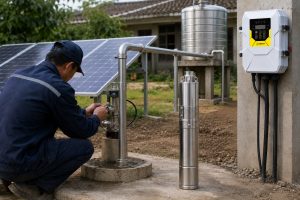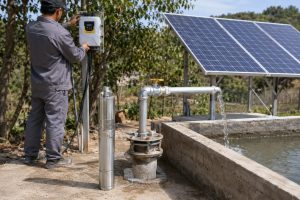
Struggling to get water from your deep borewell?
Worried about high electricity bills or unreliable power?
A solar water pump is the sustainable and cost-effective answer you need.
The best pump for a borewell depends on your specific needs. For very deep wells requiring high pressure but lower water volume, a solar screw pump is ideal. For high-volume farm irrigation, a plastic impeller pump is best. For corrosive water, a stainless steel impeller pump is superior.
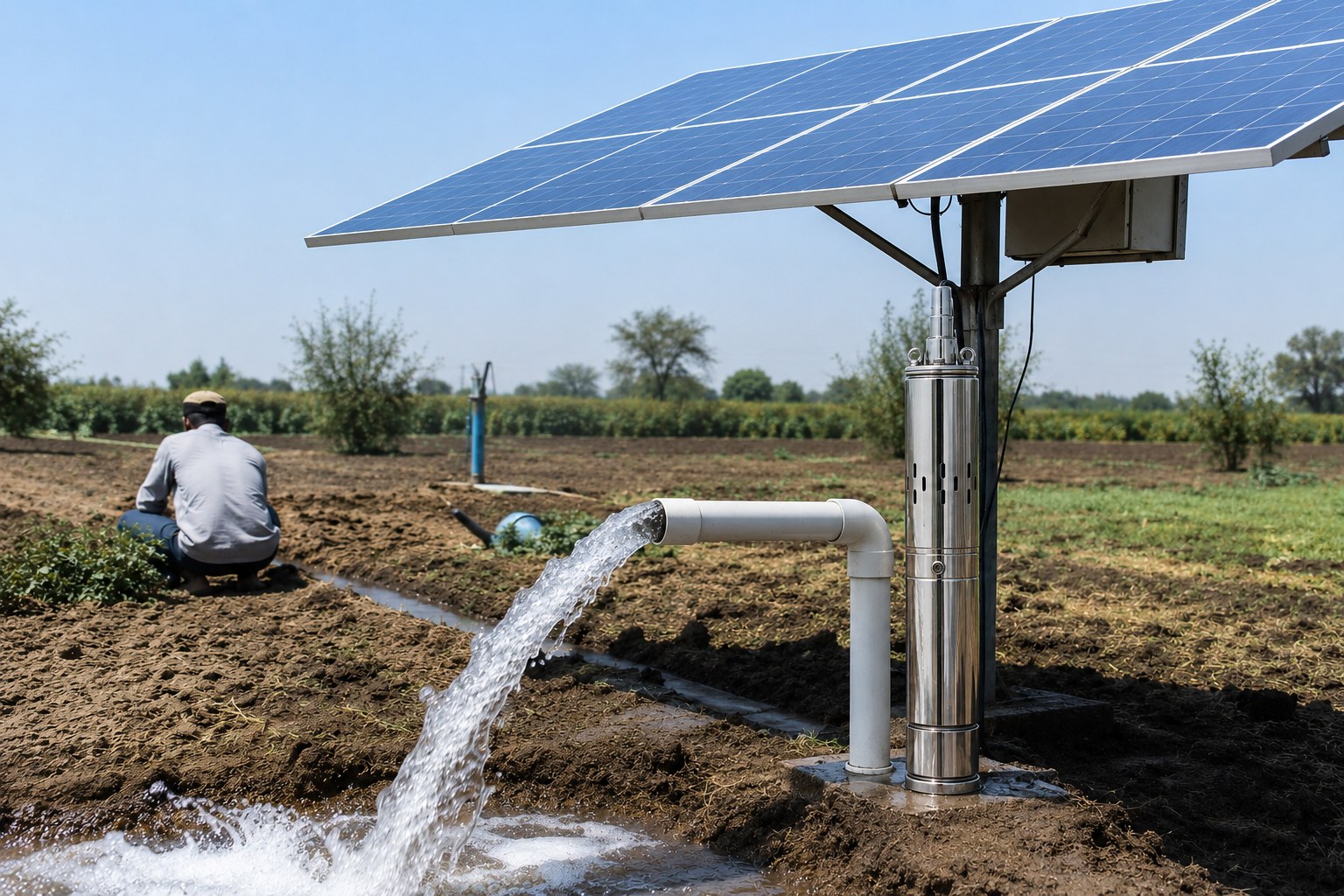
Choosing the right pump is a critical decision for securing a reliable water supply.
It involves understanding more than just the brand name on the box.
You need to match the pump's design to your well's depth, your water's quality, and your daily volume requirements.
Let's explore the different types of solar pumps, their core technology, and how to select the perfect one.
This guide will ensure you make the best long-term investment for your home, farm, or ranch.
Choosing the Right Submersible Pump for Borewell: The Solar Screw Pump
Need to lift water from extreme depths where other pumps fail?
Traditional pumps can struggle with high head or consume massive amounts of energy.
The solar screw pump is engineered specifically for these challenging deep-well applications.
The solar screw pump is a specialist for high head, low flow situations. It's the top choice for deep domestic wells and livestock watering, particularly in regions with sandy water, because its design is highly resistant to abrasion and can generate immense pressure efficiently.
A solar screw pump, also known as a progressive cavity pump, operates on a simple yet powerful principle.
It doesn't use impellers like centrifugal pumps.
Instead, it uses a single stainless steel helical rotor that turns inside a flexible rubber stator.
As the rotor spins, it creates a series of sealed cavities that "progress" from the pump's inlet to its outlet.
This action pushes the water through compression, allowing the pump to generate very high pressure, or head.
This makes it perfect for lifting water from wells that can be over 300 meters (nearly 1000 feet) deep.
Its unique design provides a steady, non-pulsating flow, which is gentle on your plumbing system.
How Screw Pumps Excel
The main strength of the screw pump is its ability to handle difficult conditions.
The rubber stator and steel rotor are highly resistant to abrasion from sand and grit.
In many regions, groundwater contains a high concentration of suspended solids.
A standard centrifugal pump would wear out quickly in these environments, with impeller damage leading to a performance loss of over 50% in a short time.
The screw pump, however, can maintain its efficiency and structural integrity for much longer, making it a more durable and reliable choice.
Ideal Applications for Screw Pumps
You will find solar screw pumps providing critical water supply in many off-grid scenarios.
They are the lifeblood for households in remote areas of Africa and Latin America, where grid power is either non-existent or unreliable.
Another primary use is for livestock drinking water.
A single screw pump can supply water to multiple troughs across a large pasture, ensuring animals are hydrated even in remote grazing lands.
For agriculture, they are best suited for small-scale, high-efficiency irrigation methods like drip systems, which require consistent pressure but not massive volume.
Comparing Screw Pump Performance
To make an informed choice, it's helpful to see how the screw pump stacks up against other types.
| Feature | Solar Screw Pump | Solar Centrifugal Pump |
|---|---|---|
| Optimal Head | Very High (100m - 300m+) | Medium to High (50m - 150m) |
| Optimal Flow Rate | Low (e.g., 1-5 m³/hour) | High (e.g., 5-20 m³/hour) |
| Sand Resistance | Excellent | Good to Poor (depends on impeller) |
| Efficiency at Depth | High | Decreases significantly at high head |
| Best For | Deep wells, domestic use | Irrigation, pond filling |
In summary, if your borewell is deep and your water demand is moderate, the solar screw pump offers an unmatched combination of depth capability, durability, and energy efficiency.
Solar Pumps for Irrigation: The Plastic Impeller Pump
Do you need to move a large volume of water for your farm or garden?
A low-flow pump simply won't meet the demands of irrigation, leaving your crops thirsty.
The solar plastic impeller pump is designed for high flow, making it an agricultural workhorse.
This multi-stage centrifugal pump delivers a high flow rate at a medium head. It uses durable, wear-resistant plastic impellers, making it a lightweight and economical solution for farm irrigation, pasture water supply, and filling ponds, especially in areas with fine sand.
The solar plastic impeller pump is a type of multi-stage centrifugal pump.
It works by using a series of impellers stacked on top of each other.
Each impeller and diffuser stage adds pressure to the water, pushing it higher.
The design focuses on moving a large volume of water efficiently rather than achieving extreme pressure.
This makes it the perfect match for most agricultural and large-scale water transfer applications.
The key innovation here is the use of high-tech, engineered plastics for the impellers.
These are not ordinary plastics; they are advanced polymers designed for high strength and exceptional wear resistance.
This material choice has several significant advantages.
The Advantage of Engineered Plastic
Modern plastic impellers are formulated to be highly resistant to abrasion from fine sand and silt.
This significantly extends the pump's lifespan compared to lower-quality pumps in wells that are not perfectly clean.
Furthermore, plastic impellers are much lighter than their stainless steel counterparts.
A lighter pump is easier and cheaper to install, requiring less heavy equipment and manpower, a crucial benefit in remote locations.
The manufacturing process for plastic components is also more cost-effective, which makes these pumps an excellent value for their performance.
They provide over 90% of the functionality of a stainless steel pump for a fraction of the price.
Where Plastic Impeller Pumps Shine
The primary application for these pumps is irrigation.
They can supply enough water for sprinklers, flood irrigation, or large-scale drip systems on farms and ranches.
They are widely used across the agricultural belts of the Americas and Africa for this reason.
These pumps are also perfect for maintaining water levels in ponds and large water features.
For large homesteads or off-grid properties, a plastic impeller pump can handle all domestic water needs while also supplying a garden or small orchard.
They provide the high flow rate needed to fill storage tanks quickly and efficiently.
Performance Breakdown
Let's look at the numbers to understand its capabilities better.
| Feature | Solar Plastic Impeller Pump | Solar Screw Pump |
|---|---|---|
| Primary Use | High-volume irrigation | Deep well domestic supply |
| Flow Rate | Very High (up to 25 m³/hour) | Low (up to 5 m³/hour) |
| Weight | Lightweight | Heavier |
| Initial Cost | Economical | Moderate |
| Best Environment | Wells with fine sand, non-corrosive | Deep wells, abrasive conditions |
While a plastic impeller pump is a robust and economical choice, it has limitations.
It is not recommended for highly corrosive water environments, such as those with very high or low pH levels.
In extremely deep wells (over 150m), the pressure demands might exceed its optimal operating range.
But for the vast majority of irrigation and general water supply needs, it offers an unbeatable mix of high performance, durability, and value.
Solar Water Pumps for Off-Grid Living: The Stainless Steel Impeller Pump
Is your water source acidic, alkaline, or salty?
Standard pumps can corrode and fail prematurely in these conditions, leading to costly replacements.
The solar stainless steel impeller pump is built to withstand the toughest water environments.
This premium pump uses SS304 stainless steel for its impellers and pump body. It is specifically designed for high corrosion resistance, offering high flow and medium-to-high head. It's the ultimate choice for harsh water conditions, ensuring longevity and reliability.
This pump is the top-tier option in the solar submersible pump lineup.
Its construction is focused on maximum durability and reliability.
The use of SS304 grade stainless steel for all components that touch water—including the impellers, diffusers, pump body, and outlet—is its defining feature.
SS304 is a specific chromium-nickel alloy that is highly resistant to a wide range of corrosive agents.
This makes the pump ideal for use in borewells where the water has a low pH (acidic) or a high pH (alkaline).
It is also the best choice for areas with high salinity or mineral content, such as coastal regions or the alkaline soil regions of Australia.
Unmatched Durability and Reliability
The investment in a stainless steel pump pays off in its service life.
While a plastic impeller pump might last several years in moderately aggressive water, a stainless steel pump can last for decades in the same conditions.
Its robust construction provides a significantly higher level of reliability, which is crucial for critical applications.
These include water supply for high-end off-grid homes, exclusive ranches, and small communities where a pump failure would be a major disruption.
The pump's design delivers both high flow rates and impressive head, making it a versatile performer.
It combines the volume capacity needed for irrigation with the pressure capability for deep wells, offering a single solution for demanding jobs.
When to Choose Stainless Steel
Deciding to invest in a stainless steel pump depends on a water quality analysis.
If your water test reveals a pH level below 6.5 or above 8.5, a stainless steel pump is strongly recommended.
Similarly, if high levels of chlorides, sulfates, or other corrosive minerals are present, this pump is the only sensible long-term choice.
It is the preferred pump for land management and conservation trusts that require equipment with a minimal failure rate and long operational life to protect sensitive ecosystems.
Although its initial cost is higher, its total cost of ownership is often lower due to its extended lifespan and reduced need for maintenance or replacement.
Side-by-Side Comparison
Here's how the stainless steel model compares to its plastic counterpart.
| Feature | Solar Stainless Steel Impeller Pump | Solar Plastic Impeller Pump |
|---|---|---|
| Main Advantage | Maximum Corrosion Resistance | Economical & Lightweight |
| Material | SS304 Stainless Steel | Engineered Polymer |
| Service Life | Very Long (10-20+ years) | Long (5-10 years) |
| Initial Cost | Higher | Lower |
| Weight | Heavier | Lighter |
| Best For | Acidic, alkaline, or salty water | General irrigation, non-corrosive water |
Choosing a stainless steel impeller pump is an investment in peace of mind.
It ensures that your water system will continue to operate reliably for many years, regardless of challenging water conditions.
Head range: The Core Power of All Solar Pumps
What truly determines a solar pump's performance and efficiency?
While the pump end is important, the motor is the heart of the entire system.
A high-efficiency motor is the key to unlocking the full potential of solar power for water pumping.
All three pump types—screw, plastic impeller, and stainless steel impeller—are powered by an advanced Brushless DC (BLDC) permanent magnet motor. This motor technology provides ultra-high efficiency, reducing solar panel requirements and overall system cost while delivering superior performance.
The BLDC permanent magnet motor is a game-changer for solar water pumping.
Unlike older brushed motors or standard AC motors, BLDC motors have no brushes that wear out, making them virtually maintenance-free.
Their design uses powerful rare-earth permanent magnets, typically Neodymium Iron Boron (NdFeB), in the rotor.
This eliminates the energy loss associated with creating a magnetic field in the rotor, resulting in dramatically higher efficiency.
A typical BLDC solar pump motor can achieve an efficiency of over 90%.
In comparison, a standard AC submersible motor might only be 60-70% efficient.
This 20-30% efficiency gain is massive in a solar-powered system.
The Impact of High Efficiency
Higher motor efficiency translates directly into significant real-world benefits.
First, it means you need fewer solar panels to achieve the same water output.
If a pump system requires 1000 watts of power, a 90% efficient motor needs about 1111 watts from the controller.
A 65% efficient motor would need over 1500 watts to do the same work.
This can reduce the number of required solar panels by 30% or more, saving you a substantial amount on the initial system cost.
Second, the compact design of BLDC motors makes the entire pump smaller and lighter.
Our motors are often up to 47% smaller and 39% lighter than traditional motors of equivalent power.
This simplifies transportation and installation, further reducing costs.
Technical Advantages Lead to Market Value
The high torque and strong power output of a BLDC motor ensure reliable pump startup even in low-light conditions.
This extends the daily operating hours of the pump, giving you more water from sunrise to sunset.
This performance is managed by an intelligent MPPT (Maximum Power Point Tracking) controller.
The controller constantly adjusts the electrical load to ensure the solar panels are operating at their peak efficiency, maximizing the energy harvest throughout the day.
This combination of an efficient motor and a smart controller is the core of a modern solar pumping system.
| Motor Technology | BLDC Permanent Magnet | Standard AC Induction |
|---|---|---|
| Efficiency | >90% | ~65% |
| Maintenance | None (brushless) | Requires maintenance |
| Solar Panel Needs | Lower (by ~30%) | Higher |
| Size & Weight | Compact & Lightweight | Bulky & Heavy |
| Longevity | Very Long | Moderate |
The BLDC motor is not just a component; it is the strategic core of the entire water pump system.
It dictates the overall efficiency, reliability, and cost-effectiveness, cementing a brand's position as a leader in "efficiency, durability, and environmental friendliness."
HYBSUN AC/DC Hybrid Solar Pumps: Water 24/7
What happens when the sun isn't shining?
A purely solar-powered system might not provide water on cloudy days or at night.
HYBSUN has solved this problem with our advanced AC/DC hybrid solar pump controllers.
The AC/DC hybrid controller ensures a worry-free, 24-hour water supply. It intelligently prioritizes solar power when available and automatically switches to an AC power source—like the grid or a generator—when solar energy is insufficient, maximizing efficiency and convenience.
Our AC/DC hybrid controllers represent the next step in water security.
The controller is designed with dual power inputs, allowing you to connect both your solar panel array and an AC power source simultaneously.
The system's smart logic always gives priority to the free energy from the sun.
When there is enough sunlight, the pump runs entirely on solar power, costing you nothing to operate.
As clouds pass over or as evening approaches, the controller's hybrid function kicks in.
It can blend power from both sources, supplementing the dwindling solar power with just enough AC power to keep the pump running at the desired speed.
This maximizes your use of free solar energy before switching over completely.
When there is no solar input at all, like at night or during heavy, multi-day storms, the controller automatically switches to the AC source.
This guarantees that you can pump water whenever you need it, day or night, rain or shine.
This technology is perfect for applications where a constant water supply is non-negotiable, such as in homes, on dairy farms, or for critical industrial processes.
It offers the best of both worlds: the cost savings and environmental benefits of solar, combined with the on-demand reliability of grid power.
Conclusion
The best borewell pump matches your well depth, water volume, and water quality.
The true advantage lies in a high-efficiency motor and an intelligent control system.
FAQs
1. How do I choose the right size submersible pump?
To size a pump, you need to know your well's depth (total head), your required flow rate (gallons per minute), and the diameter of your borewell casing.
2. How many solar panels does it take to run a well pump?
The number of panels depends on the pump's horsepower and your location's sun hours. A small 0.5 HP pump might need 2-4 panels, while a larger 3 HP pump could require 12 or more.
3. What is the difference between head and pressure in a pump?
Head is the maximum height a pump can lift water, measured in feet or meters. Pressure, measured in PSI, is the force the water exerts. They are directly related.
4. Can a solar pump fill a water tank?
Yes, this is a very common application. The pump fills a storage tank during the day, and you can use the stored water at any time via gravity or a pressure booster pump.
5. How long do solar water pumps last?
A quality solar pump system can last for decades. The solar panels are typically warranteed for 25 years, and a brushless motor can run for over 10 years without maintenance.
6. Can you run a well pump with a generator?
Yes, you can run a standard AC pump or a hybrid AC/DC solar pump with a properly sized generator. The generator must provide enough wattage to handle the pump's startup surge.
7. Is a 3-inch or 4-inch submersible pump better?
The choice depends on your borewell's casing diameter. A 4-inch pump generally offers higher flow rates but requires at least a 4-inch casing. A 3-inch pump fits in narrower wells.
8. What happens to a solar pump on cloudy days?
On cloudy days, a solar pump will run at a reduced speed or may stop if the sunlight is too low. A system with a hybrid AC/DC controller can automatically switch to grid power.