Struggling to find the right pump for your borehole?
The wrong choice can lead to high costs and system failure.
This guide simplifies your decision-making process.
**The best borehole pump depends entirely on your specific needs: well depth, water quality, and how much water you require.
For deep wells needing low flow, a solar screw pump is ideal.
For high flow in standard water conditions, a solar plastic impeller pump is most economical.
For corrosive water, a durable solar stainless steel impeller pump is necessary.**

Choosing the right pump might seem complex with so many options available.
However, understanding the core differences between the main types makes the choice much clearer.
It's not just about the pump itself, but about matching the technology to your unique environment and water demands.
Let's dive into the specifics of each pump type to see which one perfectly fits your project, ensuring you get a reliable and cost-effective water supply for years to come.
What is a Borehole Pump and How Does It Work?
**Do you need to get water from deep underground?
A borehole pump is your essential tool.
It pushes water to the surface, but how does it work efficiently?
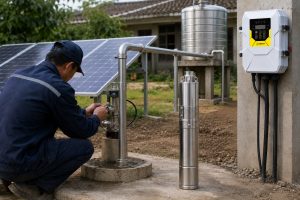
A borehole pump is a submersible pump pushed deep into a well or borehole.
A sealed motor drives impellers, which create pressure to force water up a pipe.
This design is more efficient than surface pumps that pull water, especially when powered by solar energy for off-grid applications.**
A borehole pump, also called a submersible well pump, is the heart of any system designed to extract groundwater.
These pumps are vital for agriculture, homes, and industries located away from municipal water sources.
The entire unit, comprising the pump and a tightly sealed motor, is lowered directly into the borehole.
This has two major advantages.
First, pushing water is far more energy-efficient than pulling it, especially from great depths.
Second, the surrounding water naturally cools the motor, preventing overheating and allowing for continuous, quiet operation.
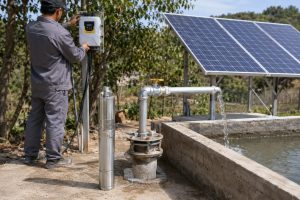
Modern systems often pair these pumps with solar power, creating a self-sufficient water solution that works completely off-grid.
The Core Components
A standard borehole pump system is simple yet effective.
It consists of:
- The Submersible Pump: The main unit with impellers that create water pressure.
- The Submersible Motor: A sealed, waterproof motor directly attached to the pump, providing the power to spin the impellers.
- Piping: Transports the pressurized water from the pump to the surface.
- Control Box: An above-ground unit that manages the pump's operation, providing start/stop functions and crucial protection against electrical faults or dry-running.
The motor turns a shaft, which rotates a series of impellers.
Each impeller adds pressure to the water, pushing it upward through the pipe.
This multi-stage process allows borehole pumps to lift water from depths of a few meters to over 300 meters.
The Rise of Solar Power
Traditionally, borehole pumps relied on grid electricity or diesel generators.
However, with the growing need for sustainable and cost-effective solutions, solar-powered borehole pumps have become the industry standard.
They use photovoltaic (PV) panels to power the pump's motor, eliminating electricity bills and reducing environmental impact.
This makes them perfect for remote ranches, off-grid homes, and farms in regions with abundant sunlight but unreliable power infrastructure.
Which Borehole Pump is Best for Deep Wells with Low Water Demand?
**Facing a very deep well but only need water for your home or livestock?
High-flow pumps are wasteful and expensive.
You need a pump designed for high pressure, not high volume.
For deep wells and moderate water needs, the solar screw pump is the unparalleled choice.
It excels at creating immense pressure (high head) with low energy consumption, making it perfect for lifting water from depths where other pumps struggle.
It's also highly resistant to sandy water.**
When your water source is hundreds of meters deep but your daily water requirement is modest—for example, for a single household, livestock troughs, or a small garden—a solar screw pump is the most efficient and logical solution.
Unlike centrifugal pumps that use speed to "throw" water, a screw pump operates on the principle of positive displacement.
This unique mechanism makes it exceptionally good at its job.
How a Screw Pump Works
A screw pump uses a simple, yet brilliant, design.
It contains a single helical screw (the rotor) that rotates inside a rubber housing (the stator).
As the screw turns, it creates sealed cavities of water that are progressively "pushed" up the pump.
This compression action generates very high pressure, allowing the pump to lift water from extreme depths.
This method is less about volume and more about force, which is exactly what’s needed for a high-head, low-flow scenario.
Performance Metrics: Flow vs. Head
The primary advantage of a screw pump lies in its performance curve.
It is designed to maintain consistent pressure even as the flow rate changes.
This makes it incredibly reliable for deep well applications where maintaining lift is critical.
| Pump Type | Typical Max Head | Typical Max Flow Rate | Best Application | Sand Resistance |
|---|---|---|---|---|
| Solar Screw Pump | 200+ meters | 5 m³/hour | Deep wells, low demand | Excellent (up to 3% sand) |
| Centrifugal Pump | 80 meters | 20 m³/hour | Shallow wells, high demand | Poor to Fair |
As the table shows, if your well is 150 meters deep, a centrifugal pump would likely fail or be extremely inefficient.
A screw pump, however, is built for this exact challenge.
Ideal Applications and Superior Sand Resistance
Screw pumps are engineered for toughness.
Because the pumping action is gentle and based on compression, they can handle water with a higher concentration of sand and silt without sustaining damage.
The rubber stator can flex to allow small particles to pass through, whereas the tight tolerances in a centrifugal pump would lead to rapid wear and failure.
This makes screw pumps the go-to choice in:
- Domestic water supply for off-grid homes with deep wells.
- Livestock drinking water systems on ranches.
- Small-scale drip irrigation in arid regions.
For anyone in electricity-scarce regions like rural Africa and Latin America, the combination of deep-well capability and low power draw makes the solar screw pump a life-changing technology.
What is the Most Economical Pump for High Flow Applications?
**Need to irrigate a farm or fill a large reservoir?
A low-flow pump just won't cut it.
You need maximum water output without breaking the bank on the initial purchase.
For high-volume water needs in non-corrosive wells, the solar plastic impeller pump is the most economical choice.
This multi-stage centrifugal pump delivers a high flow rate at a medium head, offering the best performance-to-cost ratio for applications like farm irrigation and pasture water supply.**
When your priority is moving a large volume of water efficiently, a multi-stage centrifugal pump is the answer.
Among centrifugal pumps, the model with plastic impellers offers an unbeatable combination of performance, affordability, and durability in the right conditions.
These pumps are the workhorses for agriculture and large-scale water supply in many parts of the world, including the Americas and Africa.
The Power of Multi-Stage Centrifugal Design
Unlike a screw pump that pushes water, a centrifugal pump uses a series of rotating impellers to "throw" water outward by centrifugal force.
Each impeller and its corresponding diffuser is a "stage."
As water passes through each stage, its pressure and velocity increase.
By stacking multiple stages, the pump can achieve the required head (lift).
Plastic impeller pumps are engineered to maximize flow, making them perfect for applications where you need to move a lot of water to the surface quickly.
Cost vs. Durability Analysis
The key advantage of a plastic impeller pump is its cost-effectiveness.
The impellers are made from high-strength, wear-resistant engineered polymers.
While not as robust as stainless steel in corrosive environments, these plastics are remarkably durable against abrasion from fine sand.
They are also lightweight, which reduces manufacturing and shipping costs.
| Feature | Plastic Impeller Pump | Stainless Steel Impeller Pump |
|---|---|---|
| Initial Cost Index | 100 | 150 - 170 |
| Weight Index | 100 | 140 - 160 |
| Corrosion Resistance | Fair | Excellent |
| Fine Sand Resistance | Excellent | Good |
| Best For | General farming, irrigation | Corrosive water, high-end installs |
For a farmer in a region with standard water quality, the choice is clear.
A plastic impeller pump delivers nearly the same flow as a stainless steel version for about 60-70% of the cost.
When to Choose Plastic Impellers
A solar plastic impeller pump is the optimal choice for:
- Farm and crop irrigation systems.
- Pasture water supply for large herds.
- Filling ponds and reservoirs.
- Large home gardens and landscaping.
Its high water output, excellent resistance to fine sand, lightweight design, and economical price point make it the most popular choice for high-flow applications.
However, its limitation is clear: if your water is highly acidic, alkaline, or your well is exceptionally deep, the durability of plastic may be compromised over the long term.
When Should You Invest in a Premium Stainless Steel Pump?
**Is your water quality poor, or do you simply demand the highest reliability?
A standard pump might corrode and fail prematurely, leading to costly replacements and downtime.
You need a pump built to last.
A solar stainless steel impeller pump is the premium solution for harsh water conditions and mission-critical applications.
Built with SS304 stainless steel, it offers unmatched corrosion resistance and durability, ensuring a long and reliable service life in acidic or alkaline water environments.**
While a plastic impeller pump offers great value, there are situations where investing in a higher-grade material is not just a preference, but a necessity.
A solar pump with stainless steel impellers and a stainless steel body is engineered for ultimate durability and longevity.
It is the top-tier choice for those who face challenging water conditions or who require the peace of mind that comes with the highest quality equipment.
Unmatched Corrosion Resistance
The primary reason to choose a stainless steel pump is to combat corrosion.
Water is not always pure H₂O; it can contain dissolved minerals and have a pH level that is either acidic or alkaline.
- Acidic Water (Low pH): Can eat away at lesser materials.
- Alkaline Water (High pH): Common in regions with alkaline soils, such as parts of Australia, can also be corrosive.
The SS304 stainless steel used in these pumps is highly resistant to both types of corrosion, preventing pitting and degradation that would destroy other pumps.
This ensures the pump maintains its structural integrity and hydraulic efficiency for many years.
Performance in High-End Applications
Beyond corrosion resistance, stainless steel pumps are synonymous with reliability and quality.
The rigidity of steel allows for tighter manufacturing tolerances, often resulting in slightly higher efficiency and the ability to generate both high flow and high head.
This makes them the preferred choice for:
- High-end homes and ranches where reliability is paramount.
- Water supply in coastal areas where water may have some salinity.
- Applications in regions with known alkaline soil and water.
- Any project where longevity is prioritized over initial cost.
| Attribute | Plastic Impeller | Stainless Steel Impeller |
|---|---|---|
| Lifespan (Ideal Water) | 5-10 years | 10-15+ years |
| Lifespan (Corrosive Water) | 1-3 years | 8-12+ years |
| Cost | Lower | Higher |
| Reliability | Good | Excellent |
As the comparison shows, the higher initial investment in a stainless steel pump pays for itself over time, especially in corrosive environments where a plastic pump might need to be replaced multiple times.
It's a classic case of "buy once, cry once."
If durability and long-term reliability are your main concerns, the stainless steel impeller pump is the clear winner.
What is the Engine Driving These Pumps?
**You've chosen a pump type, but what actually powers it?
The efficiency of the motor is just as important as the pump itself.
A poor motor wastes energy and requires more solar panels.
All three leading solar pump types are powered by a high-efficiency BLDC permanent magnet motor.
This advanced motor is the core of the system, boasting over 90% efficiency.
It's the secret to reducing solar panel requirements, cutting costs, and ensuring long-term, maintenance-free operation.**
The pump end—whether it's a screw, plastic impeller, or stainless steel impeller—is only half of the equation.
The true heart of a modern solar water pump system is its motor.
The use of a Brushless DC (BLDC) permanent magnet motor is a technological leap that defines the efficiency and competitiveness of the entire system.
This isn't just an incremental improvement; it's a game-changer.
The Technical Edge of BLDC Motors
A BLDC motor offers significant advantages over older brushed motors or standard AC motors.
Its design uses powerful permanent magnets (often high-grade 40SH neodymium iron boron) on the rotor and electronic controls instead of physical brushes.
This results in:
- Ultra-High Efficiency: BLDC motors convert over 90% of electrical energy into mechanical power. Traditional motors can be as low as 60-70%. This 20-30% efficiency gain is massive.
- High Torque: They provide strong rotational force even at low speeds, which is crucial for starting the pump under load, especially in deep wells.
- Compact and Lightweight Design: With no brushes and a more efficient use of materials, BLDC motors can be up to 47% smaller and 39% lighter than conventional motors of the same power output.
- No Maintenance: The absence of brushes means there are no parts to wear out and replace. The service life is exceptionally long.
| Motor Type | Efficiency | Maintenance | Size/Weight | Lifespan |
|---|---|---|---|---|
| BLDC Permanent Magnet | >90% | None | Compact, Light | Excellent |
| Brushed DC Motor | 65-75% | Brush Replacement | Bulky, Heavy | Fair |
| Standard AC Motor | 70-85% | Minimal | Moderate | Good |
The Market Value of an Efficient Motor
The strategic role of the BLDC motor cannot be overstated.
Its high efficiency has a direct, positive impact on the entire system's cost and performance.
- Reduced Solar Panel Costs: A 90% efficient motor requires significantly fewer solar panels to achieve the same water output as a 70% efficient motor. Since solar panels can be a major part of the initial investment, this saves the end-user a fistful of money.
- Simplified Installation: A lighter motor is easier and safer to handle and install, especially when dealing with deep wells.
- Lower Operating Costs: Higher efficiency means the pump can start earlier in the morning and run later in the evening, pumping more water per day using the same amount of sunlight.
- Enhanced Reliability: The maintenance-free design with a long service life means fewer failures and less downtime.
The BLDC motor is the universal driver that elevates the performance of every pump type, making the entire solar pump portfolio a highly competitive and attractive solution.
How Do You Get Water 24/7, Even on Cloudy Days?
**Solar pumps are great, but what happens when the sun doesn't shine?
Relying solely on sunlight can mean no water at night or on overcast days, which is a problem for critical water needs.
The solution is a hybrid AC/DC solar pump system.
This technology allows your pump to automatically switch between solar power and an AC source like the grid or a generator.
It ensures you have a reliable, worry-free water supply 24 hours a day, maximizing solar energy when available and providing a backup when it's not.**
While solar power offers incredible autonomy and cost savings, its one limitation is its dependence on sunlight.
For households, critical livestock operations, or irrigation systems that require water around the clock, this can be a significant drawback.
This is where the next evolution in solar pumping technology comes into play: the AC/DC hybrid controller.
The Intelligent Hybrid System
A hybrid solar pump system is designed to provide the best of both worlds.
It is equipped with an intelligent controller that can accept power from two different sources simultaneously:
- DC Power: Directly from your solar panel array.
- AC Power: From the public utility grid or a backup generator.
The controller's logic is programmed to be as efficient as possible.
How it Works: Smart Power Management
These controllers operate on a clear priority system:
- Solar First Priority: Whenever the sun is shining and the solar panels are producing sufficient power, the controller will use 100% of this free, green energy to run the pump.
- Hybrid Blending: On partly cloudy days when solar input drops, the controller won't just shut down. It will automatically draw only the necessary amount of AC power to supplement the solar energy, ensuring the pump continues to run efficiently. This maximizes the use of every available watt of solar power.
- Automatic AC Switchover: When there is no solar input at all—at night or during heavy, prolonged storms—the controller will seamlessly and automatically switch over to the AC power source to keep the water flowing.
This intelligent management means you don't have to manually switch power sources.
The system handles everything, guaranteeing you have water whenever you need it without wasting energy or money.
The Ultimate Benefit: Water Security
The development of AC/DC hybrid technology addresses the final hurdle for the widespread adoption of solar pumps.
It moves the solar pump from being just an "off-grid solution" to a "primary, ultra-efficient water solution" for everyone.
Whether you are fully off-grid with a generator backup or connected to the grid and wanting to slash your electricity bills, a hybrid system provides complete water security and peace of mind.
It ensures your water needs are met 24/7, regardless of the weather.
Conclusion
Choosing the best borehole pump means matching the pump type, motor, and control system to your specific needs.
A portfolio of screw, plastic, and steel pumps, all driven by efficient BLDC motors, provides a perfect solution for every scenario.
FAQs
What size borehole pump do I need?
The pump size depends on your well's depth (head) and the amount of water you need daily (flow rate).
A professional can help calculate the exact size for optimal efficiency.
How long do borehole pumps last?
A quality borehole pump can last 10-15 years.
Lifespan depends on water quality, usage, and proper installation.
Stainless steel models last longer in corrosive water.
Can a borehole pump run dry?
Running dry will damage the pump.
Modern controllers include dry-run protection, which automatically shuts off the pump when the water level is too low, preventing damage.
Are solar borehole pumps worth it?
Yes, for off-grid locations, they are invaluable.
They eliminate electricity costs and are environmentally friendly, offering a great return on investment over a few years.
How deep can a borehole pump go?
Standard pumps handle depths up to 150 meters.
Specialized pumps, like solar screw pumps, are designed for depths exceeding 200 meters, making them ideal for very deep wells.
Does a solar pump work on cloudy days?
Yes, but at a reduced capacity.
The pump's output is directly proportional to the sunlight it receives.
Hybrid systems can supplement with AC power on cloudy days.
How much does it cost to install a borehole pump?
Installation costs vary based on well depth, pump type, and labor rates.
Solar pump installation may also include the cost of panels and mounting hardware.
What maintenance does a borehole pump require?
Modern submersible pumps, especially those with BLDC motors, are nearly maintenance-free.
Periodic checks of the electrical system and controller are recommended to ensure optimal performance.