Finding the right well pump feels overwhelming.
You need a specific flow rate, but the technical jargon is confusing, leaving you worried about making a costly mistake.
A 1 HP to 1.5 HP submersible well pump can typically deliver 30 gallons per minute (GPM). However, the pump's ability to achieve this flow rate is highly dependent on the total head, which includes the depth of your well and your pressure tank settings.
Choosing a pump based on GPM alone is a common error.
The real performance of your pump is a balance between flow rate, the vertical distance it has to lift the water, and the pressure it needs to create for your home or irrigation system.
Understanding these factors is the key to selecting a pump that meets your needs without fail.
Let's break down how to determine your exact requirements and find the perfect pump for the job.
Understanding Your Flow Rate Needs
You know you need water, but how much?
Choosing a water treatment system or a new pump without knowing your well's flow rate is a shot in the dark.
To accurately determine your well pump's flow rate, you must measure the time it takes for the pump to complete a full cycle with your pressure tank. A simple bucket test at a spigot is often inaccurate due to pipe restrictions.
Why a Simple Bucket Test Fails
Many people think they can measure their well's flow rate by timing how long it takes to fill a bucket from a garden hose.
This method is not accurate.
A hose bib, or spigot, is usually a smaller diameter than your main water line.
This restriction reduces the amount of water that can flow through it.
The reading you get will be lower than your pump's actual capacity.
It tells you the flow rate of the spigot, not the flow rate of the well pump itself.
For tasks like sizing an iron filter, which requires a specific backwash flow rate, this inaccurate measurement can lead you to buy the wrong equipment.
The Pressure Tank Cycle Method (Step-by-Step)
This test is designed for standard submersible pump systems that use a pressure tank.
It will not work for 'constant pressure' or variable-speed systems.
You can identify a standard system by its larger, typically blue, pressure tank.
Here is the simple, more accurate process:
- Start the Pump: Run a faucet in your house until you hear the 'click' of the pressure switch and the well pump turns on.
- Stop the Water: Immediately turn off the faucet. The pump will now run to fill the pressure tank.
- Time the Refill: Start a timer the moment the pump kicks on. Let the pump run until it shuts off automatically. Stop the timer. Note this time in seconds. This is your
Cycle Time. - Drain the Tank: Get a 5-gallon bucket. Open a nearby hose bib (one without a flow-restricting aerator is best) and start collecting all the water that comes out.
- Measure the Drawdown: Keep filling and dumping the bucket until the well pump kicks on again. Keep track of the total number of gallons you collected. This is your
Drawdown Volume. - Calculate Your GPM: Use this simple formula.
(Drawdown Volume in Gallons ÷ Cycle Time in Seconds) × 60 = Gallons per Minute (GPM)
For example, if you collected 10 gallons and the pump took 60 seconds to refill the tank, your calculation would be: (10 ÷ 60) × 60 = 10 GPM.
What is a Good Flow Rate?
The ideal flow rate depends entirely on your application.
A typical household with a family of four can usually manage with a flow rate between 6 and 12 GPM for daily tasks like showering, laundry, and running the dishwasher.
However, a request for 30 GPM indicates a much higher demand.
This level of flow is common for specific, high-volume applications.
| Application | Typical GPM Requirement | Why 30 GPM Might Be Needed |
|---|---|---|
| Standard Home | 6-12 GPM | A very large home with multiple bathrooms and luxury fixtures. |
| Livestock | 2-15 GPM | Watering a large herd of cattle. |
| Small-Scale Irrigation | 5-20 GPM | Irrigating a large garden, small farm, or extensive landscaping. |
| Light Commercial | 20-50+ GPM | Supplying water for a small business or multi-unit property. |
If your needs fall into the higher-demand categories, a 30 GPM pump is a realistic target.
But remember, this flow rate must be achievable at the required pressure, which we will explore next.
How Head and Pressure Impact Your Pump Choice
Did you pick a pump with a high GPM rating but still get weak water pressure?
The problem is likely the total dynamic head, a factor many people overlook.
Every foot of vertical lift and every pound of pressure adds to your pump's workload. A standard 40-60 PSI pressure tank alone can add the equivalent of 92 to 140 feet of head, drastically affecting your pump's actual GPM output.
What is Total Dynamic Head (TDH)?
Total Dynamic Head (TDH) is the total equivalent height that a fluid is to be pumped, considering friction losses in the pipe.
It's the real measure of the work your pump has to do.
It is calculated by adding three key components together:
- Static Head: This is the vertical distance in feet from the pumping water level in the well to the highest point in your plumbing system.
- Pressure Head: This is the energy required to build pressure in your system, especially for a pressure tank. It is measured in feet.
- Friction Loss: As water moves through pipes, fittings, and valves, it encounters resistance, or friction. This friction is equivalent to adding more vertical feet for the pump to overcome. For a 30 GPM flow, friction loss can be significant, especially in long or narrow pipes.
A pump's performance curve chart shows that as TDH increases, the GPM output decreases.
Ignoring TDH is why a pump rated for 30 GPM might only deliver 15 GPM in your specific well.
Calculating Pressure Head
Your pressure tank is a major contributor to TDH.
The pump must work against the pressure inside the tank.
We can convert the pressure setting (in PSI) into an equivalent height (in feet of head).
The conversion is simple:
1 PSI = 2.31 Feet of Head
This means for every pound of pressure the pump needs to create, it's like asking it to lift the water an additional 2.31 feet higher.
Let's see how this applies to common pressure tank settings.
| Pressure Switch Setting (PSI) | Equivalent Head (Feet) | Impact on Pump |
|---|---|---|
| 30 PSI (Cut-in) | 69 feet | The minimum workload from pressure. |
| 40 PSI (Cut-in) | 92 feet | A common starting workload. |
| 50 PSI (Cut-off) | 115 feet | The pump must overcome this to fill the tank. |
| 60 PSI (Cut-off) | 140 feet | A significant workload before any water is lifted. |
A pump in a system with a 40/60 PSI switch must overcome 140 feet of head just from the pressure tank before even accounting for the well depth.
Putting It All Together: A Real-World Example
Let's calculate the TDH for a common residential scenario to see how it impacts pump selection for a 30 GPM target.
Scenario:
- Static Water Level in Well: 80 feet
- Pressure Tank Setting: 40/60 PSI (we use the cut-off pressure for the calculation)
- Friction Loss (estimated): 15 feet (for a 30 GPM flow rate through 1.25" pipe over 100 feet)
Calculation:
- Static Head: 80 feet
- Pressure Head: 60 PSI × 2.31 = 138.6 feet (let's round to 140 feet)
- Friction Loss: 15 feet
- Total Dynamic Head (TDH): 80 + 140 + 15 = 235 feet
Now, you must find a pump that can deliver 30 GPM at 235 feet of TDH.
Looking at a typical pump performance chart, you'll see a dramatic difference.
| Pump Horsepower | GPM at 100 ft Head | GPM at 235 ft Head |
|---|---|---|
| 1.0 HP | 25 GPM | ~12 GPM |
| 1.5 HP | 35 GPM | ~22 GPM |
| 2.0 HP | 45 GPM | ~30 GPM |
As you can see, a 1.5 HP pump that looks great on paper falls short.
In this scenario, you would need to upgrade to a 2.0 HP pump to reliably achieve your 30 GPM goal.
This is why calculating TDH is not just an academic exercise; it's essential for getting the performance you pay for.
Choosing the Right Pump Type for 30 GPM
You know your GPM and TDH, but what kind of pump should you choose?
The pump's internal design is critical for efficiency, longevity, and handling your specific water conditions.
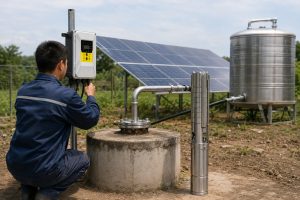
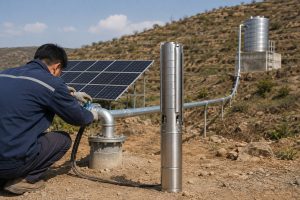
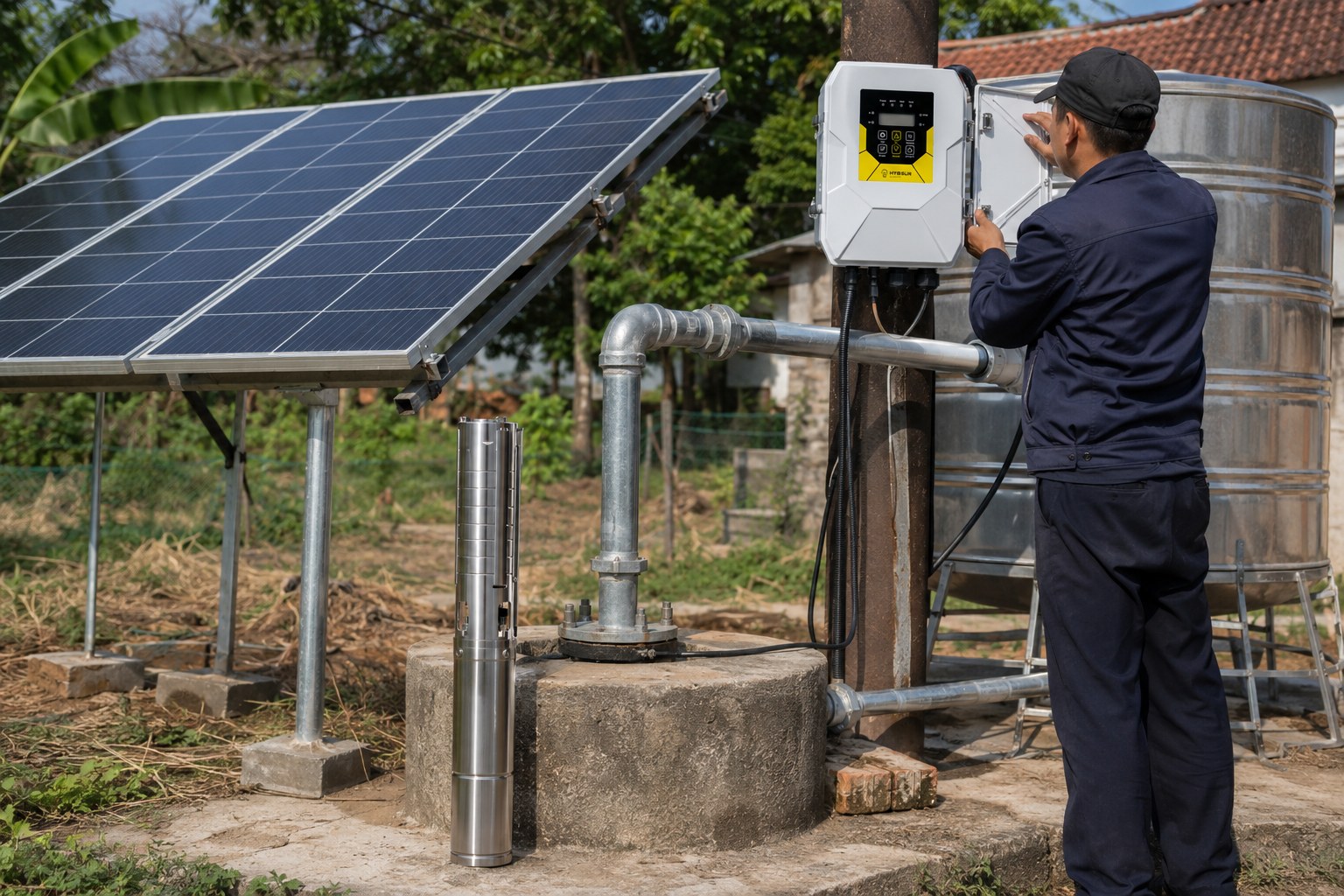
For a high-flow target like 30 GPM, a multi-stage centrifugal pump is the ideal choice. Solar-powered versions with either wear-resistant plastic or corrosion-resistant stainless steel impellers offer excellent performance for farm, ranch, and residential use.
The Workhorse: Solar Plastic Impeller Pump
When high flow is the priority and the budget is a key consideration, the solar plastic impeller pump is an excellent choice.
This is a type of multi-stage centrifugal pump.
It uses a series of durable, engineered plastic impellers that spin at high speed to move water.
Key Characteristics:
- High Flow, Medium Head: These pumps are designed to move large volumes of water, making them perfect for achieving a 30 GPM target for applications like farm irrigation, filling stock tanks, or supplying large homes.
- Excellent Wear Resistance: The engineered plastic material offers superior resistance to abrasion from fine sand and sediment. This significantly extends the pump's life in wells that are not perfectly clean, a common issue in many regions.
- Economical and Lightweight: Plastic impellers are more cost-effective to manufacture, making the overall pump more affordable. Their lower weight also simplifies installation, reducing labor time and costs.
This pump type is widely used in Africa and the Americas, where robust, high-volume water delivery is needed for agriculture and daily life.
However, they are less suited for very deep wells or water with high levels of corrosive elements.
The Premium Choice: Solar Stainless Steel Impeller Pump
For the ultimate in durability and reliability, especially in challenging water conditions, the solar stainless steel impeller pump is the superior option.
This pump also operates as a multi-stage centrifugal pump but uses impellers made from high-grade SS304 stainless steel.
Key Characteristics:
- Maximum Corrosion Resistance: Stainless steel is inherently resistant to rust and corrosion. This makes it the only choice for wells with acidic or alkaline water (low or high pH), which would quickly degrade lesser materials.
- Long Service Life and High Reliability: The strength and durability of stainless steel mean these pumps can withstand harsh conditions and operate reliably for many years. This is critical for high-end homes, valuable livestock operations, and commercial applications where downtime is not an option.
- High Flow and High Head: These pumps are engineered for premium performance, delivering both high flow rates like 30 GPM and handling the medium-to-high head pressures associated with deep wells and demanding systems.
While the initial cost is higher, the extended lifespan and reduced risk of failure provide a lower total cost of ownership over time.
They are the preferred solution in regions with known water quality issues, such as the alkaline soils in Australia or parts of the Americas.
When High Flow Isn't the Priority: Solar Screw Pump
It's also important to know what pump not to choose for a 30 GPM target.
The solar screw pump, also known as a progressive cavity pump, is a specialized tool for a different job.
It uses a helical rotor (a screw) inside a rubber stator to push water.
This design is incredibly effective at creating very high pressure.
This allows it to pump water from extreme depths (high head).
However, this design is inherently low-flow.
It is perfect for providing domestic water to a single home from a very deep well but is not suitable for high-volume applications like irrigation that require 30 GPM.
| Pump Type | Best For | Flow Rate | Head Pressure | Sand Resistance |
|---|---|---|---|---|
| Plastic Impeller | High-volume irrigation, farms | High (30+ GPM) | Medium | Excellent |
| Stainless Steel Impeller | Corrosive water, high-end homes | High (30+ GPM) | Medium-High | Good |
| Screw Pump | Very deep wells, domestic use | Low (2-8 GPM) | Very High | Superior |
Understanding this portfolio allows a distributor to meet any customer need, from deep-well domestic supply to high-flow agricultural irrigation.
The Power Behind the Pump: Motor and Control Systems
A powerful pump is only half the system.
The motor that drives it and the controller that manages it are what determine the true efficiency and reliability of your water supply.
Modern solar water pumps are powered by Brushless DC (BLDC) permanent magnet motors with efficiencies over 90%. This advanced technology dramatically reduces solar panel requirements and operating costs compared to older motor designs.
The BLDC Motor Advantage
The motor is the heart of the pump system.
The transition to BLDC permanent magnet motors represents a massive leap in efficiency.
Unlike traditional AC or brushed DC motors that can waste 30-50% of energy as heat, a BLDC motor converts over 90% of its electrical energy directly into rotational force.
Technical Advantages:
- Extreme Efficiency: Efficiencies exceeding 90% mean more water is pumped for every watt of solar power generated. This can reduce the number of solar panels needed by up to 25%, a significant cost saving.
- High Power Density: These motors use powerful neodymium iron boron permanent magnets. This allows them to be incredibly powerful for their size. A BLDC motor can be up to 47% smaller and 39% lighter than a traditional motor of the same power output. This makes installation easier and less expensive.
- Superior Reliability: The "brushless" design means there are no brushes to wear out and replace. This eliminates a common point of failure, resulting in a maintenance-free motor with a very long service life.
- High Torque: BLDC motors provide high starting torque, which is essential for getting the pump moving, especially in deep wells or against high pressure.
The motor is the core driver of performance and competitiveness.
A system built around a high-efficiency BLDC motor will always outperform and outlast one that is not.
The Role of the MPPT Controller
The motor is powered by solar panels, but the connection is not direct.
An intelligent controller, known as an MPPT (Maximum Power Point Tracking) controller, sits between them.
The job of the MPPT controller is to act as a smart power manager.
It constantly monitors the output of the solar panels, which varies with sunlight intensity, and adjusts the electrical load to extract the maximum possible power at any given moment.
This process can boost the overall system output by up to 30% compared to a system without MPPT.
It ensures that the BLDC motor receives optimal voltage and current, allowing it to run at its most efficient speed for the available sunlight.
It also provides critical protections for the pump, such as dry-run protection, over-voltage protection, and thermal shutdown.
Hybrid Power for 24/7 Operation
The biggest limitation of a purely solar-powered system is simple: no sun, no water.
This is a major concern for critical applications.
To solve this, advanced hybrid controllers have been developed.
HYBSUN has pioneered an AC/DC hybrid controller that provides ultimate flexibility and reliability.
This controller has inputs for both DC power from solar panels and AC power from the grid or a generator.
The system operates with intelligent, automatic switching:
- Priority Solar: When there is sufficient sunlight, the controller uses 100% free energy from the solar panels.
- Hybrid Assist: On overcast days when solar power is reduced, the controller will blend AC power with the available DC power, maximizing the use of solar energy before drawing from the grid.
- AC Takeover: At night or during extended periods of no sun, the controller automatically switches to the AC power source to ensure an uninterrupted water supply.
This technology provides the best of both worlds: the cost savings and environmental benefits of solar, combined with the 24/7 reliability of grid power.
It guarantees worry-free water access around the clock.
Conclusion
Achieving 30 GPM requires a systems approach.
You must match the right pump type and horsepower to your calculated TDH, all powered by an efficient motor and intelligent controller.
Frequently Asked Questions
What is a good GPM for a house?
A typical home needs 6 to 12 GPM. This flow rate is usually enough to run a couple of fixtures, like a shower and a sink, at the same time.
How many GPM does a 1 HP well pump produce?
A 1 HP pump can produce anywhere from 5 to 25 GPM. The exact amount depends entirely on the total head, or how high it has to lift the water.
Can I put a bigger pump in my well?
You can, but it's risky if the well's recovery rate can't keep up. Installing too large a pump can drain the well dry and damage both the pump and the well itself.
How do I increase my well water GPM?
You may be able to increase GPM by upgrading your pump, cleaning the well screen, or installing larger diameter pipes to reduce friction. Always consult a professional first.
Does a deeper well mean less GPM?
Yes, generally. The deeper the pump is set, the more energy it uses for lifting, which leaves less energy for producing flow (GPM). This is a key part of the TDH calculation.
What size pump do I need for a 300 foot well?
For a 300-foot well, the pump size depends on the required GPM. For low flow (5-10 GPM), a 1 HP pump might work, but for higher flow, you could need 2 HP or more.
Is low flow the same as low pressure?
Not exactly. You can have high pressure but low flow if there's a restriction in the pipes. Low pressure means the pump isn't generating enough force.
How much does a 30 GPM well pump cost?
The cost varies widely based on brand, materials, and horsepower, from a few hundred to several thousand dollars. Solar pumps with stainless steel components are at the higher end.