Your beautiful pond has become a murky mess.
This is not just an eyesore; it's an unhealthy environment for fish and plants.
Draining it is the key to restoring its health and beauty.
You can pump out a small pond using a submersible pump placed in the deepest area.
Alternatively, for a powerless option, create a siphon with a garden hose.
Both methods effectively remove water for cleaning or maintenance, restoring your pond's clarity and health.
Choosing the right method to drain your pond is a crucial first step.
The best approach depends on your pond's size, your budget, and whether you have access to electricity.
Some methods are fast and powerful, while others are slow, silent, and free.
This guide will walk you through every option, from high-tech pumps to simple physics tricks.
You will learn how to identify when your pond needs draining and how to do it safely and effectively.
Let's dive in and find the perfect solution for your pond.
Signs to Drain the Pond
Your pond seems unhealthy, but you're not sure why.
Ignoring the warning signs can lead to irreversible damage and harm to its inhabitants.
Learning to spot these signals tells you exactly when it's time for a full drain and reset.
Key signs that you need to drain your pond include a damaged liner, persistent algae blooms, excessive sludge buildup, and declining fish health.
These symptoms point to a failing ecosystem that requires a fresh start to thrive again.
A healthy pond is a balanced ecosystem.
When that balance is lost, the pond will show clear signs of distress.
Ignoring these signs is like ignoring a check engine light in your car.
The problem will only get worse and more expensive to fix.
Understanding these indicators allows you to act proactively, protecting your investment and the life within your pond.
Here are the most critical signs to watch for.
A Damaged Pond Liner
A pond liner is the waterproof barrier that holds the water.
Even a small tear or crack can lead to significant problems.
You might notice the water level dropping more than an inch per day, which is a classic sign of a leak.
Visible wear, cracks, or holes in the liner material are direct evidence of damage.
This water loss can destabilize the ground around your pond, leading to substrate erosion.
Early detection and repair are far less costly than dealing with a major structural failure later.
Algae Blooms
A little algae is normal, but a full-blown bloom is a major red flag.
Excessive algae growth turns your pond water green or stringy and soupy.
This happens when there are too many nutrients, like nitrates and phosphates, in the water.
These blooms consume huge amounts of oxygen at night, which can suffocate your fish and other aquatic life.
Draining the pond is the most effective way to remove these excess nutrients and start over with a clean slate.
Sludge and Tannins
Over time, organic matter like leaves, fish waste, and dead plants settles at the bottom.
This material decomposes into a thick, black layer called sludge.
A sludge layer thicker than two inches can release harmful gases, such as hydrogen sulfide, which smells like rotten eggs.
It also clouds the water and can clog pumps and filters.
Tannins from leaves can stain the water a tea-like brown color.
A full drain allows for the complete removal of this unhealthy buildup.
Fish and Wildlife Health
Your pond's inhabitants are sensitive indicators of its health.
If your fish become lethargic, gasp for air at the surface, or show signs of disease, it often points to poor water quality.
A decline in the activity of frogs, dragonflies, and other wildlife is also a warning.
These issues are frequently caused by low oxygen, high ammonia, or other problems stemming from sludge and algae.
Draining and cleaning the pond is sometimes the only way to restore a safe and thriving habitat.
How to Drain a Pond with a Pump?
You need to empty your pond, and you need it done efficiently.
Trying to bail water out by hand is slow, exhausting, and impractical for most ponds.
A pump provides the power and speed to get the job done with minimal physical effort.
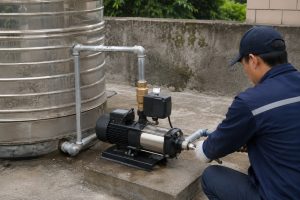
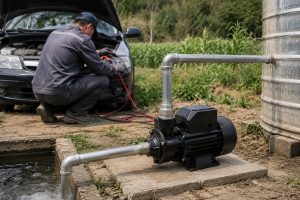
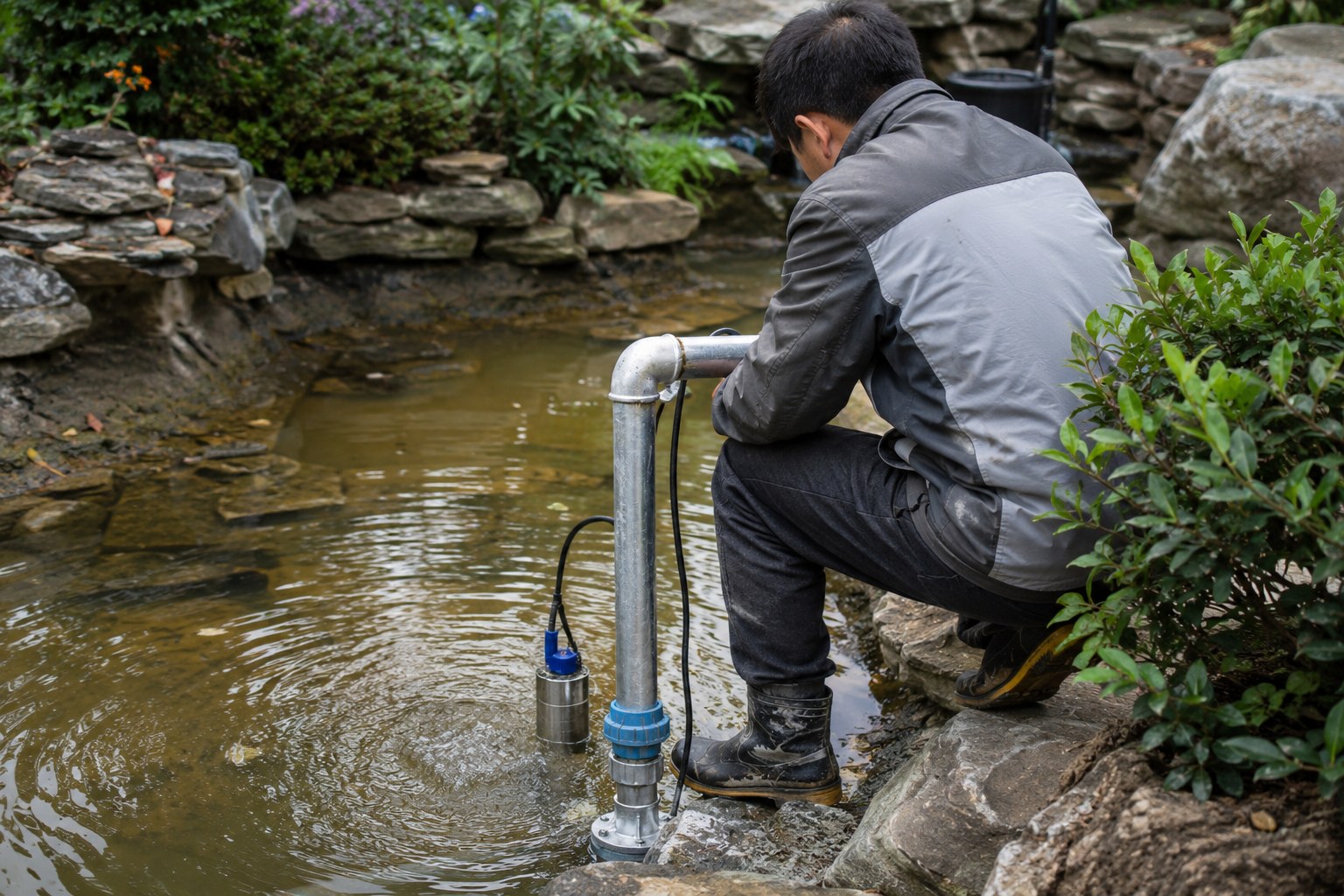
To drain a pond with a pump, use a submersible model designed for dirty water.
Place the pump in the deepest part of the pond, attach a discharge hose leading away from the area, and plug it in.
The pump will quickly and effectively remove the water.
Using a pump is the most common and effective way to drain a pond.
It's faster and more thorough than any manual method.
However, not all pumps are created equal.
The type of pump you choose will depend on your pond's size, the amount of debris, and your power source.
From powerful submersible units to eco-friendly solar options, there's a pump for every situation.
Let's explore the best pump types for the job.
Submersible Pumps: The Go-To Choice
Submersible pumps are the most popular option for a reason.
They are designed to be placed directly in the water, making setup incredibly simple.
For best results, choose a "solids-handling" or "dirty water" pump.
These are built to pass small debris, leaves, and sludge without clogging, which is a common issue with standard "clean water" pumps.
A pump with a flow rate of 2,000 gallons per hour (GPH) can drain a 1,000-gallon pond in just 30 minutes.
Simply lower the pump into the deepest part of your pond, connect a discharge hose, and run the hose to an area where the water can drain safely without causing erosion.
Solar-Powered Pumps: The Eco-Friendly Option
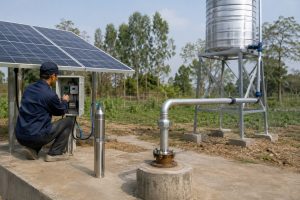
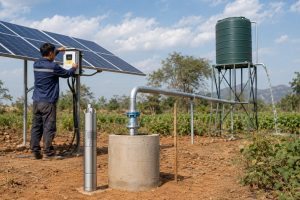
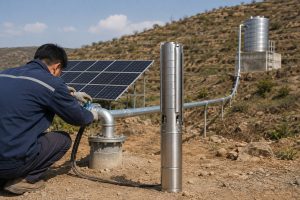
For those without easy access to an electrical outlet or who prefer a green solution, solar-powered pumps are an excellent alternative.
These pumps run on energy from the sun, eliminating electricity costs and reducing your carbon footprint.
Modern solar pumps often use highly efficient BLDC (Brushless DC) permanent magnet motors.
These motors can be over 90% efficient, converting more sunlight into pumping power.
This high efficiency means you can achieve a decent flow rate with fewer solar panels, reducing the initial setup cost by up to 30% compared to older solar technology.
While their flow rate is typically lower than electric pumps, they are perfect for smaller ponds or for draining water over a longer period.
| Feature | Solar-Powered Pump | Traditional Electric Pump |
|---|---|---|
| Power Source | Solar Panels | Grid Electricity |
| Operating Cost | Nearly zero after purchase | Varies with electricity rates |
| Best For | Remote areas, eco-conscious users | Fast draining, large ponds |
| Flow Rate | Lower (e.g., 200-800 GPH) | Higher (e.g., 1,000-5,000+ GPH) |
| Debris Handling | Varies, some models are for clean water only | Excellent with solids-handling models |
Hand Pumps: For Small Jobs and Precise Control
A hand pump is a manual, labor-intensive option, but it has its place.
It's useful for very small ponds, water features, or when you only need to remove a small amount of water.
It's also a great backup method if your primary pump fails.
Using a hand pump gives you complete control over the draining process.
You can target specific areas and easily manage the water flow.
While it requires physical effort, it's a simple and effective tool for situations where power and scale don't justify a motorized pump.
How to Drain a Pond without a Pump?
You need to drain your pond but have no pump or access to electricity.
You might feel stuck, thinking there's no way to get the water out.
Fortunately, you can use simple principles of physics to drain your pond for free.
You can drain a pond without a pump by creating a siphon with a hose.
This method uses gravity to pull water out of the pond.
Simply fill a hose with water, place one end in the pond, and position the other end at a lower elevation to start the flow.
Draining a pond doesn't always require machinery.
With a bit of know-how, you can harness the power of gravity to do the work for you.
These pump-free methods are silent, cost nothing to operate, and are perfect for off-grid locations or smaller ponds.
They are also gentle on the pond's ecosystem, causing minimal disturbance.
The two primary methods are creating a siphon and using a gravity drain.
Let's break down how to perform each one.
Creating a Siphon
Siphoning is a surprisingly effective technique that works on ponds of many sizes.
The only requirements are a hose and a discharge point that is lower than the surface of the water in your pond.
The greater the height difference, the faster the water will flow.
A standard 1-inch diameter garden hose can drain several hundred gallons per hour.
Here is a step-by-step guide:
- Submerge the Hose: Place the entire garden hose into the pond, allowing it to fill completely with water. You should see all the air bubbles escape.
- Seal One End: Keep one end of the hose under the water. Tightly seal the other end with your thumb or a screw-on cap.
- Position the Hose: Carefully lift the sealed end out of the pond and carry it to your desired drainage area. Do not let the other end in the pond come out of the water.
- Start the Flow: Place the sealed end on the ground at a point lower than the pond's water level and release your thumb. Water will begin to flow immediately and will continue until the water level in the pond drops below the intake end of the hose.
Gravity Drainage
This method is more of a permanent installation than a temporary fix.
It's ideal for ponds built on a slope or a terraced landscape.
A gravity drain is a pipe or trench installed at the lowest point of the pond during its construction.
This drain leads to a lower elevation point away from the pond.
When you need to drain the pond, you simply open a valve or remove a plug.
The water then flows out effortlessly due to gravity.
While this requires significant pre-planning, it is the easiest and fastest pump-free draining method available for those who can incorporate it into their pond design.
| Method | How It Works | Best For | Pros | Cons |
|---|---|---|---|---|
| Siphoning | Uses gravity and atmospheric pressure via a hose. | Small to medium ponds, no electricity. | No cost, quiet, simple setup. | Slower than a pump, requires a lower discharge point. |
| Gravity Drain | A built-in pipe at the pond's lowest point. | Ponds on sloped terrain. | Fast, effortless once installed. | Requires installation during construction. |
Choosing the Right Pump for the Job
You're ready to use a pump, but the sheer number of options is confusing.
Choosing the wrong pump can lead to frustration, wasted money, and a job half-done.
Understanding the key differences will help you select the perfect tool for your specific needs.
For draining a pond, a submersible "solids-handling" pump is your best choice as it won't clog with debris.
For general circulation or waterfalls, you must also consider the pond's volume and the required "head height" to pump water vertically.
The pump is the heart of many pond systems.
It not only helps with draining but also with filtration and creating beautiful water features like fountains and waterfalls.
The right pump operates efficiently, lasts for years, and keeps your pond healthy.
The wrong pump will struggle, clog frequently, and use excess electricity.
To make an informed decision, you need to understand pump sizing, drive types, and specialty features.
This knowledge ensures you invest in a pump that perfectly matches your pond's demands.
Sizing Your Pump
The most important specification for a pump is its flow rate, measured in gallons per hour (GPH).
A common rule of thumb for pond circulation is that the pump should circulate half of the pond's total volume every hour.
To calculate your pond's volume:
Pond Volume (Gallons) = 7.5 × Average Length (ft) × Average Width (ft) × Average Depth (ft)
For example, a pond that is 10 feet long, 8 feet wide, and 2 feet deep has a volume of approximately 1,200 gallons.
7.5 × 10 × 8 × 2 = 1,200 gallons
For circulation, you would need a pump with a flow rate of at least 600 GPH.
For draining, a higher GPH will get the job done faster.
Pump Drive Types Explained
The motor, or drive, is what powers the pump.
- Direct Drive Pumps: These are powerful and can push water to significant heights (high "head"), making them ideal for large waterfalls. However, they tend to use more electricity and some older models use oil for lubrication, which can be fatal to fish if a seal breaks.
- Magnetic Drive Pumps: These use magnets to spin the impeller, which means the motor is completely sealed and uses no oil. They are highly energy-efficient and safe for fish, but they typically have lower head height, making them better for circulation and small fountains.
- BLDC Motors: Often found in modern solar pumps, Brushless DC motors are the pinnacle of efficiency. Their advanced design provides high torque and power in a compact size, moving more water with less energy. Some systems even feature AC/DC hybrid controllers, allowing the pump to automatically switch between solar power and grid power. This ensures 24/7 operation, even on cloudy days or at night, maximizing energy from the sun when available and relying on AC power only when necessary.
Specialty Pumps to Consider
- Solids-Handling Pumps: When draining a pond, this is the most critical feature. These pumps have a wide intake and a specialized impeller that can pass debris like leaves, algae, and sludge up to 2 inches in diameter without clogging.
- External Pumps: These pumps are installed outside the pond in a dry location. They are generally more efficient and longer-lasting than submersibles, making them a good choice for large ponds (over 1,000 gallons) that run continuously. However, they are more complex to install and can be noisier.
- Corrosion-Resistant Pumps: If your water is acidic, alkaline, or has high salt content, a standard pump can corrode quickly. Pumps made with stainless steel or high-grade plastic impellers are designed to withstand these harsh conditions, ensuring a much longer service life.
Pump Maintenance for a Long Life
Your new pump is working perfectly, but for how long?
A pump failure is always inconvenient and can quickly lead to a decline in your pond's health.
Investing in a replacement is costly, but simple maintenance can prevent this scenario.
To maximize your pump's lifespan, unplug it and clean the intake screen and impeller every few months.
Remove any wrapped debris or mineral buildup.
Before winter, remove the pump and store it in a frost-free location to prevent freeze damage.
A pond pump is a hardworking piece of equipment that runs for hours on end.
Just like any machine, it requires a little care to perform at its best.
Neglecting maintenance is the number one reason for premature pump failure.
Luckily, the process is quick and easy.
A few minutes of cleaning a couple of times a year can add years to your pump's life, ensuring your pond stays clear and healthy.
Follow this guide for routine cleaning and seasonal storage.
Routine Cleaning Schedule
Regular cleaning prevents clogs and keeps the motor from overworking.
A good schedule is essential.
- Monthly Check: Visually inspect the pump's intake screen for large debris like leaves or string algae and remove it.
- Quarterly Cleaning: Perform a more thorough cleaning 2-4 times per year, especially in the fall when leaf debris is high.
Here is the step-by-step cleaning process:
- Unplug the Pump: Safety first. Always disconnect the pump from its power source before handling it.
- Remove from Pond: Lift the pump out of the water and place it on a stable surface.
- Clean the Exterior: Use a stiff brush and a garden hose to remove algae and grime from the pump housing and intake screen.
- Inspect the Impeller: Remove the volute (the cover over the impeller). Check the impeller for any wrapped debris like string algae or fishing line. Carefully remove it. The impeller should spin freely.
Dealing with Tough Buildup
If you have hard water, you may notice a white, crusty buildup on your pump.
This is calcium and other mineral deposits that can hinder the pump's performance.
Vinegar is an excellent and safe way to dissolve these deposits.
Create a solution of 50% white vinegar and 50% water in a bucket.
Submerge the pump and its components in the solution and let them soak for 30-60 minutes.
For a stuck impeller, you can even run the pump in the bucket of vinegar solution (with the volute removed) for 20-30 minutes to help break it free.
After soaking, the buildup should brush off easily.
Winterizing Your Pump
In climates where temperatures drop below freezing, you must protect your pump.
Running a pump in freezing weather can create ice dams that cause the pond to drain, potentially burning out the pump motor.
It is highly recommended to shut down the feature for the winter.
Remove the pump from the pond after a final cleaning.
The best way to store it is to place it in a bucket of water in a location that will not freeze, like a basement or heated garage.
This keeps the seals and O-rings moist, preventing them from drying out and cracking over the winter.
This simple step ensures your pump will be ready to go in the spring.
Conclusion
Draining your pond is a vital maintenance task.
Whether you use a powerful pump or a simple siphon, the right technique makes it manageable.
Regular care ensures your pond remains a healthy, beautiful centerpiece for years.
FAQs
How can I drain my pond cheaply?
The cheapest way is to use a siphon.
This method uses a simple garden hose and gravity, requiring no electricity and costing nothing to operate.
Can I use a shop vac to drain a pond?
A shop vac can remove small amounts of water and sludge from the very bottom.
However, it is not practical for draining the entire pond.
How long does it take to drain a pond with a pump?
It depends on the pond's volume and the pump's flow rate.
A 2,000 GPH pump can drain a 1,000-gallon pond in about 30 minutes.
What is the fastest way to drain a pond without a pump?
A pre-installed gravity drain is the fastest non-pump method.
If one isn't installed, using multiple, large-diameter hoses to create several siphons at once will speed up the process.
Do you have to remove fish to drain a pond?
Yes, you must safely house your fish in a temporary holding tank.
The tank should be filled with pond water and have an aerator.
How do you get sludge out of a pond?
After draining most of the water, use a pond vacuum, shop vac, or a shovel and bucket to manually remove the thick sludge layer.
Can I use a regular water pump to drain a pond?
You can, but it's risky.
Regular "clean water" pumps can easily clog and burn out from the debris and sludge found in pond water.
How often should you drain a pond?
A full drain is only needed every 5 to 10 years.
More frequent partial water changes are better for maintaining a stable ecosystem.