Struggling to keep your pond water clear and healthy?
A stagnant pond can quickly become a problem, but choosing the right pump can seem complicated.
For a small pond, a good rule of thumb is to choose a pump with a flow rate, measured in gallons per hour (GPH), that is at least 1.5 times the total volume of your pond. For example, a 200-gallon pond needs a pump with a minimum flow rate of 300 GPH.
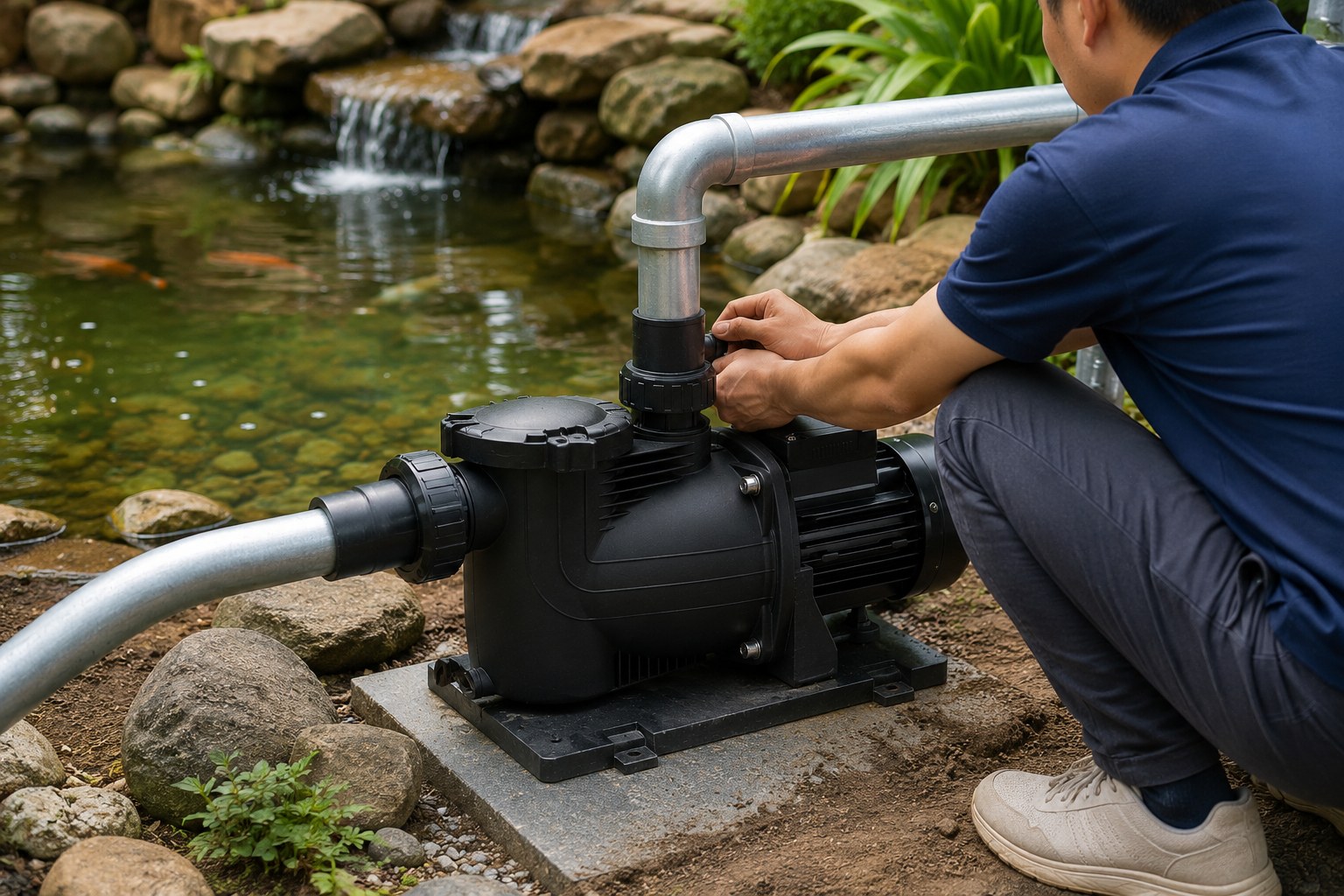
Choosing the right pump is one of the most important decisions you'll make for the health of your pond.
It's the heart of your aquatic ecosystem, circulating and oxygenating the water for your fish and plants.
But it's not just about a single number.
Factors like waterfalls, the number of fish, and even the type of pump technology you choose all play a critical role.
Let's explore how to select the perfect pump to create a thriving pond environment, from basic calculations to advanced, energy-efficient technologies.
Why a Pump is The Heart of Your Pond
Is your pond water looking murky or developing an unpleasant smell?
This is a common sign of stagnant water, which lacks the circulation needed for a healthy ecosystem.
A pond pump is essential for circulating water through a filtration system, preventing stagnation, and adding vital oxygen. It acts as the life support system for your pond, ensuring water clarity and the well-being of fish and plants.
To truly grasp the importance of a pump, we need to look at what it does for your pond's ecosystem.
A pump doesn't just move water; it drives several critical processes that maintain balance and beauty in your pond.
Without this constant movement, your pond can quickly run into problems that are difficult and costly to fix.
The Dangers of Stagnation
Still water is a breeding ground for problems.
Without circulation, debris settles on the bottom and decomposes, releasing harmful gases and consuming oxygen.
This creates an environment where "bad" anaerobic bacteria thrive, leading to foul odors and sludge buildup.
Algae also flourishes in stagnant, nutrient-rich water, turning your beautiful pond into a green mess.
The Role of Aeration and Filtration
A pump solves these issues by creating a continuous cycle.
- Filtration: The pump pulls water from the pond and pushes it through a filter. The filter traps physical debris (leaves, fish waste) and provides a home for beneficial bacteria that break down invisible toxins like ammonia.
- Aeration (Oxygenation): As the pump moves water, especially through features like waterfalls or fountains, it agitates the surface. This process is crucial for gas exchange, allowing harmful carbon dioxide to escape and life-giving oxygen to dissolve into the water. Fish, plants, and beneficial bacteria all require high levels of dissolved oxygen to thrive.
The table below illustrates the stark difference between a pond with and without proper circulation.
| Feature | Pond with Pump | Pond without Pump (Stagnant) |
|---|---|---|
| Water Clarity | Clear | Murky, Green (Algae Blooms) |
| Oxygen Level | High & Stable | Low & Fluctuating (Dangerous for Fish) |
| Smell | Fresh, Earthy | Foul, "Swampy" Odor |
| Fish Health | Active & Healthy | Stressed, Sick, Prone to Disease |
| Debris | Removed by Filter | Accumulates as Sludge |
Essentially, choosing to install a pump is choosing to create a vibrant, living water feature rather than a stagnant pool.
It is the single most effective tool for maintaining long-term pond health.
Calculating The Perfect Pump Flow Rate (GPH)
Confused by all the numbers like GPH and head pressure?
Sizing a pump can feel like a complex math problem, leading many pond owners to guess and end up with the wrong equipment.
To calculate your pump size, first find your pond's volume in gallons (Length x Width x Depth in feet x 7.5). Then, aim for a pump that circulates this volume at least once every two hours. For fish ponds, circulate the full volume every hour (e.g., a 1000-gallon pond needs a 1000 GPH pump).
Getting the flow rate right is a balancing act.
A pump that's too weak won't provide adequate filtration, leading to poor water quality.
A pump that's too powerful can create a stressful, turbulent environment for your fish.
Let's break down the two key metrics you need to master: Flow Rate (GPH) and Head Pressure.
Step 1: Calculate Your Pond's Volume
First, you need to know how much water you're dealing with.
For a square or rectangular pond, the formula is simple:
Length (ft) x Width (ft) x Average Depth (ft) x 7.5 = Pond Volume in Gallons
For an irregularly shaped pond, you can approximate the volume by taking measurements at several points to find an average length and width.
Step 2: Determine Your Base Flow Rate (GPH)
The flow rate, measured in Gallons Per Hour (GPH), tells you how much water a pump can move.
The general rule is to circulate the entire volume of your pond's water at least once every two hours.
- Formula:
Pond Volume / 2 = Minimum GPH
However, this is just the starting point.
For ponds with fish, especially Koi, the waste load is much higher.
- Rule for Fish Ponds: Circulate the entire volume of water at least once every hour.
- Formula:
Pond Volume = Recommended GPH
| Pond Type | Circulation Goal | Example: 500 Gallon Pond |
|---|---|---|
| Water Garden (Plants only) | Once every 2 hours | 250 GPH |
| Goldfish Pond | Once every 1-2 hours | 250 - 500 GPH |
| Koi Pond | At least once per hour | 500+ GPH |
Step 3: Account for Head Pressure
Head pressure is one of the most commonly overlooked factors.
It's the total resistance your pump has to overcome to move water from point A to point B.
It is determined by two things:
- Vertical Lift: The height in feet from the pond's surface to the highest point the water will reach (e.g., the top of a waterfall).
- Pipe Friction: For every 10 feet of horizontal tubing, add 1 foot of head pressure.
Example Calculation:
You have a waterfall that is 4 feet above the pond's surface.
You are using 20 feet of tubing to get the water there.
- Vertical Lift = 4 feet of head pressure
- Pipe Friction = 2 feet of head pressure (20 feet of tube / 10)
- Total Head Pressure = 6 feet
When you shop for a pump, its packaging will show a chart that lists its GPH at different levels of head pressure.
You need to find a pump that provides your target GPH at your calculated head pressure.
For our example, if you need 1000 GPH, you must find a pump that delivers 1000 GPH at 6 feet of head.
Adjusting Pump Size for Water Features and Fish
Think you've found the right pump size based on volume alone?
Adding a waterfall or a heavy fish load can drastically change your needs, leaving an undersized pump struggling to keep up.
For waterfalls, add 100 GPH for every inch of waterfall width for a subtle flow, or 200 GPH per inch for a strong cascade. For fish, add an extra 100 GPH for every 10 inches of total fish length to handle the increased bio-load.
Your pond's volume provides a baseline for pump selection, but the real-world features and inhabitants are what truly define your final requirements.
A pump that's perfect for a simple water garden will be completely inadequate for a Koi pond with a dramatic waterfall.
Let's quantify how these popular additions impact your GPH needs.
Sizing for Waterfalls and Streams
Waterfalls not only add beauty and relaxing sounds but are also fantastic for aeration.
However, they require significant pumping power.
The flow you need depends on the width of the waterfall spillway (the lip over which water flows) and the effect you desire.
| Desired Waterfall Effect | GPH Needed per Inch of Spillway Width | Example: 12-inch Wide Waterfall |
|---|---|---|
| Trickle / Gentle Flow | 50 - 100 GPH | 600 - 1,200 GPH |
| Average / Sheet Flow | 100 - 150 GPH | 1,200 - 1,800 GPH |
| Strong / Roaring Flow | 150 - 200+ GPH | 1,800 - 2,400+ GPH |
Important: Remember that this GPH requirement is in addition to the GPH needed for basic circulation and must be delivered at the calculated head pressure of the waterfall.
Sizing for Fountains and Spitters
Fountains and decorative spitters typically require much less flow than waterfalls.
Most small fountain kits will come with a recommended pump size, often in the 100 to 500 GPH range.
The key consideration here is the "max head" or "lift" rating of the pump.
If you want a fountain spray to reach 3 feet high, you need a pump with a max head rating of at least 3 feet.
Flow rate will decrease as you approach the maximum lift height.
Adjusting for Fish Load
Fish are the biggest producers of waste (ammonia) in a pond.
The more fish you have, and the larger they are, the more robust your circulation and filtration system needs to be.
A simple rule is to increase your pump's GPH to turn over the pond's volume more frequently.
- Lightly Stocked (a few goldfish): Turn over volume every 1.5 - 2 hours.
- Moderately Stocked: Turn over volume every 1 - 1.5 hours.
- Heavily Stocked (Koi pond): Turn over volume at least once per hour. Some experts recommend a turnover rate of 1.5x to 2x per hour.
A more precise method is to consider the total "bio-mass".
- A good rule of thumb: Add 10 gallons of pump capacity for every inch of fish.
- Example: If you have ten 6-inch goldfish, that's 60 total inches of fish.
- Calculation: 60 inches / 1 inch * 10 gallons = 600 gallons.
- This means you should add a capacity equivalent to a 600-gallon pond to your pump's calculation, effectively increasing its required GPH.
By layering these calculations—starting with volume, adding the needs of your water features, and finally adjusting for your fish population—you can zero in on the perfect pump size that will keep your entire pond system in beautiful harmony.
Exploring Advanced Pond Pump Technologies
Are you still thinking of pond pumps as simple, one-size-fits-all devices?
The technology has evolved, offering specialized solutions for everything from deep wells to corrosive water, with a focus on energy efficiency.
Modern pump technology includes specialized designs like screw pumps for high head, plastic impeller pumps for high flow, and stainless steel pumps for corrosion resistance. These are often powered by highly efficient motors, reducing energy costs and environmental impact.
While a small garden pond might use a simple magnetic drive pump, understanding more advanced pump technologies can help you make a smarter, more durable, and more efficient choice, especially for larger ponds or more demanding applications.
These advanced options, often seen in agricultural and domestic water supply, offer principles and performance benefits that are now being applied to the pond market.
For Low Flow and High Head: The Screw Pump
Imagine needing to lift water from a very deep source, like a well or a very tall waterfall.
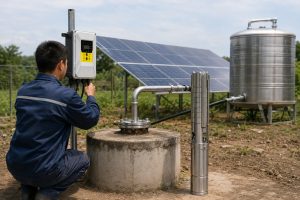
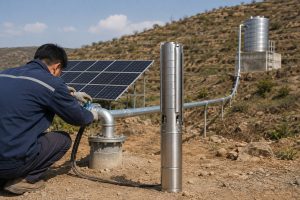
This is where a solar screw pump excels.
It uses a single stainless steel screw (rotor) rotating inside a rubber housing (stator).
This action traps and pushes "pockets" of water upward under high pressure.
- Performance: Low flow, but extremely high head (vertical lift). It can push water much higher than a standard centrifugal pump of similar size.
- Best Use Case: Ideal for deep water sources, very tall water features, or situations where high pressure is needed for a small amount of water.
- Key Advantage: Excellent resistance to sand and solids. The design can handle gritty water that would quickly destroy other pump types.
For High Flow and Wear Resistance: The Plastic Impeller Pump
This is the workhorse for moving large volumes of water efficiently.
It is a multi-stage centrifugal pump that uses a series of durable plastic impellers to accelerate water.
It's designed for high output at medium head pressures.
- Performance: Very high flow rate, medium head. Perfect for large waterfalls, streams, and circulating large ponds quickly.
- Best Use Case: Farm ponds, large landscape features, and any application where moving the maximum amount of water is the priority.
- Key Advantage: Lightweight, economical, and surprisingly resistant to abrasion from fine sand, making it a great value for general use.
For Ultimate Durability: The Stainless Steel Impeller Pump
When water quality is poor or longevity is paramount, nothing beats stainless steel.
This pump model uses impellers and a pump body made from high-grade SS304 stainless steel.
It is specifically designed for harsh conditions.
- Performance: High flow rates and medium-to-high head, similar to the plastic impeller model but with superior durability.
- Best Use Case: Ponds in areas with acidic or alkaline water, coastal areas with salt spray, or for high-end installations where reliability is the absolute top priority.
- Key Advantage: Unmatched corrosion resistance and a very long service life. It is the premium choice for challenging environments.
| Pump Technology | Best For | Flow Rate | Head Pressure | Sand Resistance |
|---|---|---|---|---|
| Screw Pump | Deep lift, pressure | Low | Very High | Excellent |
| Plastic Impeller | Moving lots of water | Very High | Medium | Good |
| Stainless Steel Impeller | Corrosive water, longevity | High | Medium-High | Good |
By understanding these different types, you can look beyond the basic GPH rating and choose a pump whose fundamental design is matched to your specific pond's challenges, ensuring better performance and a longer lifespan.
The Power Behind the Pump: Why Your Motor Matters
Do you assume that a higher GPH pump will always mean a higher electricity bill?
That's an old way of thinking.
The real driver of cost and performance is the motor, and modern technology has made huge leaps in efficiency.
The core of a modern, efficient pump is a Brushless DC (BLDC) permanent magnet motor. These motors can be over 90% efficient, converting more electricity into water movement. This reduces running costs, requires fewer solar panels in off-grid systems, and ensures a longer service life.
The pump's impeller or screw gets all the attention, but it's just a passive component.
The motor is the active heart, the engine that determines how much power is consumed and how much work gets done.
A pump is only as good as its motor, and the shift to BLDC technology is a game-changer.
What is a BLDC Motor?
A Brushless DC (BLDC) motor is a significant upgrade over traditional AC or brushed DC motors.
It uses powerful permanent magnets (often high-grade neodymium iron boron) on the rotor and electronically controlled electromagnets on the stator.
By eliminating the physical "brushes" that wear out in older motors, they become far more reliable and efficient.
The Efficiency Advantage
The most critical benefit is efficiency.
- Traditional Motors: Often operate in the 50-70% efficiency range. This means 30-50% of the electricity you pay for is wasted as heat and noise.
- BLDC Motors: Routinely exceed 90% efficiency. Almost all the energy consumed is used to spin the shaft and pump water.
This high efficiency has a direct impact on your wallet.
A pump with a 90% efficient motor can produce the same GPH as a pump with a 60% efficient motor while using 33% less electricity.
Since a pond pump runs 24/7, these savings add up significantly over a year.
Technical and Practical Advantages
The benefits of a BLDC motor extend beyond just a lower electricity bill.
| Feature | BLDC Motor Advantage | Why It Matters to You |
|---|---|---|
| Size & Weight | Up to 47% smaller and 39% lighter | Easier to install, handle, and ship. Allows for more compact pump designs. |
| Torque | High torque at all speeds | The pump can start easily even under load and responds quickly to changes in demand. |
| Maintenance | No brushes to replace | "Maintenance-free" design significantly increases reliability and reduces lifetime cost. |
| Lifespan | Longer service life | Fewer moving parts to wear out and less heat generation leads to a more durable product. |
| Control | Allows for variable speed | Can be paired with smart controllers to precisely adjust flow rate, saving even more energy. |
For solar applications, the high efficiency is even more critical.
A 90% efficient pump motor requires fewer expensive solar panels to achieve the same water flow compared to a less efficient competitor, dramatically lowering the initial system cost.
When choosing a pump, don't just look at the GPH.
Ask about the motor technology.
Investing in a pump with a high-efficiency BLDC motor is one of the smartest decisions you can make for both your pond and your budget.
Advanced Control: Getting the Most From Your Pump
Think a pump is just an "on/off" device?
Modern systems offer intelligent control that can adapt to changing conditions, maximize energy use, and guarantee water flow 24/7.
Advanced pumps use intelligent controllers, like MPPT for solar, to maximize energy utilization. Hybrid AC/DC systems offer the ultimate reliability, automatically switching from solar power to grid power when sunlight is insufficient, ensuring continuous operation.
The pump and motor are the muscle, but the controller is the brain.
A smart controller can transform a good pump into a brilliant one by optimizing its performance in real-time.
This is especially true for solar-powered systems and for anyone who demands absolute reliability from their water source.
Maximizing Solar Power with MPPT
If you're using a solar pump, an MPPT controller is non-negotiable.
MPPT stands for Maximum Power Point Tracking.
Solar panels have a complex relationship between voltage and current that changes constantly with the amount of sunlight and temperature.
An MPPT controller continuously monitors the panel's output and adjusts the electrical load to find the "maximum power point"—the sweet spot where the panel produces the absolute most wattage.
- Without MPPT: A simple controller might only capture 60-70% of a panel's potential power.
- With MPPT: An intelligent MPPT controller can boost energy harvest by up to 30%.
This means you get more water pumped earlier in the morning, later in the evening, and even on overcast days.
It makes the entire solar pump system vastly more effective and reliable.
The Ultimate in Reliability: AC/DC Hybrid Systems
What happens to your solar-powered pond on a string of cloudy days, or if you need to run a water feature at night?
This is the challenge that hybrid AC/DC controllers solve.
These advanced controllers are designed with two simultaneous power inputs: one for your DC solar panels and one for your AC grid power (or a generator).
The system's logic is designed for maximum efficiency and worry-free operation:
- Priority on Solar: As long as the sun is shining, the controller will prioritize using the free energy from the solar panels.
- Hybrid Function: If sunlight is weak (like on a cloudy day), the controller can intelligently blend solar power with a small amount of AC power to maintain the desired pump speed. This maximizes the use of every bit of solar energy.
- Automatic Switchover: When the solar input drops to zero (at night), the controller seamlessly and automatically switches over to full AC power.
- Seamless Return: The next morning, as soon as the solar panels start producing power again, the controller automatically switches back to solar priority.
This technology provides the best of both worlds: the low running cost and environmental benefits of solar, combined with the 24/7 reliability of the electrical grid.
It ensures that your pond's life support system never shuts down, giving you complete peace of mind.
Conclusion
Choosing the right pump involves balancing pond volume, features, and fish load with the right technology.
From basic calculations to advanced motors, the perfect pump ensures a healthy, efficient, and beautiful pond for years to come.
FAQs
Can a pond pump be too big for a pond?
Yes.
A pump that is too powerful can create excessive turbulence, which may stress fish and damage delicate aquatic plants.
It can also be inefficient and costly.
How many hours a day should a pond pump run?
A pond pump should run 24 hours a day, 7 days a week.
Continuous circulation is essential for stable oxygen levels and effective filtration, keeping the water healthy for fish.
Do I need a pump in my pond if I have plants?
It is still highly recommended.
While plants help with oxygenation, a pump ensures proper water circulation, prevents stagnant areas, and powers a filter to remove debris and waste.
What is the difference between GPH and head height?
GPH (Gallons Per Hour) is the volume of water a pump moves.
Head height (or lift) is the maximum vertical distance the pump can push that water against gravity.
How do I keep my pond pump from clogging?
Place the pump on a raised surface, not the very bottom of the pond.
Use a pre-filter or a skimmer box, and clean the pump's intake screen and impeller regularly.
Are solar pond pumps any good?
Yes, modern solar pumps with efficient BLDC motors and MPPT controllers are very effective.
They are perfect for off-grid locations and can significantly reduce electricity costs for any pond.
What size pump do I need for a 1000-gallon pond?
For a 1000-gallon pond with fish, you need a pump with a flow rate of at least 1000 GPH.
If you have a waterfall, you will need to add its GPH requirement to this total.