Struggling to choose a water pump?
An oversized pump can damage your equipment, create safety risks, and waste a significant amount of money on electricity.
You need to understand how to match the pump to the job.
Yes, a pump can absolutely be too powerful.
An oversized pump is a common and costly mistake.
It can damage filters, create unsafe water flow, and waste electricity.
This leads to expensive repairs, higher bills, and potential safety hazards in your water system.
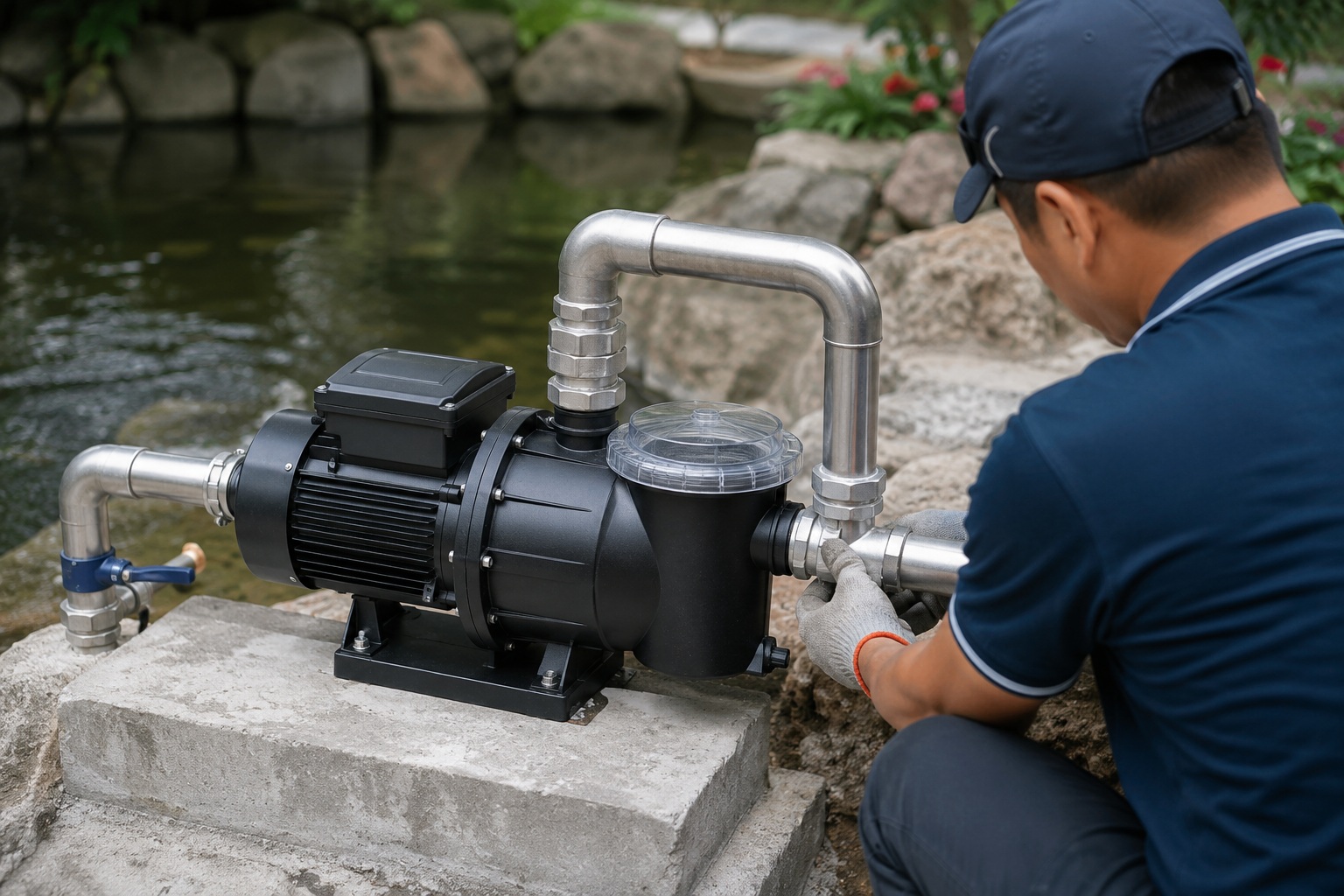
The question of a pump being "too powerful" is a critical one.
It applies not just to backyard ponds but to every water-moving application.
This includes everything from residential drinking water wells to large-scale agricultural irrigation.
The core principles of pump selection are universal.
Understanding these principles is the key to building efficient, reliable, and cost-effective water systems.
It allows you to move beyond a simple "bigger is better" mindset.
You can then focus on what truly matters: matching the right technology to the specific job.
This knowledge is essential for anyone involved in water management, from a homeowner to a large-scale distributor sourcing products for a diverse market.
Let's explore how these principles apply to different pump technologies and applications.
Understanding the Right Fit: The Low Flow, High Head Solution
Need to pull water from a deep well?
A weak pump won't work, and a standard pump might not have the lifting power you need.
This can leave you without water.
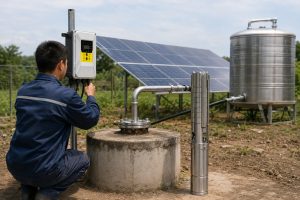
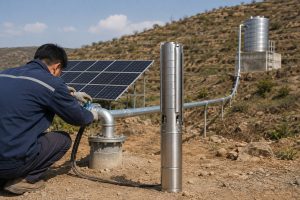
For deep wells and low-volume needs, a solar screw pump is the ideal solution.
It provides the immense head pressure required to lift water from great depths.
It does this without wasting energy on excessive flow, making it perfect for targeted applications.
A pump can be powerful in two ways: high flow rate or high head pressure.
Choosing the wrong type of power is a common mistake.
A solar screw pump is engineered for one specific kind of power: lifting force.
What is a Solar Screw Pump?
This pump uses a simple, robust design.
A rotating stainless steel screw (rotor) turns inside a durable rubber stator.
This action creates sealed cavities of water that are pushed upwards.
It’s like a screw turning and pushing the water up through the pipe.
This progressive cavity design generates very high pressure, allowing it to lift water from wells that are hundreds of meters deep.
However, the volume of water it moves, its flow rate (measured in Gallons Per Hour or GPH), is relatively low.
Performance in a Nutshell: Head vs. Flow
| Pump Type | Primary Strength | Best Application | Weakness |
|---|---|---|---|
| Screw Pump | Very High Head | Deep Well Domestic Water | Low Flow Rate |
| Impeller Pump | Very High Flow | Surface Irrigation | Lower Head Pressure |
| Booster Pump | High Pressure | Pressurizing Existing Flow | Requires Inlet Flow |
The Danger of a Mismatched "Powerful" Pump
What happens if you use a "powerful" high-flow pump for a deep well?
It will fail.
It may have a high horsepower rating, but it lacks the necessary head pressure to overcome the force of gravity and friction in a deep pipe.
The pump will run, consume a lot of electricity, but little to no water will reach the surface.
Conversely, using a screw pump for surface irrigation would be inefficient.
You would get the water, but the low flow rate wouldn't be enough for large fields.
This is why understanding that "powerful" is not a one-size-fits-all term is crucial.
For applications like domestic water supply, livestock drinking troughs, and small-scale drip irrigation, especially in electricity-scarce regions, the high-head, low-flow power of a screw pump is the perfect, efficient solution.
Its high resistance to sand also makes it incredibly durable in harsh water conditions.
When Is More Water the Answer? The High Flow, Wear-Resistant Choice
Your farm or pasture needs water, and lots of it.
A pump with low flow simply won't get the job done on time.
This can lead to dry fields and thirsty livestock.
A solar plastic impeller pump is the answer for high-volume needs like irrigation.
This multi-stage centrifugal pump delivers high flow rates efficiently.
It is also built to withstand wear from the fine sand often found in agricultural water sources.
When the goal is to move a large quantity of water over a relatively short distance, you need a different kind of power.
This is where flow rate becomes the most important metric.
You need a pump optimized to deliver a high volume of Gallons Per Hour (GPH) or Gallons Per Minute (GPM).
How High-Flow Impeller Pumps Work
Instead of a screw, these pumps use a series of impellers.
An impeller is essentially a spinning rotor with blades that flings water outwards using centrifugal force.
As water is thrown from the center, it creates a low-pressure zone that draws more water in.
A multi-stage pump contains several of these impellers stacked on top of each other.
Each stage adds more pressure, allowing the pump to achieve a balance of both high flow and moderate head.
The use of durable, engineered plastic for the impellers makes them lightweight, cost-effective, and highly resistant to abrasion from fine sand.
Balancing Flow, Head, and Pipe Size
The primary danger of "too powerful" in a high-flow system is exceeding the physical limitations of your plumbing.
Every pipe size has a maximum recommended flow rate to maintain efficiency and safety.
Pushing too much water too quickly leads to extreme friction losses, wasted energy, and potential damage.
| Pipe Diameter (inches) | Recommended Max Flow (GPM) | Absolute Max Flow (GPM) |
|---|---|---|
| 1.5" | 26 | 38 |
| 2" | 45 | 65 |
| 3" | 100 | 138 |
| 4" | 165 | 238 |
Exceeding these limits is a textbook example of a pump being too powerful for its system.
Consequences of an Oversized High-Flow Pump
- Massive Energy Waste: Friction increases exponentially with velocity. Pushing 80 GPM through a 2" pipe wastes far more energy than using a 3" pipe. You pay for power that only heats up the water.
- Equipment Damage: High velocity can be abrasive. It can erode pipe fittings and damage filtration systems or sprinklers that are not designed for that flow rate.
- Poor Performance: In irrigation, excessive flow can lead to "water hammer" (damaging pressure spikes when valves close) and poor distribution, where areas closest to the pump get flooded while areas at the end of the line remain dry.
For farm irrigation, pasture water supply, and filling reservoirs, a high-flow pump is the correct choice.
But "powerful" must be matched to the system's capacity.
It's about selecting a pump that delivers the required GPH at the system's specific head pressure, without exceeding the safe velocity limits of the pipes.
Tackling Tough Conditions: The Premium Corrosion-Resistant Pump
Are you dealing with acidic, alkaline, or salty water?
A standard pump will corrode and fail in months, not years.
This leads to constant, costly replacements and system downtime.
For corrosive water, a solar stainless steel impeller pump is the only reliable choice.
Its full SS304 stainless steel construction ensures long life and high performance in harsh chemical environments.
It is a premium solution for situations where other pumps would quickly fail.
Sometimes, the challenge isn't just about flow or head pressure.
It's about survival.
In water conditions that are chemically aggressive, the material of the pump becomes the most critical factor.
A pump that dissolves is not powerful at all.
The Science of Superior Durability
The power of a stainless steel pump lies in its resilience.
This model utilizes an SS304 stainless steel impeller, pump body, and motor housing.
SS304 is a specific grade of steel containing high levels of chromium and nickel.
This composition creates a passive, non-reactive layer on the surface of the steel that protects it from rust and corrosion.
This makes it the ideal choice for:
- Acidic or alkaline water conditions found in some ground-water.
- Brackish water with moderate salt content.
- Alkaline soil regions, common in parts of Australia and the Americas, which can affect water chemistry.
Justifying the Cost: Is It Overkill?
A stainless steel pump has a higher upfront cost.
However, selecting a cheaper pump for a corrosive environment is a classic example of a poor investment.
Consider the Total Cost of Ownership (TCO).
| Factor | Standard Pump | Stainless Steel Pump |
|---|---|---|
| Initial Cost | $500 | $900 |
| Lifespan in Corrosive Water | 1.5 Years | 8+ Years |
| Replacement Cost over 8 years | $2,167 (3 replacements) | $0 |
| Total Cost over 8 years | $2,667 | $900 |
This simple calculation doesn't even include the cost of downtime, labor for replacements, or potential damage caused by a failed pump.
In the right application, the "more expensive" stainless steel pump is vastly more economical.
Sizing Still Matters
Even with the most durable pump, correct sizing is essential.
An oversized stainless steel pump will still waste energy and can cause the same flow-related problems as any other pump type.
The goal is to pair this premium durability with the precise performance needed for the application, whether it's supplying high-end homes, ranches, or specific industrial processes.
It’s the ultimate combination of brawn and brains: a pump built to survive anything, yet sized to operate with perfect efficiency.
The Unseen Powerhouse: Why the Motor Matters More Than the Pump
You’ve carefully selected a pump type for your needs.
But what is driving it?
An inefficient motor is like putting a gas-guzzling engine in a race car—it will waste energy and ruin performance.
The heart of a modern, efficient pump is the BLDC motor.
Its exceptional efficiency, often exceeding 90%, means you get more water for less power.
This reduces the number of solar panels needed, cuts system costs, and maximizes performance.
For decades, pump power was measured in horsepower (HP).
This is a misleading and outdated metric.
It only tells you how much power a motor consumes, not how much useful work it produces.
The true measure of a motor's power is its efficiency.
What is a BLDC Permanent Magnet Motor?
BLDC stands for Brushless DC.
It represents a massive leap in motor technology.
- Brushless: Traditional DC motors use carbon "brushes" to transmit power. These brushes wear out, create dust, and cause energy loss. A brushless design is frictionless, maintenance-free, and far more efficient.
- Permanent Magnet: The rotor (the spinning part) is made from high-strength permanent magnets, typically Neodymium Iron Boron (NdFeB). These powerful, rare-earth magnets create a strong magnetic field without consuming any electricity.
This combination results in a motor that is incredibly powerful for its size.
The Efficiency Advantage in Numbers
An older AC or brushed DC motor might have an efficiency of 60-75%.
A modern BLDC motor achieves an efficiency of over 90%.
What does a 20% efficiency gain actually mean?
- It means a pump system needs roughly 25% fewer solar panels to do the same amount of work. This is a massive cost saving.
- It means the motor can be much smaller and lighter. A BLDC motor can be up to 47% smaller and 39% lighter than a traditional motor with the same output power. This makes shipping cheaper and installation far easier.
- It runs cooler and lasts longer. Wasted energy is lost as heat. A more efficient motor generates less heat, extending the life of its bearings and windings.
| Motor Feature | Traditional AC/Brushed Motor | BLDC Permanent Magnet Motor | Impact |
|---|---|---|---|
| Efficiency | 60-75% | >90% | Lower solar panel cost |
| Maintenance | Brushes need replacement | Maintenance-free | Lower lifetime cost |
| Size/Weight | Large and Heavy | Compact and Light | Easier installation, lower shipping |
| Lifespan | Shorter | Longer | Higher ROI |
A pump can only be as good as the motor that drives it.
Focusing on motor efficiency is how you achieve true power—the power of getting more done with less energy.
It's the core technology that makes modern solar pumping not just possible, but highly practical and economical.
Beyond the Sun: Ensuring 24/7 Water with Hybrid Technology
Solar power is fantastic, but what happens on cloudy days or at night?
Relying 100% on the sun can leave you without water when you need it most.
This unpredictability is a major concern.
An AC/DC hybrid controller eliminates this worry.
It intelligently and automatically switches between solar power and a backup AC source like the grid or a generator.
This ensures a reliable, uninterrupted water supply 24 hours a day.
The final piece of the modern water pump puzzle isn't the pump or the motor, but the brain that controls them.
For a solar pumping system, this is the pump controller.
A standard controller simply manages the power from the solar panels.
A hybrid controller, however, offers a new level of power and flexibility.
How Hybrid Controllers Create True Power Security
This technology provides the best of both worlds.
A hybrid controller, like the one developed by HYBSUN, features two power inputs: one for DC power from solar panels and one for AC power from the grid or a generator.
The system operates on a simple, intelligent priority:
- Solar First: As long as the sun is providing enough power, the system runs 100% on free, clean energy from the photovoltaic (PV) panels.
- Intelligent Supplementing: When clouds pass over and the solar power dips, the hybrid function kicks in. Instead of switching off, the controller draws just enough AC power to supplement the solar input, keeping the pump running while maximizing the use of every available watt of solar.
- Automatic Switchover: When the sun goes down or during extended periods of bad weather, the controller seamlessly switches to the AC source to ensure there is no interruption in the water supply.
- No User Intervention: This entire process is automatic. The controller identifies the available power sources and makes the most efficient choice without requiring you to flip a switch.
A Critical Feature for Distributors and End-Users
For an end-user, the benefit is obvious: worry-free water, 24/7.
It removes the single biggest drawback of a solar-only system.
For a distributor, this feature is a powerful selling point.
It allows you to offer a solar solution that isn't a compromise.
You can provide customers with a system that gives them the energy independence and cost savings of solar, combined with the rock-solid reliability of grid power.
It transforms the conversation from "What if there's no sun?" to "You'll have water, no matter what." This hybrid capability is the key to unlocking new markets and providing comprehensive, reliable water solutions.
Conclusion
Choosing the right pump is not about finding the most "powerful" one.
It’s about matching the right technology—the pump type, motor efficiency, and control system—to the specific application.
This ensures ultimate efficiency, reliability, and cost-effectiveness.
FAQs
What happens if your pond pump is too strong?
A pump that is too strong can cause excessive water turbulence, stressing fish. It can also overwhelm your filter, leading to poor water quality and potential equipment damage.
Can you reduce the flow of a pond pump?
Yes, many pumps have adjustable flow settings. You can also install a ball valve on the output line to manually restrict the flow, but be careful not to create excessive back-pressure.
How many times should a pond pump turn over the water?
A good rule of thumb is to circulate the entire volume of your pond at least once every one to two hours. For ponds with a heavy fish load, circulating it once per hour is better.
Does a bigger pond need a bigger pump?
Yes, generally, a larger pond requires a pump with a higher flow rate (GPH) to ensure proper circulation and filtration throughout the entire water volume.
Is it better to have a pump that is too big or too small?
If you are unsure, it is slightly better to choose a pump that is a little too big. You can often reduce the flow of a larger pump, but you cannot make a small pump more powerful.
How do I know if my pump is too powerful?
Signs include a "whirlpool" effect at the skimmer, loud noise from water flow, a filter that constantly needs cleaning, or fish that seem stressed and hide from the current.
What size pump do I need for a 2000 gallon pond?
For a 2000-gallon pond, you should aim for a pump with a flow rate of at least 2000-3000 GPH, ensuring the water circulates every one to 1.5 hours.
What does head height mean for a pond pump?
Head height, or head pressure, is the vertical distance the pump needs to push water. It's measured from the pond's surface to the highest point of your waterfall or filter outlet.