Struggling with unreliable power and high bills for water pumping?
A solar water pump offers energy independence and long-term savings.
The average price for a complete 1 hp solar pump system is between $700 and $1,000.
This cost varies based on the pump's type, the technology it uses, and the components included in the kit.
Understanding these factors is key to finding the best value.
Price is just the starting point.
A cheap pump might not be the right pump for your well.
Choosing the wrong system can lead to poor performance and wasted money.
To make a smart investment, you need to look beyond the price tag.
Let's explore the different types, technologies, and features that determine the true cost and value of a 1 hp solar pump system.
A Complete Guide to 1 HP Solar Pump Prices
Feeling overwhelmed by the different prices for solar pumps?
You're not alone.
The market offers a wide range, which can be confusing.
This section breaks down the costs clearly.
A 1 HP solar water pump system typically costs between $700 and $1,000.
The final price depends on whether you choose a submersible or surface pump, and an AC, DC, or hybrid model.
Let's look at the numbers.
Price Comparison by Pump Type and Technology
The specific components in a solar pump kit directly influence its price.
DC pumps, for example, often cost slightly more than AC pumps upfront due to their highly efficient motors.
However, they don't require a large inverter, which balances the cost.
Hybrid and on-grid systems have more complex controllers, adding to their price, but they also offer greater flexibility and potential for savings.
The table below provides an estimated price range for different 1 HP solar pump configurations.
These prices generally include the pump, motor, controller, and solar panels.
Keep in mind that factors like brand reputation, warranty, and material quality can cause prices to vary by 10% to 15%.
| Solar Water Pump Type | Estimated Price Range (USD) | Best For |
|---|---|---|
| AC Surface Solar Pump | $700 - $800 | Shallow water, most budget-friendly option |
| AC Submersible Solar Pump | $750 - $850 | Deep wells, compatible with AC power |
| DC Surface Solar Pump | $780 - $880 | Shallow water, high system efficiency |
| DC Submersible Solar Pump | $800 - $900 | Deep wells, highest efficiency |
| On-Grid 1 HP Water Pump | $850 - $950 | Areas with stable grid access, net-metering benefits |
| Hybrid 1HP Solar Pump | $900 - $1,000+ | 24/7 operation, off-grid reliability with backup |
What's Included in the System Price?
When you see a price for a "complete system," it usually covers more than just the pump.
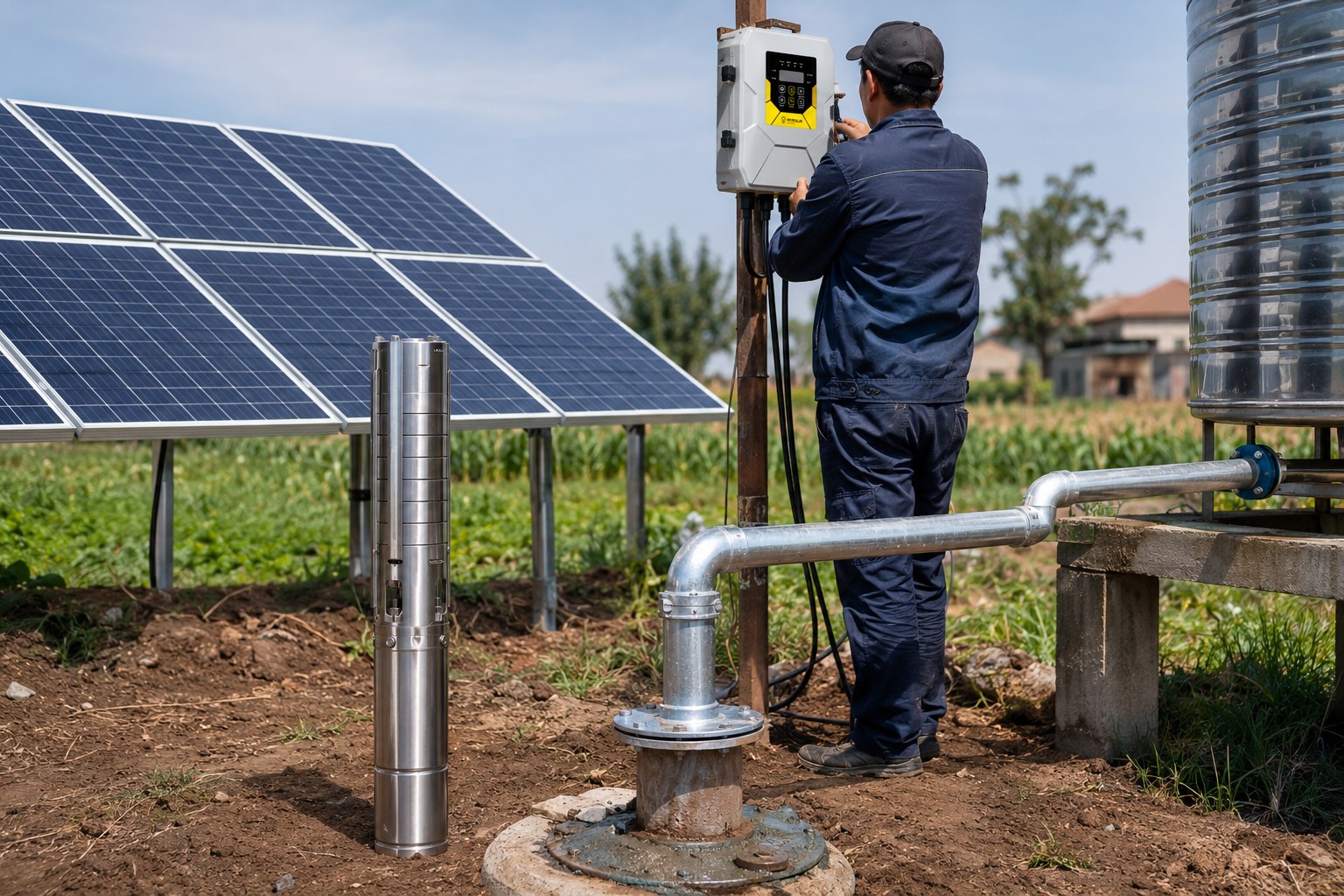
A standard 1 HP solar pump kit includes several essential components.
Key Components in a 1 HP System:
- Solar Pump: The pump itself, which can be a submersible or surface type.
- Motor: A 1 HP motor, often a high-efficiency brushless DC (BLDC) type.
- Solar Panels: A 1kW solar array, typically consisting of three 335W panels.
- Controller: An intelligent device (often with MPPT) that manages power from the panels to the pump.
- Mounting Structure: The frame for installing the solar panels on the ground or a roof.
- Accessories: Includes necessary cables, connectors, pipe fittings, and sensors for dry-run protection.
It's important to note that these prices usually do not include government subsidies.
Many countries and states offer significant subsidies for agricultural solar pumps, sometimes covering up to 90% of the cost.
Always check with your local agricultural or energy agency to see what incentives you are eligible for.
This can dramatically reduce your initial investment.
Choosing the Right Type: Submersible vs. Surface Pumps
Is your water source a deep well or a shallow pond?
Answering this question is the first step in choosing the right pump.
Using the wrong type is inefficient and can damage the equipment.
A submersible pump is designed for deep water sources, like a borehole deeper than 20 meters (65 feet).
For shallow water, such as from a lake, stream, or storage tank, a surface pump is the correct and more economical choice.
The Submersible Solar Pump: For Deep Water Sources
Submersible pumps are built for depth.
They are long, cylindrical, and designed to be fully submerged in the water source.
This design uses the pressure of the water to help push it to the surface, making it very efficient for lifting water from deep underground.
A 1 HP submersible pump is ideal for borewells and deep open wells where the water level is far below the ground.
Within this category, there are different internal mechanisms to consider.
- Solar Screw Pumps: These are excellent for very deep wells and can handle water with some sand content. They provide lower flow but can achieve a very high lift (head).
- Solar Centrifugal Pumps: These use impellers (either plastic or stainless steel) to move water. They offer higher flow rates and are suitable for most residential and agricultural irrigation needs from deep wells.
You also have a choice between DC and AC submersible pumps.
A 1 HP DC Submersible Pump is highly efficient because the DC power from the solar panels can run the motor directly, without conversion losses.
This makes it a preferred choice for off-grid applications where maximizing every bit of sunlight is crucial.
A 1 HP AC Submersible Pump requires an inverter to change the panel's DC power to AC.
While this adds a component and a small efficiency loss (around 3-5%), AC motors are widely available and can sometimes be easier to service.
The Surface Solar Pump: For Shallow Water Transfer
A surface pump is not designed to go in the water.
Instead, it is installed on dry land.
It uses suction to pull water from a nearby source.
This makes it perfect for applications where the water is easy to access.
Use a surface pump for drawing water from ponds, lakes, rivers, or storage tanks.
They are also commonly used to increase water pressure in a system, acting as a booster pump.
The general rule is that surface pumps are effective when the water source is less than 20 meters (65 feet) deep.
Like their submersible counterparts, they come in DC and AC models.
A 1 HP DC Surface Pump offers great efficiency and is simple to install, connecting directly to the solar controller.
It's a robust choice for transferring large volumes of water for irrigation or filling livestock troughs.
A 1 HP AC Surface Pump is often the most affordable entry into solar pumping.
It uses an inverter, but the overall system cost can be lower, making it an attractive option for budget-conscious projects with shallow water sources.
For any 1 HP surface pump system, you will need approximately 60 square feet (about 5.6 square meters) of clear, shadow-free space to install the required 1kW of solar panels.
Understanding Pump Technology: From Screw to Impeller
The pump's exterior tells you if it's for deep or shallow water.
The pump's interior technology determines how it performs.
The internal design dictates its flow rate, pressure, and durability.
A solar screw pump is your specialist for high-lift, low-flow needs in sandy water.
For high-volume irrigation, a plastic impeller pump is a cost-effective workhorse.
For the ultimate in durability against corrosion, the stainless steel impeller pump is the premium choice.
Solar Screw Pump: The Deep Well Specialist
The solar screw pump works differently from most pumps.
It doesn't use impellers.
Instead, it uses a single helical rotor (the screw) that turns inside a rubber stator.
This action creates sealed cavities that move water upward with each rotation.
This mechanism is known as a progressing cavity pump.
It is exceptionally good at creating high pressure.
This means it can lift water from extreme depths, often exceeding 100 meters, even with a small 1 HP motor.
The main trade-off is flow rate, which is lower compared to centrifugal pumps.
Its key advantage is its incredible resistance to abrasion.
The rubber stator and steel screw can handle water with a higher concentration of sand and silt without damage.
This makes it the perfect solution for newly drilled wells or areas with challenging water quality.
Solar Plastic Impeller Pump: The High-Flow Workhorse
This is the most common type of centrifugal pump.
It uses a series of stacked impellers made from engineered, wear-resistant plastic.
As the impellers spin at high speed, they throw water outward, creating pressure that moves it up the pipe.
Each stage (impeller and diffuser) adds more pressure, increasing the total head the pump can achieve.
The primary advantage of plastic impeller pumps is their ability to deliver a high flow rate.
This makes them ideal for flood irrigation, filling large storage tanks quickly, and other applications where water volume is more important than extreme pressure.
They are lightweight and significantly more cost-effective to produce than their stainless steel counterparts.
Modern engineering plastics offer good durability and resistance to fine sand.
However, they are not recommended for highly corrosive water or in applications where the highest possible durability is the main concern.
Solar Stainless Steel Impeller Pump: The Premium Choice
This pump operates on the same centrifugal principle as the plastic impeller pump.
The critical difference is the material.
Both the impellers and the pump housing are made from SS304 or even higher-grade SS316 stainless steel.
This construction provides superior durability and, most importantly, excellent corrosion resistance.
It is the best choice for pumping water that is acidic, alkaline, or has high salinity.
These conditions can quickly degrade plastic or cast-iron components.
The stainless steel impeller pump is built for longevity in the toughest water environments.
It ensures water purity, making it suitable for drinking water systems.
While it represents a higher initial investment, its extended service life and reliability in harsh conditions often result in a lower total cost of ownership over the long term.
| Pump Internal Type | Flow Rate | Head (Lift) | Sand Resistance | Corrosion Resistance | Primary Application |
|---|---|---|---|---|---|
| Screw Pump | Low | Very High | Excellent | Good | Deep wells (>80m), sandy water, livestock |
| Plastic Impeller | High | Medium | Good (fine sand) | Fair | General farm irrigation, tank filling |
| Stainless Steel Impeller | High | Medium-High | Fair | Excellent | Corrosive water, drinking water supply |
The Power Behind the Pump: Motor and Controller Technology
A pump is just a tool.
The motor and controller bring that tool to life.
They are the heart and brain of the entire solar pumping system.
Their efficiency and intelligence determine how much water you get from the sun.
Modern solar pumps use advanced Brushless DC (BLDC) motors that are over 90% efficient.
They are paired with MPPT controllers that can boost water output by 30%, ensuring you get the most from every solar panel.
The motor is the engine that drives the pump.
Traditional pumps often use AC induction motors or brushed DC motors.
Modern solar pumps have moved to a superior technology: the Brushless DC (BLDC) permanent magnet motor.
This is a major leap forward.
Instead of brushes that wear out, they use electronics to control the motor, making them virtually maintenance-free.
The rotor is built with powerful permanent magnets, often made from neodymium iron boron.
This design leads to several key benefits:
- High Efficiency: BLDC motors convert over 90% of the electrical energy into mechanical power. A typical AC motor might be 60-70% efficient. This means a BLDC motor needs up to 20-30% less power (and fewer solar panels) to do the same work.
- High Torque: They deliver strong torque even at low speeds. This allows the pump to start reliably early in the morning, late in the afternoon, or on cloudy days.
- Compact and Lightweight: With no brushes and a more efficient design, BLDC motors can be up to 40% smaller and lighter than traditional motors of the same power rating. This simplifies installation, especially for deep well pumps.
- Long Service Life: With no brushes to replace, the motor's lifespan is limited only by its bearings, which are designed to last for more than a decade.
The MPPT Controller: The Intelligent Brain
If the motor is the heart, the controller is the brain.
It manages the flow of power from the solar panels to the motor.
The most important feature of a modern solar pump controller is Maximum Power Point Tracking (MPPT).
Solar panels have a unique voltage and current at which they produce the most power.
This "maximum power point" changes throughout the day with the angle of the sun and cloud cover.
An MPPT controller constantly monitors the solar panels and adjusts the electrical load to ensure the motor is always receiving the maximum available power.
Compared to a basic controller, MPPT technology can increase the total volume of water pumped per day by as much as 30%.
The controller also serves as a critical safety device, providing protections for both the motor and the pump against:
- Over-current and over-voltage
- Dry running (operating without water)
- Overheating
- Reverse polarity
Exploring Advanced Controller Options
Beyond standard MPPT, advanced controllers offer even more flexibility.
One of the most valuable innovations is the hybrid AC/DC controller.
This smart device can accept power from both the solar panels (DC) and the electrical grid or a generator (AC).
The controller is programmed to prioritize solar power.
It will run the pump using 100% solar energy whenever possible.
If the sunlight is weak, its hybrid function can blend AC power with the available DC power to maintain the pump's operation.
When there is no sunlight, like at night or on very rainy days, it can automatically switch over completely to the AC source.
This ensures you have a reliable water supply 24/7, without having to manually switch power sources.
This technology gives you the best of both worlds: the free energy of the sun and the constant reliability of the grid, all in one automated system.
Conclusion
The true cost of a 1 hp solar pump is not just its price tag.
It's the value it delivers over years of service.
By matching the right pump type and technology to your specific water source and needs, you secure a reliable, cost-effective, and sustainable water supply for the future.
FAQs
How many solar panels are needed for a 1 hp pump?
A 1 hp pump typically requires 1,000 watts (1kW) of solar panels.
This is often achieved using three 335-watt panels or a similar configuration.
How deep can a 1 hp solar pump lift water?
This depends on the pump type.
A 1 hp centrifugal pump can lift water up to 50 meters, while a 1 hp screw pump can exceed 100 meters.
Can a solar pump run without a battery?
Yes, the vast majority of solar water pumps are designed to run directly from solar panels during the day without any batteries, simplifying the system and reducing cost.
How long do solar water pumps last?
The solar panels have a 25-year performance warranty.
The pump and high-quality BLDC motor are designed for a service life of over 10 years with minimal maintenance.
What is the daily water output of a 1hp solar pump?
It varies greatly with sunlight and head, but a typical range is from 6,000 to over 38,000 liters per day.
More sun and lower lift result in more water.
Can I use my existing water pump with solar panels?
Yes, in many cases.
By installing a device called a Variable Frequency Drive (VFD), you can power an existing AC pump with DC solar panels.