Running out of water in a remote location is a serious problem.
You need a reliable water source, but extending the power grid is expensive or impossible.
Solar water pumps offer an independent, cost-effective solution for your water needs.
Modern solar water pumps can push water from extraordinary depths, reaching up to 1400 feet (about 427 meters) of total pumping head. This capability is comparable to some of the most powerful conventional AC-powered pumps on the market, making them suitable for a vast range of applications.
This remarkable performance has changed the game for agriculture, livestock, and domestic water supply in off-grid areas.
While 1400 feet represents the upper limit, most real-world applications fall into a more common range.
Understanding the technology behind these pumps and the different types available is crucial.
It helps you select a system that provides a reliable water supply for years to come.
Let's explore how high these pumps can go, how they work, and which type is right for you.
How High Can Water Be Pumped?
You might think solar pumps are only for shallow wells, with limited power.
This misconception comes from older, less efficient technologies that struggled to pump water more than 100 feet.
Today's technology tells a very different story, offering powerful solutions for deep wells.
*Modern solar pumps can lift water from depths up to 1400 feet. While most systems we see are for wells between 50 and 300 feet deep, advanced options are available for even the most extreme depths, ensuring a solution exists for nearly any well.
Dive Deeper: Understanding Pumping Height and Modern Capabilities
The maximum height a pump can push water is one of its most critical specifications.
This is technically known as "total dynamic head."
It's not just about the depth of your well.
It includes the vertical distance from the water level in the well to the highest point of delivery, plus any pressure needed at the outlet and friction loss in the pipes.
Modern advancements have dramatically increased this capability by over 1300% compared to early models.
What Exactly is 'Pumping Head'?
Pumping head is the total equivalent height that a fluid is to be pumped, taking into account friction losses in the pipe.
It's measured in feet or meters.
There are two main components:
- Static Head: This is the total vertical distance from the pumping water level in the well to the final destination, like the top of a storage tank.
- Friction Head: As water moves through pipes and fittings, it encounters resistance, or friction. This resistance creates back pressure, which the pump must overcome. This is the friction head.
The pump's required head is the sum of the static head and the friction head.
A pump must be powerful enough to overcome both to deliver water effectively.
Common vs. Extreme Pumping Depths
While solar pumps can reach 1400 feet, the majority of systems are designed for more common depths.
Choosing the right pump means matching its capabilities to your specific well depth and water needs.
A system designed for 1000 feet will be oversized and inefficient for a 150-foot well.
| Application Type | Typical Pumping Head (Feet) | Typical Pumping Head (Meters) | Use Case Examples |
|---|---|---|---|
| Common Residential | 50 - 200 ft | 15 - 60 m | Supplying a single home, garden irrigation. |
| Common Agricultural | 150 - 400 ft | 45 - 122 m | Livestock watering, small-scale crop irrigation. |
| Deep Well / Extreme | 400 - 1400 ft | 122 - 427 m | Deep aquifer access, remote community water supply. |
Factors That Determine Maximum Pumping Height
Several key technological components work together to achieve these impressive depths.
The leap to 1400 feet wasn't from a single invention but from the synergy of an entire system.
- High-Efficiency Motors: Modern pumps use brushless DC (BLDC) motors that can be over 90% efficient, converting more electrical energy into pumping power.
- Advanced Pump Ends: The design of the pump itself, whether a screw or centrifugal impeller type, is optimized for high-pressure, deep-well applications.
- Powerful Solar Panels: The cost of solar panels has dropped while their efficiency has increased, allowing for larger, more powerful arrays that can drive a pump motor all day.
- Intelligent Controllers: Modern controllers use Maximum Power Point Tracking (MPPT) to constantly optimize the power drawn from the solar panels, squeezing every available watt to run the pump, even in lower light.
Together, these advancements mean that the old limits of 50-100 feet are a distant memory.
Solar Pumping Explained: What Are Solar Pumps & How They Work?
You need a dependable water source where there's no power grid.
Relying on manual labor or expensive, polluting diesel generators is a major challenge.
Solar pumps provide an automated, clean, and cost-effective alternative by harnessing the power of the sun.
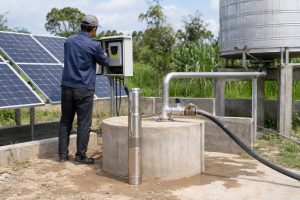
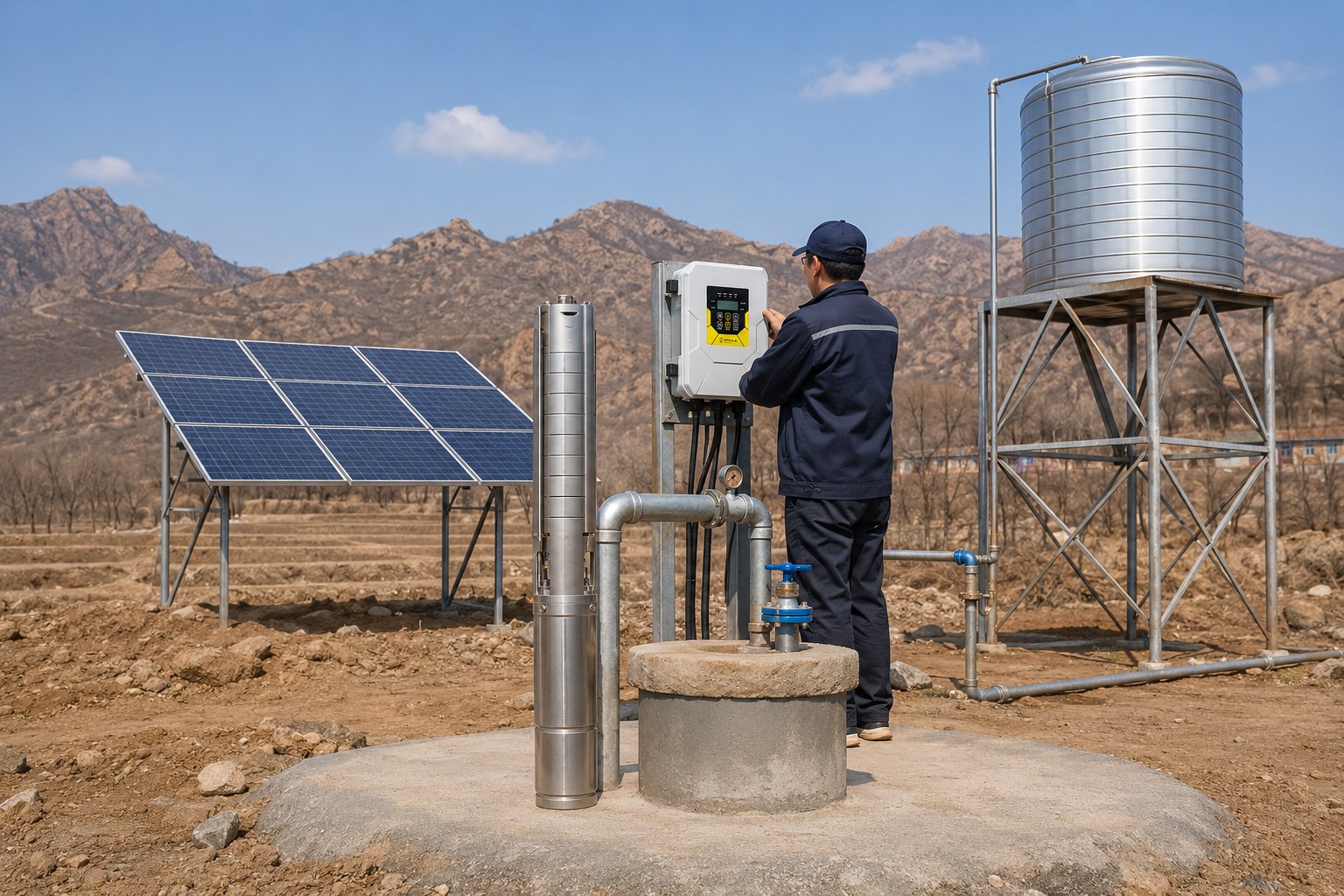
A solar-powered water pump system uses photovoltaic (PV) panels to capture sunlight and convert it into DC electricity. This electricity powers a motor, which in turn drives a pump to move water from a source like a well, river, or lake to where it's needed.
Dive Deeper: The Components and Technology Behind Solar Pumping
At its core, a solar pump is a beautifully simple concept.
It transforms sunlight into the mechanical energy needed to move water.
However, the efficiency and reliability of modern systems come from the sophisticated components working in concert.
Understanding these parts helps you appreciate the system's power and durability.
The Core Components of a Solar Pumping System
Every solar pumping system, regardless of its size or power, consists of a few essential parts.
- Solar Panels: These are the system's power source. They are made of photovoltaic (PV) cells that generate direct current (DC) electricity when exposed to sunlight.
- Pump Controller: This is the brain of the system. It manages the power from the solar panels, protects the motor from electrical issues, and often includes features like low-water sensors and Maximum Power Point Tracking (MPPT) to maximize water output.
- Pump and Motor Unit: This is the heart of the system. The motor, powered by the controller, drives the pump. The pump is the mechanical part that physically moves the water. It is typically submerged deep in the well.
- Piping and Wiring: These components transport the electricity from the panels to the pump and the water from the pump to its destination.
The Engine of Efficiency: The BLDC Permanent Magnet Motor
The single biggest leap in solar pump performance came from motor technology.
Most high-end solar pumps today use a Brushless DC (BLDC) permanent magnet motor.
These are not the same motors you'd find in a typical household appliance.
They are engineered for extreme efficiency, often exceeding 90%.
This means more than 90% of the electricity from the solar panels is converted into rotational force to pump water.
By contrast, older brushed motors or standard AC motors are significantly less efficient.
| Motor Feature | BLDC Permanent Magnet Motor | Conventional Brushed/AC Motor |
|---|---|---|
| Efficiency | > 90% | 60% - 75% |
| Lifespan | Very Long (no brushes to wear out) | Shorter (brushes need replacement) |
| Maintenance | Virtually Maintenance-Free | Requires regular maintenance |
| Size & Weight | Compact and light (up to 47% smaller) | Larger and heavier |
| Performance | High torque, consistent power | Variable, less effective in low light |
This high efficiency is crucial.
It means you need fewer solar panels to achieve the same water output, reducing the system's overall cost and footprint.
The use of powerful rare-earth magnets, like neodymium iron boron, gives these motors incredible torque in a compact size, making them lighter and easier to install.
Choosing the Right Pump: A Guide to Solar Deep Well Pump Types
You know a solar pump can meet your depth needs, but which one is right?
Choosing the wrong pump type can lead to poor performance, premature failure, and wasted investment.
The key is to match the pump's design to your specific water source and application.
For deep wells, there are three main types. Solar screw pumps are ideal for very high lift with lower flow. Plastic impeller pumps provide high flow and are wear-resistant. Stainless steel impeller pumps offer premium corrosion resistance for harsh water conditions.
Dive Deeper: Matching the Pump to Your Water Needs
The pump itself, often called the "pump end," is the part that does the physical work.
It sits at the bottom of the motor in the well.
Its design determines the pump's flow rate and pressure (head) characteristics.
Let's break down the three most popular types of solar deep-well pumps to help you decide.
Solar Screw Pump: The High-Head Specialist
The solar screw pump, also known as a progressing cavity pump, works differently from most pumps.
It uses a single helical-shaped stainless steel screw that rotates inside a rubber stator.
This action creates sealed cavities that "push" water upward.
- Best For: Very deep wells where you need to lift water from great depths (high head), but don't need a massive amount of water per minute (low flow).
- Applications: Domestic water supply for homes, filling livestock drinking troughs, and small-scale drip irrigation.
- Advantages: Excellent high-lift capability. Highly resistant to sand and grit, as the rubber stator can handle abrasive particles better than impellers.
Solar Plastic Impeller Pump: The High-Flow Workhorse
This is a type of multi-stage centrifugal pump.
It uses a series of stacked impellers, or spinning disks, to move water.
As water passes through each stage, its pressure increases.
Modern versions use durable, engineered plastics for the impellers.
- Best For: Applications that require a high volume of water at a medium head.
- Applications: Farm irrigation, pasture water supply, filling large ponds or tanks, and residential use with high water demand.
- Advantages: Delivers high flow rates. Excellent resistance to fine sand. Lightweight and more economical than stainless steel models.
Solar Stainless Steel Impeller Pump: The Premium Durability Choice
This pump is structurally similar to the plastic impeller model but uses a higher-grade material.
The impellers, diffusers, and pump body are all made from corrosion-resistant stainless steel, typically SS304.
- Best For: Environments with corrosive water or for users who demand the longest possible service life.
- Applications: Water sources with acidic or alkaline conditions, regions with alkaline soils, and high-end residential or commercial properties.
- Advantages: Superior corrosion resistance. Extremely long service life and high reliability. Maintains efficiency over many years.
At-a-Glance Pump Comparison
Choosing the right model is a balance of performance, durability, and cost.
| Feature | Solar Screw Pump | Solar Plastic Impeller Pump | Solar Stainless Steel Impeller Pump |
|---|---|---|---|
| Primary Strength | High Head (Lift) | High Flow Rate | High Durability & Corrosion Resistance |
| Flow Rate | Low to Medium | High | High |
| Head (Lift) | Very High | Medium | Medium to High |
| Sand Resistance | Excellent | Good (for fine sand) | Moderate |
| Best Application | Deep domestic wells | Farm irrigation, high-volume needs | Corrosive water, premium applications |
| Relative Cost | Moderate | Economical | Premium |
Ultimately, the entire system is powered by a high-efficiency BLDC motor and managed by an intelligent MPPT controller.
This combination ensures that whichever pump end you choose, you are getting the most water possible from the available sunlight.
How To Use A Solar Water Pump 24 Hours A Day
The sun provides free energy, but it doesn't shine at night.
Your water needs for livestock, irrigation, or your home don't stop when the sun sets.
This creates a dilemma: how do you ensure a constant water supply from a solar-powered system?
To get water 24/7, you have three main options. The best method is storing water in an elevated tank. You can also add batteries to shift pumping time to the evening, or use a hybrid AC/DC controller that automatically switches to generator or grid power at night.
Dive Deeper: Strategies for Around-the-Clock Water Access
A solar water pump's primary job is to run when the sun is shining.
Extending its utility into the night requires planning and some additional components.
The right strategy for you depends on your specific needs, location, and budget.
Let's explore the three effective methods.
Option 1: Store the Water, Not the Power
This is the simplest, most reliable, and most recommended method for 24-hour water access.
The concept is easy.
During the day, the solar pump works to fill a large storage tank.
The tank is typically placed on high ground or a tower.
At night, you get your water from the tank using gravity.
- How it works: The pump over-produces water during peak sun hours, storing the excess for later. A float switch in the tank can automatically turn the pump off when the tank is full, and turn it back on when the water level drops.
- Advantages: Extremely reliable with no complex electronics. The "battery" is the tank of water. It's the most cost-effective solution for long-term 24/7 access. Gravity provides natural water pressure.
Option 2: Shift Pumping Time with Batteries
If a large storage tank isn't feasible, batteries are another option.
However, it's important to understand what batteries do.
Adding batteries does not magically create more pumping hours in a day.
A standard system provides about 6 hours of pumping on a sunny day.
Batteries allow you to store that solar energy and use those 6 hours of pumping time whenever you want, including in the evening.
If you need to pump for a significant portion of the day and store power for the night, you must add extra solar panels to your system.
These extra panels are dedicated to charging the batteries while the primary panels run the pump.
Option 3: The Best of Both Worlds - The Hybrid AC/DC System
For ultimate flexibility and worry-free operation, a hybrid system is the superior choice.
These systems use a special controller that can accept both DC power from solar panels and AC power from the utility grid or a generator.
- How it works: The intelligent controller prioritizes solar power. During the day, it runs the pump entirely on free solar energy. As the sun fades, it can blend AC power with solar power to keep the pump running. When there is no solar input at night, it will automatically switch to AC power to ensure the pump can run anytime.
- Advantages: This provides a truly uninterrupted water supply. You maximize savings by using solar whenever possible but have the reliability of a backup power source. It's an automated, hands-off solution that ensures you never run out of water due to a cloudy day or nighttime needs.
Conclusion
Modern solar water pumps are powerful, versatile, and reliable.
With the right pump type, a high-efficiency motor, and a smart controller, you can secure a water supply in almost any location.
FAQs
Can a solar pump fill a water tank?
Yes, this is one of their most common and effective uses. A float switch can be added to the tank to automatically stop the pump when it's full.
How long do solar water pumps last?
Solar panels can last over 25 years. The brushless motors and pump ends are designed for many years of use with minimal maintenance, often lasting over a decade.
Do solar pumps work on cloudy days?
Yes, but at a reduced flow rate. Systems with MPPT controllers are much better at utilizing the limited power available on overcast days to continue pumping water.
What size solar pump do I need?
This depends on your daily water requirement (gallons per day), the total pumping head (depth + elevation), and your geographic location (amount of sunlight).
Can a solar pump run a whole house?
Yes, a properly sized solar pump system, usually paired with a storage tank and a pressure pump, can provide all the water needed for a typical household.
How much does a solar water pump system cost?
The cost varies widely based on depth and flow requirements. While the initial investment is higher than a simple AC pump, the long-term savings on electricity or fuel are substantial.
Are solar water pumps hard to install?
No, they are designed for simplicity. With fewer components than a generator-powered system, they can often be installed by local technicians or capable individuals without specialized engineering.
Is a bigger solar panel always better for a pump?
Not necessarily. The solar panel array must be correctly sized to match the voltage and current requirements of the pump's motor and controller to ensure efficiency and prevent damage.