Your pump system is acting up, and you suspect the water pump is failing.
This could mean costly downtime and repairs.
But what if the pump isn't the real problem at all?
A seemingly bad water pump is often a misdiagnosis of another, simpler issue.
Problems like a faulty thermostat, an airlock in the lines, a slipping drive belt, or even an electrical issue can mimic the symptoms of pump failure.
Identifying the true culprit can save significant time and money.
Before you commit to a costly pump replacement, it's essential to investigate other potential causes.
Many components within a cooling or water transfer system are interconnected.
A failure in one part can easily create symptoms that point to another.
Understanding these common look-alikes is the first step toward an accurate and efficient solution.
Let's explore the issues that are frequently mistaken for a bad water pump.
Is It a Leak or Something More?
You've discovered a puddle of fluid under your equipment.
The immediate assumption is a catastrophic pump failure.
But a leak is a symptom, not a diagnosis, and it doesn't always point back to the pump itself.
A fluid leak does not automatically mean the water pump has failed.
It can often originate from a less expensive component, such as a cracked hose, a loose clamp, or a degraded gasket somewhere else in the system.
Properly tracing the leak is crucial before ordering a replacement pump.
Tracing the Leak's Origin
The first step in diagnosing a leak is to clean the area thoroughly.
Years of accumulated grime can obscure the true source.
Once the pump and surrounding components are clean, operate the system and watch for the first sign of fresh fluid.
Leaks often start small and run downwards due to gravity.
A trail of white, crusty residue, sometimes tinged with the color of the coolant, indicates a slow leak that has been evaporating on hot surfaces.
This can make tracing more difficult but also confirms the leak has been present for some time.
Use a flashlight and a mirror to inspect hard-to-see areas around the pump housing, hoses, and connections.
Gasket Failure vs. Shaft Seal Failure
It's important to differentiate between the types of seals associated with a water pump.
The pump has a main gasket or seal that mates it to the engine block or motor housing.
It also has an internal shaft seal.
-
Gasket Leak: If the gasket between the pump and the mounting surface fails, you will see fluid seeping from the edges of the pump's base.
This can be caused by old age, improper installation, or system overheating.
In some cases, simply replacing this gasket—a much cheaper part—can solve the problem. -
Shaft Seal Leak: A leak from the "weep hole" or from behind the pulley is a definitive sign of internal pump failure.
This weep hole is a safety feature designed to allow fluid to escape when the internal shaft seal fails, preventing it from damaging the pump's bearings.
A leak from here means the pump itself must be replaced.
| Leak Location | Potential Cause | Recommended Action |
|---|---|---|
| Around the pump's mounting base | Failed mounting gasket, loose bolts | Tighten bolts, replace gasket |
| From the weep hole or behind the pulley | Internal shaft seal failure | Replace the entire water pump |
| From a connected hose | Cracked hose, loose clamp | Replace hose, tighten/replace clamp |
| Seemingly random location on engine | Pinhole leak in another component | Thoroughly inspect entire system |
The Overlooked Role of Corrosion
Corrosion is a silent killer in any fluid system.
Using the wrong type of coolant or mixing it with tap water can accelerate corrosion by over 50%.
This corrosive action doesn't just affect the pump.
It can eat away at metal pipes, hose fittings, and even the radiator or heat exchanger.
Visible rust or buildup on the pump's exterior, especially around the pulley, can indicate that the system has been compromised by corrosion.
This corrosion can create pinhole leaks in other components that are easily mistaken for a pump leak, leading to a frustrating and incorrect diagnosis.
Why Is My System Overheating?
An overheating warning is one of the most alarming signals a system can produce.
The water pump is responsible for circulation, so it's naturally the first suspect.
You fear a complete system meltdown is imminent.
But several other malfunctions can stop circulation and cause a dangerous temperature spike.
Overheating is a critical symptom but is not exclusively caused by the water pump.
A stuck thermostat accounts for over 30% of overheating incidents mistaken for pump failure.
Other causes include airlocks, low fluid levels, or blockages that restrict flow, all of which must be ruled out.
The Faulty Thermostat: A Common Imposter
The thermostat is a valve that controls the flow of coolant based on temperature.
It's designed to help the system warm up quickly and then maintain an optimal operating temperature.
It can fail in two ways, both of which can be mistaken for pump failure.
-
Stuck Closed: If the thermostat fails to open, it traps coolant within the engine block or initial loop.
The pump may be working perfectly, but it cannot push the coolant to the radiator or heat exchanger to be cooled.
This causes a rapid and dangerous temperature rise.
A simple test is to feel the inlet and outlet hoses of the radiator (with caution); if one is hot and the other is cold, the thermostat is likely stuck closed. -
Stuck Open: While less dangerous, a thermostat stuck open can also cause confusion.
The system will take much longer to reach operating temperature, and in cold weather, it may never get warm enough.
This can affect performance and efficiency.
The Hidden Danger of Airlocks
An airlock is a bubble of trapped air in the cooling system that physically blocks the flow of fluid.
Even a powerful water pump cannot push fluid through a large pocket of air.
This creates the exact same symptom as a failed pump: no circulation and rapid overheating.
Airlocks are commonly introduced after the system has been drained and refilled, for example, after replacing a hose or changing the coolant.
If your overheating problem started immediately after a recent service, an airlock is a very likely culprit.
Properly "burping" or bleeding the system according to the manufacturer's procedure is essential to remove all trapped air.
Simple Checks Before Complex Repairs
Before condemning the water pump, perform these simple checks.
| Symptom | Potential Non-Pump Cause | How to Check |
|---|---|---|
| Rapid Overheating | Stuck Thermostat | Check for temperature difference between radiator hoses. |
| Overheating After Service | Airlock in System | Perform system bleeding procedure. |
| Gradual Overheating | Low Coolant/Fluid Level | Check reservoir and radiator (when cool). |
| Overheating Under Load | Clogged Radiator/Heat Exchanger | Inspect fins for debris; consider a system flush. |
Low fluid level is another common and easily overlooked cause.
A pump cannot move fluid that isn't there.
A slow leak may have reduced the fluid level over time to a point where circulation is compromised, causing the system to overheat.
Always check the fluid level in the reservoir and radiator (only when the system is cool) before assuming a major component has failed.
What's That Squealing or Whining Noise?
A new, unnerving noise from your equipment is always cause for concern.
High-pitched squeals or whines often get blamed on the water pump's bearings or motor.
This can sound like an expensive repair waiting to happen.
However, the source of the sound might be a much simpler and cheaper fix.
A squealing or whining noise is frequently misattributed to a failing water pump.
In over 60% of such cases, the noise is actually caused by a loose or worn drive belt slipping on the pulley.
A misaligned pulley or external corrosion can also produce similar sounds.
Decoding the Sounds: Squeal vs. Whine vs. Grind
Different noises point to different problems.
Learning to distinguish between them is key to an accurate diagnosis.
-
A High-Pitched Squeal: This noise is almost always related to the drive belt.
It's a sound of rubber slipping against a metal pulley.
The squeal will often change in pitch or frequency with engine RPMs and may be worse on cold starts or in damp weather.
It can be caused by a worn-out belt that has become glazed and hard, or a belt tensioner that is no longer providing adequate pressure.
A simple spray of water on the belt can temporarily quiet the noise, confirming the belt is the issue. -
A Persistent Whine: A steady whining noise that rises and falls with RPMs often points to a bearing issue.
However, it may not be the water pump's bearing.
Other components driven by the same belt, like the alternator or an idler pulley, have bearings that can fail and produce a similar sound.
A mechanic's stethoscope is the best tool to isolate the exact source of the whine. -
A Deep Grinding or Rumbling: This is the most serious sound.
A low-pitched grinding or rumbling noise that you can sometimes feel as a vibration is a classic sign of a severely failed water pump bearing.
The shaft will have excessive play, causing the internal impeller to scrape against the pump housing.
If you hear this sound, stop the system immediately to prevent further damage.
The Problem with the Pulley
The water pump pulley itself can be the source of noise.
It's not just a simple wheel; its condition is critical.
| Noise Type | Common Cause | Simple Test |
|---|---|---|
| High-Pitched Squeal | Slipping Drive Belt | Spray water on the belt; if noise stops, it's the belt. |
| Rhythmic Chirp | Belt Misalignment / Worn Pulley | Visually inspect belt tracking and pulley for wobble. |
| Steady Whine | Failing Bearing (Pump or other) | Use a stethoscope to pinpoint the noisy component. |
| Grinding/Rumbling | Catastrophic Pump Bearing Failure | Check for pulley wobble (engine off); immediate shutdown required. |
A pulley can become damaged, especially on older equipment.
Rust can build up, creating an uneven surface that chews up belts and causes noise.
The pulley can also crack or bend, causing it to wobble as it rotates.
With the engine off and cool, grab the water pump pulley and try to wiggle it.
Any side-to-side or in-and-out movement indicates a worn bearing and a failing pump.
However, if the pulley is solid but the belt looks worn or loose, you've likely found your noise problem, and it's not the pump itself.
Is It the Pump or the Power Source?
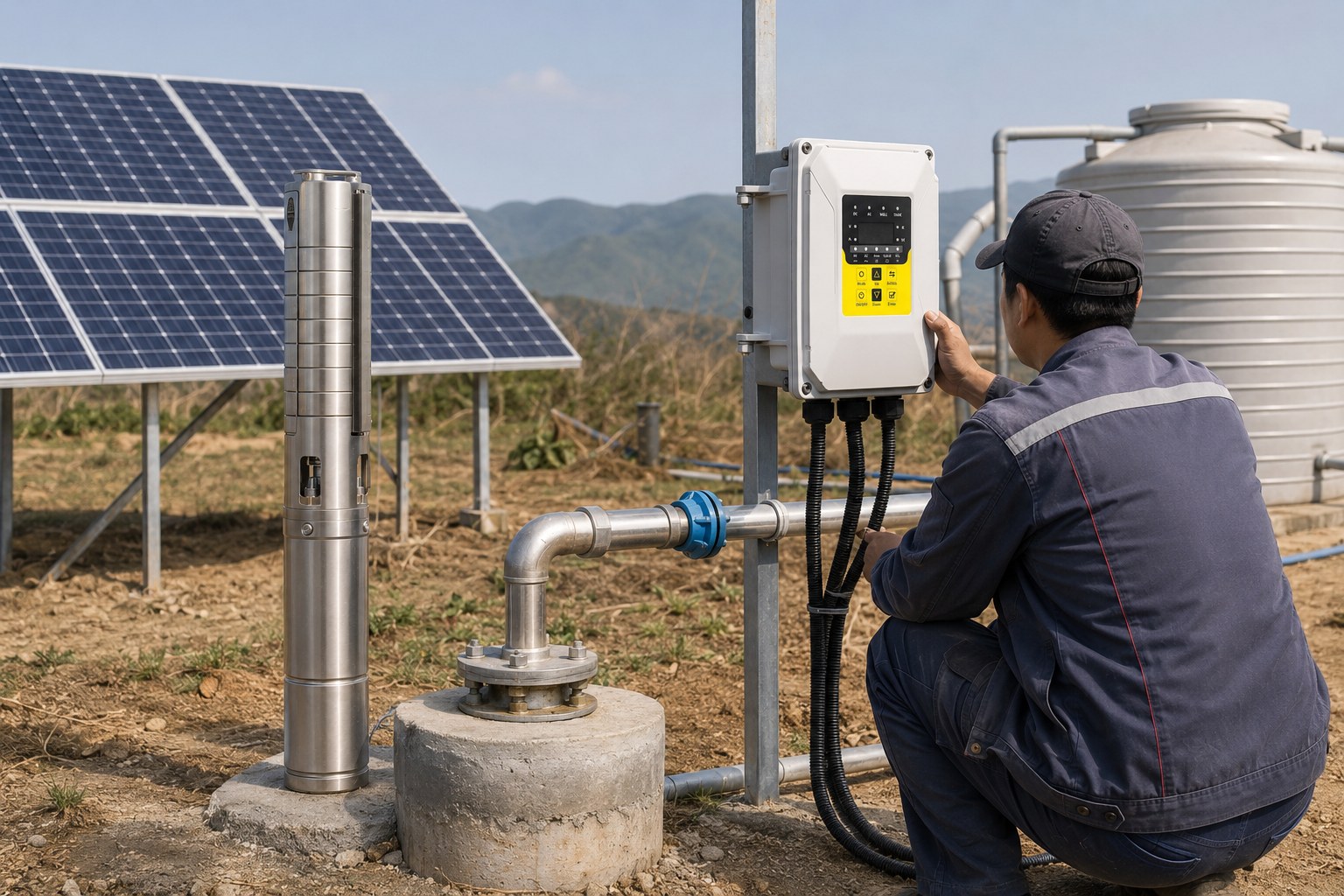
Your electric or solar-powered pump has stopped working.
The silence is deafening, and you assume the pump motor has burned out.
This is a common assumption for systems that rely on an external power source.
But what if the problem isn't with the pump at all, but with the power getting to it?
For electric and especially solar pumps, a lack of operation is often mistaken for pump failure.
In reality, the issue is frequently upstream.
A faulty controller, insufficient power from solar panels, or a simple wiring problem accounts for over 40% of "dead pump" service calls.
The Controller: The Brains of the Operation
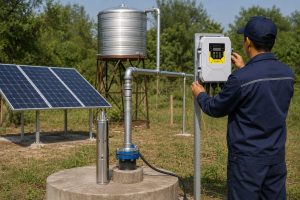
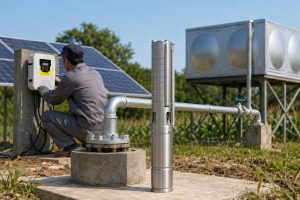
In modern pump systems, especially solar-powered ones, a controller is the critical link between the power source and the pump motor.
This is often an MPPT (Maximum Power Point Tracking) controller.
Its job is to manage the variable power from solar panels and deliver it to the pump in the most efficient way possible.
If this controller fails, the pump is dead in the water, even if the motor is in perfect condition.
A failed controller can exhibit symptoms like no output, erratic pump behavior, or displaying fault codes.
Before condemning a high-efficiency BLDC motor, which has a very long service life, always test the input and output of the controller.
Some advanced systems use AC/DC hybrid controllers, allowing them to switch to grid power when solar is unavailable.
If the pump runs on AC but not DC, the problem is almost certainly with the solar array or the DC side of the controller, not the pump.
Not Enough Juice: The Power Supply Problem
A pump can only work as hard as the power it receives.
This is especially true for solar pumps.
- Dirty Panels: A layer of dust, pollen, or bird droppings can reduce a solar panel's output by up to 30%, which may not be enough to start or run the pump.
- Shading: Even partial shading on a single panel can dramatically reduce the output of the entire array.
- Degradation: Over many years, solar panels slowly lose efficiency.
- Wiring Issues: A loose connection, a corroded terminal, or a damaged wire can prevent full power from reaching the controller.
A simple voltage and amperage check at the controller's input terminals can quickly tell you if the problem is with the power supply or the pump system itself.
The Motor-Controller Relationship
Modern solar pumps often use highly efficient BLDC (Brushless DC) permanent magnet motors.
These motors boast efficiencies over 90% and are significantly more compact and durable than traditional motors.
However, they are not simple devices.
They rely on the controller to provide a precise sequence of electrical pulses to operate.
If the signal from the controller is weak, erratic, or nonexistent, the motor will not run correctly, or at all.
This interdependence means you cannot diagnose the motor without first verifying the controller's function.
| Symptom (Solar Pump) | Potential Electrical Cause | Diagnostic Step |
|---|---|---|
| Pump not running at all | No power from panels; Failed controller | Check panel voltage/amperage; Check controller for fault lights. |
| Pump starts and stops | Insufficient sunlight; Intermittent wiring issue | Check for shading/dirty panels; Inspect all wiring connections. |
| Pump runs slow | Low light conditions; Panel degradation | Measure panel output vs. specifications. |
| Controller is on, no pump action | Failed controller output; Damaged wire to pump | Test for voltage at the controller's output terminals. |
So, before you start the difficult work of pulling a pump from a deep well, always start your diagnosis at the power source.
Check the panels, inspect the wiring, and test the controller.
Often, the "bad pump" is just a pump that's starved for power.
Conclusion
Diagnosing a "bad" water pump requires looking beyond the pump itself.
A methodical approach that checks for leaks, overheating causes, strange noises, and power supply issues first can prevent a costly and unnecessary replacement.
FAQs
How do I know if my thermostat or water pump is bad?
If the engine overheats quickly but the radiator stays cool, it's likely a stuck thermostat.
A grinding noise or a leak from the pump's weep hole points to a bad water pump.
Can a bad belt make it seem like the water pump is bad?
Yes.
A slipping belt can cause a loud squeal and may not turn the pump pulley effectively, leading to overheating, mimicking a pump failure.
What sound does a failing water pump make?
A failing water pump often makes a low-pitched grinding or rumbling noise, indicating the internal bearings are gone.
A high-pitched whine can also be an early sign.
Can a clogged radiator cause water pump symptoms?
Yes.
A clogged radiator restricts coolant flow, which will cause the engine to overheat even if the water pump is working perfectly.
How can you tell if your water pump is working?
With the engine running and warm, you should see coolant circulating in the radiator or feel the gentle vibration of fluid moving through the upper radiator hose.
When replacing a water pump, what else should you replace?
It's wise to also replace the thermostat, drive belts, and any hoses that feel soft or look cracked, as they are inexpensive and accessible during the job.
Can low coolant cause a whining noise?
Yes, in some cases.
If the coolant is very low, the pump can cavitate (try to pump air), which can cause a whining or gurgling sound.
Will a bad water pump always leak?
Not always.
A pump can fail internally—such as a bearing seizure or a broken impeller—without any external leak, leading to overheating as the only initial symptom.