Struggling with water access in off-grid areas?
High electricity bills and unreliable power grids can halt your water supply, impacting farms and homes.
A 4-stage pump is a type of multi-stage centrifugal pump. It uses four impellers stacked in series to progressively build pressure. This allows it to lift water from greater depths or push it over longer distances compared to single-stage pumps.
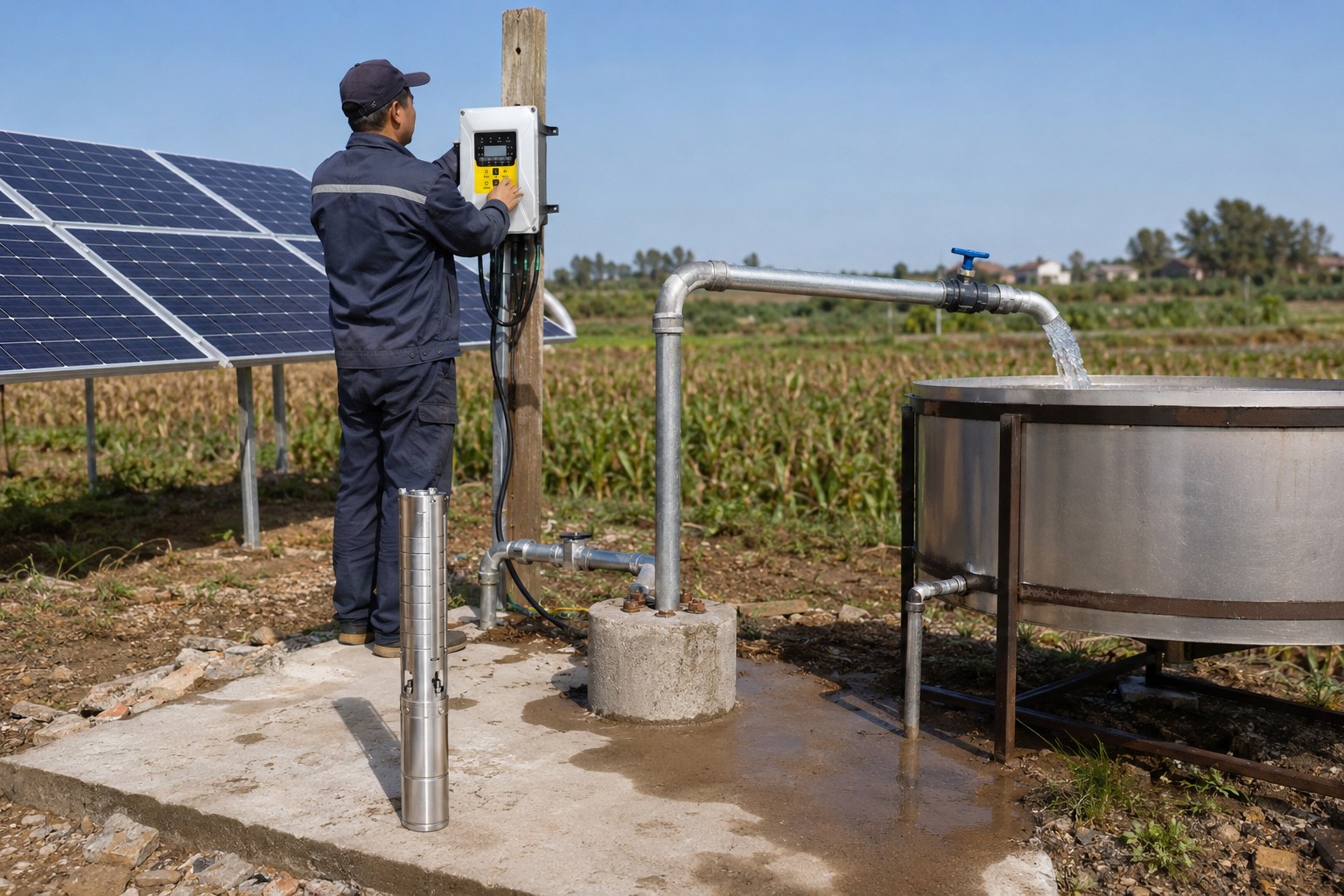
Understanding what a 4-stage pump is opens the door to a world of specialized water solutions.
But is it always the right choice for your needs?
Let's explore the different types of solar pumps, including multi-stage designs, to find the perfect fit for any application.
This guide will help you understand the technology so you can make an informed decision.
Can I Really Install a Solar Pump Myself?
Worried about complex installations?
The thought of hiring expensive installers and dealing with strangers on your property can be a major hurdle for any project.
Yes, you can. Modern solar pump kits are designed for DIY installation. With comprehensive manuals, how-to videos, and dedicated support teams, many customers successfully install their own systems in an afternoon, even with no prior experience.
The Skills You Already Have
Many potential installers overestimate the difficulty of the project.
The reality is that you likely already possess the fundamental skills needed.
If you can handle basic home plumbing or simple electrical wiring, you are well-equipped for a solar pump installation.
The process primarily involves connecting pipes and making simple, guided electrical connections.
- Basic Plumbing: This involves using Teflon tape on screw fittings to ensure a watertight seal. You will also use hose clamps to secure flexible pipes.
- Basic Wiring: This typically includes joining wires with butt splices and protecting them with heat-shrink tubing. You will also connect wires to standard terminals on the controller.
These skills are common in many household repair and hobbyist projects.
You do not need to be a licensed plumber or electrician.
Tools and Support Provided
Modern solar pump systems are sold as complete kits.
They are designed to eliminate guesswork and trips to the hardware store.
These kits often come with specialized tools and comprehensive support materials.
The goal is to empower you to succeed without needing outside help.
A robust support system is a key feature of a quality DIY kit.
This includes famously helpful install videos and award-winning user manuals.
These manuals come complete with diagrams, checklists, and flowcharts.
You can often find complete install videos online that walk you through the entire process.
If you encounter any issues, dedicated support engineers are available via phone or text.
This real-time assistance ensures you are never left stuck and can get to the finish line.
Comparing DIY vs. Professional Installation
Choosing between a Do-It-Yourself installation and hiring a professional involves weighing cost, time, and control.
For many rural property owners, the DIY approach offers significant advantages that go beyond just saving money.
It provides a level of independence and system knowledge that professional installation cannot.
Consider the following comparison:
| Feature | DIY Installation | Professional Installation |
|---|---|---|
| Cost | Can save 50-70% on labor costs. | High upfront cost for labor and travel. |
| Scheduling | Install on your own time, no waiting. | Can involve long wait times and scheduling. |
| System Knowledge | You learn your system inside and out. | You are dependent on the installer for service. |
| Privacy | No strangers on your property. | Requires access for unfamiliar crews. |
| Satisfaction | Immense satisfaction from a completed project. | A transactional service. |
The financial savings are often the primary motivator.
However, the peace of mind that comes from knowing your own water system is invaluable for long-term ownership.
Solar Screw Pump: The Deep Well Specialist?
Need water from a very deep well?
Traditional pumps often struggle with high head requirements, leaving you without a reliable water source for your home or livestock.
A solar screw pump, also known as a progressing cavity pump, excels in high-head, low-flow applications. It uses a helical screw rotor inside a rubber stator to push water upwards, making it ideal for deep wells and situations with high sand content.
How a Screw Pump Works
The screw pump operates on a principle called positive displacement.
It doesn't use centrifugal force like impeller pumps.
Instead, it consists of a single helical rotor made of stainless steel.
This rotor turns inside a double-helical rubber stator.
As the rotor spins, it creates a series of sealed cavities that progress from the pump's inlet to its outlet.
Water is trapped in these cavities and pushed steadily upwards through the pipe.
This mechanism is highly effective at building pressure.
It can generate very high head (lifting height) even at low motor speeds.
This compression-based action is what makes it so suitable for extracting water from wells that can be over 200 meters deep.
Key Applications and Advantages
The unique design of the screw pump gives it specific advantages for challenging environments.
Its ability to handle solids is a major benefit.
The pump can manage water with a higher concentration of sand or silt than most centrifugal pumps.
This reduces the risk of abrasion and premature failure in newly drilled or sandy wells.
- Domestic Water Supply: Perfect for providing water to off-grid homes and cabins from deep boreholes.
- Livestock Drinking Water: Reliably delivers water to troughs in remote pastures, even when the water source is far below ground.
- Small-Scale Irrigation: Suitable for drip irrigation systems in gardens or small plots where high pressure is needed more than high volume.
Its primary markets are regions with deep water tables and limited access to the power grid, such as parts of Africa and Latin America.
Performance Metrics
When evaluating a screw pump, the key metrics are head, flow rate, and sand tolerance.
These pumps are engineered for a specific performance curve that prioritizes pressure over volume.
They are the go-to solution when centrifugal pumps cannot generate enough lift.
The trade-off for exceptional head is a lower flow rate.
| Feature | Solar Screw Pump | Typical Centrifugal Pump |
|---|---|---|
| Max Head | Up to 200+ meters | 50-100 meters |
| Flow Rate | Low (e.g., 5-20 Liters/Minute) | High (e.g., 50-150 Liters/Minute) |
| Sand Tolerance | High (up to 3-5% concentration) | Low (less than 1% concentration) |
| Mechanism | Positive Displacement | Centrifugal Force |
| Best For | Deep wells, high lift, moderate sand | Shallow wells, high volume, clean water |
This specialization makes the screw pump a critical component of a comprehensive solar pump portfolio.
It fills a niche that other pump types cannot effectively serve.
Solar Plastic Impeller Pump: The High-Flow Workhorse?
Need to move a lot of water for irrigation or livestock?
Low-flow pumps just don't cut it, risking crop failure and thirsty animals.
This is a multi-stage centrifugal pump using durable, wear-resistant plastic impellers. It is designed for high-flow, medium-head applications like farm irrigation. Its lightweight and economical design makes it a popular choice for many users.
Understanding Multi-Stage Design (like a 4-Stage Pump)
This type of pump directly addresses the question of what a 4-stage pump is.
A multi-stage pump contains several sets of impellers and diffusers arranged in a series.
Each set is called a "stage."
A 4-stage pump, therefore, has four impellers.
As water enters the pump, the first impeller spins and throws the water outward, increasing its velocity.
The water then passes through a diffuser, which converts this velocity into pressure.
This pressurized water is then fed directly into the inlet of the second stage.
The second impeller adds more energy, and the second diffuser converts it into even higher pressure.
This process repeats through all four stages.
Each stage acts as a pressure booster, progressively increasing the head.
This design allows the pump to achieve a much higher total head than a single-stage pump operating at the same speed and diameter.
A 4-stage pump strikes a balance, providing significantly more pressure than a 2-stage model without the cost and complexity of a 10-stage model.
The Role of Engineered Plastic Impellers
The choice of material for the impellers is critical to the pump's performance and longevity.
While stainless steel is an option, many high-flow models use impellers made from advanced, engineered plastics.
These are not ordinary plastics; they are high-strength polymers designed for durability and hydraulic efficiency.
The advantages are significant.
- Wear Resistance: Engineered plastic impellers show excellent resistance to abrasion from fine sand. This makes them more durable than some metals in sandy well conditions.
- Cost-Effectiveness: Plastic impellers are more economical to manufacture, which reduces the overall cost of the pump. This makes it an accessible option for farms and home gardens.
- Lightweight: These pumps are considerably lighter, often weighing up to 30% less than their all-metal counterparts. This simplifies transportation and installation.
- Hydraulic Efficiency: The smooth, molded surfaces of plastic impellers can reduce friction, contributing to better overall pump efficiency.
However, they are not suitable for highly corrosive water or extremely deep wells where immense pressure could cause deformation.
Ideal Use Cases and Performance
The combination of high flow and medium head makes the plastic impeller pump extremely versatile.
It is the workhorse for applications where moving a large volume of water is the top priority.
Its performance characteristics make it widely used across Africa, Asia, and the Americas.
| Number of Stages | Typical Max Flow (LPM) | Typical Max Head (Meters) | Best Application |
|---|---|---|---|
| 2 Stages | 120 LPM | 30 Meters | Shallow well, high-volume transfer, pond circulation |
| 4 Stages | 100 LPM | 60 Meters | Farm irrigation, livestock, deeper home wells |
| 6 Stages | 80 LPM | 90 Meters | Deep well irrigation, community water supply |
Its main applications include:
- Farm Irrigation: Powering sprinklers or flood irrigation systems for small to medium-sized farms.
- Pasture Water Supply: Quickly filling large tanks and reservoirs for livestock.
- Residential Use: Supplying ample water for large gardens and homes from moderately deep wells.
This pump type represents a perfect balance of performance, durability, and cost for a majority of agricultural and residential users.
Solar Stainless Steel Impeller Pump: The Ultimate in Durability?
Dealing with corrosive or mineral-rich water?
Standard pumps can quickly degrade and fail, leading to costly replacements and system downtime.
This premium pump uses SS304 stainless steel for both the impeller and pump body. It offers exceptional corrosion resistance and longevity, making it the best choice for acidic, alkaline, or saline water conditions and ensuring maximum reliability.
Why Stainless Steel Matters
Stainless steel, specifically grade SS304, is the gold standard for pump construction in harsh water environments.
This material contains high levels of chromium and nickel, which form a passive, non-reactive layer on the surface.
This layer protects the underlying metal from rust and corrosion.
The benefits are critical for long-term reliability.
SS304 is highly resistant to both acidic and alkaline water.
It can operate reliably in water with a pH range from 5.5 to 8.5 without significant degradation.
This makes it essential for regions with naturally acidic groundwater or alkaline soils, such as parts of Australia and the Americas.
Furthermore, stainless steel offers superior structural integrity.
The impellers will not warp or deform under the high pressures found in very deep wells.
This ensures consistent performance and efficiency over the pump's entire lifespan, which can be up to 2-3 times longer than other materials in corrosive conditions.
When to Choose Stainless Steel Over Plastic
The decision between stainless steel and engineered plastic impellers depends entirely on the water quality and application demands.
While plastic impellers offer great value and sand resistance, they have limitations.
Stainless steel becomes the necessary choice in specific scenarios.
- Corrosive Water: If a water test reveals low pH (acidic), high pH (alkaline), or high salinity, stainless steel is non-negotiable for ensuring a long service life.
- High Temperatures: In geothermal applications or very hot climates, stainless steel maintains its strength and shape better than plastic.
- Critical Applications: For high-end homes, commercial operations, or community water supplies where reliability is paramount, the long-term durability of stainless steel justifies the investment.
The table below provides a clear comparison:
| Feature | Stainless Steel Impeller | Engineered Plastic Impeller |
|---|---|---|
| Corrosion Resistance | Excellent | Moderate |
| Sand Resistance | Good | Excellent (for fine sand) |
| Initial Cost | Higher | Lower |
| Weight | Heavier | Lighter |
| Lifespan (Harsh Water) | Very Long | Shorter |
| Best For | Corrosive water, high-end applications | General use, sandy water, budget-conscious |
Long-Term Value Proposition
The initial cost of a stainless steel impeller pump is higher than a plastic model.
This can be a deterrent for some buyers.
However, it is crucial to consider the total cost of ownership, not just the purchase price.
In an environment with corrosive water, a cheaper pump might fail in 2-3 years.
This leads to the cost of a replacement pump, installation labor, and significant downtime where no water is available.
A stainless steel pump, in the same conditions, could last for a decade or more.
The higher initial investment is an insurance policy against premature failure.
Over its lifespan, the stainless steel pump provides a much better return on investment (ROI).
It delivers peace of mind and an uninterrupted water supply, making it the most cost-effective choice for anyone dealing with challenging water quality.
BLDC Permanent Magnet Motor: The Heart of the System?
Are you wasting solar power?
An inefficient motor means you need more solar panels and get less water, increasing costs and reducing system performance.
The Brushless DC (BLDC) permanent magnet motor is the core of modern solar pumps. Its high-efficiency design, often exceeding 90%, converts more solar energy into water flow, reducing the number of solar panels needed and lowering overall system costs.
The Efficiency Advantage
The single most important feature of a BLDC motor is its incredible efficiency.
Traditional brushed DC motors or AC motors often have efficiencies in the range of 60-75%.
This means 25-40% of the precious energy generated by your solar panels is lost as heat.
BLDC motors, by contrast, consistently achieve efficiencies of over 90%.
This massive 15-30% improvement in efficiency has a direct impact on the entire system.
With a more efficient motor, the pump can produce the same amount of water flow and pressure while consuming significantly less power.
This means you can power the pump with a smaller, less expensive solar array.
For an end-user, this can reduce the upfront system cost by 20-30% and makes the entire project more financially viable.
Technical Breakdown: How BLDC Motors Work
The superior performance of a BLDC motor comes from its advanced design.
As the name implies, it has no brushes.
In a traditional brushed motor, carbon brushes make physical contact with a commutator to deliver power to the rotor.
This contact creates friction, heat, wear, and energy loss.
A BLDC motor eliminates this.
It uses a permanent magnet rotor, often made from high-strength neodymium iron boron (like 40SH grade magnets).
The stator contains the windings, which are energized in a controlled sequence by an external electronic controller.
This creates a rotating magnetic field that pulls the permanent magnet rotor around.
- No Brushes: Eliminates friction, wear, and sparking. This results in a maintenance-free design with a much longer service life.
- Permanent Magnets: High-strength magnets create a powerful magnetic field with no energy consumption, boosting torque and efficiency.
- Electronic Control: Precise electronic commutation allows for variable speed control and optimization for solar power input.
This design also results in a motor that is significantly more compact and lightweight.
A BLDC motor can be up to 47% smaller and 39% lighter than a traditional motor with the same power output.
Market Impact and User Benefits
The adoption of BLDC motor technology has revolutionized the solar water pump market.
It is the key enabling technology that makes solar pumping both practical and affordable.
The benefits for distributors and end-users are clear and compelling.
| Feature | BLDC Motor | Brushed DC Motor |
|---|---|---|
| Efficiency | >90% | 60-75% |
| Lifespan | 20,000+ hours | 2,000-5,000 hours |
| Maintenance | None (no brushes to replace) | Requires regular brush replacement |
| Size/Weight | Compact and lightweight | Bulkier and heavier |
| Control | Precise speed and torque control | Limited control |
For an end-user, this means a lower initial system cost, zero maintenance, higher reliability, and more water per watt of solar power.
For a distributor, it means offering a technologically superior product that is more competitive and provides greater customer satisfaction.
The BLDC motor is not just a component; it is the engine that drives the entire value proposition of a modern solar water pump.
AC/DC Hybrid Systems: Uninterrupted Water Supply?
What happens on cloudy days or at night?
Relying solely on the sun means your water supply is intermittent and unpredictable, which isn't always acceptable.
AC/DC hybrid systems provide a 24/7 water solution. The smart controller automatically prioritizes free solar (DC) power when available and seamlessly switches to a grid or generator (AC) source during low light or at night, ensuring constant water flow.
How Hybrid Controllers Work
A hybrid AC/DC controller is the brain of a truly resilient water system.
It is designed with two separate power inputs: one for DC power from solar panels and one for AC power from the grid or a generator.
The controller's sophisticated electronics continuously monitor the power available from the solar panels.
It incorporates a Maximum Power Point Tracking (MPPT) algorithm.
This MPPT function constantly adjusts the electrical load of the motor to extract the maximum possible power from the solar array as sunlight conditions change throughout the day.
When solar power is sufficient, the controller uses 100% of this free energy to run the pump.
If clouds appear and solar power drops, the controller can blend AC power with the available DC power to maintain pump speed.
When there is no solar input at all, such as at night, it automatically switches over to use the AC source exclusively.
This entire process is seamless and requires no manual intervention.
The Benefit of Automatic Switching
The primary benefit of a hybrid system is water security.
You are no longer limited by the weather or the time of day.
This automatic functionality provides total peace of mind.
It ensures that water is always available when you need it, which is critical for many applications.
This feature also maximizes the use of free solar energy.
The controller is programmed to always prioritize solar power.
It will only draw power from the AC source when absolutely necessary.
This means you get the 24/7 reliability of a grid-powered pump while still enjoying the cost-saving benefits of solar.
In regions with inconsistent weather, a hybrid system can increase the total daily water output by up to 40% compared to a DC-only system.
It bridges the gap between solar energy's environmental benefits and the practical need for a constant, reliable water supply.
Applications for Hybrid Systems
While a DC-only solar pump is perfect for many applications like remote livestock watering, the hybrid system is essential when a constant water supply is non-negotiable.
Its flexibility makes it the ideal solution for a wide range of users.
- Domestic Water Supply: Ensures a family has water for drinking, cooking, and sanitation 24 hours a day, regardless of weather.
- Critical Agricultural Operations: Provides uninterrupted water for dairy farms, hydroponic systems, or any agricultural process that cannot tolerate downtime.
- Small Community Water Systems: Delivers a reliable public water supply in off-grid villages, using solar during the day and a small generator for backup at night.
- Commercial and Industrial Use: Supports processes that require a constant water feed, blending environmental responsibility with operational necessity.
The hybrid AC/DC system represents the ultimate evolution of solar pumping.
It combines energy independence, cost savings, and absolute reliability into a single, intelligent package.
Conclusion
A successful solar pump system combines the right pump type, an efficient motor, and smart controls.
This ensures a reliable, cost-effective water solution for any need.
FAQs
What is the difference between a 3 stage and 4 stage water pump?
A 4-stage pump has one additional impeller and diffuser set. This allows it to generate higher pressure and lift water from greater depths than a 3-stage pump.
How many stages does a submersible pump have?
Submersible pumps can have anywhere from a single stage to over 50 stages, depending on the required head and flow rate for the specific application.
What is the disadvantage of a submersible pump?
The main disadvantage is that maintenance or repair requires pulling the entire pump out of the well, which can be a difficult and costly process.
How long do solar water pumps last?
A quality solar water pump system can last 15-20 years. The BLDC motor often has a lifespan of over 20,000 hours, while solar panels are warrantied for 25 years.
Can a solar pump work at night?
A standard solar pump cannot work at night. However, a hybrid AC/DC system can automatically switch to grid or generator power to pump water 24/7.
How deep can a solar pump pull water?
This depends on the pump type. Solar screw pumps can pull water from over 200 meters deep, while multi-stage centrifugal pumps are typically used for depths up to 150 meters.
What is the best type of solar water pump?
The best type depends on your needs. Screw pumps are for deep wells (high head), while multi-stage centrifugal pumps are for irrigation (high flow).
Can I use a solar pump for my swimming pool?
Yes, dedicated solar pool pumps are available. They are highly efficient and can significantly reduce the electricity costs associated with running a pool filter and circulation system.