Struggling with an underpowered water pump is a costly problem.
It leads to project delays, system failures, and wasted investment.
A 1 HP submersible pump can typically push water vertically between 200 to 400 feet (60 to 122 meters). However, the actual performance depends heavily on the required flow rate, pump design, and total system pressure. At higher heads, the water volume (GPM) will be lower.
Choosing the right pump involves more than just horsepower.
Understanding the relationship between power, pressure, and flow is essential for designing a reliable and efficient water system.
This guide breaks down the critical factors that determine a 1 HP pump's true vertical lifting capability.
It will help you select the perfect pump for your specific application, ensuring optimal performance for years to come.
Head and Horsepower Relationship of 1HP Water Pump
Misunderstanding how a pump's power relates to its performance can lead to choosing the wrong model.
This results in either insufficient water flow or wasted energy and money.
The performance of a 1 HP water pump is defined by an inverse relationship between head (the vertical distance it lifts water) and flow rate. As the required lifting height increases, the volume of water the pump can deliver per minute decreases.
Understanding the Pump's Core Trade-Off
A 1 horsepower motor provides a fixed amount of energy, approximately 750 watts.
This energy must be divided between two tasks.
The first task is lifting water against gravity, which creates pressure.
The second task is moving a certain volume of water.
You cannot maximize both at the same time.
If a pump needs to lift water very high, it uses most of its energy to build pressure.
This leaves less energy for moving a large volume of water, resulting in a lower flow rate.
Conversely, if the pump only has to lift water a short distance, it can dedicate more energy to moving water.
This results in a much higher flow rate.
The Pump Curve (H-Q Curve) Explained
This trade-off is visually represented on a pump's performance curve, also known as an H-Q (Head-Quantity) curve.
This chart is the single most important tool for selecting the right pump.
The vertical axis shows the Total Dynamic Head (TDH) in feet or meters.
The horizontal axis shows the flow rate in gallons per minute (GPM) or cubic meters per hour (m³/h).
The curve on the graph shows that at the maximum head (the highest point the pump can push water), the flow rate drops to nearly zero.
At zero head, the flow rate is at its maximum.
Your goal is to find a pump where your system's required head and flow rate fall within the pump's "Best Efficiency Point" (BEP) on the curve.
Operating near the BEP ensures the pump runs efficiently, consumes less power, and has a longer service life.
| Total Dynamic Head (Feet) | Typical Flow Rate (GPM) for 1 HP Pump | Efficiency |
|---|---|---|
| 100 | 25 - 35 | High |
| 200 | 15 - 25 | Optimal |
| 300 | 10 - 15 | Moderate |
| 400 | 5 - 10 | Low |
The Power of an Efficient Motor
The engine behind the pump is the motor.
Its efficiency directly impacts how well the 1 HP of power is converted into water movement.
Traditional AC motors often have efficiencies around 70-80%.
However, modern solar pumps utilize advanced Brushless DC (BLDC) permanent magnet motors.
These motors achieve efficiencies exceeding 90%.
This significant 10-20% efficiency gain means more of the sun's energy is used to pump water, not wasted as heat.
For a B2B distributor, offering pumps with high-efficiency BLDC motors provides a clear competitive advantage.
It means your customers can achieve their required flow and head with fewer solar panels, reducing the total system cost by up to 25% and simplifying installation.
Depth and Applicability of 1HP Water Pump
Choosing a pump based on well depth alone is a common mistake.
This often results in a system that fails to deliver enough water pressure for daily needs.
A 1 HP pump's suitability depends on the pumping water level, not just the well's total depth. For shallow wells (under 25 feet), a surface pump works. For deeper wells, a 1 HP submersible pump can lift water from 180 to over 310 feet, depending on its design.
Shallow Well vs. Deep Well Pumps
The first critical distinction is whether you need a shallow well or deep well pump.
The physics of suction limits how high a pump can be placed above the water source.
A shallow well pump, such as a centrifugal or jet pump, sits at the surface.
It pulls water up from the well.
Due to atmospheric pressure, these pumps are only effective for water levels 25 feet (about 7.5 meters) or less.
A 1 HP shallow well pump is perfect for drawing water from ponds, rivers, or shallow wells with stable water tables.
For depths greater than 25 feet, you must use a deep well submersible pump.
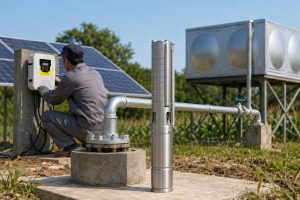
This type of pump is submerged directly in the water at the bottom of the well.
It pushes water up instead of pulling it.
This design overcomes suction limitations and allows it to lift water from hundreds of feet below the surface.
A 1 HP deep well submersible pump is the standard for most residential, agricultural, and livestock water systems.
Deep Well Pump Technologies for Diverse Needs
Not all 1 HP deep well pumps are the same.
The internal design determines its ideal application, offering a portfolio of solutions for distributors to meet various market demands.
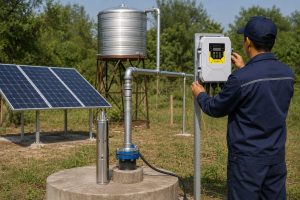
Three main types of solar deep well pumps dominate the market.
1. Solar Screw Pump (Low Flow, High Head):
This design uses a helical rotor (a screw) inside a rubber stator.
As the screw turns, it creates sealed cavities that move water upward.
This mechanism generates very high pressure, making it ideal for extremely deep wells.
It is also highly resistant to sand and silt, a common issue in many regions of Africa and Latin America.
Its main limitation is a lower flow rate compared to other designs.
2. Solar Plastic Impeller Pump (High Flow, Wear-Resistant):
This is a multi-stage centrifugal pump.
It uses a series of stacked plastic impellers to build pressure and flow.
This design is optimized for high water output at medium head levels.
The durable, wear-resistant plastic impellers offer excellent performance in water with fine sand.
This makes them a cost-effective and lightweight solution for farm irrigation and residential water supply in the Americas and Africa.
3. Solar Stainless Steel Impeller Pump (Premium, Corrosion-Resistant):
This model is also a multi-stage centrifugal pump but features impellers and a pump body made from high-grade SS304 stainless steel.
It is engineered for durability in harsh water conditions.
This includes acidic or alkaline water found in some parts of Australia and the Americas.
It offers high flow rates and a long service life, positioning it as a premium option for high-end homes, ranches, and applications where water quality is a concern.
| Pump Type | Best For | Max Head (1 HP Model) | Flow Rate (1 HP Model) | Key Advantage |
|---|---|---|---|---|
| Solar Screw Pump | Deep wells, high sand content, domestic use | 300 - 400+ feet | Low (5-10 GPM) | High head, excellent sand resistance |
| Plastic Impeller Pump | Farm irrigation, high volume needs, moderate depth | 200 - 300 feet | High (15-25 GPM) | High flow, economical, wear-resistant |
| Stainless Steel Pump | Corrosive water, high-end applications, long-term reliability | 200 - 350 feet | High (15-25 GPM) | Maximum durability, corrosion-proof |
Factors That Affect Pumping Distance
Focusing only on horsepower and head ignores a critical enemy of pump performance.
Friction within your water system can steal up to 50% of your pump's power.
Pipe diameter, system design, and the power source are crucial factors that determine how far a 1 HP pump can truly push water. Undersized pipes create excessive friction, dramatically reducing both flow rate and effective vertical lift, sometimes by half or more.
The Critical Role of Pipe Diameter
Friction head is the pressure your pump must overcome just to move water through the pipes and fittings.
This is where many systems fail.
Using a pipe that is too small for your required flow rate creates a bottleneck.
Water has to move faster through a smaller pipe to deliver the same volume.
This increased velocity creates massive friction, which the pump must work against.
A common rule of thumb is to keep water velocity between 5 and 8 feet per second for optimal efficiency.
For every 100 feet of horizontal pipe, you can expect a certain amount of friction head loss.
This loss is not linear; it increases exponentially with flow rate.
| Pipe Diameter | Flow Rate (GPM) | Friction Loss per 100 ft of Pipe (feet of head) |
|---|---|---|
| 1.25 inch | 10 | ~2.5 feet |
| 1.25 inch | 20 | ~9.0 feet |
| 2 inch | 10 | ~0.4 feet |
| 2 inch | 20 | ~1.5 feet |
As the table shows, doubling the flow rate in a 1.25-inch pipe increases friction loss by over 3.5 times.
Simply upgrading to a 2-inch pipe reduces that friction loss by nearly 85%.
For distributors, advising clients to invest in proper pipe sizing is crucial for customer satisfaction.
It ensures the pump performs as advertised and prevents callbacks and complaints.
System Design and Efficiency
Every component in your water system adds to the total friction.
Each 90-degree elbow, tee fitting, or check valve creates turbulence and resistance.
This is equivalent to adding several extra feet of straight pipe.
A well-designed system minimizes the number of bends and fittings.
Using smooth, sweeping elbows instead of sharp 90-degree fittings can reduce friction loss at each turn by over 50%.
Proper wire sizing is also critical, especially for long-distance submersible pump installations.
Undersized wires cause voltage drop, which starves the motor of power and can lead to overheating and premature failure.
Power Source and Intelligent Control
The stability and optimization of the power source are paramount, especially for solar pumps.
A solar pump's performance fluctuates with the sun's intensity.
This is where an intelligent MPPT (Maximum Power Point Tracking) controller becomes essential.
The MPPT controller constantly adjusts the electrical load to ensure the pump motor receives the optimal voltage and current from the solar panels.
It maximizes energy harvest throughout the day, increasing total water output by up to 30% compared to systems without MPPT.
Furthermore, advanced systems now offer AC/DC hybrid controllers.
This technology provides unparalleled water security.
The controller prioritizes free solar energy whenever it's available.
If clouds appear or during the night, it can automatically blend in or switch entirely to an AC power source, like the grid or a generator.
This ensures a reliable, 24/7 water supply, a powerful selling point for applications that cannot afford downtime.
How Do I Know What Size Submersible Pump I Need?
Guessing the right pump size often leads to failure.
You end up with a system that either provides a weak trickle of water or a pump that burns out prematurely.
To size a pump correctly, you must calculate your system's Total Dynamic Head (TDH) and determine your required flow rate (GPM). Then, select a pump whose performance curve shows it can efficiently deliver that GPM at your calculated TDH.
Step-by-Step Guide to Calculating TDH
Total Dynamic Head (TDH) is the total equivalent height that water must be lifted.
It considers not only the vertical lift but also all the friction in the system.
It is the true measure of the work your pump has to do.
1. Measure Vertical Lift (Static Head):
This is the vertical distance from the pumping water level in the well to the highest point of delivery (e.g., the top of a storage tank or the inlet of a pressure tank).
Example: Water level in well is 150 feet deep, and the pressure tank is 5 feet above ground. Static Head = 150 + 5 = 155 feet.
2. Calculate Friction Loss (Friction Head):
This is the head lost due to friction in the pipes and fittings.
Use a pipe friction loss chart.
You will need your planned flow rate (GPM), pipe diameter, and total pipe length.
Remember to add the equivalent length for all fittings.
Example: For 20 GPM through 200 feet of 2-inch pipe, friction loss is about 3 feet. Adding fittings might bring the total to 10 feet of friction head.
3. Determine Required Pressure (Pressure Head):
This accounts for the pressure needed at the delivery point.
Most residential systems operate with a pressure tank that cycles between 30 and 50 PSI.
Use the highest pressure setting for your calculation.
To convert PSI to feet of head, multiply by 2.31.
Example: 50 PSI required pressure. Pressure Head = 50 x 2.31 = 115.5 feet.
4. Sum the Components:
Add all three parts together to find your TDH.
TDH = Static Head + Friction Head + Pressure Head
Example: TDH = 155 ft + 10 ft + 115.5 ft = 280.5 feet.
Matching Your Needs to the Right Pump
With your TDH (280.5 feet) and required flow rate (20 GPM), you can now look at pump curves.
You need a 1 HP pump that can deliver at least 20 GPM at a TDH of 281 feet.
This data-driven approach removes all guesswork.
It ensures you select a pump that operates efficiently and reliably for your specific system.
| Application Scenario | Typical GPM Need | Example TDH Calculation | Recommended 1 HP Pump Type |
|---|---|---|---|
| Rural Home Water Supply | 10-15 GPM | 200 ft lift + 10 ft friction + 115 ft pressure = 325 ft TDH | Solar Screw Pump (High Head) |
| Small Farm Irrigation | 20-30 GPM | 100 ft lift + 30 ft friction + 70 ft pressure = 200 ft TDH | Plastic Impeller (High Flow) |
| Livestock Watering | 10 GPM | 250 ft lift + 20 ft friction + 46 ft pressure = 316 ft TDH | Solar Screw or SS Impeller Pump |
| Pond to High-End Home | 25 GPM | 50 ft lift + 15 ft friction + 115 ft pressure = 180 ft TDH | Stainless Steel Impeller Pump |
By following this process, B2B distributors can confidently guide their clients to the perfect solution.
This builds trust and establishes a reputation for expertise and reliability.
Conclusion
A 1 HP pump can lift water over 300 feet.
However, its true power lies in matching the right pump design and an efficient motor to your system's specific head and flow requirements.
FAQs
How many GPM can a 1 hp pump produce?
A 1 HP pump can produce from 5 to 40 GPM. The flow rate depends on the total head; higher head results in lower GPM.
How much pressure can a 1 hp pump produce?
A 1 HP pump can produce over 170 PSI (400 feet of head). High-head models like screw pumps generate more pressure than high-flow centrifugal models.
Can a 1 hp pump lift water 100 feet?
Yes, a 1 HP pump can easily lift water 100 feet. At this relatively low head, it can deliver a high flow rate, often 25-35 GPM.
What is the difference between a 1/2 hp and 1 hp well pump?
A 1 HP pump can deliver roughly double the flow rate at the same head or reach a significantly higher maximum head compared to a 0.5 HP pump.
How many solar panels do I need for a 1 hp pump?
A 1 HP (750W) solar pump typically requires 3-4 solar panels of 300-400W each. This provides enough power to run the pump effectively, even in less-than-perfect sunlight.
Is 1 HP enough for a well pump?
Yes, 1 HP is sufficient for most residential and small agricultural wells up to 250-300 feet deep, providing adequate flow for household use and light irrigation.
What size wire for a 1 hp submersible pump?
The required wire size depends on the pump's voltage and the distance from the controller. For a 200-foot run, a 1 HP, 230V pump typically needs 10-gauge wire.
Can a pump be too powerful for a well?
Yes. An oversized pump can drain the well faster than it refills (overpumping), causing the pump to run dry and burn out. Always match the pump's GPM to the well's recovery rate.