Struggling to get reliable water in an off-grid location is a common problem.
Incorrectly configuring your system leads to inefficiency and potential equipment damage.
Properly setting your solar pump inverter unlocks maximum performance and ensures a dependable water supply.
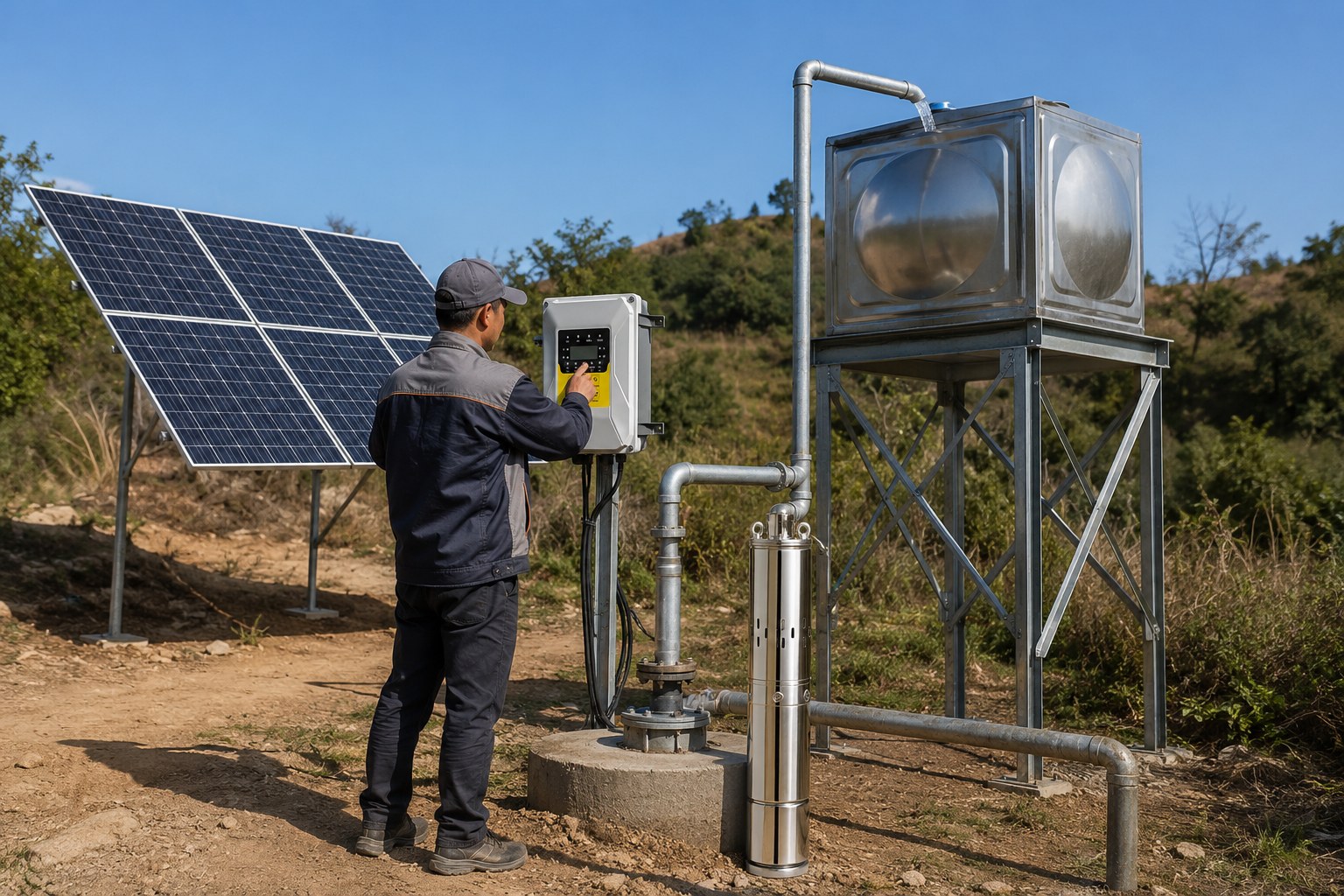
Setting a solar pump inverter involves correctly connecting your solar panels and pump, then configuring key parameters on the controller. You must input the pump motor’s rated voltage, current, frequency, and speed from its nameplate. Properly setting protection features like dry-run and low-voltage cutoff is also essential for longevity.
Understanding these settings is the foundation of a successful and long-lasting solar water pumping system.
But before we dive into the specific parameters, it’s crucial to understand what an inverter is and the powerful technology behind it.
This knowledge will make the setup process intuitive and straightforward.
What Is a Solar Pump Inverter and How Does It Work?
You often hear the term "inverter," but its role in a solar pump system can seem unclear.
Without it, your pump would run inefficiently, struggling in anything but perfect sunlight.
An inverter acts as the intelligent brain of your system, providing a smart throttle for your pump.
A solar pump inverter is an advanced electronic device that controls the pump motor's speed for maximum efficiency. It converts the direct current (DC) from solar panels into the appropriate power for the pump. It constantly adjusts its output to match available sunlight, maximizing daily water volume.
The Core Function: Power Conversion and Control
A solar pump inverter's primary job is to be the middleman between your solar panels and your pump motor.
For systems with AC motors, the inverter converts the variable DC power from the solar array into a stable AC power supply.
For modern systems using high-efficiency Brushless DC (BLDC) motors, the inverter regulates the DC power directly.
More importantly, it incorporates Maximum Power Point Tracking (MPPT).
MPPT technology is crucial for solar applications.
It continuously scans the output of the solar panels to find the optimal combination of voltage and current.
This process ensures the motor receives the maximum possible power at any given moment, whether it's bright noon or a partly cloudy afternoon.
An efficient MPPT algorithm can boost the total water pumped per day by up to 30% compared to a system without it.
Variable Speed vs. Fixed Speed
The most significant advantage of an inverter is its ability to provide variable speed control.
Think of it like driving a car.
A traditional, fixed-speed pump is like flooring the gas pedal to get going and then slamming on the brakes when you reach your destination.
It's either 100% ON or 100% OFF.
This on-off cycling creates a high inrush of current every time it starts, putting immense stress on the motor windings and mechanical parts.
An inverter-driven pump, however, is like smoothly pressing the accelerator.
It provides a "soft start," gently ramping up the motor speed.
As the sun gets stronger, the inverter increases the motor's speed.
As a cloud passes over, it slows the motor down instead of shutting off completely.
This smooth operation dramatically reduces mechanical and electrical stress, leading to a much longer lifespan for your pump.
| Feature | Fixed-Speed System | Inverter-Driven System |
|---|---|---|
| Motor Speed | Single speed (100% or 0%) | Variable speed (e.g., 30% - 100%) |
| System Startup | Hard start with 5-7x current spike | Soft start with low, controlled current |
| Efficiency | Lower, especially in low light | Up to 40% higher over a full day |
| Water Flow | Pulsating and inconsistent | Smooth and steady |
| Equipment Lifespan | Shorter due to high stress | Significantly longer |
The Powerhouse: High-Efficiency BLDC Motors
The inverter's perfect partner is a Brushless DC (BLDC) permanent magnet motor.
These motors are the core of modern, high-performance solar pumps.
Unlike traditional brushed motors, they have no brushes that wear out, making them virtually maintenance-free.
Their efficiency ratings often exceed 90%, whereas older AC or brushed DC motors might operate at only 60-70% efficiency.
The motor's rotor is typically constructed from high-grade permanent magnets, such as 40SH neodymium iron boron.
This powerful magnetic material allows for a compact, lightweight design that delivers high torque and power.
A BLDC motor can be up to 47% smaller and 39% lighter than a traditional motor of the same power rating.
When an inverter is paired with a BLDC motor, the result is a highly efficient system that requires fewer solar panels and operates more reliably, reducing both upfront and long-term costs.
Inverter Pumps vs. Traditional Pumps: A Performance Comparison
Choosing the right pump can feel overwhelming with the variety of options available.
Making the wrong choice can lead to inadequate water supply and frequent, costly maintenance.
Understanding the key performance differences between modern inverter-driven pumps helps you select the perfect solution for your specific application.
Inverter-driven pumps deliver superior real-world efficiency, quieter operation, and a more stable water supply compared to traditional on-off pumps. While old-style pumps may cost less upfront, the long-term savings from reduced energy needs and longer equipment life make inverter systems a smarter investment for most applications.
Deep Wells and High Head: The Solar Screw Pump
For applications requiring water from very deep wells, the solar screw pump is an exceptional choice.
This type of pump is a positive displacement pump.
It uses a single helical rotor (the screw), typically made of stainless steel, that rotates inside a resilient rubber stator.
This action creates sealed cavities of water that are pushed up the pump, generating very high pressure, or "head."
A solar screw pump can efficiently lift water from depths exceeding 200 meters.
While its flow rate is generally lower than centrifugal pumps, its high-head capability is unmatched.
It is also highly resistant to abrasion, making it ideal for wells with higher sand content (up to 50 g/m³).
When powered by an inverter, a screw pump can operate slowly but effectively even in low light, consistently providing water for domestic use or livestock, where steady pressure is more important than high volume.
High Volume for Irrigation: The Solar Plastic Impeller Pump
When the goal is to move a large volume of water for applications like farm irrigation or filling reservoirs, a multi-stage centrifugal pump is the answer.
Models equipped with plastic impellers offer a fantastic balance of performance and value.
These pumps use a series of impellers and diffusers to build pressure and generate high flow rates at a medium head.
The use of engineered, wear-resistant plastic for the impellers makes the pump lightweight, easier to install, and more economical.
This design also provides excellent resistance to fine sand, which can quickly wear down other pump types.
Paired with an inverter, the pump's speed can be precisely controlled to match the daily irrigation needs and solar availability.
This prevents over-pumping and conserves water, while the soft start protects the impellers from the torque shock of a direct-on-line start.
Demanding Conditions: The Solar Stainless Steel Impeller Pump
In environments with corrosive water or where maximum durability is required, the solar stainless steel impeller pump is the premium choice.
This pump features a robust construction with both the pump body and the multi-stage impellers made from high-grade SS304 or even SS316 stainless steel.
This makes it highly resistant to corrosion from acidic or alkaline water (suitable for a pH range of 5-9).
It is the ideal solution for drawing water in coastal regions, areas with unique soil chemistry, or for high-end residential water systems where water quality and pump longevity are paramount.
Like its plastic impeller counterpart, it delivers high flow at medium-to-high head.
The inverter control is critical for this premium product.
It ensures the pump operates within its best efficiency point, protecting the investment and guaranteeing a reliable water supply for years, even in the harshest of water conditions.
| Pump Type | Best Application | Flow Rate | Head/Pressure | Sand Resistance | Key Advantage |
|---|---|---|---|---|---|
| Solar Screw Pump | Deep wells, livestock | Low | Very High | Excellent | Unmatched high head capability |
| Plastic Impeller Pump | Farm irrigation, gardens | High | Medium | Good | High flow, cost-effective |
| Stainless Steel Impeller | Corrosive water, premium homes | High | Medium-High | Moderate | Extreme durability, corrosion resistance |
How to Set the Inverter Parameters
Your new solar pump system is installed, but the inverter's digital display presents a confusing menu of parameters.
Entering the wrong values can lead to poor performance, constant error shutdowns, or even a permanently damaged pump motor.
Let's walk through the essential settings to ensure your system runs with optimal efficiency and safety from day one.
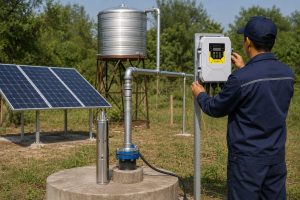
To set your inverter, you must first enter the basic motor parameters found on the pump’s nameplate: Rated Voltage, Rated Current, Rated Frequency, and Rated Speed. Next, configure vital protection settings like Dry Run Protection and Low-Voltage Cutoff to safeguard your equipment from common operational hazards.
Step 1: Entering Basic Motor Parameters
This is the most critical step in the setup process.
These values tell the inverter exactly what kind of motor it is connected to, allowing it to control and protect it correctly.
You will find all this information on the metal nameplate attached to the pump motor.
- Rated Voltage (V): Enter the motor's operating voltage precisely as listed. A 48V motor needs the inverter set to 48V. A mismatch can trigger over-voltage or under-voltage faults and damage the motor.
- Rated Current (A): This is also known as Full Load Amps (FLA). Enter this value exactly. The inverter uses this setting as a baseline to detect an overload condition (e.g., a jammed pump). Setting this value too high will disable the overload protection.
- Rated Frequency (Hz): This defines the motor's design speed, typically 50Hz or 60Hz depending on your region. This must match the motor's specification. For BLDC pumps, this setting may be labeled as "Max Frequency."
- Rated Speed (RPM): Input the motor's rated Revolutions Per Minute. The inverter uses this along with the frequency to calculate the precise speed and ensure smooth operation across the entire power range.
Step 2: Configuring Operational and Protection Settings
Once the basic motor profile is set, you need to configure the safety limits.
These settings protect your pump from the most common causes of failure.
- Maximum/Minimum Frequency: This sets the operational speed range. A good practice is to set a minimum frequency of around 25-30Hz. This ensures the motor has enough torque to start pumping water and prevents it from running too slowly and overheating. The maximum should be set to the motor's rated frequency (e.g., 50Hz or 60Hz).
- Dry Run Protection: This is arguably the most important protection feature. A pump running without water will quickly overheat and fail. The inverter can detect this condition by monitoring the motor's power consumption. When a pump runs dry, the load drops significantly. You must set a "dry run current" or "dry run power" threshold (e.g., 70% of the motor's no-load current). If the inverter detects the load has dropped below this threshold for a set period, it will shut down the pump to prevent damage.
- Low Voltage Cutoff (DC): This setting protects the system from trying to operate on insufficient sunlight. Running on very low voltage can cause the motor to stall while current continues to flow, leading to overheating. Set a DC input voltage level below which the inverter will go into standby mode. For a 48V nominal system, a cutoff of 42V is a common and safe setting.
Step 3: Enabling Advanced and Hybrid Features
Modern inverters offer features that can significantly enhance performance and convenience.
- MPPT Function: The Maximum Power Point Tracking function should be enabled by default on any solar pump inverter. Check the menu to ensure it is active. This is the core feature that optimizes power from your solar panels throughout the day.
- Hybrid AC/DC Mode: If your inverter and controller support a hybrid function, this is a game-changing feature for 24/7 water security. You can connect both your solar panels (DC) and a grid or generator supply (AC) simultaneously. You can then set a "switchover voltage" or select a "hybrid" mode. When the DC voltage from the panels drops below your set point due to clouds or at night, the controller will automatically supplement or switch entirely to the AC power source. This guarantees you have water whenever you need it, maximizing the use of free solar energy while providing the reliability of a grid connection.
When is an Inverter-Driven Solar Pump the Right Choice?
The higher initial cost of an inverter-driven pump system can cause hesitation.
It's tempting to opt for a cheaper, traditional on-off system to save money upfront.
Let's clearly define the specific scenarios where the investment in inverter technology pays significant dividends, making it the smarter long-term choice.
An inverter-driven pump is unequivocally worth it if you use your pump frequently, for long durations, or in areas with variable weather. The dramatic gains in energy efficiency, extended equipment lifespan, and superior operational stability provide a powerful return on investment that outweighs the higher initial cost.
For Frequent and Long-Duration Pumping
This is where the financial benefits of an inverter become most apparent.
Many water pumping applications, such as filling a large livestock tank or running an irrigation system, require hours of operation each day.
A traditional pump would cycle on and off, drawing a massive surge of current with every start.
An inverter-driven pump, in contrast, will ramp up to the required speed and maintain a steady flow.
Running continuously at 50% speed can use as little as 20-30% of the energy consumed by a fixed-speed pump cycling to achieve the same water volume.
In a solar-powered system, this means you can pump significantly more water with the same number of solar panels.
Over a 5-year operational period, the cumulative energy savings can easily reach 40-50%, more than covering the initial price difference of the inverter.
For Noise-Sensitive Applications
Noise is an often-overlooked but critical factor, especially for residential water supply, pool pumps near a patio, or livestock operations where quiet is preferred.
A fixed-speed pump is always running at 100% speed and load.
This generates a considerable amount of noise, often in the 65-75 decibel (dB) range, similar to a vacuum cleaner.
An inverter pump, once the target pressure or flow is reached, throttles down to a maintenance speed, perhaps running at only 30-60% of its maximum output.
At these lower speeds, the noise from the motor and fan can drop by 10-20 dB.
To the human ear, a 10 dB reduction is perceived as making something half as loud.
This massive reduction in noise pollution is a significant quality-of-life improvement for any nearby home or property.
For Variable Sunlight and Cooler Seasons
In early spring, late fall, or on days with intermittent clouds, solar energy input is inconsistent.
This is where traditional solar pump systems fail.
A fixed-speed pump requires a high threshold of power to start.
As clouds pass, the power will dip below this threshold, and the pump will shut off.
When the sun returns, it will attempt another high-current hard start.
This constant, stressful cycling is inefficient and damaging.
An inverter system handles these conditions with grace.
It doesn't need a high power threshold to operate.
If solar input drops to 50%, the inverter simply slows the pump to 50% speed.
You still get water, just at a lower flow rate.
This ability to operate across a much wider range of solar conditions means your pumping day starts earlier, ends later, and continues through partly cloudy weather.
This "graceful degradation" of performance dramatically increases the total volume of water pumped per day and can extend your effective pumping season by weeks or even months.
Myths and Marketing to Watch For
The solar pump market is filled with bold marketing claims that can be confusing or outright misleading.
Believing these myths can lead you to purchase an unsuitable or underperforming product for your needs.
Let's debunk some of the most common myths so you can evaluate products based on facts, not fiction.
Be highly skeptical of marketing that promises impossibly high efficiency numbers or claims a system is completely "maintenance-free." Always prioritize products with transparent, real-world performance data and third-party certifications over those with inflated laboratory-based specifications. True value is found in proven reliability.
Myth 1: “Inverter pumps always pump more water per hour.”
This statement is misleading.
The key advantage of an inverter pump is not its peak flow rate, but its total daily volume.
Under perfect, full-sun conditions, a properly sized fixed-speed pump and an inverter pump running at 100% speed will have very similar maximum flow rates (measured in gallons or liters per minute).
The inverter's superiority comes from its wider operational window.
It starts pumping earlier in the morning when the sun is weak and continues pumping later in the evening.
It also keeps pumping at a reduced rate during cloudy periods when a fixed-speed pump would have shut down entirely.
Because of this extended runtime, the total volume of water pumped over an entire day by an inverter system is often 20-40% higher than a traditional system using the same solar array.
Myth 2: “Extremely high efficiency numbers (98%+) are normal.”
You will often see brands advertising an inverter efficiency or a BLDC motor efficiency of 98% or even higher.
While this might be true for that single component in a perfect lab environment, it is not representative of real-world system performance.
The only metric that truly matters to an end-user is the "wire-to-water" efficiency.
This measures the overall system efficiency, taking into account losses from the solar panels, the inverter, the motor, and the pump's hydraulic end.
A realistic and excellent wire-to-water efficiency for a complete solar pump system is in the 40-60% range.
For a transparent comparison, look at the complete system's performance chart, which shows the flow rate at different head levels, rather than focusing on the efficiency of a single component.
Myth 3: "Modern solar pumps are completely maintenance-free."
While modern systems with BLDC motors and high-quality inverters are incredibly reliable and require very little maintenance, they are not "no-maintenance."
For any solar pump system to perform optimally over its lifespan, some simple periodic checks are necessary.
- Solar Panels: Panels must be cleaned regularly. A layer of dust, pollen, or bird droppings can reduce power output by 20% or more, directly impacting water flow.
- Inverter: The inverter's cooling fans and air vents should be checked and cleared of dust and debris to prevent overheating.
- Pump Intake: If the pump is in a well or pond with sediment or vegetation, the pump's intake screen should be inspected annually to ensure it is not clogged.
A "low-maintenance" system is an accurate description; a "no-maintenance" system does not exist.
Conclusion
Properly setting your solar pump inverter is the most critical step for achieving efficiency and reliability.
Matching parameters and understanding the technology unlocks the full potential of your off-grid water system.
FAQs
What size solar pump inverter do I need?
The inverter should be sized to match your pump motor's power rating. Check the motor's horsepower (HP) or kilowatt (kW) rating and choose an inverter with an equal or slightly higher rating.
Can I run a solar pump at night?
Yes, if you have a hybrid inverter connected to the AC grid or a generator. Alternatively, you can pump water into a storage tank during the day for use at night.
What happens if the solar pump runs dry?
A properly configured inverter with dry-run protection will detect the drop in motor load and automatically shut off the pump to prevent it from overheating and being damaged.
How many solar panels do I need for a pump?
As a general rule, the total wattage of your solar array should be at least 1.5 times the wattage rating of your pump motor to ensure good performance, even in less-than-ideal conditions.
What is the difference between a VFD and a solar pump inverter?
A solar pump inverter is a specialized type of Variable Frequency Drive (VFD). It includes all the features of a VFD plus the crucial MPPT algorithm needed to optimize power from solar panels.
Do inverter pumps last longer?
Yes, they generally do. The soft-start function dramatically reduces mechanical and electrical stress on the motor and pump, which can significantly extend the system's operational lifespan compared to hard-starting pumps.
What is MPPT in a solar inverter?
MPPT stands for Maximum Power Point Tracking. It is a smart technology that constantly adjusts the electrical load to extract the absolute maximum amount of power from the solar panels as sunlight conditions change.
How far can a solar pump push water?
This depends entirely on the pump type. Solar screw pumps are designed to push water from very deep wells (high head), while centrifugal pumps are designed to move large volumes of water over shorter distances (high flow).