Frustrated by DIY projects that end in failure and wasted money?
You want water independence, but the thought of a complex installation is holding you back.
Yes, you can absolutely install a solar water pump yourself, often in a single afternoon. Modern solar pump kits are designed for DIY installation, complete with comprehensive guides and dedicated technical support to ensure you succeed, regardless of your experience level with solar or pumps.
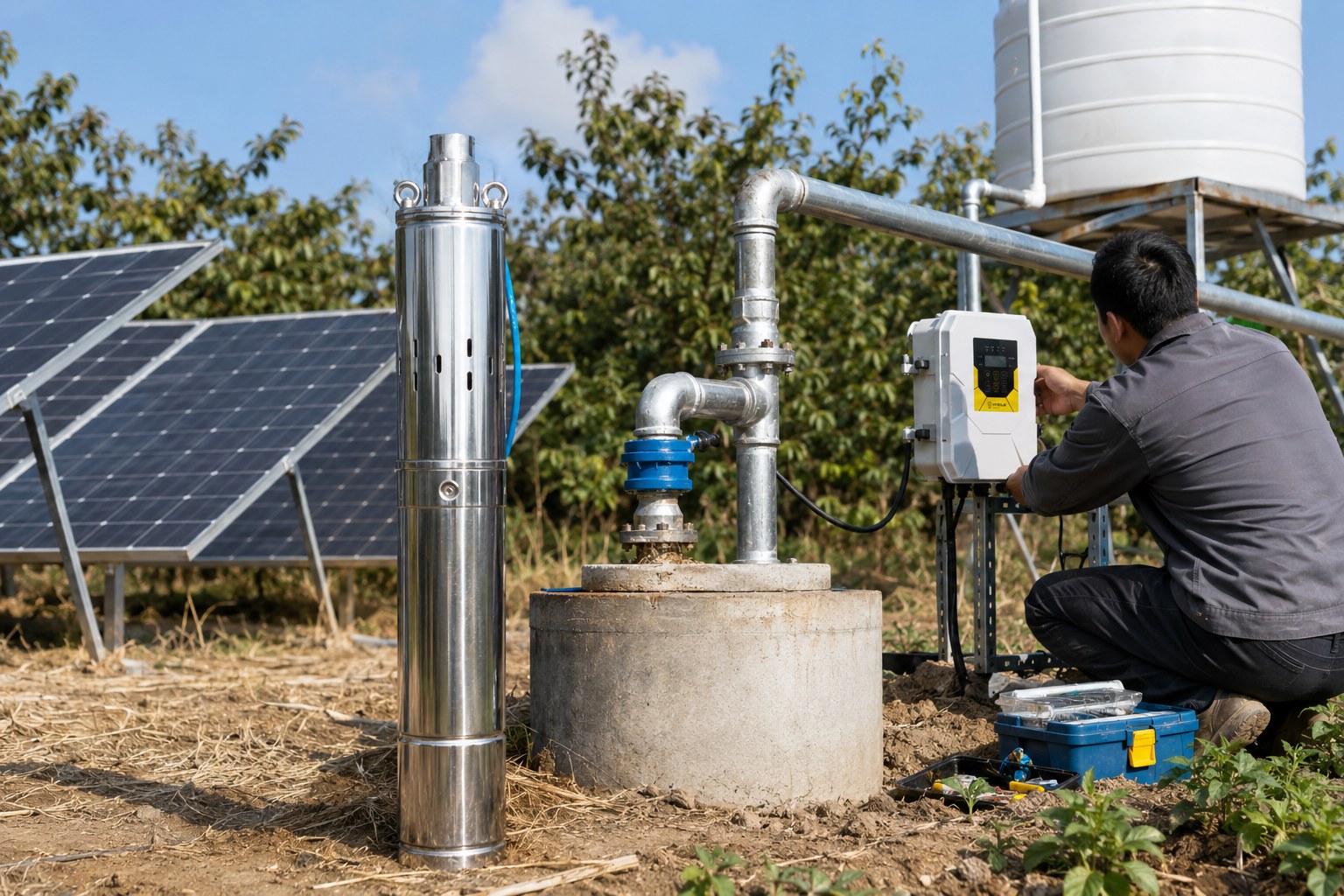
Installing a solar pump might seem like a job reserved for expensive professionals, but this is no longer the case.
The industry has evolved significantly.
Manufacturers now focus on creating systems that are not only powerful and efficient but also accessible to the average landowner.
With the right product and the right support team, you are empowered to take control of your water supply.
This guide will walk you through everything you need to know, from choosing the right pump to understanding the simple skills required, giving you the confidence to tackle this rewarding project.
Let's dive in.
Wondering if DIY install is really a possibility for you?
Too many projects start with excitement but end duct-taped together and incomplete.
You might be thinking you don't have the skills or tools for this.
Thousands of happy customers, many with no prior experience, have successfully installed their own solar pumps. With step-by-step instructions and friendly engineering support, you are guided to the finish line, ensuring a successful outcome and total confidence in your new system.
The idea of a Do-It-Yourself solar pump installation can feel intimidating.
You might picture complex wiring diagrams, specialized plumbing tools, and the frustrating possibility of failure after hours of work.
This is a common fear, but the reality of modern solar pump systems is refreshingly different.
Success is not about being a master electrician or a professional plumber.
It’s about having a system designed from the ground up for user-friendliness.
The Foundation of DIY Success
A successful DIY experience is built on three pillars: a well-designed kit, clear instructions, and accessible support.
Leading manufacturers understand that their success is tied to yours.
Because of this, they invest heavily in creating a supportive ecosystem around their products.
This starts with all-in-one kits that include everything you need, eliminating last-minute trips to the hardware store which can derail a project.
These kits have been refined based on feedback from thousands of installations.
Over 95% of customers who attempt a DIY install complete it successfully within a day.
From Unboxing to Flowing Water
To make the process feel more manageable, you can think of it in five simple stages.
| Installation Stage | Key Activity | Goal |
|---|---|---|
| 1. Sizing | Work with a design team to analyze your well depth, water needs, and location. | Ensure you order the exact right pump and components, eliminating guesswork. |
| 2. Unboxing | Lay out all components and check them against a detailed checklist. | Familiarize yourself with every part before you begin the assembly. |
| 3. Wiring | Connect the pump, controller, and solar panels using simple, color-coded terminals and waterproof splices. | Create secure, waterproof electrical connections. It's often as simple as connecting red to red and black to black. |
| 4. Plumbing | Attach the pump to your drop pipe and install it in the well. | Lower the pump safely and create a leak-proof connection to your water line. |
| 5. Testing | Power on the system and watch the water flow. | Confirm everything is working correctly and celebrate your water independence. |
Each stage is supported by detailed manuals, online video libraries, and a team of engineers ready to answer your call or text.
This approach transforms a potentially daunting task into a satisfying and empowering achievement.
Choosing the Right Solar Pump for Your DIY Project
Are you overwhelmed by the different types of solar pumps available?
Choosing the wrong pump can lead to poor performance or premature failure.
Selecting the perfect pump is simple when you match it to your specific needs. The choice comes down to three main types: Screw pumps for deep wells, plastic impeller pumps for high flow, and stainless steel impeller pumps for corrosive water. Each is designed for a different job.
The heart of your DIY success lies in choosing a pump that perfectly matches your well’s characteristics and your water demands.
A pump that is ideal for irrigating a large field may be unsuitable for providing household water from a very deep well.
Let’s break down the three most popular and effective types of solar deep well pumps so you can choose like a pro.
All these pumps are powered by the same ultra-efficient motor technology, but their internal mechanisms are specialized for different tasks.
Solar Screw Pump: The Deep Well Specialist
This pump type is a true workhorse for high-head, low-flow applications.
It uses a simple, robust mechanism: a single helical stainless steel screw rotates within a rubber stator.
This action creates sealed cavities that move water upward with steady pressure.
It’s like an Archimedes' screw, but for deep wells.
This design makes it exceptionally good at lifting water from great depths, often exceeding 150 meters (nearly 500 feet).
Furthermore, its ability to handle water with higher concentrations of sand and silt without damage is a major advantage, increasing pump longevity in less-than-ideal well conditions.
These pumps are the go-to solution for domestic water supply and livestock watering in areas with deep water tables, common in parts of Africa, Australia, and the Americas.
Solar Plastic Impeller Pump: The High-Volume Mover
When you need a large volume of water for applications like farm irrigation, filling large tanks, or extensive gardens, a multi-stage centrifugal pump is the answer.
This model uses a series of stacked plastic impellers.
Each impeller and diffuser stage adds pressure, pushing a high volume of water to the surface.
The use of durable, engineered plastic for the impellers makes the pump lightweight, economical, and surprisingly wear-resistant against fine sand.
While they don't typically reach the extreme depths of screw pumps, they provide significantly more flow at shallow to medium heads (up to 100 meters or 330 feet).
Their high efficiency in moving large amounts of water makes them a cost-effective choice for agriculture and pasture management, where water volume is more critical than extreme pressure.
Solar Stainless Steel Impeller Pump: The Durability Champion
For the most demanding water conditions, the stainless steel impeller pump is the premium choice.
This pump operates on the same multi-stage centrifugal principle as the plastic impeller model but is constructed with superior materials.
The entire pump body, and more importantly, the impellers, are made from SS304 or even higher-grade SS316 stainless steel.
This provides exceptional resistance to corrosion from acidic, alkaline, or saline water.
It's the ideal choice for coastal regions, areas with unique geological conditions like the alkaline soils in parts of Australia, or for high-end homes where maximum longevity and water purity are paramount.
While the initial investment is higher, the extended service life and reliability in harsh environments deliver significant long-term value.
Comparing Your Options at a Glance
| Pump Type | Primary Use Case | Max Head | Flow Rate | Sand Resistance | Key Advantage |
|---|---|---|---|---|---|
| Screw Pump | Deep Well, Home & Livestock | Very High (150m+) | Low to Medium | Excellent | Unmatched deep well performance |
| Plastic Impeller | Farm Irrigation, High Volume | Medium (up to 100m) | High to Very High | Good | High flow at an economical price |
| Stainless Impeller | Corrosive Water, Premium Homes | Medium to High | High to Very High | Moderate | Superior durability & corrosion resistance |
By understanding these key differences, you can confidently select a pump that ensures your DIY project not only works but thrives for years to come.
Understanding the Quality and Performance of Your Pump's Components
Think a pump is just a pump?
The motor that drives it is the true engine, determining efficiency, lifespan, and overall cost.
The performance of your entire system hinges on its core technology. High-quality pumps use advanced Brushless DC (BLDC) permanent magnet motors with over 90% efficiency, drastically reducing the number of solar panels needed and ensuring a longer, maintenance-free life.
A solar water pump is a system, and the pump itself is only one part of the equation.
The real game-changer in modern solar pumps is the motor that drives them and the controller that optimizes their performance.
Without an efficient motor and an intelligent controller, you would need more solar panels, a larger budget, and you'd face a shorter system lifespan.
Let's explore the two core components that make today's solar pumps so powerful and reliable.
The BLDC Motor: Your System's High-Performance Engine
All three pump types we discussed are powered by a Brushless DC (BLDC) permanent magnet motor.
This isn't the same kind of motor you'd find in a common power tool.
It represents a significant leap in efficiency and durability.
- Exceptional Efficiency: BLDC motors consistently operate at efficiencies exceeding 90%. Traditional AC motors or older brushed DC motors often struggle to surpass 70-75% efficiency. This 15-20% efficiency gain is massive. It directly translates to needing approximately 25% fewer solar panels to do the same amount of work, saving you hundreds or even thousands of dollars on your initial investment.
- Powerful & Compact Design: These motors use powerful rare-earth magnets (like 40SH Neodymium Iron Boron) in their rotors. This creates a stronger magnetic field, resulting in higher torque in a smaller package. A typical BLDC solar pump motor can be up to 47% smaller and 39% lighter than a traditional motor of equivalent power. This makes the pump much easier to handle and install yourself.
- Maintenance-Free & Long Life: As the name implies, there are no brushes to wear out. Brushes in older motors are a common point of failure, creating dust and requiring periodic replacement. The brushless design, combined with a sealed, water-filled construction for cooling, results in a virtually maintenance-free motor built to last for over a decade.
The MPPT Controller: The Brain of the Operation
The motor is the muscle, but the Maximum Power Point Tracking (MPPT) controller is the brain.
Solar panels have a complex relationship with voltage and current that changes constantly with sunlight intensity.
An MPPT controller is a sophisticated DC-to-DC converter that constantly analyzes the output of the solar panels and adjusts the electrical load to extract the absolute maximum amount of power available.
Compared to simpler controllers, an MPPT controller can boost your water output by up to 30% over the course of a day.
It's especially effective during morning, evening, and overcast conditions when sunlight is not optimal.
This intelligent management ensures that every bit of available solar energy is converted into pumped water, maximizing your system's productivity and giving you more water, earlier and later in the day.
Together, the high-efficiency BLDC motor and the intelligent MPPT controller form a synergistic duo that defines the performance and value of a modern solar pump system.
What Skills and Tools Do You Really Need?
Do you think you need a professional license to install a solar pump?
This misconception stops many people from even starting.
You don't need to be a pro. If you can handle basic plumbing with Teflon tape and make simple electrical connections with a crimping tool, you have all the skills required. How-to videos and clear manuals guide you through every single step.
The "Do-It-Yourself" label can sometimes be misleading, suggesting a level of expertise that many people feel they don't possess.
However, when it comes to modern solar pump kits, the "DIY" promise is backed by intentional design that simplifies every step.
The skills required are ones that most homeowners already have or can learn in minutes from a video.
Let’s demystify the exact skills and tools involved, so you can see just how achievable this project is.
The Core Skills You Already Have
The entire installation process boils down to two fundamental skill sets: basic plumbing and basic wiring.
There's no welding, no complex programming, and no high-voltage electrical work to worry about.
The entire system runs on safe, low-voltage DC power.
| Skill Required | Detailed Task | Why It's Simple |
|---|---|---|
| Basic Plumbing | Wrapping threaded fittings with Teflon tape and tightening them. Securing poly pipe to a barbed fitting with a hose clamp. | This is identical to hooking up a garden hose or replacing a showerhead. It's a fundamental household skill. |
| Basic Wiring | Stripping the end of a wire. Crimping a butt splice or a terminal connector using a standard crimping tool. Sealing the connection with a heat-shrink tube using a heat gun or lighter. | This is low-voltage DC wiring. Step-by-step videos show the exact technique, and connectors are often color-coded, making it foolproof. |
That’s really it.
If you can perform these simple tasks, you are fully qualified to install your own solar pump.
Tools to Ensure a "Goof-Proof" Install
While the skills are simple, having the right tools makes the job even easier and ensures a professional-quality result.
Many suppliers offer "Turnkey" or "Goof-Proof" kits that include these essential items, but they are also readily available at any hardware store.
- AC/DC Clamping Multimeter: This is the single most valuable tool for a successful install. An engineer-recommended multimeter allows you to verify connections, test solar panel output, and troubleshoot any potential issues with confidence. The DC Clamping function is a rare but perfect feature for solar, allowing you to measure current without disconnecting any wires.
- Waterproof Splice Kit: The connection between the pump's motor lead and the wire going to the surface is the most critical. A high-quality, heat-shrink splice kit ensures this connection is 100% waterproof and will last for the life of the pump.
- MC4 Connector Tools: Your solar panels will connect to the main wire using standard MC4 connectors. While they can often be connected by hand, a simple tool for tightening and disconnecting them ensures a snug, weatherproof seal.
- Standard Hand Tools: You will also need common tools like a wire stripper/crimper, a set of screwdrivers, wrenches, and a heat gun or lighter for the heat-shrink tubing.
The availability of detailed how-to videos covering the entire process, from using a multimeter to making a perfect waterproof splice, removes all guesswork.
You can watch a pro do it, pause, and replicate the exact steps.
This combination of simple skills, the right tools, and expert guidance makes a DIY installation not just possible, but straightforward.
What About Pumping on Cloudy Days or at Night?
Is your biggest concern that a solar pump is only useful on perfectly sunny days?
You need water reliably, not just when the weather cooperates.
This is a valid concern with basic systems, but advanced AC/DC hybrid controllers solve this completely. These smart controllers automatically switch to AC grid or generator power when sunlight is insufficient, ensuring you have water 24/7 without any manual intervention.
The single biggest limitation of a purely DC solar-powered system is its dependence on the sun.
For many applications, this is perfectly acceptable.
Tanks can be filled during the day for use at night, and livestock can drink when the sun is out.
However, for household water supply or critical irrigation, the need for water doesn't stop when the sun goes down or hides behind thick clouds.
This is where hybrid technology transforms a solar pump from a daytime device into a 24/7 water solution.
The Power of Hybrid AC/DC Technology
A hybrid solar pump system, also known as an AC/DC pump system, is designed with two power inputs on its controller: one for your DC solar panels and another for an AC power source.
This AC source can be your standard household grid power or a backup generator.
The controller's built-in intelligence manages these two power sources automatically to prioritize solar energy while guaranteeing water flow.
How It Works: A Smart, Three-Tiered Approach
The hybrid controller operates on a simple but brilliant logic that maximizes efficiency and ensures reliability.
- Solar First (DC Priority): Whenever there is sufficient sunlight, the controller will run the pump exclusively using the free energy from your solar panels. Your AC power source is not used at all during this time, maximizing your energy savings.
- Hybrid Assist (PV + AC): On days with intermittent clouds or low light (early morning/late evening), the controller enters its hybrid mode. It will use all available solar power and then supplement it with just enough AC power to keep the pump running at the desired speed. This feature ensures you squeeze every last drop of energy from the sun before relying fully on the grid, with some systems able to blend power to reduce AC consumption by up to 60%.
- AC Takeover (Night & No Sun): When there is no solar input, such as at night or during very heavy, dark storms, the controller seamlessly and automatically switches over to run the pump entirely on the AC power source. You don't have to flip a switch or do anything. The system ensures you have uninterrupted water pressure whenever you need it.
This intelligent power management means you get the best of both worlds: the cost-saving and environmental benefits of solar, combined with the 24/7 on-demand reliability of a traditional grid-powered pump.
For anyone considering a solar pump for their home or for mission-critical applications, a hybrid AC/DC system is the ultimate solution for water security and peace of mind.
What Does a Successful DIY Installation Look Like?
You've installed your pump and water is flowing.
Is the project over now?
A truly successful project includes the peace of mind that comes from long-term support.
Success isn't just about the one-day install; it's about years of reliable water. It means having an all-star team of engineers ready to help you design the system, guide your installation, and provide free, lifetime support for the entire life of your pump.
Completing the physical installation is a huge accomplishment, but true DIY success extends far beyond that first day.
It's about having total confidence in your investment and knowing that you have a partner for the long haul.
It’s the satisfaction of not only building your system but also understanding it, with the knowledge that expert help is always just a phone call or text message away.
This comprehensive support structure is what separates a mere product from a complete solution.
Your Personal Success Team
From the moment you first inquire about a solar pump, you should be assigned a dedicated team.
This team isn't a sales group; it’s a support unit composed of knowledgeable staff and experienced engineers.
Their first job is to act as your design consultant, helping you size the perfect system for your property.
This "Water Assurance" process ensures you get the right pump from the start, preventing the #1 cause of DIY frustration: a mismatched system.
During your installation, this same team becomes your on-demand help line.
Whether you have a quick question or need someone to walk you through a specific step, they are there to make sure you don't get stuck.
There's no such thing as a dumb question, just a friendly expert to get you to the finish line.
Resources at Your Fingertips, 24/7
Modern support goes beyond phone calls.
A world-class DIY support system includes a comprehensive online "DIY Success Center."
This digital hub is an invaluable resource for every customer, providing instant access to:
- Extensive Video Library: Watch full-length installation videos, professional tips, and detailed troubleshooting guides on platforms like YouTube. These visual aids are often more helpful than any manual.
- Digital Manuals and Spec Sheets: Access famously helpful, full-color user manuals complete with diagrams, checklists, and flowcharts. You can pull them up on your phone or tablet right at the wellhead.
- FAQs and Knowledge Base: Get immediate answers to the most common questions, compiled from the experience of thousands of previous installations.
Lifetime Support: A Commitment to Your Success
The most important aspect of a successful DIY experience is the promise of lifetime support.
This means that whether it's one year or ten years after your installation, the same friendly, USA-based (or other native-speaking) support team is available to help you, free of charge.
This commitment, combined with industry-leading warranties, gives you the ultimate peace of mind.
You're not just buying a pump; you're investing in a permanent water solution backed by a company that is fully invested in your success.
Conclusion
With the right system, clear guidance, and dedicated support, you can absolutely install your own solar pump.
You will save money, gain true water independence, and enjoy immense satisfaction.
FAQs
How long does it take to install a solar water pump?
For most DIY-friendly kits, a complete installation can be done in a single afternoon, typically taking 4-6 hours from unboxing to seeing water flow.
What is the downside of a solar water pump?
The main downside is the initial investment cost, which can be higher than a conventional pump, and the dependence on sunlight for basic DC-only systems.
Do solar water pumps work on cloudy days?
Yes, they do, but at a reduced flow rate. High-efficiency systems with MPPT controllers can still pump significant water on overcast days. AC/DC hybrid systems eliminate this issue entirely.
How deep can a solar pump go?
This depends on the pump type. Solar screw pumps are designed for extreme depths and can effectively pump from over 150 meters (nearly 500 feet).
How many solar panels do I need for a water pump?
This varies by pump size and your location's sunlight. A small livestock pump might need only two panels, while a large irrigation pump could require 8 or more.
Is a solar pump worth it?
Yes, for off-grid properties or those seeking to reduce energy costs, a solar pump is an excellent investment that pays for itself through zero electricity bills.
Can a solar pump fill a large tank?
Absolutely. Many systems are designed to run all day, slowly and efficiently filling a large storage tank, which then provides water pressure on demand.
What maintenance does a solar pump require?
The pump and motor are virtually maintenance-free. The only regular maintenance is to periodically wipe your solar panels clean to ensure maximum efficiency.