Struggling with water pressure from your deep well?
Choosing the wrong pump wastes energy and leads to premature failure.
Let's find the exact horsepower your 200-foot well requires.
For a 200-foot deep well, you will typically need a 3/4 HP to 1.5 HP pump.
The final choice depends on your required Gallons Per Minute (GPM) and the Total Dynamic Head (TDH), not just the depth.
Accurate calculation prevents undersizing and ensures reliable water flow.
Selecting the right pump is more than a simple guess based on depth.
It’s a crucial calculation that impacts your system's efficiency, longevity, and your daily water supply.
To make an informed decision, you must understand all the variables that contribute to a pump's workload.
Let's break down the essential factors you need to consider.
Key Factors in Sizing Your Well Pump
Choosing a pump based on depth alone is a common mistake.
This can lead to poor performance and costly replacements.
You need to evaluate several critical factors to ensure efficiency.
The most important factors for pump sizing are well depth, static water level, required flow rate (GPM), and pressure needs.
Considering these elements together allows you to calculate the Total Dynamic Head (TDH), which is the true measure of the work your pump must do.
Choosing the correct pump size is a science.
It ensures your water system operates at peak efficiency.
An incorrectly sized pump, whether too large or too small, creates significant problems.
A deep dive into each sizing factor reveals why a holistic approach is necessary for a reliable and long-lasting water solution.
Well Depth and Water Level
The physical depth of your well is the starting point.
For a 200-foot well, this depth dictates the minimum power required to lift water.
However, the pump doesn't lift water from the very bottom.
It lifts water from the static water level, which is where the water table naturally sits inside the well casing when the pump is off.
This measurement is far more important than the total drilled depth.
Furthermore, you must account for "drawdown."
Drawdown is the distance the water level drops when the pump is actively running.
The true pumping level is the static water level minus the drawdown.
This is the real vertical distance the pump must overcome.
For example, a 200-foot well with a 60-foot static water level and 15 feet of drawdown has a pumping level of 75 feet.
The pump needs to lift water 75 feet just to reach the surface.
GPM and Pressure Requirements
Gallons Per Minute (GPM) describes the volume of water you need.
This is determined by your household or operational demands.
A small home might only need 8-12 GPM.
A larger home with a garden or a small farm could require 15-25 GPM or more.
Pressure, measured in Pounds per Square Inch (PSI), is the force delivering water to your fixtures.
A standard home system operates between 40-60 PSI.
This pressure must be converted into "feet of head" to be included in your calculation.
To do this, you multiply the required PSI by 2.31.
So, a 50 PSI requirement adds another 115.5 feet (50 x 2.31) to the pump's workload.
Friction Loss
Water moving through pipes creates friction.
This friction creates resistance, which the pump must also overcome.
This is known as friction loss.
Factors that increase friction loss include:
-
Longer pipe runs.
-
Smaller pipe diameters.
-
More elbows and fittings.
-
Higher flow rates (GPM).
Friction loss is also calculated in feet of head and added to the total.
For a 200-foot well, a 1-inch pipe carrying 10 GPM can add over 15 feet of friction loss.
Using a larger 1.25-inch pipe could reduce this loss by more than 50%, improving overall system efficiency.
How To Calculate Your Pump's True Workload
Are you unsure how all these factors translate into a pump size?
The calculation seems complex, but it's a straightforward formula.
This formula gives you the Total Dynamic Head (TDH).
You calculate Total Dynamic Head (TDH) with this formula: TDH = Vertical Lift + Friction Loss + Pressure Head.
This value, combined with your required GPM, allows you to consult a pump's performance curve to find the perfect horsepower for your specific 200-foot well.
The TDH calculation is the most critical step in selecting a well pump.
It moves you beyond simple estimates and into precise engineering.
By quantifying the total work your pump needs to do, you can choose a model that operates in its most efficient range.
This precision saves you money on electricity and extends the life of your equipment.
Let's walk through a practical example.
Step-by-Step TDH Calculation
Imagine you have a 200-foot deep well.
Here are the specific conditions:
- Static Water Level: 60 feet below the ground.
- Drawdown: 15 feet when pumping.
- Vertical Lift: Your pressure tank is 5 feet above ground.
- Pressure Requirement: You need 50 PSI at the tank.
- Pipe Details: 200 feet of 1.25" pipe.
- Flow Rate: Your household requires 10 GPM.
Now, let's calculate the components of TDH.
Breaking Down the Formula
First, determine the Total Vertical Lift.
This is the distance from the pumping water level to the pressure tank.
- Pumping Water Level = Static Water Level (60 ft) + Drawdown (15 ft) = 75 ft.
- Height Above Ground = 5 ft.
- Total Vertical Lift = 75 ft + 5 ft = 80 feet.
Next, calculate the Pressure Head.
- Required Pressure = 50 PSI.
- Conversion Factor = 2.31.
- Pressure Head = 50 PSI × 2.31 = 115.5 feet.
Then, find the Friction Loss.
- Using a friction loss chart, 200 feet of 1.25" pipe at 10 GPM results in approximately 7 feet of loss.
- Friction Loss = 7 feet.
Finally, add them all together for the TDH.
- TDH = Total Vertical Lift (80 ft) + Pressure Head (115.5 ft) + Friction Loss (7 ft).
- Total Dynamic Head (TDH) = 202.5 feet.
Matching TDH to a Pump Curve
With a required flow of 10 GPM and a TDH of 202.5 feet, you can now look at pump performance charts.
You would select a pump where the 10 GPM and 202.5 feet intersection point falls within the pump's "Best Efficiency Range."
For these specifications, a 1 HP pump would likely be the ideal choice.
A 3/4 HP pump might struggle to meet the demand, while a 1.5 HP pump would be oversized and inefficient.
This calculation demonstrates why a 200-foot well can require different pump sizes under different conditions.
Choosing The Right Type of Pump
You know your required HP, but what type of pump is best?
Your well depth and application will narrow down the options significantly.
Making the wrong choice can compromise efficiency.
For a 200-foot well, a submersible pump is the only suitable choice.
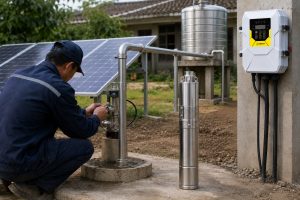
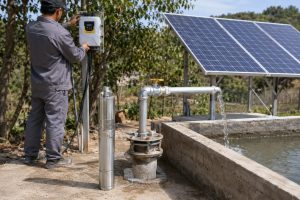
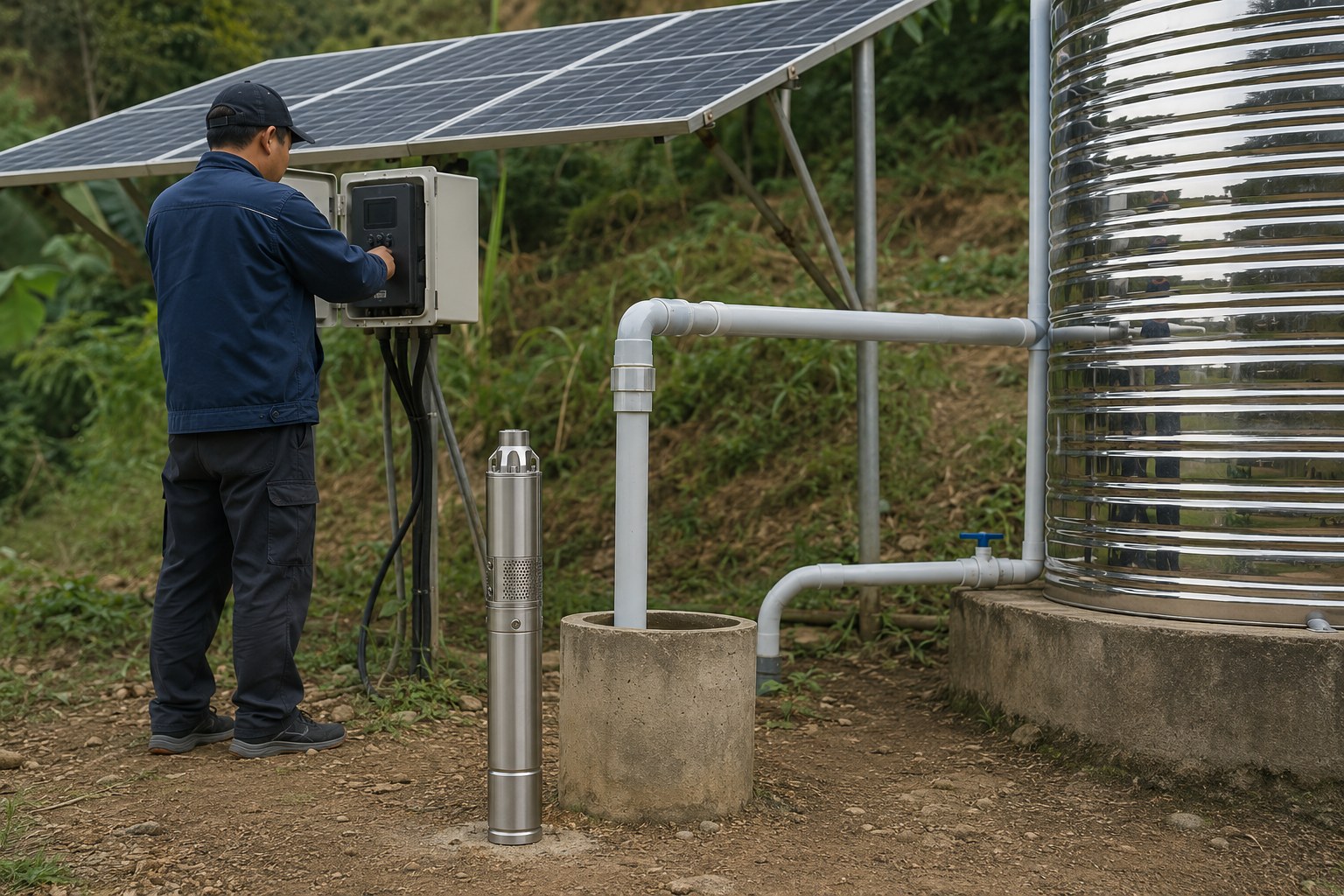
These pumps are designed for deep wells and operate efficiently while fully submerged. Modern solar-powered submersible pumps offer grid-independent, cost-effective solutions for various water needs.
The pump a a 200-foot well is non-negotiable.
Jet pumps are only effective for shallow wells, typically less than 25 feet deep.
A submersible pump is placed deep inside the well, pushing water to the surface rather than pulling it.
This design is vastly more efficient for deep applications.
Within the world of submersible pumps, especially solar-powered models, there are specialized designs for different needs.
The Power of BLDC Motors
At the heart of modern solar pumps is the Brushless DC (BLDC) permanent magnet motor.
These motors are a game-changer for off-grid water solutions.
They boast efficiencies exceeding 90%, which is a significant improvement over standard AC motors.
This high efficiency means you need fewer solar panels to power your system, reducing upfront costs by up to 30%.
The compact design also makes them 39% lighter and 47% smaller, simplifying installation.
Key advantages include high torque for reliable startups, maintenance-free operation, and a long service life.
This core technology drives the performance of all advanced solar pump types.
Solar Screw Pump: For High Head
The solar screw pump is designed for low flow and very high head applications.
It uses a stainless steel helical rotor inside a rubber stator.
This design acts like an archimedes screw, pushing water upward with each rotation.
It is ideal for deep wells where you don't need a large volume of water.
- Best Use: Domestic water, livestock watering.
- Key Advantage: Excellent sand handling capability (up to 5% sand content) and ability to overcome extremely high vertical lift.
- Limitation: Lower flow rates, typically under 10 GPM.
Solar Impeller Pumps: For High Flow
For applications requiring higher volumes of water, like irrigation or filling large tanks, a multi-stage centrifugal impeller pump is the answer.
These pumps come in two main varieties:
| Pump Type | Impeller Material | Best For | Key Advantage(s) |
|---|---|---|---|
| Plastic Impeller Pump | Engineering Plastic | Farm irrigation, pasture water | High flow, excellent fine sand resistance, cost-effective. |
| Stainless Steel Impeller Pump | SS304 Stainless Steel | Corrosive water, high-end homes | Superior corrosion resistance, durability, long service life. |
The plastic impeller option provides a fantastic balance of performance and value for most agricultural uses.
The stainless steel model is a premium solution for harsh water conditions or where maximum longevity is the priority.
These pumps, powered by BLDC motors and managed by smart MPPT controllers, create a powerful and flexible product portfolio to meet nearly any water demand.
Problems With An Oversized Pump
Think a bigger pump is always better?
This common misconception leads to significant problems and higher costs.
An oversized pump can damage your well and itself.
An oversized pump causes "short cycling," where it turns on and off rapidly.
This frequent cycling wears out the motor, wastes a tremendous amount of energy, and can over-pump your well, potentially causing damage to the well itself by drawing in sand and sediment.
The belief that more horsepower provides a "safety margin" is flawed.
A pump is designed to operate most efficiently within a specific performance range.
Forcing it to operate outside this range by oversizing it leads directly to mechanical and electrical stress.
The consequences are not just inconvenient; they are expensive.
Let’s explore the specific issues that arise.
Short Cycling and Motor Wear
Short cycling is the most immediate problem.
An oversized pump fills your pressure tank very quickly.
This rapid fill causes the pressure switch to shut the pump off.
Because the tank fills so fast, a small amount of water use will cause the pressure to drop and trigger the pump to turn on again.
This on-off-on-off sequence can happen every few seconds.
Each startup subjects the motor to a massive inrush of electrical current, which generates heat and stress on the motor windings.
This repeated stress is the leading cause of premature motor failure.
A properly sized pump might cycle a few times per hour; an oversized pump could cycle hundreds of times, reducing its lifespan from over a decade to just a couple of years.
Energy Waste
A larger motor naturally consumes more electricity.
When oversized, it uses more power than necessary for every minute it runs.
The frequent startups caused by short cycling exacerbate this issue.
The initial current surge on startup is 3 to 5 times higher than the motor's normal running current.
When this happens constantly, your electricity bill can increase by 25% or more compared to a correctly sized system.
In a solar-powered system, this means you need a larger, more expensive solar array and controller to handle the high power demands, increasing your initial investment unnecessarily.
Well Damage
Perhaps the most dangerous consequence is damage to your well.
A pump that is too powerful can extract water faster than the aquifer can replenish it.
This is called over-pumping.
It dramatically increases the drawdown, potentially lowering the water level below the pump's intake.
Running the pump dry can destroy it in minutes.
Even if it doesn't run dry, over-pumping increases the velocity of water entering the well screen.
This high velocity can pull sand, silt, and sediment into the well, which can clog the well screen, abrade the pump's internal components, and ultimately ruin your water source.
Problems With An Undersized Pump
Is choosing a smaller pump to save money a good idea?
While the initial cost is lower, an undersized pump creates its own set of frustrating and damaging problems.
It will likely cost you more in the long run.
An undersized pump will run constantly and fail to provide adequate water pressure.
This leads to a frustrating user experience, like weak showers. Constant operation also causes the motor to overheat, leading to premature burnout and the need for a costly replacement.
Choosing a pump that is too small for the job is a false economy.
The pump is forced to work continuously beyond its designed operational capacity.
This constant strain leads to a cascade of failures that negate any initial savings.
You not only get poor performance but also face the expense of replacing the pump much sooner than expected.
Let’s look at the specific symptoms and consequences.
Symptoms of an Undersized Pump
The signs of an undersized pump are impossible to ignore in daily use.
You will experience a noticeable drop in water pressure.
- Weak Showers: The flow of water is weak and unsatisfying.
- Multiple Fixtures Problem: Running the dishwasher while someone takes a shower causes pressure to drop for both.
- Inability to Keep Up: The pump cannot supply enough water to meet peak demand, and the pressure tank empties quickly.
- Constant Running: You can hear the pump running almost non-stop because it can never fully pressurize the system to the switch's shut-off point.
These symptoms are not just minor annoyances.
They are clear indicators that your pump is under severe stress.
Consequences of Constant Operation
A water pump motor is designed to run for a period, then shut off to cool down.
An undersized pump rarely gets this chance.
Running continuously causes the motor to overheat.
While most pumps have thermal overload protection that will shut the motor off to prevent a fire, these repeated overheating events degrade the motor's internal insulation and windings.
Eventually, the motor will fail completely.
This constant operation not only destroys the pump but also consumes more electricity over time.
While its hourly consumption is less than an oversized pump, running 24/7 adds up.
It delivers a poor user experience while simultaneously working itself to death and increasing your operating costs.
The only correct solution is to replace it with a pump that has been properly sized using the TDH calculation.
Conclusion
For a 200-foot well, a 1 HP pump is often right.
But you must calculate TDH to be certain.
This ensures efficiency, reliability, and long pump life.
FAQs
What size pump do I need for a 200 ft well?
A 200-foot well typically requires a 3/4 HP to 1.5 HP pump. The exact size depends on water level, flow rate (GPM), and pressure needs.
Can I use a 1/2 hp pump for a 200 ft well?
No, a 1/2 HP pump is generally too weak. It's designed for shallow wells under 100 feet and would fail to provide adequate pressure from 200 feet.
How many GPM does a 1 HP well pump produce?
A 1 HP pump can produce between 12-20 GPM. This output varies based on the total dynamic head (TDH) it is working against.
Is a bigger well pump better?
No, bigger is not better. An oversized pump will short-cycle, causing premature wear, wasting energy, and potentially damaging your well. Proper sizing is critical.
How do I know if my well pump is too small?
Signs of a small pump include low water pressure, a noticeable pressure drop when multiple taps are open, and the pump running constantly without shutting off.
How long should a 1 HP well pump last?
A properly sized and installed 1 HP submersible pump should last between 10 to 15 years. Factors like water quality and usage can affect its lifespan.
What size wire do I need for a 1hp well pump 200 feet?
For a 1 HP, 230V pump at 200 feet, you will typically need 10-gauge (AWG) copper wire to prevent significant voltage drop and ensure proper motor performance.
What is the best type of pump for a deep well?
A submersible pump is the best and only suitable type for deep wells. It is highly efficient because it pushes water to the surface instead of pulling it.