Choosing the right borehole pump feels overwhelming.
A wrong choice leads to wasted money and unreliable water.
This guide simplifies the selection process for you.
To choose the best borehole pump, you must first assess your daily water needs, measure your borehole's depth and yield, and determine your available power source (grid, solar, or hybrid). Then, match these requirements with the right pump type—submersible for deep wells, jet for shallow wells, or specialized solar pumps.
Selecting the right pump is more than a simple purchase.
It's a long-term investment in your property's water security.
An incorrect pump can result in high energy bills, frequent maintenance, and an inadequate water supply.
This guide will walk you through the essential factors, from pump types to power systems, ensuring you make a confident and cost-effective decision that guarantees a reliable water source for years to come.
Solar Screw Pump: Low Flow, High Head
Do you have a very deep well?
Standard pumps often can't handle extreme depths, leaving you without water.
This specialized pump is designed for exactly that challenge.
A solar screw pump is a positive displacement pump ideal for deep wells requiring high head but low flow. It uses a stainless steel screw rotor to efficiently push water to the surface, making it perfect for domestic water supply and livestock in off-grid locations.
A solar screw pump works on a simple yet effective principle called the progressive cavity.
It is uniquely suited for challenging well conditions where other pumps might fail.
This technology allows it to lift water from depths exceeding 200 meters (over 650 feet) with remarkable efficiency, a feat that is difficult for many centrifugal pumps to achieve on solar power alone.
Its robust design is also a key advantage in remote or harsh environments.
How a Screw Pump Mechanism Works
The core of the pump consists of a single helical rotor, typically made of stainless steel, that rotates inside a double helical rubber stator.
As the rotor turns, it creates a series of sealed cavities that "progress" from the pump's inlet to its outlet.
Water is trapped in these cavities and pushed steadily upwards.
This mechanism provides a consistent, non-pulsating flow and can handle water with higher sand content—up to 3% solids by volume—without sustaining significant damage.
Performance Specifications and Key Advantages
The primary trade-off with a screw pump is flow rate versus head.
It excels at creating high pressure (head) but generally delivers a lower volume of water compared to impeller pumps.
This makes it perfect for applications like filling a storage tank over the course of a day.
| Feature | Specification | Impact on Performance |
|---|---|---|
| Max Head | Up to 300 meters (980 ft) | Can access water from exceptionally deep aquifers. |
| Max Flow Rate | 0.5 - 4 m³/hour | Ideal for low-demand uses like homes and livestock. |
| Sand Resistance | Tolerates up to 3% sand | Reduces wear and tear, extending pump life. |
| Efficiency | Typically 60-75% | Lower energy consumption, runs on fewer solar panels. |
Best-Use Scenarios
This pump is the go-to solution for specific water needs, particularly in regions with deep water tables and limited access to the grid.
- Remote Domestic Water: Provides a reliable daily water supply for off-grid homes and cabins.
- Livestock Watering: Fills troughs and tanks consistently for cattle, sheep, and other animals in remote pastures.
- Small-Scale Drip Irrigation: Delivers a steady, low-volume supply perfect for targeted drip systems in small gardens or orchards.
Its performance in regions like Africa and Latin America, where deep wells are common and electricity is scarce, has made it an indispensable tool for rural development.
Solar Plastic Impeller Pump: High Flow, Wear-Resistant
Need a large volume of water for your farm?
A low-flow pump simply won't keep your crops or livestock properly hydrated.
This high-flow pump is built to deliver.
A solar plastic impeller pump is a multi-stage centrifugal pump designed for high-flow, medium-head applications. It uses wear-resistant plastic impellers to move large water volumes efficiently, making it an economical choice for farm irrigation, pasture management, and residential gardens.
When your water demand is high, a multi-stage plastic impeller pump is often the most cost-effective and efficient solution.
Unlike a screw pump that pushes water, a centrifugal pump uses rotational energy to throw water outwards, creating flow.
By stacking multiple impellers in series cascades, the pump can build sufficient pressure to lift large volumes of water from moderate depths, typically up to 150 meters (around 500 feet).
This design is engineered for volume, capable of moving over 10 times more water than a comparable screw pump in the same timeframe.
Understanding Multi-Stage Centrifugal Design
Each stage of the pump consists of an impeller and a diffuser.
The motor spins the impellers, which use centrifugal force to accelerate the water.
The water then passes through a diffuser, which slows it down and converts its velocity into pressure.
The pressurized water from the first stage is then fed into the inlet of the second stage, where the process repeats.
This stacking effect multiplies the pressure, allowing the pump to achieve the necessary head for farm and irrigation use.
The use of engineered polymers for the impellers makes the pump lightweight, corrosion-resistant, and highly effective at handling fine sand without significant wear.
Performance and Economic Value
This pump's strength lies in its ability to balance high output with affordable operational costs, especially when powered by solar.
Its efficiency and flow rate make it a workhorse for agricultural applications.
| Feature | Specification | Impact on Performance |
|---|---|---|
| Max Head | Up to 150 meters (490 ft) | Suitable for most farm and ranch wells. |
| Max Flow Rate | Up to 20 m³/hour | Can irrigate large fields or water large herds quickly. |
| Material | Engineered Plastic Impellers | Lightweight, economical, and resistant to fine sand. |
| Efficiency | Typically 65-80% | High water output per watt of solar power. |
Common Applications and Limitations
This pump is widely adopted in agricultural regions across continents like Africa and the Americas.
- Farm Irrigation: Provides the high flow needed for sprinkler systems, flood irrigation, or large-scale drip networks.
- Pasture Water Supply: Quickly fills large storage tanks or multiple troughs to accommodate hundreds of cattle.
- Residential Use: Ideal for large gardens, filling swimming pools, or general household use where well depth is moderate.
However, its plastic components may not be suitable for highly corrosive water or extreme well depths, where the high pressure could cause premature wear.
In those cases, a more robust material is required.
Solar Stainless Steel Impeller Pump: Premium Quality, Corrosion Resistance
Is your water quality poor or corrosive?
Standard pumps can corrode and fail quickly in acidic or alkaline water.
This premium pump is built to withstand the harshest conditions.
A solar stainless steel impeller pump is a high-performance centrifugal pump constructed with SS304 impellers and a full stainless steel body. It is engineered for high flow and medium-to-high head applications in corrosive water, ensuring long-term durability and reliability.
When water quality is a concern, material choice becomes the most critical factor in pump selection.
A stainless steel impeller pump provides the ultimate defense against corrosion, abrasion, and premature failure caused by aggressive water chemistry.
This model is essentially a premium upgrade to the plastic impeller pump, offering similar high-flow characteristics but with superior longevity and resilience.
Constructed from food-grade SS304 stainless steel, every component that touches water—from the impellers and diffusers to the pump housing itself—is protected against rust and chemical degradation.
This makes it the definitive choice for wells with acidic (low pH) or alkaline (high pH) water, commonly found in specific geological regions in Australia and parts of the Americas.
The Advantage of Stainless Steel Construction
Stainless steel offers several distinct benefits over other materials.
Its inherent corrosion resistance prevents the leaching of harmful materials into the water supply, making it safe for potable water systems.
Furthermore, its hardness provides exceptional resistance to abrasion from sand and grit, leading to a service life that can be over 50% longer than plastic impeller models under identical abrasive conditions.
Durability vs. Cost: An Investment in Reliability
While the upfront cost of a stainless steel pump is higher, its total cost of ownership is often lower in challenging environments.
Reduced maintenance, fewer replacements, and consistent performance justify the initial investment, especially in mission-critical applications.
| Feature | Specification | Impact on Performance |
|---|---|---|
| Max Head | Up to 200 meters (650 ft) | Higher pressure capability due to stronger materials. |
| Max Flow Rate | Up to 22 m³/hour | Optimized hydraulics for superior flow efficiency. |
| Material | SS304 Stainless Steel | Maximum corrosion and abrasion resistance. |
| Service Life | 10-15 years | Significantly longer lifespan in harsh water conditions. |
Specialized Markets and High-End Applications
The durability and reliability of this pump make it the preferred option for high-value applications where pump failure is not an option.
- Challenging Water Quality: Essential for regions with known acidic, alkaline, or saline groundwater.
- High-End Homes and Ranches: Provides a "set it and forget it" solution for homeowners who demand the highest quality and reliability.
- Commercial and Municipal Backup: Used as a durable backup water supply for small communities or commercial operations.
Its higher weight and cost position it as a premium product, targeting niche markets where water quality dictates the need for uncompromising durability.
BLDC Permanent Magnet Motor: Core Power, High Efficiency
What truly drives a solar pump's performance?
The pump itself is only half the story.
The motor is the engine that determines efficiency, reliability, and overall cost.
All three pump types are powered by a Brushless DC (BLDC) permanent magnet motor, a highly advanced motor that achieves over 90% efficiency. Its design minimizes energy loss, reducing the number of solar panels required and lowering the total system cost.
The BLDC motor is the heart of the modern solar water pump system.
Its technological superiority over traditional AC or brushed DC motors is the primary reason solar pumping has become so viable and cost-effective.
Unlike brushed motors that rely on physical contact to transfer power, a BLDC motor uses an electronic controller and powerful permanent magnets to create rotation.
This contactless design eliminates friction, arching, and brush wear, resulting in a motor that is not only more efficient but also virtually maintenance-free with a much longer service life.
Key Technical Advantages of BLDC Motors
The efficiency of a BLDC motor, which can exceed 90%, is its most significant advantage.
For comparison, a typical AC submersible motor may have an efficiency of only 60-70%.
This 20-30% efficiency gain means the BLDC motor can do the same amount of work with significantly less power.
The rotor is constructed with high-grade 40SH neodymium iron boron magnets, which create a powerful magnetic field with less energy.
- High Power Density: A BLDC motor is up to 47% smaller and 39% lighter than an AC motor with the same power output. This makes installation easier and less expensive.
- High Torque: It provides consistent high torque across a wide speed range, allowing the pump to start reliably even in low-light conditions.
- Maintenance-Free: The brushless design means there are no parts to wear out and replace.
The Strategic Value in a Pumping System
The motor's efficiency has a cascading effect on the entire system's cost and performance.
A more efficient motor requires fewer solar panels to achieve the desired water output.
Since solar panels often account for 40-50% of the total system cost, a 25% reduction in panel requirements can lead to substantial savings.
This financial benefit, combined with its long-term reliability, makes the BLDC motor a strategic component that enhances the overall value proposition of the solar pump.
It's the core technology that makes solar pumping not just an environmentally friendly choice, but a financially smart one.
The Overall Solar Pumping System
How do these components work together?
A great pump and motor are not enough.
A complete system needs an intelligent controller and the right power source to deliver water reliably.
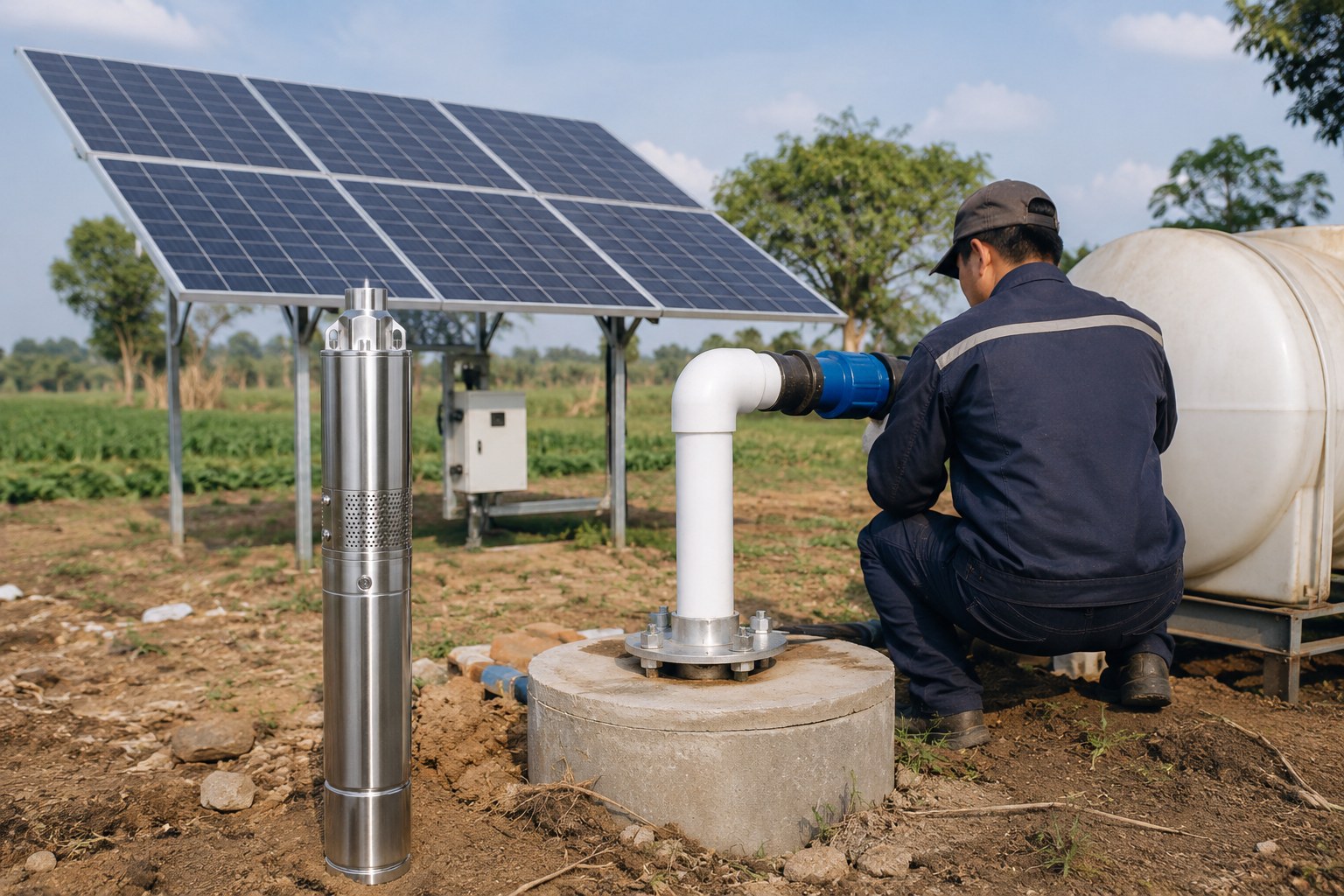
A solar pumping system integrates the pump and motor with an MPPT controller and solar panels. For 24/7 operation, an AC/DC hybrid controller can automatically switch between solar and grid/generator power, ensuring a constant water supply regardless of weather conditions.
A complete solar pumping solution is more than just a pump.
It is a synergistic system where each component is optimized to work together.
The goal is to maximize water output while minimizing cost and complexity.
This system integration is what provides a reliable, autonomous water supply for homes, farms, and livestock in any location.
The Role of the MPPT Controller
The brain of the system is the Maximum Power Point Tracking (MPPT) controller.
Solar panels produce a variable voltage and current depending on sunlight intensity.
The MPPT controller constantly analyzes the output from the solar panels and adjusts the electrical load to extract the absolute maximum amount of power available at any given moment.
This intelligent management can boost the system's daily water output by up to 30% compared to systems with a basic controller.
It also provides crucial protection for the motor against over-voltage, under-voltage, and overheating.
The Power of Hybrid AC/DC Systems
While solar power is ideal, water needs don't stop when the sun goes down or on cloudy days.
This is where hybrid AC/DC technology provides the ultimate solution for water security.
A hybrid controller can accept both DC power from solar panels and AC power from the grid or a generator.
The controller's logic prioritizes solar power first.
It will use 100% solar energy whenever it is sufficient.
If solar energy wanes due to clouds, the controller automatically blends in just enough AC power to meet the demand, maximizing the use of free solar energy.
When there is no solar input at all (e.g., at night), it seamlessly switches over to the AC source.
This ensures you have worry-free access to water 24 hours a day, making it perfect for critical applications like household water supply or large-scale irrigation.
This flexibility eliminates the need for expensive battery storage systems in many cases.
Conclusion
Choosing the right borehole pump means matching your specific water needs with the right technology.
Consider flow, depth, water quality, and power source to find your ideal, long-lasting solution.
FAQs
What is the best type of pump for a deep well?
For very deep wells (over 150 meters), a solar screw pump is often the best choice. It is specifically designed for high-head, low-flow applications.
How many solar panels do I need for a well pump?
The number of panels depends on the pump's power rating, the well's depth, and your daily water needs. An efficient BLDC motor reduces the number of panels required by over 25%.
Can a solar water pump work without batteries?
Yes, most solar pumps are designed to work directly from solar panels during the day. Water is typically pumped into a storage tank for use when the sun isn't shining.
What is a borehole pump?
A borehole pump is a type of submersible pump designed to be installed deep underground to extract water from a well or borehole. They are essential for accessing groundwater sources.
How long does a submersible well pump last?
The lifespan depends on the pump's quality, water conditions, and usage. A high-quality stainless steel pump can last 10-15 years, while standard models typically last 8-10 years.
What is the difference between a submersible pump and a jet pump?
A submersible pump is placed inside the well and pushes water up. A jet pump sits above ground and uses suction to pull water up, making it suitable only for shallow wells (less than 8 meters).
How much does it cost to replace a borehole pump?
Costs vary widely based on pump type, brand, and labor rates. The pump itself can range from a few hundred to several thousand dollars, with installation adding to the final cost.