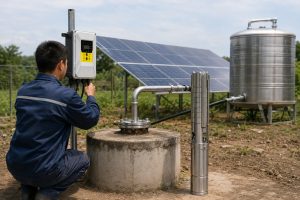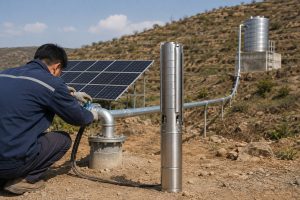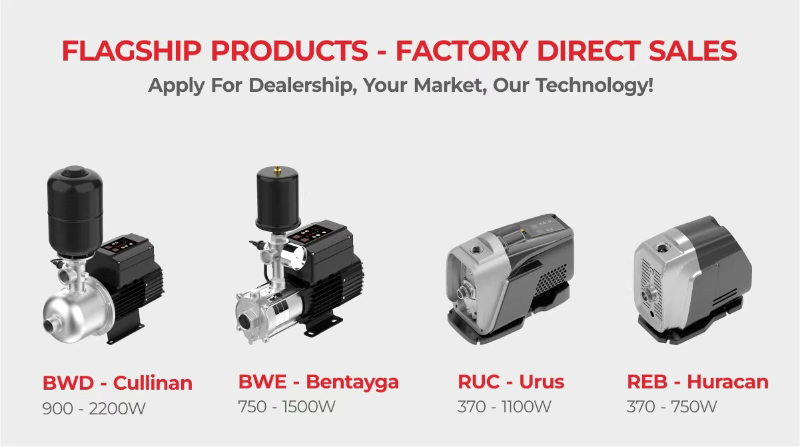
Tired of shocking electricity bills just to keep your pool clean?
Worried that your pool's energy consumption is hurting the environment?
There is a cost-effective, green solution that puts the sun to work for you.
For a standard 1.5 HP pool pump running 8 hours a day, you will typically need between 6 to 10 solar panels, each rated at 300-400 watts. The final number depends heavily on your geographic location, available sunlight, and overall system efficiency.
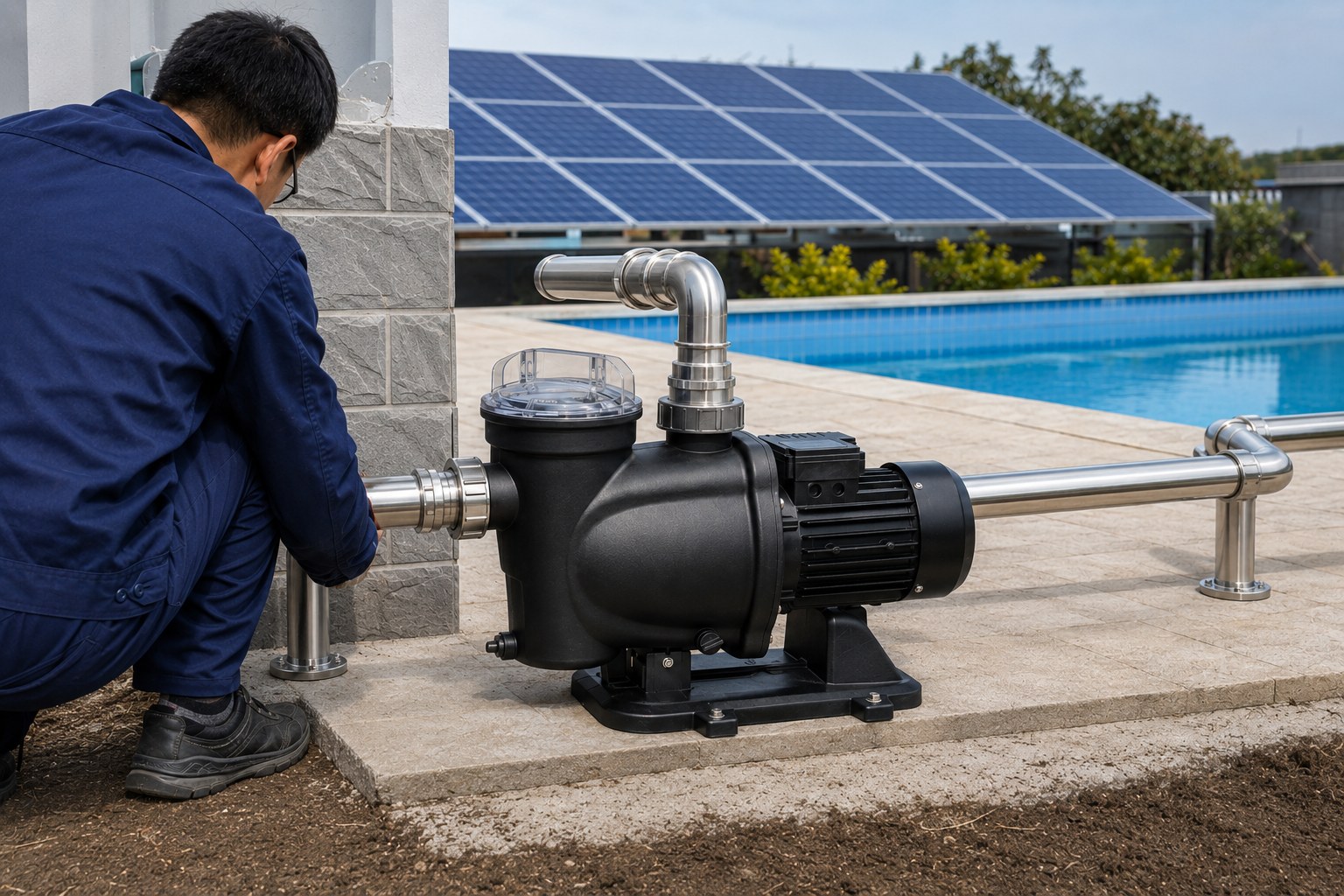
Calculating your exact needs isn't a matter of guesswork.
It's a straightforward process that ensures you invest in a system that performs reliably without overspending.
This guide will walk you through the essential steps, from understanding your pump's power draw to accounting for real-world inefficiencies.
By following along, you can confidently determine the perfect number of solar panels for your specific pump, unlocking years of energy savings.
Let's begin the calculation.
Step 1: Calculate Your Pool Pump’s Daily Energy Needs
Are you unsure how much power your pool pump actually uses every day?
This uncertainty often leads to buying too many or too few panels.
Let's eliminate the guesswork and calculate your pump's exact energy consumption.
To determine your pump's daily energy needs, you simply multiply its power rating in watts by the number of hours it runs each day. A 1,100-watt pump operating for 8 hours uses 8,800 watt-hours (or 8.8 kWh) of energy daily.
Finding Your Pump's Wattage
The first piece of information you need is the pump's power consumption, measured in watts (W).
You can usually find this printed on a label directly on the pump's motor.
If the label only lists horsepower (HP), you can easily convert it.
One horsepower is approximately equal to 746 watts.
Therefore, a 1.5 HP pump consumes about 1.5 * 746 = 1,119 watts.
For simplicity, let's round this to 1,100 watts.
It is critical to use the correct wattage for an accurate calculation.
Determining Your Pump's Daily Run Time
Next, you need to know how many hours your pump runs per day.
This typically ranges from 6 to 8 hours.
The ideal run time ensures the entire volume of your pool water passes through the filter at least once a day, a process known as "turnover."
For our example, we will use a standard run time of 8 hours.
Knowing this allows you to calculate the total daily energy consumption.
This value, measured in watt-hours (Wh) or kilowatt-hours (kWh), is the foundation of your entire solar panel calculation.
For example, our 1,100-watt pump running for 8 hours consumes 1,100 W * 8 h = 8,800 Wh, or 8.8 kWh per day.
Example Daily Energy Consumption
Different pool sizes require different pump capacities.
A larger pool needs a more powerful pump, which in turn consumes more energy.
Understanding this relationship is key for potential distributors advising clients.
The table below illustrates the daily energy consumption for common pump sizes, all assuming an 8-hour daily run time.
| Pump Horsepower (HP) | Approximate Wattage (W) | Daily Run Time (Hours) | Daily Energy Use (kWh) |
|---|---|---|---|
| 1.0 HP | 750 W | 8 | 6.0 kWh |
| 1.5 HP | 1,100 W | 8 | 8.8 kWh |
| 2.0 HP | 1,500 W | 8 | 12.0 kWh |
| 3.0 HP | 2,200 W | 8 | 17.6 kWh |
This data provides a clear baseline for sizing a solar array.
Step 2: Factor in Your Location’s Peak Sun Hours
Do you live in a cloudy region or an area with long winters?
You might worry that solar power isn't a viable option for you.
The secret is to understand "peak sun hours," a more precise metric than simple daylight hours.
Peak sun hours represent the number of hours per day when the solar intensity is at its peak (1,000 W/m²). This value, which varies significantly by location and season, is the most important factor in determining a solar panel's actual daily energy output.
What Exactly Are Peak Sun Hours?
A common mistake is to confuse peak sun hours with the total hours of daylight.
A solar panel generates power from sunrise to sunset, but the intensity is not constant.
Power generation is low in the early morning and late afternoon.
It is highest around midday when the sun is directly overhead.
"Peak sun hours" is a standardized unit that effectively squishes all the distributed sunlight of a day into a number of equivalent hours of "peak" sun.
For example, a location might have 12 hours of daylight but only 5 peak sun hours.
This means the total solar energy received that day is equivalent to what would be received in 5 hours of maximum intensity sunlight.
How Peak Sun Hours Affect Panel Count
This metric directly impacts your system design.
A location with more peak sun hours requires fewer solar panels to generate a specific amount of energy.
Conversely, a location with fewer peak sun hours needs more panels to accomplish the same task.
This is why a solar pump system in Arizona will look very different from one in the Northeast United States or Northern Europe.
As a distributor, understanding the peak sun hours in your target markets is essential for providing accurate quotes and effective solutions to your customers.
You can find this data from national renewable energy labs, such as the NREL in the United States, or other meteorological services.
Estimated Peak Sun Hours for Global Regions
To design a system, you need reliable data for your specific area.
The values can vary not just by country but also by region within a country.
Below is a table providing a general estimate of average daily peak sun hours for various regions, which is useful for preliminary planning.
| Region | Average Peak Sun Hours (Daily) |
|---|---|
| Southwestern US (Arizona, California) | 5.5 - 7.5 |
| Australia (Most regions) | 4.5 - 6.5 |
| Middle East (Saudi Arabia, UAE) | 5.5 - 7.0 |
| Southern Africa | 5.0 - 6.5 |
| South America (Chile, Brazil) | 4.0 - 6.0 |
| Northern Europe | 2.5 - 4.0 |
Always consult local, up-to-date solar irradiance maps for the most precise figures.
Step 3: Size Your Solar Array and Account for Inefficiency
Simply matching a panel's advertised output to your pump's needs seems logical.
However, this approach is a common trap that ignores real-world performance losses.
Failing to account for system inefficiencies will leave your pump underpowered and your investment wasted.
First, divide your pump's daily energy needs (in kWh) by your area's peak sun hours to find the basic required solar array size (in kW). Then, you must increase this number by 20-25% to build a buffer for inevitable real-world energy losses.
The Basic Sizing Formula
The starting point for your calculation is a simple formula.
System Size (kW) = Daily Energy Use (kWh) / Peak Sun Hours (h)
Using our ongoing example of a 1.5 HP pump (8.8 kWh/day) in a location with 5 peak sun hours:
System Size (kW) = 8.8 kWh / 5 h = 1.76 kW
This means you need a solar array that can generate 1.76 kW, or 1,760 watts, of power during peak sun conditions.
However, this is an ideal number in a perfect world.
Why You Must Add an Inefficiency Buffer
Solar systems never operate at 100% of their rated capacity.
Several factors contribute to this power loss, and a smart design must account for them.
- Weather: Clouds, fog, and rain can dramatically reduce output.
- Temperature: Solar panels lose efficiency as they get hotter. A panel's output can decrease by 10-15% on a very hot day.
- Dirt and Debris: Dust, leaves, and bird droppings on the panel surface can block sunlight.
- Wiring and Inverter Losses: Energy is lost as it travels through wires and is converted by the controller, typically around 5-10%.
- Panel Degradation: All solar panels slowly lose efficiency over time, a process called degradation.
To ensure your pump runs reliably even under less-than-ideal conditions, you must add a safety margin.
A standard buffer of 20-25% is recommended.
So, our 1.76 kW system size becomes: 1.76 kW * 1.25 = 2.2 kW (or 2,200 watts).
Calculating the Final Panel Count
Now you have the final, adjusted power requirement for your solar array: 2,200 watts.
The last step is to divide this number by the wattage of a single solar panel.
Solar panel wattage typically ranges from 300W to 500W for modern panels.
Let's assume we are using 400-watt panels.
Number of Panels = 2,200 W / 400 W = 5.5
Since you cannot install half a panel, you must always round up.
In this case, you will need 6 solar panels of 400 watts each to reliably power your 1.5 HP pool pump.
The Power Within: How Efficient Motors Reduce Panel Needs
Buying more solar panels seems like the only way to meet your pump's power demands.
But what if the pump itself could save you money and reduce system complexity?
A highly efficient motor completely changes the sizing equation.
Modern solar pumps use high-efficiency Brushless DC (BLDC) permanent magnet motors. These motors can be over 90% efficient, reducing a pump's energy draw by 30% or more compared to standard AC motors. This directly translates to needing fewer solar panels.
The BLDC Motor Advantage
Traditional pumps often use AC induction motors, which have an efficiency of around 60-70%.
This means 30-40% of the electrical energy is wasted as heat, not used for pumping water.
BLDC motors are a technological leap forward.
They use powerful permanent magnets on the rotor and have no brushes that wear out.
An electronic controller manages the motor, resulting in significantly higher efficiency, often exceeding 90%.
This means more of the sun's energy is converted into the useful work of moving water.
Efficiency by the Numbers
This efficiency gain has a dramatic impact on the number of solar panels you need.
A BLDC motor can perform the same amount of work as a larger, less efficient AC motor while consuming far less power.
For example, a pump that would require a 1,100-watt AC motor might only need an 840-watt BLDC motor to achieve the same water flow.
This reduction in power demand directly shrinks the required size of your solar array, saving you money on panels, mounting hardware, and installation complexity.
The table below shows a direct comparison.
| Motor Type | Power for Same Flow Rate | Daily Energy Use (8 hrs) | Required 400W Panels (5 PSH, 25% buffer) |
|---|---|---|---|
| Standard AC Motor (~70% Eff.) | 1,100 W | 8.8 kWh | 6 panels |
| High-Efficiency BLDC Motor (~92% Eff.) | 840 W | 6.72 kWh | 5 panels |
As you can see, choosing a pump with a BLDC motor can reduce your panel count, in this case by one whole panel, lowering initial system cost.
Beyond Efficiency: Other BLDC Benefits
The advantages of BLDC motors go beyond just energy savings, which is a key selling point for distributors.
- Longer Lifespan: With no brushes to wear out, BLDC motors can run for over 20,000 hours, significantly outlasting their brushed counterparts.
- Maintenance-Free: The lack of wearable parts means these motors require virtually no maintenance over their lifetime.
- Compact and Lightweight: BLDC motor designs are inherently more compact. They can be up to 47% smaller and 39% lighter than traditional motors of similar power, simplifying installation and shipping.
- Quiet Operation: These motors run much more quietly, a significant benefit for residential pool applications.
For a distributor, offering products with this advanced motor technology creates a strong competitive advantage based on efficiency, durability, and long-term value.
Beyond Pool Pumps: The Versatility of Solar Pumping Technology
You have successfully solved the energy needs for a pool pump.
But what about other water challenges, like irrigation or deep well extraction?
Limiting your product line to pool pumps means missing out on massive global markets.
The same core technology—efficient BLDC motors and intelligent controllers—is highly versatile. This technology powers a wide portfolio of pumps, from high-head screw pumps for deep wells to corrosion-resistant impeller pumps for agriculture, meeting diverse water needs worldwide.
Matching Pump Type to Application
While the motor provides the power, the pump end determines how that power is used.
The design of the pump's mechanics is specialized for the intended application.
This allows for a complete and competitive product portfolio that can serve households, farms, and ranches across different continents and water conditions.
Distributors with a diverse portfolio can meet more customer needs and capture a larger market share.
The three most popular types of solar deep well pumps showcase this versatility.
For Deep Wells and High Lifts: Solar Screw Pumps
In arid regions across Africa and Latin America, water is often found hundreds of feet below ground.
A solar screw pump is designed for this high-head, low-flow scenario.
It uses a stainless steel screw rotating inside a rubber stator.
This action pushes water upwards with immense pressure, making it ideal for deep domestic wells and livestock watering.
A key advantage is its high resistance to sand, a common issue in boreholes that can quickly destroy other pump types.
For High Volume Irrigation: Solar Impeller Pumps
For applications like farm irrigation or pasture water supply, high water volume is more important than extreme pressure.
Multi-stage centrifugal pumps with impellers excel here.
- Plastic Impeller Pumps: These are economical, lightweight, and offer excellent resistance to fine sand. They deliver high flow at a medium head, making them popular in Africa and the Americas for agriculture and large gardens.
- Stainless Steel Impeller Pumps: In regions with acidic or alkaline water, such as parts of Australia, corrosion is a major concern. A pump with a full SS304 stainless steel body and impellers offers superior durability and a long service life, targeting high-end residential and premium agricultural markets.
This flexible product portfolio allows distributors to provide tailored, reliable water solutions for nearly any off-grid or rural scenario.
What About Cloudy Days? The Smart Solution of Hybrid Systems
A solar pump works beautifully when the sun is shining.
But what happens on a string of cloudy days, or if you need to run the pump at night?
Relying solely on solar power can mean having no water when you need it most.
An AC/DC hybrid controller brilliantly solves this problem. It automatically prioritizes solar power when available but can seamlessly blend in or switch to grid (AC) power or a generator when sunlight is insufficient. This ensures a reliable, worry-free water supply 24/7.
How Hybrid Controllers Work
This intelligent controller is designed with dual power inputs.
You can connect both your solar panel array and an AC power source (like the utility grid or a backup generator) to the controller at the same time.
The controller's internal logic is programmed to always use the free energy from the sun first.
It constantly monitors the solar input.
When the photovoltaic power is sufficient to run the pump, the AC input remains on standby.
If clouds roll in and the solar power drops, the controller automatically draws power from the AC source to keep the pump running at the desired speed.
When the sun returns, it switches back to solar priority.
This entire process is seamless and requires no manual intervention.
The "Hybrid" Function: Maximizing Every Ray of Sun
Advanced controllers offer more than just a simple switch.
They can actually blend the two power sources.
If the solar panels are producing some power, but not enough to run the pump at full speed, the controller doesn't just give up and switch fully to AC.
Instead, it will use all the available solar power and supplement it with just enough AC power to meet the demand.
This "hybrid" function ensures you are maximizing the use of free solar energy at all times, only using paid grid power as a last resort.
The Market Advantage for Distributors
For a B2B audience of importers and distributors, the hybrid controller is not just a feature; it's a powerful market expander.
It transforms a solar pump from a "sunny weather only" product into a reliable, all-weather water solution.
This eliminates the primary concern for many potential end-users and justifies a premium price point.
It makes solar pumping a viable and attractive solution even in regions with less predictable sunshine.
Offering products with this capability allows distributors to market a "worry-free water" solution, a compelling message that drives sales and builds brand reputation for reliability and intelligence.
Conclusion
Calculating solar panel needs involves understanding your pump's energy use, location's sun, and system efficiency.
Advanced, efficient motors and smart hybrid controllers are key to optimizing performance, reliability, and cost.
Frequently Asked Questions
Can I run a pool pump on just one solar panel?
Generally, no. Most pool pumps require a multi-panel array to generate sufficient voltage and current, especially considering real-world conditions and system losses.
Do solar pool pumps work on cloudy days?
Standard systems will stop or run slowly. Systems with an AC/DC hybrid controller, however, will automatically switch to grid power to ensure uninterrupted operation.
How long do solar-powered pool pumps last?
Pumps equipped with high-quality BLDC motors can last for 20,000 to 30,000 hours, which is significantly longer than the 2,000-5,000 hour lifespan of traditional motors.
Is it better to have a separate solar system for a pool pump?
Dedicating an array to the pump can be beneficial. It avoids conflicting with your home's main solar system limits and ensures all generated power goes directly to the pump.
What maintenance do solar pump systems require?
These systems are very low-maintenance. Panels may need occasional cleaning, and pumps with brushless DC motors are virtually maintenance-free due to having no wearable parts.
Can solar panels damage my pool pump?
No. A properly designed system includes a controller that regulates voltage and current, protecting the pump motor from any potential damage from power fluctuations.
What is the main benefit of a BLDC motor in a solar pump?
Its primary benefit is high efficiency (over 90%). This means it requires significantly less power and fewer solar panels to perform the same amount of work as a standard motor.
Can I use a battery with my solar pool pump?
Yes, batteries can be added to store excess solar energy for nighttime or cloudy day use. However, this adds significant cost and complexity to the system.