Running a pool pump is expensive.
Grid electricity costs are always rising.
Solar power offers a clean, cost-effective solution to keep your pool sparkling without the high bills.
For a typical 2 HP pool pump, you will need approximately 6 to 7 solar panels of 300 watts each. The exact number depends on your pump's power, daily run time, and your geographic location's peak sun hours. This setup ensures efficient, grid-free operation.
Calculating your exact needs is a straightforward process.
It ensures you don't overspend or under-power your system.
Let's break down the different approaches and calculations to find the perfect number of panels for your pool.
The Two Main Ways to Power Your Pool Pump with Solar
You want to use solar for your pool pump, but you're not sure where to start.
There are two main paths, each with its own benefits.
Understanding them is the first step.
You can either dedicate new panels to a special DC solar pump (off-grid) or power your existing AC pump with a larger, grid-tied home solar system. The off-grid option offers energy independence for your pool, while the grid-tied option offers more system-wide flexibility.
Choosing the right path depends on your current setup, budget, and energy goals.
Both options drastically reduce the cost of running your pool, which can account for up to 18% of a home's electricity bill.
Let's explore these two methods in more detail.
Option 1: The Dedicated Off-Grid System
This approach creates a self-contained power plant just for your pool.
You buy a specific DC (Direct Current) pool pump designed to run directly from solar.
A set of 4 to 6 solar panels is wired directly to this pump through a controller.
When the sun shines, the pump runs.
It's beautifully simple and completely independent of the utility company.
This means you will never pay for grid electricity to power your pump again.
Because the system isn't connected to the grid, you often don't need utility permission to install it.
This is a major advantage in areas with strict regulations on grid-tied solar installations.
The pump's operation naturally syncs with the swimming season.
It runs longer and harder during the sunny summer months and less in the winter.
However, this method requires you to replace your existing AC pump.
If your panels produce more power than the pump needs, that excess energy is wasted because it cannot power anything else in your home.
Option 2: The Integrated Grid-Tied System
This is often the most efficient use of your solar investment.
You install a standard, grid-connected solar system on your home that is large enough to power both your household appliances and your pool pump.
A system of 6kW or more is typically recommended.
You don't need to change your existing AC pool pump.
You simply set your pump's timer to run during peak sunlight hours, usually from 10 a.m. to 3 p.m.
During this time, the solar panels are generating a surplus of electricity.
This "free" solar energy powers your pump.
Any excess solar power not used by the pump or your home is exported to the grid, often earning you a credit on your bill (known as a Feed-In Tariff).
This ensures no solar energy ever goes to waste.
The main downside is that on very overcast days, your pump might still draw some expensive electricity from the grid.
Comparison Table: Off-Grid vs. Grid-Tied
| Feature | Dedicated Off-Grid System | Integrated Grid-Tied System |
|---|---|---|
| Pump Type | Requires new DC Pump | Uses existing AC Pump |
| Grid Connection | No | Yes |
| Excess Energy | Wasted | Used by home or exported to grid |
| Cloudy Day Power | Pump stops | Draws from the grid |
| Installation | Simpler wiring, no utility permit | Requires utility interconnection |
| Initial Cost | Lower for just the pump system | Higher for the whole-home system |
| Overall Efficiency | Less efficient (wasted energy) | More efficient (all energy used) |
How to Calculate the Solar Panels for Your Specific Pump
Calculating your solar needs seems complex, but it's just a few simple steps.
Getting this right is crucial for a system that works efficiently.
An undersized system won't clean your pool, and an oversized one wastes money.
First, find your pump's daily energy use in watt-hours. Then, divide that number by your area's peak sun hours to find the required solar system size in kilowatts (kW). Finally, account for energy losses and divide by the panel wattage to get the number of panels.
This calculation provides a reliable estimate to guide your purchase.
Let's walk through each step with a clear example so you can do it yourself.
Remember that this is an estimate, and a professional installer can provide a more precise plan.
Step 1: Calculate Your Pump's Energy Consumption
The first piece of the puzzle is how much power your pump uses.
This is usually rated in horsepower (HP) or watts (W).
One horsepower is equal to 745.7 watts.
So, a 1.5 HP pump uses approximately 1,119 watts.
1.5 HP x 745.7 W/HP = 1,118.55 W
Next, determine how many hours your pump runs each day.
A common run time is 8 hours to ensure the pool water fully circulates.
Now, multiply the wattage by the hours to get the daily energy consumption in watt-hours (Wh).
1,119 W x 8 hours = 8,952 Wh
To make the number easier to work with, we convert it to kilowatt-hours (kWh) by dividing by 1,000.
8,952 Wh / 1,000 = 8.95 kWh per day
This is your daily energy target.
Step 2: Find Your Location's Peak Sun Hours
"Peak sun hours" is not just the number of daylight hours.
It's the average number of hours per day when solar irradiance is at its peak (1,000 watts per square meter).
This number is the most critical factor and varies significantly by location.
For example, Arizona may get over 5.75 peak sun hours, while a state like Vermont may get less than 4.
You can find this data from sources like the National Renewable Energy Laboratory (NREL).
| State | Average Peak Sun Hours | State | Average Peak Sun Hours |
|---|---|---|---|
| Arizona | 5.25 - 5.75+ | New York | 4.0 - 4.25 |
| California | 4.0 - 5.75+ | Florida | 4.75 - 5.5 |
| Texas | 4.5 - 5.75+ | Illinois | 4.0 - 4.5 |
| Ohio | < 4.0 - 4.25 | Washington | < 4.0 - 4.5 |
For our example, let's assume our location gets 5 peak sun hours.
Step 3: Calculate the Number of Panels
Now, we can determine the required size of your solar array.
Divide your daily energy consumption by your peak sun hours.
8.95 kWh / 5 hours = 1.79 kW
This means you need a solar system capable of producing 1.79 kW of power.
However, solar systems are not 100% efficient.
Weather, panel angle, dirt, and wiring all cause energy loss.
It is standard practice to add a buffer of about 15-25% to account for these real-world losses.
Let's add a 20% buffer for a conservative estimate.
1.79 kW x 1.20 = 2.15 kW
So, you need a system that is at least 2.15 kW.
Finally, divide this system size by the wattage of the solar panels you plan to use.
Panel wattages typically range from 300W to 500W.
Using 400W panels (or 0.4 kW):
2.15 kW / 0.4 kW per panel = 5.37 panels
Since you can't buy a fraction of a panel, you must round up.
You would need 6 solar panels of 400 watts each to reliably power your 1.5 HP pool pump.
Choosing the Right Equipment for Your Solar Pool System
The number of panels is only part of the story.
The quality and type of your pump and controller are just as important.
Making a poor choice here can lead to system failure and wasted investment.
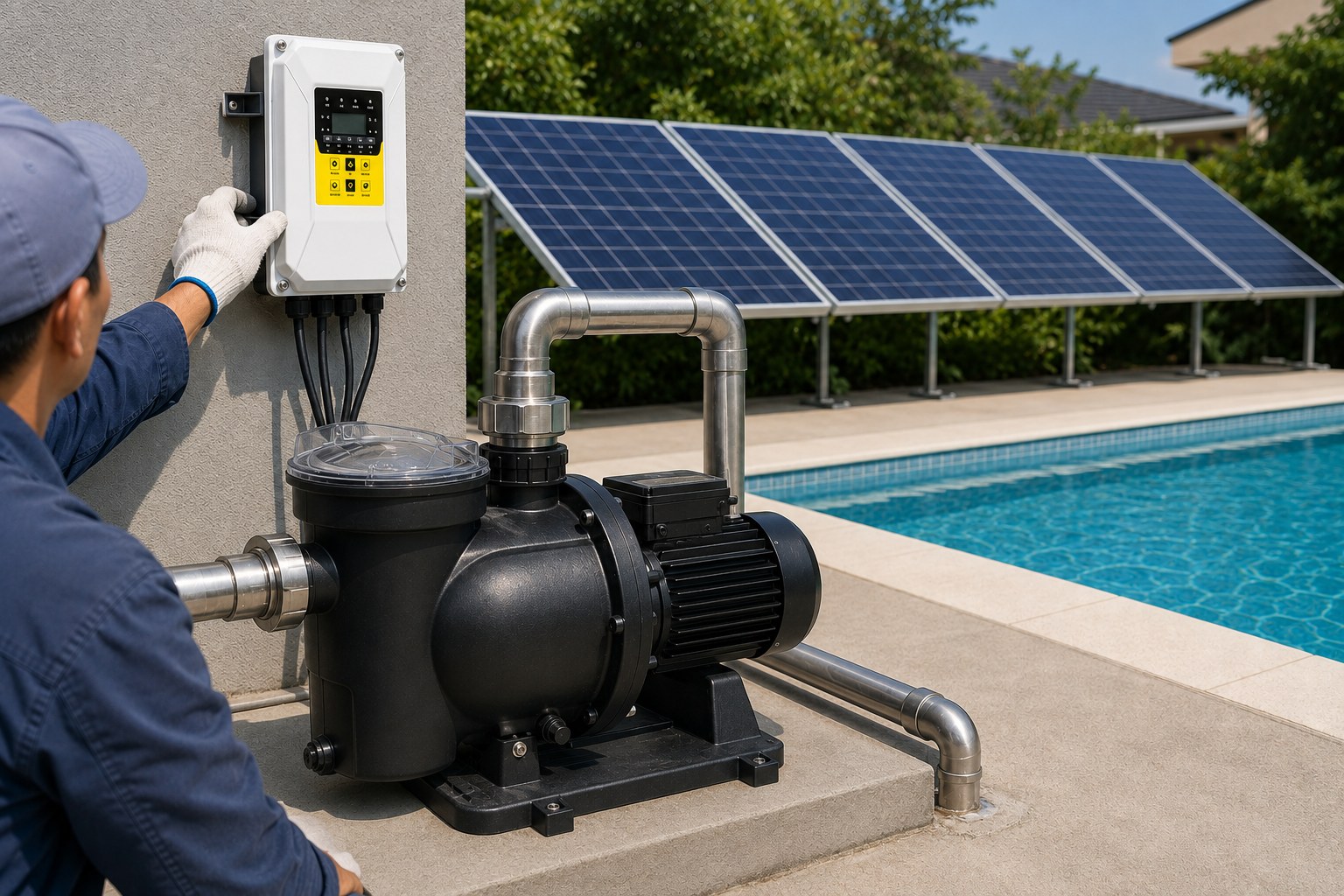
Focus on a high-efficiency DC pump with a brushless motor (BLDC) and an intelligent MPPT controller. This combination minimizes the number of panels needed, extends the pump's lifespan, and maximizes the energy harvested from the sun each day.
The technology inside these components has a massive impact on performance and reliability.
A cheap pump might seem like a good deal, but it will likely cost you more in the long run through inefficiency and early failure.
Let's dive into the key components that make a solar pump system truly effective.
The Heart of the System: The Motor
The motor is the engine of your pump.
Most modern, high-quality DC solar pumps use a Brushless DC (BLDC) permanent magnet motor.
These motors are a game-changer for solar applications.
Their efficiency often exceeds 90%, compared to 75-80% for a standard AC motor.
This 10-15% efficiency gain is significant.
It means the motor converts more of the sun's energy into water-pumping action, reducing the number of solar panels you need to buy.
A system with a 90% efficient BLDC motor might require only 5 panels, whereas a less efficient motor might need 6 panels to do the same job.
These motors also have a much longer lifespan, typically rated for 20,000 to 30,000 hours of operation.
A traditional brushed motor might only last 2,000 to 5,000 hours.
That's a potential 10x increase in durability, saving you from costly replacements.
Not All Pumps Are Created Equal: Pump Types
If you choose a dedicated DC pump, you'll find there are different types for different needs.
- Solar Screw Pumps: These use a metal screw to push water. They are excellent for deep wells where you need to lift water from great depths (high head), but they provide lower flow rates. They are also highly resistant to sand.
- Solar Centrifugal Pumps: These use an impeller to move water. They are designed for high flow rates at lower to medium heads. They are perfect for circulating pool water or for farm irrigation. These pumps come with different impeller materials.
- Plastic Impeller: A cost-effective and lightweight option that is great for general use and has good resistance to fine sand.
- Stainless Steel Impeller: A premium, more durable option. It is highly resistant to corrosion, making it ideal for saltwater pools or areas with aggressive water chemistry.
The Brains of the Operation: The Controller
The solar pump controller is a small box that manages the power from the panels to the pump.
A good controller is essential.
Look for one with Maximum Power Point Tracking (MPPT).
An MPPT controller constantly adjusts the electrical load to extract the maximum possible power from the solar panels as sunlight conditions change.
This can boost your system's output by up to 30% compared to a system without one.
Some low-quality systems have a critical flaw: they cycle on and off rapidly during partly cloudy conditions.
This start-stop action puts immense stress on the motor and can cause it to burn out quickly.
Advanced controllers have "soft start" algorithms that prevent this.
Even better, some modern controllers feature a hybrid AC/DC input.
This allows the system to automatically switch to grid power (AC) on cloudy days or at night when solar is unavailable.
It ensures your pool stays clean 24/7 while prioritizing free solar energy whenever possible.
Understanding System Losses and Real-World Performance
Your calculations give you a perfect-world number.
But reality is never perfect.
You must account for factors that reduce your system's output, or you'll be underpowered.
Ignoring these losses is a common mistake that leads to disappointment.
Your solar system will lose 15-25% of its potential power due to factors like heat, panel orientation, dirt, and electrical resistance. Factoring in a buffer of at least 20% ensures your pump runs reliably even on less-than-perfect days.
These losses are not a sign of a faulty system; they are a normal part of how solar technology works.
A smart system design anticipates and minimizes them.
Let's break down where this energy disappears and what you can do about it.
Why Systems Underperform Their Rating
Several factors chip away at your panels' rated wattage.
- Temperature: Solar panels are tested at 25°C (77°F). For every degree above this, their efficiency drops by about 0.3-0.5%. On a hot roof, a panel's surface can easily reach 65°C (149°F), reducing its output by over 12%.
- Panel Orientation and Tilt: For maximum production, panels should face true south (in the Northern Hemisphere) at a tilt angle roughly equal to your latitude. Any deviation from this ideal angle will reduce the energy captured.
- Shading and Dirt: Even a small amount of shade from a tree branch or vent pipe can significantly reduce a panel's output. Dust, pollen, and bird droppings also block sunlight and can decrease performance by 5% or more if not cleaned.
- Wiring and Inverter Losses: Energy is lost as heat as it travels through wires (resistive loss). The controller or inverter that converts the electricity for the pump also consumes a small amount of power, typically leading to a 3-10% efficiency loss.
How to Mitigate Losses
You can't eliminate all losses, but you can minimize them.
Ensure there is a gap of a few inches between your panels and the roof to allow for airflow, which helps keep them cooler.
Work with an installer to find the optimal placement and angle for your panels, avoiding any potential sources of shade throughout the day.
Clean your panels once or twice a year, or more often if you live in a dusty or polluted area.
Using the correct gauge of wire for the distance between your panels and pump will minimize resistive losses.
Most importantly, follow the calculation guide.
The step where you add a 20% buffer to your required system size is specifically designed to overcome these combined real-world losses.
This ensures you have enough power on tap to meet your pump's needs day in and day out.
Conclusion
Calculating the right number of solar panels for your pool pump involves a few key steps.
It empowers you to build an efficient, cost-effective system that will save you money for years.
FAQs
Can I run a pool pump directly from a solar panel?
Yes, but only with a special DC pump and a controller. You cannot connect a standard AC pump directly to a solar panel as the power types are incompatible.
Is it worth getting solar for a pool pump?
Absolutely. A pool pump is a major energy user. Solar can eliminate this cost, offering a return on investment in as little as 3-5 years and reducing your carbon footprint.
How big of a solar system do I need to run a pool pump?
A 1.5 HP pump typically needs a 2-2.5 kW system, which is about 5-6 panels of 400W each. The exact size depends on your pump, location, and run time.
How long will a solar pool pump last?
A quality DC solar pump with a brushless motor can last 20,000-30,000 hours, or over 10 years of typical seasonal use. This is much longer than standard AC pumps.
Do solar pool pumps work on cloudy days?
They run at a reduced speed on overcast days. For full performance, some systems use a hybrid controller that can automatically switch to grid power when sunlight is insufficient.
Can you run a pool pump 24/7 with solar?
Not with solar alone, as panels don't produce power at night. To run 24/7, you would need a large battery bank or a hybrid controller connected to the grid.