Worried about your pool pump's high energy bill?
Running it less saves money, but what about water quality?
There's a better way to balance both.
Yes, a variable speed pump should ideally run 24/7. Running at low speeds for longer periods provides superior filtration and chemical distribution. This method uses significantly less energy—up to 80% less—than a single-speed pump running for just a few hours, making it both healthier for your pool and cheaper to operate.
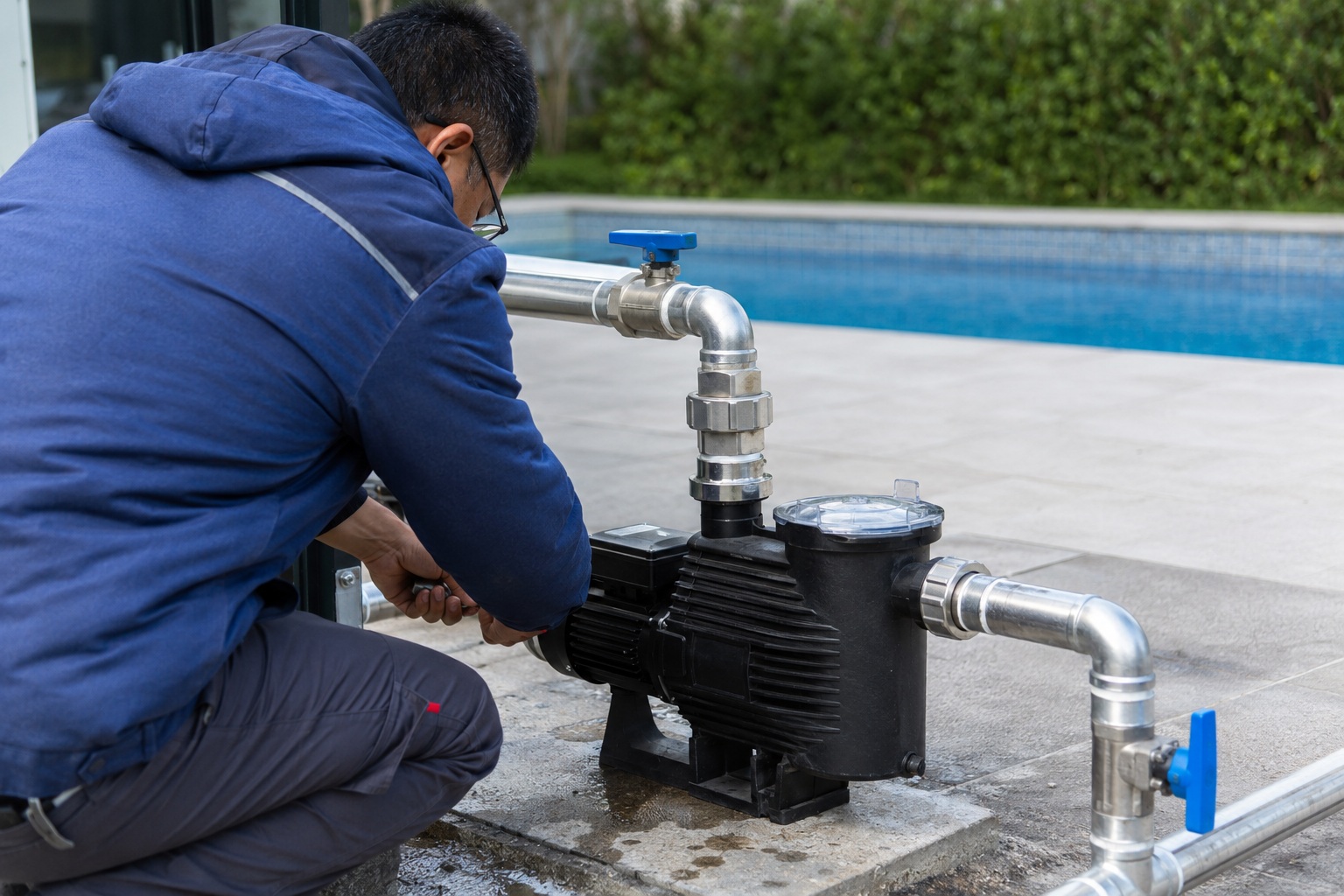
Running a pool pump all day might seem wasteful.
For years, the standard advice was to run it for 8-12 hours and then shut it off.
This was based on old, inefficient technology.
Modern variable speed pumps have completely changed the rules.
Let's break down why continuous, low-speed operation is the new standard for professional pool care.
We will explore the science behind the massive energy savings.
We will also see how it impacts your pool's health and how to find the perfect schedule for crystal-clear water without the high cost.
This approach will help you understand the true value of upgrading your circulation system.
What Happens If You Run a Pool Pump 24/7?
Running a pump nonstop sounds expensive and unnecessary.
For older pumps, it is.
But for modern pumps, it’s a game-changer for water clarity and health.
Running a traditional single-speed pump 24/7 leads to massive energy bills and premature equipment failure. In contrast, a modern variable speed pump can run 24/7 at low speeds, drastically improving filtration while saving up to 80% on energy costs compared to short, high-speed cycles.
The conversation about 24/7 pump operation is really a tale of two different technologies.
How you answer the question depends entirely on the type of pump connected to your pool.
Understanding the difference between the old and new ways is crucial for any pool owner or distributor.
It highlights the shift from brute-force circulation to intelligent, efficient water management.
The Old Way: Single-Speed Pumps
Single-speed pumps are the dinosaurs of the pool world.
They have one setting: on.
When you switch one on, its induction motor spins at a constant, high speed, typically around 3,450 RPM (Revolutions Per Minute).
This high speed is necessary to provide enough flow for tasks like backwashing or running a cleaner, but it's massive overkill for simple, everyday filtration.
It’s like driving your car everywhere in first gear.
You get there, but you burn an enormous amount of fuel.
Running a single-speed pump 24/7 is financially punishing.
A typical 1.5 horsepower (HP) model can consume over 2,000 watts per hour.
| Pump Type | Daily Run Time | Daily Energy Use | Estimated Daily Cost (@$0.15/kWh) |
|---|---|---|---|
| 1.5 HP Single-Speed | 8 Hours | 16 kWh | $2.40 |
| 1.5 HP Single-Speed | 24 Hours | 48 kWh | $7.20 |
As the table shows, running it 24/7 can triple your daily cost, adding over $140 to your monthly electric bill.
This constant, high-stress operation also causes significant wear and tear on the pump's motor, bearings, and seals, leading to a shorter lifespan and more frequent, costly repairs.
The New Standard: Variable Speed Pumps (VSPs)
Variable speed pumps are the modern, intelligent solution.
Instead of one fixed speed, they allow you to program various speeds for different tasks.
For daily filtration, you can run the pump at a very low speed (e.g., 1,500 RPM).
This slow, gentle circulation is far more effective at filtering small particles and distributing chemicals evenly.
The best part is the energy savings.
Running a VSP at a low speed 24/7 can cost significantly less than running an old single-speed pump for just 8 hours.
| Pump Type | Daily Run Time | Avg. Speed (RPM) | Estimated Daily Cost (@$0.15/kWh) |
|---|---|---|---|
| 1.5 HP Single-Speed | 8 Hours | 3,450 RPM | $2.40 |
| 1.5 HP Variable-Speed | 24 Hours | 1,500 RPM | $0.90 |
A VSP running 24/7 provides continuous filtration for superior water quality at less than half the cost of an old pump running for a third of the time.
This constant movement prevents algae, keeps the water clearer, and reduces the need for expensive chemical treatments, making it the superior choice for both cost and performance.
How Does a Variable Speed Pump Save So Much Energy?
How can running a pump three times longer cost 60% less?
It seems to defy logic.
The secret lies in a fundamental law of fluid dynamics and advanced motor technology.
The incredible efficiency comes from the Pump Affinity Law. This law states that if you halve the pump's speed, you reduce its power consumption by 87.5% (to one-eighth). VSPs leverage this by running at very low speeds, resulting in massive energy savings even over 24-hour periods.
The energy-saving capabilities of variable speed pumps are not just a minor improvement; they represent a revolutionary leap in efficiency.
This leap is made possible by two key factors working together.
First is the physics of how water moves, and second is the sophisticated motor technology that powers the pump.
Grasping these concepts is essential for understanding the value proposition you can offer to customers.
Understanding the Pump Affinity Law
The Pump Affinity Law is a core principle in fluid mechanics.
It describes the relationship between a pump's speed, flow rate, and power consumption.
The most important part of this law for pool owners is this: power consumption is proportional to the cube of the flow rate.
In simple terms, a small decrease in pump speed creates a disproportionately massive decrease in energy use.
Let’s look at the numbers.
| Speed Reduction | Flow Reduction | Power Consumption Reduction |
|---|---|---|
| 10% | 10% | ~27% |
| 30% | 30% | ~66% |
| 50% (Half Speed) | 50% | 87.5% (Uses 1/8th the power) |
This is why running a VSP at a low speed for 24 hours is so economical.
Even though you run it three times as long as an 8-hour single-speed cycle, you might be using only one-eighth of the power at any given moment.
The result is a net energy saving of over 60-80%.
This principle is the foundation of all VSP savings and the main reason they have become mandatory in many regions for new pool installations.
The Power of the Permanent Magnet Motor
The second piece of the puzzle is the motor itself.
Old single-speed pumps use standard induction motors, a technology that has been around for over a century.
These motors are relatively inefficient, with energy efficiency ratings often between 30% and 70%.
A significant portion of the electricity they consume is wasted as heat rather than used to move water.
Variable speed pumps, on the other hand, use a much more advanced motor.
These are known as brushless DC (BLDC) or Permanent Magnet (PM) motors.
This is the same type of motor technology used in electric vehicles.
Instead of using electricity to create a magnetic field in the rotor, they use powerful, built-in permanent magnets.
This design is inherently more efficient.
- Induction Motor Efficiency: 30% - 70%
- BLDC/Permanent Magnet Motor Efficiency: Over 90%
This 20-60% efficiency advantage means that for every watt of electricity, more power is converted into the work of pumping water.
When you combine the hyper-efficient motor with the massive savings from the Pump Affinity Law, you get a pump that can move water with unparalleled cost-effectiveness.
Why is 24/7 Circulation Better for Your Pool?
You might save a few dollars by turning your pump off.
But in doing so, you're creating a stagnant backyard pond.
This stillness is a breeding ground for problems that cost more to fix.
Continuous circulation prevents stagnant water, which is where algae and bacteria thrive. It ensures chemicals are always evenly distributed and your filter is constantly removing contaminants. This leads to a cleaner, safer, and healthier pool that requires fewer expensive chemical shocks to maintain.
A beautiful, inviting pool is a healthy pool.
And the single most important factor for a healthy pool is circulation.
When water is stagnant, it becomes a perfect environment for all the things you don't want.
Running a pump 24/7 at a low speed solves these problems proactively rather than forcing you to react to them with harsh chemicals later.
This consistent motion is the key to maintaining perfect water with minimal effort.
Achieving Optimal Turnover Rate
A crucial concept in pool maintenance is the "turnover rate."
This is the amount of time it takes for the entire volume of water in your pool to pass through the filtration system one time.
For a residential pool, a single turnover per day is the absolute minimum.
However, health standards for public pools, based on the Gage-Bidwell Law of Dilution, recommend three to four turnovers every 24 hours.
This means the entire volume of water should be filtered and sanitized every 6 to 8 hours.
- Single-Speed Pump (8-hour schedule): Achieves 1 turnover. The water then sits stagnant for 16 hours, allowing bacteria and algae to multiply.
- Variable Speed Pump (24-hour schedule): Achieves 3-4 turnovers. The water is constantly being refreshed, filtered, and sanitized, keeping contaminants at bay.
With 24/7 circulation, your pool is always in the process of being cleaned.
This drastically reduces the chances of an algae bloom and ensures the water is always safe for swimmers.
Better Filtration and Chemical Efficiency
The effectiveness of your pool's filter is also affected by the speed of the water passing through it.
When water is blasted through the filter at the high speeds of a single-speed pump, it can force smaller particles of dirt and debris right through the filter media.
Lower speeds allow the filter to work more effectively.
Water flows gently through the media, giving it more time to capture tiny contaminants like dust, pollen, and dead algae spores.
This results in visibly clearer, more polished water.
Furthermore, circulation is essential for any sanitizer or chemical to work.
Chlorine, salt chlorine generators, AOP systems, and UV sanitizers only treat the water that passes through them.
- Without 24/7 circulation: Chemicals become concentrated in some areas and non-existent in others. The water your family swims in may not be properly sanitized, and "dead spots" with low circulation become breeding grounds for algae.
- With 24/7 circulation: A consistent, low level of sanitizer is maintained evenly throughout the entire pool. Every part of the pool stays protected, which can reduce your overall chemical consumption and eliminate the harsh "chlorine smell" caused by used-up chlorine (chloramines).
How to Determine the Right Schedule for Your Pump?
Running 24/7 is ideal, but what's the right speed?
Setting it too high wastes energy.
Setting it too low won't clean the pool.
Finding the sweet spot is key to optimization.
Start by calculating your pool's required flow rate for a single turnover in 8 hours. Program your VSP to run at this low speed for most of the day (e.g., 20 hours). Then, schedule a few hours at a higher speed for specific tasks like running cleaners or skimming debris.
A variable speed pump is a powerful tool, but it's only as good as its programming.
Simply running it at a random low speed is not enough.
To truly maximize efficiency and water quality, you need to create a custom schedule based on your pool's specific needs, including its size, features, and usage.
This tailored approach ensures you are getting the job done without wasting a single watt.
Calculating Your Minimum Flow Rate (GPM)
First, you need to determine the minimum flow rate required to turn over your pool's water.
This is measured in Gallons Per Minute (GPM).
The formula is straightforward:
(Pool Volume in Gallons / Desired Turnover Hours) / 60 = Minimum GPM
Let's use a 24,000-gallon pool as an example.
We want to achieve three turnovers per day, which means one turnover every 8 hours.
(24,000 Gallons / 8 Hours) / 60 minutes = 50 GPM
Your goal is to find the lowest RPM setting on your pump that achieves a flow rate of 50 GPM.
Most VSP controllers display either RPM or GPM, making this easy to set.
This low-speed setting will be the foundation of your 24/7 schedule.
Creating a Multi-Speed Schedule
A typical pool doesn't just need filtration.
It may have a suction-side cleaner, a skimmer that works best with more flow, or water features.
A VSP allows you to program a daily schedule with different speeds for these different needs.
Here is a sample schedule for our 24,000-gallon pool:
| Time of Day | Duration | Speed (RPM) | GPM (Approx.) | Purpose |
|---|---|---|---|---|
| 10 PM - 2 PM | 16 Hours | 1,400 RPM | 50 GPM | Primary Filtration (3 Turnovers) |
| 2 PM - 6 PM | 4 Hours | 2,400 RPM | 75 GPM | Surface Skimming & Cleaning |
| 6 PM - 10 PM | 4 Hours | 1,400 RPM | 50 GPM | Evening Filtration |
This schedule runs the pump 24/7.
It dedicates 20 hours to ultra-efficient, low-speed filtration and adds a 4-hour, higher-speed cycle to handle surface debris during the afternoon.
It delivers over three full turnovers while keeping energy costs at an absolute minimum.
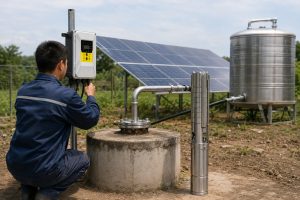
What About Solar Pumps and Cloudy Days?
For pool owners using solar power, the idea of 24/7 operation can raise questions about nighttime or cloudy days.
This is where advanced controller technology comes in.
Modern solar pump systems are often equipped with AC/DC hybrid controllers.
This technology provides a seamless solution for uninterrupted power.
- During the day: The controller pulls power directly from the solar panels to run the pump.
- At night or on cloudy days: When solar input is insufficient, the controller automatically identifies the lack of DC power and switches to an AC power source from the grid.
This hybrid functionality ensures your pool pump continues to run 24/7, maintaining perfect circulation regardless of the weather or time of day.
It maximizes the use of free solar energy while providing the reliability of grid power as a backup, offering the best of both worlds.
Conclusion
Running a variable speed pump 24/7 is not only possible but is the optimal strategy for superior water quality and maximum energy savings.
The key is low-speed operation.
FAQs
How many hours a day should I run my variable speed pool pump?
Ideally, you should run it 24/7 at a low, energy-efficient speed. This ensures constant circulation and filtration, which keeps the water healthier and clearer.
What RPM should I run my variable speed pool pump?
For general filtration, a low speed of 1,000-1,500 RPM is highly efficient. For tasks like running a cleaner, you may need 2,200-2,800 RPM for a few hours.
Does running a pool pump 24/7 use a lot of electricity?
With an old single-speed pump, yes, it's very expensive. But with a variable speed pump on low RPM, it uses far less energy than a single-speed running for just 8 hours.
Is it better to run a pool pump at night or during the day?
With a VSP, it's best to run it 24/7. If you must choose, running during the day helps circulate chemicals while the sun's UV rays are actively depleting them.
What is the most energy efficient pool pump schedule?
The most efficient schedule is running 24/7 at the lowest speed that achieves at least one full turnover per day, with short bursts of higher speed only as needed for cleaning.
Can a variable speed pump pay for itself?
Absolutely. With typical energy savings of 60-80%, a VSP can often pay for its higher upfront cost in just 1-2 pool seasons through dramatically lower electricity bills.
How does a variable speed pump affect pool chemicals?
It improves chemical effectiveness by ensuring constant, even distribution throughout the pool. This prevents algae growth and can reduce your overall chemical usage over time.
Do I need to run my VSP at a high speed at all?
Yes, but only for short periods. Higher speeds are necessary for specific tasks like backwashing the filter, operating suction-side automatic cleaners, or running water features like waterfalls.