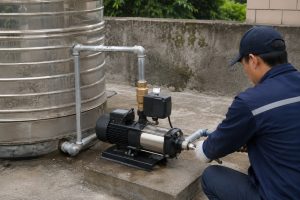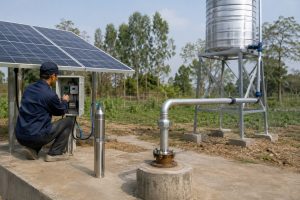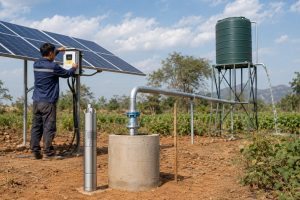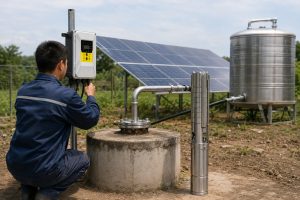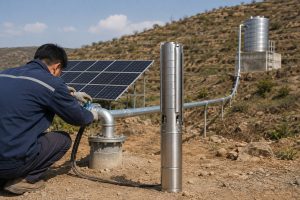
Struggling with high electricity bills for your water pump?
Or perhaps you need a reliable water source completely off-grid?
Solar power offers a clean, cost-effective, and sustainable solution.
The number of solar panels you need depends on your pump's power, daily run time, and your location's sunlight.
A typical 1 HP pump might need 4 to 8 panels of 300 watts each.
However, a precise calculation is essential for optimal performance and to avoid unnecessary costs.
Getting the number of panels right is crucial for your water system's success.
If you have too few panels, your pump will struggle or fail to operate when you need it most.
If you have too many, you have spent more money than necessary on your initial investment.
This guide will break down everything you need to know.
We will cover the essential calculations for sizing your system correctly.
We will also explore the different types of pump technology to help you choose the most efficient option for your specific needs.
Let's begin.
How Does a Solar Pump System Work?
Confused by how sunlight can pump water from deep underground?
It might seem like magic at first.
But the science behind it is simple, proven, and incredibly reliable.
A solar pump system uses solar panels to capture sunlight and convert it directly into DC electricity.
This electricity then powers a specialized motor, which in turn drives the pump to move water.
A controller is used to optimize power and protect the motor.
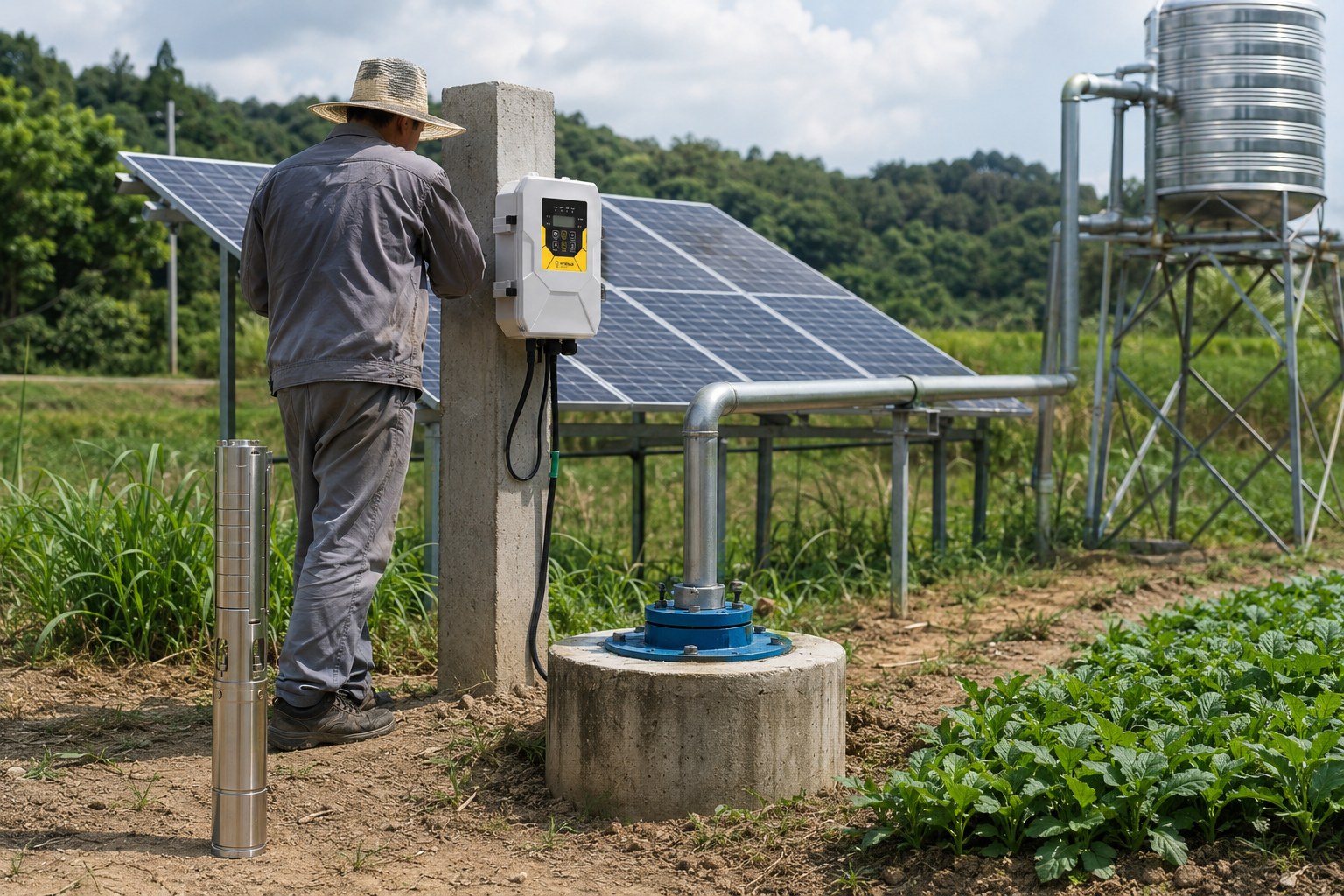
A solar water pumping system is more than just a pump and a panel.
It is a complete system where each component plays a vital role in delivering water efficiently.
Understanding these parts helps you appreciate how they work together to provide a reliable water supply, often in places where no other power source is available.
The core principle is the photovoltaic effect, where solar cells generate an electric current when exposed to light.
This clean, free energy is the foundation of the entire operation.
Let's look at the key components in more detail.
The Components of a Solar Pumping System
-
Solar Panels: These are the power source of the system.
They are also known as a photovoltaic (PV) array.
The panels absorb photons from sunlight.
This process creates DC (Direct Current) electricity.
The total power of the array must be sufficient to run the pump motor effectively, even in less-than-ideal sunlight. -
Water Pump and Motor: This is the heart of the system that does the physical work.
The motor takes the DC electricity from the panels and uses it to operate the pump.
Modern systems often use high-efficiency Brushless DC (BLDC) motors, which can achieve efficiencies over 90%.
This means more of the sun's energy is converted into water pumping action, reducing the number of panels needed.
The pump itself can be a surface pump for ponds or a submersible pump for deep wells. -
Pump Controller: This is the brain of the operation.
A controller, especially one with Maximum Power Point Tracking (MPPT), is crucial for efficiency and protection.
It regulates the voltage and current from the solar panels to match the pump's requirements perfectly.
This maximizes the water output throughout the day.
It also protects the pump motor from damage due to electrical irregularities and can shut it down if the water source runs dry, preventing burnout. -
Optional Components: Depending on the system's complexity and requirements, other components may be included.
An inverter is used if the pump motor requires AC (Alternating Current) instead of DC.
A water tank is often used for storage, allowing water to be collected during peak sun hours for use at any time.
This is often more cost-effective than using batteries.
How to Calculate Your Water Pump's Energy Needs?
Feeling overwhelmed by terms like watts, horsepower, and kilowatt-hours?
Calculating your pump's energy needs can feel complex.
But it is a straightforward process you can do yourself with a few key pieces of information.
First, find your pump's wattage rating (1 horsepower is approximately 746 watts).
Next, multiply this wattage by the number of hours you need to run the pump each day.
This gives you the daily energy in watt-hours (Wh).
This number is the target your solar panels must produce.
A precise calculation is the foundation of an efficient and cost-effective solar pumping system.
This process ensures you install a solar array that is powerful enough to meet your daily water demands without being oversized and unnecessarily expensive.
By following a clear, step-by-step method, you can confidently determine the exact size of the solar system you require.
This calculation involves understanding your pump's power consumption, the amount of sunlight available in your specific location, and accounting for real-world inefficiencies.
Let's walk through the calculation process with a practical example.
Step 1: Find Your Pump's Power Consumption (Watts)
The first step is to determine how much power your pump draws.
This is typically listed in horsepower (HP) or watts (W) on the pump's specification plate.
If it's in HP, you need to convert it to watts.
- Conversion Formula: 1 Horsepower = 745.7 Watts
For example, a 1.5 HP well pump would have a wattage of:
1.5 HP × 745.7 W/HP = 1,118.55 Watts
We can round this to 1,119 watts for simplicity.
Step 2: Determine Daily Pumping Hours
Next, decide how many hours per day your pump needs to run.
This depends entirely on your water needs.
For household water supply, it might be 4-6 hours.
For agricultural irrigation, it could be 8 hours or more.
Let's assume our 1.5 HP pump needs to run for 5 hours per day to fill a storage tank.
Step 3: Calculate Total Daily Energy Required (kWh)
Now, calculate the total energy your pump will consume in a day.
- Energy Formula: Watts × Hours = Watt-hours (Wh)
Using our example:
1,119 Watts × 5 Hours = 5,595 Wh
To make the number more manageable, we convert it to kilowatt-hours (kWh) by dividing by 1,000.
5,595 Wh ÷ 1,000 = 5.595 kWh
Your solar panels need to generate approximately 5.6 kWh of energy every day.
Step 4: Determine Your Location's Peak Sun Hours
"Peak sun hours" is a critical value for solar calculations.
It represents the number of hours per day when the sun's intensity is at its peak (1,000 watts per square meter).
This value is not the same as the number of daylight hours.
It varies significantly by geographic location and season.
You can find this data from renewable energy labs or local solar installers.
| Location Example | Average Daily Peak Sun Hours |
|---|---|
| Arizona, USA | 6.5 |
| Germany | 3.0 |
| Central India | 5.5 |
| South Africa | 5.0 |
Let's assume our system is in a location with 4.5 peak sun hours per day.
Step 5: Calculate the Required Solar Array Size (kW)
To find the size of the solar array needed, divide your daily energy requirement by the peak sun hours.
- Array Size Formula: Daily kWh ÷ Peak Sun Hours = Required kW
For our example:
5.6 kWh ÷ 4.5 Peak Sun Hours = 1.24 kW
This means you need a solar array capable of producing 1.24 kilowatts (or 1,240 watts) of power.
Step 6: Account for System Inefficiencies
Solar systems are not 100% efficient.
Energy is lost due to factors like heat, dust on panels, wiring resistance, and controller inefficiency.
It is standard practice to add a buffer of 15% to 25% to account for these losses.
Let's use a 20% buffer (multiplying by 1.20).
- Adjusted Array Size Formula: Required kW × 1.20 = Final Array Size
1.24 kW × 1.20 = 1.49 kW
You need a solar array that is at least 1.49 kW (1,490 watts).
Step 7: Calculate the Number of Solar Panels
Finally, divide the adjusted array size by the wattage of a single solar panel.
Panel wattages typically range from 300W to 500W.
Let's assume we are using 400-watt panels.
- Number of Panels Formula: Final Array Size (in watts) ÷ Panel Wattage = Number of Panels
1,490 Watts ÷ 400 W/panel = 3.725 Panels
Since you cannot buy a fraction of a panel, you must round up to the next whole number.
In this case, you would need 4 solar panels of 400 watts each to reliably run your 1.5 HP pump for 5 hours a day.
Choosing the Right Type of Solar Pump for Your Needs?
Is any solar pump good enough for your project?
Not all pumps are created equal.
Choosing the wrong one means wasted energy and poor performance, even with enough panels.
The best pump depends entirely on your specific water source and application requirements.
Screw pumps excel at providing high pressure for very deep wells.
Plastic impeller pumps deliver high volumes of water, perfect for irrigation.
Stainless steel impeller pumps offer ultimate durability against corrosion in harsh water conditions.
Selecting the right pump technology is just as important as correctly sizing your solar array.
The efficiency of the pump and its motor directly impacts the overall system's performance and cost.
A more efficient pump requires fewer solar panels to do the same amount of work, saving you money on your initial investment and ensuring better performance over the long term.
The market offers a diverse range of solar pumps, each designed for a specific purpose.
Understanding their differences is key to building a system that is not only effective but also durable and reliable for years to come.
Let's explore the core technologies that define modern solar pumps.
The Powerhouse: High-Efficiency BLDC Motors
At the core of most modern, high-performance solar pumps is a Brushless DC (BLDC) permanent magnet motor.
This is the engine that drives the system.
Unlike older motor types, BLDC motors can achieve efficiencies exceeding 90%.
This high efficiency is a game-changer.
It means that more of the precious energy generated by your solar panels is converted into actual water-pumping power, rather than being lost as heat.
These motors often use powerful rare-earth magnets, such as Neodymium iron boron (NdFeB), which create a strong magnetic field.
This results in high torque, allowing the pump to start easily even in low-light conditions.
Technically, a BLDC motor can be up to 47% smaller and 39% lighter than a traditional motor of the same power output.
This makes installation easier and reduces shipping costs.
Crucially, their brushless design means there are no brushes to wear out, leading to a maintenance-free and exceptionally long service life.
For Deep Wells: The Solar Screw Pump
The solar screw pump, also known as a progressing cavity pump, is a specialist for high-head, low-flow applications.
It uses a single helical stainless steel rotor (the "screw") that rotates inside a rubber stator.
This action creates sealed cavities that move water upwards through compression.
This design allows it to generate very high pressure, making it the ideal choice for lifting water from extremely deep wells.
| Pump Type | Typical Flow Rate | Typical Head (Pressure) | Best Application |
|---|---|---|---|
| Screw Pump | Low (5-20 GPM) | Very High (up to 600+ ft) | Deep well domestic water |
Screw pumps are also highly resistant to sand and sediment, which would quickly damage other pump types.
This makes them very durable in wells with less-than-perfect water quality, which is common in many off-grid regions.
Their primary limitation is their lower flow rate, making them best suited for domestic water supply, livestock watering, and small-scale drip irrigation rather than large-scale farming.
For High Volume Irrigation: The Solar Plastic Impeller Pump
When you need to move a lot of water, a multi-stage centrifugal pump with plastic impellers is often the most economical and effective choice.
These pumps use a series of stacked impellers that spin at high speed to push water outwards and upwards.
Each stage adds more pressure, allowing them to achieve a good balance of high flow rate and medium head.
The use of engineered plastic for the impellers makes these pumps lightweight and highly resistant to abrasion from fine sand.
This durability in sandy conditions is a significant advantage for farm and pasture wells.
Because they deliver a high volume of water, they are perfect for flood irrigation, center-pivot systems, and supplying water to large livestock operations.
However, plastic impellers may not be suitable for extremely deep wells where immense pressure is required or in water that is highly corrosive.
For Harsh Water Conditions: The Solar Stainless Steel Impeller Pump
For premium applications or in areas with aggressive water, the stainless steel impeller pump is the top-tier solution.
This pump operates on the same multi-stage centrifugal principle as the plastic impeller model.
However, its key components, including the impellers and pump housing, are constructed from SS304 or even higher-grade stainless steel.
This provides superior resistance to corrosion from acidic or alkaline water, which can be found in certain geological regions or coastal areas with saltwater intrusion risk.
| Material | Corrosion Resistance | Sand Resistance | Cost |
|---|---|---|---|
| Plastic | Fair | Excellent (fine sand) | Low |
| Stainless Steel | Excellent | Good | High |
While they are heavier and have a higher initial cost, their exceptional durability ensures a very long service life and high reliability in challenging environments.
This makes them the go-to choice for high-end residential water systems, commercial operations, and agricultural applications in regions with known water quality issues, ensuring a safe and consistent water supply for decades.
What About Cloudy Days or Nighttime Pumping?
Worried that solar pumps only work in perfect, bright sunshine?
What happens when you need water on a cloudy day or after the sun has set?
This is a common and valid concern for anyone considering a solar-powered system.
Modern solar pumping systems are designed with these challenges in mind and offer practical solutions.
The most common method is simply storing water in a tank.
However, for direct power, advanced AC/DC hybrid controllers can automatically switch between solar and grid or generator power.
This ensures a 24/7 water supply without needing a large, expensive battery bank.
Relying solely on direct sunlight means your water supply would be intermittent.
It would be strong at noon, weak in the morning and evening, and nonexistent at night or on heavily overcast days.
Fortunately, several strategies exist to overcome this and provide a consistent, reliable water source around the clock.
The best solution for you will depend on your specific needs, budget, and whether you have access to an alternate power source.
Let's explore the most effective ways to ensure your water keeps flowing, no matter what the weather is doing.
The Simple, Effective Solution: Water Storage Tanks
The most straightforward and often most cost-effective way to ensure a constant water supply is to pump and store water when the sun is shining.
A solar pump can fill a large, elevated storage tank during the day.
Water can then be gravity-fed from the tank whenever it is needed, day or night.
This approach has several benefits:
- Cost-Effective: A plastic or metal water tank is generally much cheaper than a large battery bank.
- Low Maintenance: Tanks require very little maintenance compared to batteries, which need monitoring and eventual replacement.
- Reliability: It is a simple, mechanical system with few points of failure.
You are storing the water itself, not electrical energy.
The size of the tank you need depends on your daily water consumption and how many "no-sun" days you want to be prepared for.
A common strategy is to size the tank to hold a 2-3 day supply of water.
The High-Tech Solution: AC/DC Hybrid Pumping Systems
For applications where a constant, on-demand water flow is critical and a large tank is not practical, an AC/DC hybrid system is an excellent solution.
These systems use an intelligent controller with inputs for both DC power from solar panels and AC power from the electrical grid or a generator.
The controller's logic is designed for maximum efficiency:
- Prioritize Solar: The controller will always use available solar power first, as it is free.
- Hybrid Function: When solar power is low (e.g., on a cloudy day), the controller can blend AC power with the available DC power to keep the pump running at the desired speed.
This maximizes the use of free solar energy before drawing from the grid. - Automatic Switchover: When there is no solar input at all (e.g., at night), the controller automatically switches over to run the pump entirely on the AC power source.
This ensures uninterrupted, 24/7 water availability without the need for batteries, providing the best of both worlds: the cost savings of solar and the reliability of the grid.
The Role of Batteries in Off-Grid Systems
While often replaced by the two solutions above, battery storage is still a viable option for some solar pumping systems, particularly smaller ones or those in remote locations with no access to AC power.
In this setup, solar panels charge a battery bank during the day.
The pump can then draw power from the batteries at any time.
However, this approach has significant drawbacks.
Batteries add considerable cost and complexity to the system.
They also have a limited lifespan (typically 5-10 years) and require regular maintenance to perform correctly.
For most water pumping applications, storing water in a tank is a far more practical and economical form of "energy" storage.
Conclusion
Sizing a solar pump system requires calculating energy needs, considering your location, and, most importantly, choosing the right high-efficiency pump technology for your specific application.
FAQs
How many solar panels does it take to run a 1 hp water pump?
Typically, a 1 HP pump needs 4 to 6 solar panels of 300-400W each. The exact number depends on your location's sun hours and the pump's efficiency.
Can a solar panel run a water pump directly?
Yes, a DC solar panel can power a DC water pump directly. However, a controller is highly recommended to protect the pump and maximize daily water output.
What size solar panel do I need for a 12v water pump?
This depends on the pump's wattage. A 100-watt 12V pump would typically need a 120W to 150W solar panel to account for real-world system losses.
Do solar water pumps work on cloudy days?
Yes, but they operate at a reduced capacity. Water storage tanks or AC/DC hybrid systems are common solutions to ensure a consistent supply during cloudy periods.
How long do solar water pumps last?
A well-maintained system can last over 20 years. The solar panels often have a 25-year performance warranty, while the pump motor may need servicing every 5-10 years.
Is a solar water pump worth it?
Yes, especially for off-grid locations or to eliminate high electricity bills. The initial investment is typically paid back over time through zero energy costs and low maintenance requirements.
How deep can a solar pump pull water from?
This depends on the pump type. Solar screw pumps are designed for high pressure and can lift water from depths exceeding 600 feet (about 180 meters).
Do I need batteries for my solar water pump?
Not usually. It is more common and cost-effective to pump water into a storage tank during the day for use at night, rather than storing electricity in batteries.