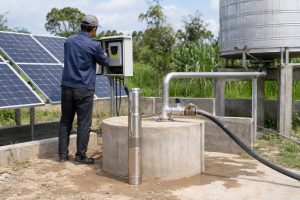
Struggling to get water from a deep, off-grid well?
Grid power is costly and unreliable, leaving you without a consistent water source.
A solar pump can be the answer.
Solar well pumps can effectively pump water from depths requiring up to 1,000 feet of total head.
However, the physical pump is typically submerged no more than 400 feet below the water's surface.
The pump's power, not just its depth, determines its performance.
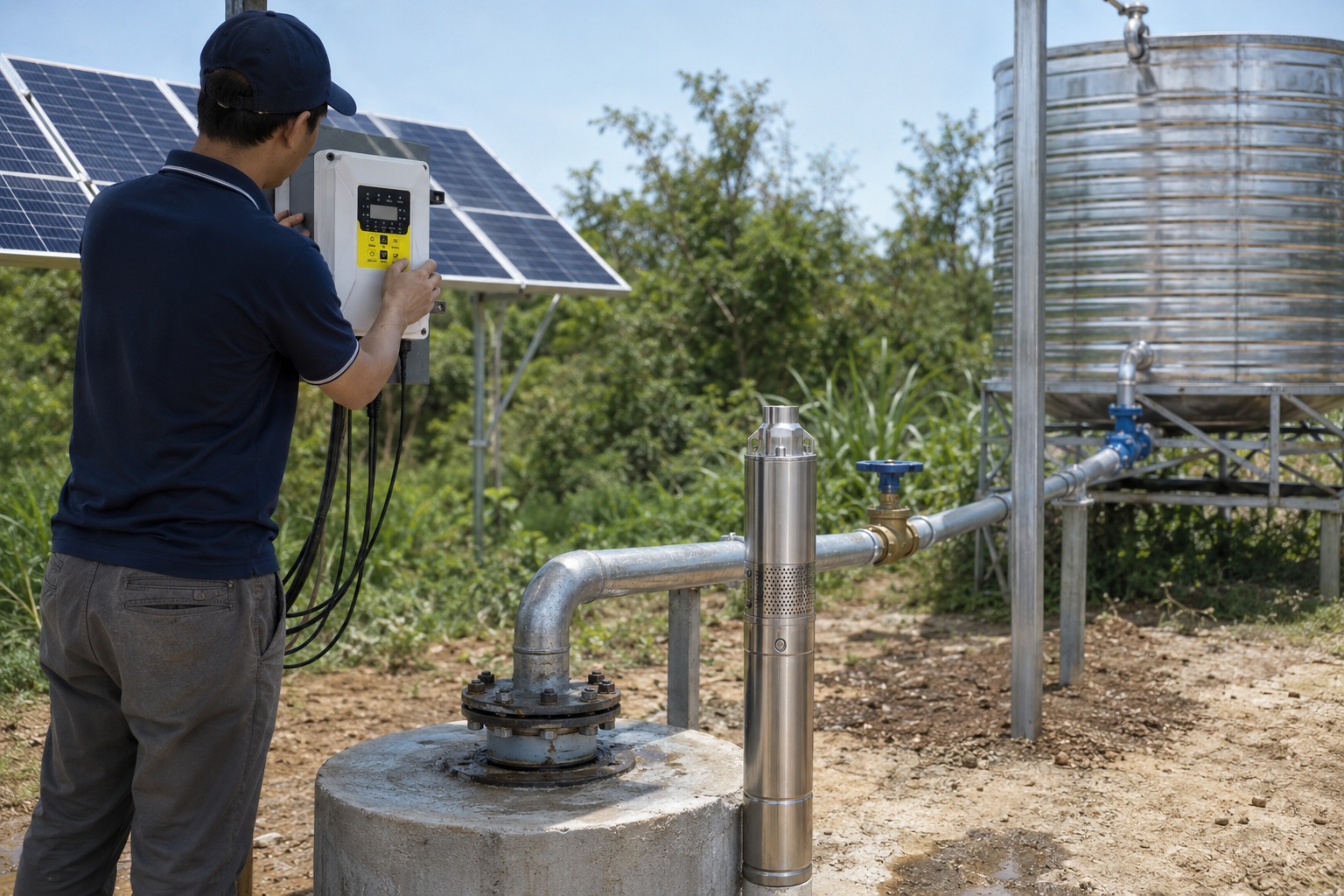
Understanding how deep a solar pump can go is more than just a single number.
It involves a mix of factors like well depth, water level, and the pressure needed to move water to your storage tank.
A pump that can handle a 1,000-foot head is incredibly powerful, but it's crucial to understand what "head" really means for your specific project.
This guide will break down everything from pump depth and total head to the different types of pumps available and how to power them correctly.
Let's explore how to select a system that delivers reliable water, no matter how deep your well is.
Understanding Total Pump Head and Well Depth
Miscalculating your well's water needs can lead to buying the wrong pump.
This is a frustrating and expensive mistake to correct.
Learn the difference between simple well depth and Total Pump Head.
Total Pump Head is the total vertical distance the pump must push water.
It includes the static water level, any elevation change to the tank, and pressure requirements.
This calculation is essential for sizing your pump correctly, ensuring it has enough power for the job.
To choose the right solar pump, you must move beyond the simple question of well depth and learn to calculate your Total Pump Head, also known as Total Dynamic Head (TDH).
This figure represents the total work your pump needs to do.
It is the single most important factor in pump selection.
Getting it right ensures your system performs efficiently and lasts for years.
Getting it wrong leads to low water flow, premature pump failure, and wasted investment.
What is Static Water Level?
The Static Water Level is the starting point for all calculations.
It is not the total depth of your well.
It is the distance from the ground surface down to the top of the water inside your well casing when the pump is not running.
This measurement can change seasonally, so it's best to measure it during the driest time of year to ensure your pump will always be submerged.
Calculating Total Pump Head (TDH)
Total Pump Head is a sum of several factors that create resistance against the pump.
The formula is straightforward:
TDH = Static Water Level + Elevation Rise + Friction Loss + Pressure Head
Let's break down each component:
- Static Water Level: The distance from the ground to the water.
- Elevation Rise: The vertical height difference between the wellhead and the storage tank inlet. If your tank is 50 feet uphill, you add 50 feet to your TDH.
- Friction Loss: As water moves through pipes, it creates friction, which is like adding extra head. This depends on pipe diameter, length, and flow rate. Longer, narrower pipes create more friction. This is often a smaller, but still important, number.
- Pressure Head: If you are pumping into a pressure tank, you must account for the pressure the pump has to overcome. To convert PSI to feet of head, multiply the tank's maximum pressure setting by 2.31.
A common 40 PSI pressure tank adds approximately 92.4 feet (40 x 2.31) of head to your calculation.
| TDH Calculation Component | Example Value | Description |
|---|---|---|
| Static Water Level | 150 feet | Distance from ground to water surface. |
| Elevation Rise | 20 feet | Tank is 20 feet uphill from the well. |
| Friction Loss | 10 feet | Estimated for pipe length and flow. |
| Pressure Head (40 PSI Tank) | 93 feet | For pumping into a pressurized system. |
| Total Pump Head (TDH) | 273 feet | The total work the pump must do. |
Pumping Depth vs. Submersion Limit
It is critical to distinguish between the pump's ability to lift water and how deep it can physically sit in the water.
A pump might be rated for 1,000 feet of TDH but have a maximum submersion depth of only 400 feet.
The immense water pressure in very deep wells can crush a pump's housing or damage its seals if it's not designed for it.
Therefore, even if your well is 800 feet deep, if the static water level is at 300 feet, you can place the pump just below that level (e.g., at 320 feet) and still effectively pump water, as long as the TDH is within the pump's specification.
Sizing Your System: How Many Solar Panels Are Needed?
You found the perfect pump, but what happens if you don't give it enough power?
Your pump will underperform, struggle on cloudy days, or fail to start at all.
This negates your entire investment.
You must correctly match your solar panel array to your pump's power requirements.
The number of panels depends on the pump's horsepower (HP) and type.
Small DC pumps may run on as few as two 100-watt panels (200W total).
Large AC pumps for major irrigation can require over 300 panels, generating more than 120,000 watts of power.
The heart of any solar pumping system is the balance between the motor's demand and the solar array's supply.
A larger, more powerful pump requires a larger solar array.
The choice between a system designed specifically for solar (DC) and a more traditional AC pump also significantly impacts the number of panels you'll need.
Understanding this relationship is key to designing a reliable and cost-effective system.
DC vs. AC Solar Pumps
Solar pumping systems primarily use two types of motors: DC (Direct Current) and AC (Alternating Current).
-
DC Solar Pumps: These pumps use motors designed to run directly on solar power. They are typically Brushless DC (BLDC) motors, which are over 90% efficient. This high efficiency means they require less solar power (fewer panels) for the same amount of work compared to AC pumps. They are ideal for small-to-medium applications, from 1/4 HP up to around 10 HP.
-
AC Solar Pumps: These are standard industrial pumps that can be run on solar power using a specialized solar inverter or controller. While the pumps themselves can be less expensive, the system is less efficient overall. They are used for very high-volume applications, from 1/2 HP up to 100 HP or more, where a comparable DC pump may not be available.
Matching Watts to Horsepower
The power of a pump motor is measured in horsepower (HP), while solar panel output is measured in watts (W).
You must provide enough watts to meet the motor's demands.
As a general rule, a more powerful motor needs a proportionally larger solar array.
The table below provides a rough guide for common system sizes, showing how DC systems are more power-efficient at lower horsepower ratings.
| Pump Type | Motor Size (HP) | Approx. Solar Array (Watts) | Typical # of 375W Panels |
|---|---|---|---|
| DC Pump | 0.5 HP | 400 - 600 W | 2 |
| DC Pump | 1.0 HP | 800 - 1,200 W | 3 - 4 |
| DC Pump | 3.0 HP | 2,500 - 3,000 W | 7 - 8 |
| AC Pump | 1.0 HP | 1,200 - 1,500 W | 4 |
| AC Pump | 10 HP | 11,000 - 12,000 W | 30 - 32 |
| AC Pump | 100 HP | 120,000 W | 320 |
The Role of the Controller
The solar pump controller is the brain of the system.
It manages the power from the solar panels and delivers it to the pump motor.
A high-quality Maximum Power Point Tracking (MPPT) controller is essential.
It constantly adjusts the electrical load to maximize the power harvested from the panels, increasing water output by up to 30% compared to systems without one.
This is especially important during low-light conditions like cloudy days or early mornings.
Some advanced controllers also offer hybrid functionality.
They can accept both DC power from solar panels and AC power from the grid or a generator.
The system prioritizes solar power and only draws AC power when sunlight is insufficient, ensuring a 24/7 water supply.
Choosing the Right Pump: Flow Rate vs. Head
A deep well pump is not a one-size-fits-all solution for every water need.
Choosing the wrong type of pump can result in poor performance or premature failure.
You will be left with low pressure or a pump damaged by sand.
Select a pump based on its internal design, which dictates its performance characteristics.
Choose a pump based on your specific application.
Screw pumps excel at providing high head (pressure) with low flow, perfect for very deep wells.
Centrifugal pumps with impellers provide high flow rates at medium head, ideal for irrigation.
Material choice—plastic or stainless steel—depends on water quality.
Once you know your Total Pump Head, the next step is to match it with your desired flow rate, measured in Gallons Per Minute (GPM).
Different applications have vastly different needs.
A home may require 10 GPM, while large-scale agriculture could need over 100 GPM.
The internal mechanics of a pump determine its ability to deliver a certain flow rate at a specific head.
The three most common types of solar deep well pumps are screw pumps, plastic impeller pumps, and stainless steel impeller pumps.
Solar Screw Pumps: The Deep Well Specialist
A solar screw pump, also known as a progressing cavity pump, works like an Archimedes' screw.
It uses a single helical rotor spinning inside a rubber stator.
This action creates sealed cavities of water that are pushed upwards.
This design is incredibly effective at creating high pressure, making it ideal for applications with very high head (deep wells) but lower flow rate requirements.
They are the go-to choice for domestic water supply and livestock watering from wells over 400 feet deep.
A major advantage is their exceptional resistance to sand and grit, which would quickly destroy other pump types.
Solar Centrifugal Pumps: The Volume Movers
Centrifugal pumps use a series of impellers that spin at high speed.
Water is drawn in at the center of the impeller and thrown outward by centrifugal force.
Each impeller stage adds more pressure to the water.
These pumps are designed for high flow rates at low-to-medium head.
They are perfect for farm irrigation, pasture management, and filling large reservoirs where moving a lot of water quickly is the priority.
They are available with two main impeller types:
- Plastic Impellers: These are lightweight, economical, and offer good resistance to wear from fine sand. They are an excellent, cost-effective choice for many agricultural applications in regions with moderately sandy water.
- Stainless Steel Impellers: These offer superior durability and corrosion resistance. They are the premium choice for applications with aggressive water (acidic or alkaline) or for users who demand the longest possible service life and reliability.
The Powerhouse: High-Efficiency BLDC Motors
The performance of any solar pump is ultimately determined by its motor.
Modern, high-quality solar pumps are powered by Brushless DC (BLDC) permanent magnet motors.
These motors are a leap forward in technology, with efficiencies exceeding 90%.
Traditional AC motors or brushed DC motors might only be 60-75% efficient.
This 15-30% efficiency gain means a BLDC motor requires significantly less power from your solar panels to do the same amount of work.
This can reduce the number of panels needed by up to 30%, lowering the initial system cost and simplifying installation.
These motors are also electronically commutated, meaning there are no brushes to wear out.
This results in a maintenance-free design with a much longer service life.
| Pump Type | Best For | Flow Rate | Head/Pressure | Sand Resistance | Relative Cost |
|---|---|---|---|---|---|
| Screw Pump | Very Deep Wells, Homes | Low | Very High | Excellent | Moderate |
| Plastic Impeller | Farm Irrigation, High Volume | High | Medium | Good | Low |
| Stainless Steel Impeller | Corrosive Water, Premium Use | High | Medium-High | Fair | High |
Budgeting Your Project: Solar Well Pump Costs
Budgeting for a solar pump system can feel overwhelming.
Hidden costs for panels or installation can quickly derail your project plans.
A clear budget requires understanding the key factors that drive the final price.
You must break down the costs of the pump, panels, and installation.
A complete solar well pump system typically costs between $1,200 and $4,500.
The final price is driven by three main factors: the depth of your well, the flow rate you need, and the size of the required solar panel array.
The total investment in a solar water pump system is a combination of several components.
While the average cost provides a starting point, your specific needs will determine the final price tag.
Deeper wells require more powerful—and more expensive—pumps.
Higher flow rate demands also increase costs.
Finally, remember that many pump kits do not include solar panels, which must be budgeted as a separate but essential expense.
Cost Factor: Well Depth
The deeper your well and the higher your Total Pump Head, the more powerful your pump needs to be.
This directly impacts the cost.
A pump designed for a shallow 100-foot well is much simpler and less expensive than a high-pressure model built to push water from 400 feet or more.
The cost increases significantly for pumps capable of handling very deep wells, as they require stronger motors, more robust construction, and more stages.
| Well Depth (Total Head) | Typical Pump System Cost |
|---|---|
| 0–150 feet | $1,200 – $2,000 |
| 150–300 feet | $2,500 – $3,000 |
| 300–400+ feet | $3,500 – $10,000+ |
Cost Factor: Flow Rate (GPM)
Flow rate measures how much water the pump can move in a set time, usually in Gallons Per Minute (GPM).
The GPM you need depends on your water consumption.
A small cabin might only need 3 GPM, while a family home with multiple bathrooms and appliances typically requires 8 to 12 GPM.
To estimate your need, count one GPM for every major water fixture (e.g., shower, toilet, kitchen sink, dishwasher).
Pumps with higher flow rate capabilities have larger motors and more complex impeller designs, which increases their cost.
| Flow Rate | Approx. Pump-Only Cost |
|---|---|
| 1.5 GPM | $950 |
| 3.5 GPM | $1,100 |
| 10 GPM | $1,500 |
Cost Factor: Solar Panels
Solar panels are a significant part of the total system cost, and they are often sold separately from the pump kit.
It is crucial to confirm whether panels are included in your initial quote.
The price of solar panels is typically measured per watt.
Most panels cost between $1.00 to $1.50 per watt.
A standard 100-watt panel, common for smaller systems, would cost $100 to $150.
If your pump requires 800 watts of power, you can expect to spend $800 to $1,200 on panels.
What's Included in a Kit?
When purchasing a solar well pump kit, read the contents carefully.
A basic kit usually includes the pump and motor, plus a controller.
More comprehensive kits might include wire splices, a water level sensor, and basic wiring.
However, solar panels, mounting racks, piping, and extensive wiring are almost always separate purchases.
Hiring a professional for installation is also an additional cost but is highly recommended to protect your warranty and ensure the system is installed safely and correctly.
Conclusion
Choosing the right solar pump hinges on your well's depth, flow needs, and water quality.
The motor efficiency and controller intelligence are vital for a durable, cost-effective water solution.
FAQs
Can a solar pump work without a battery?
Yes, most systems pump directly when the sun shines. They store water in a tank, which is more cost-effective and durable than storing energy in batteries.
How long does a solar well pump last?
A quality system can last over 10 years, with the solar panels often guaranteed for 25 years. The motor's design is key to its longevity.
Can solar pumps run at night?
Not on solar power alone. To run at night, you need a battery bank or a hybrid controller connected to an AC power source like the grid or a generator.
Do solar pumps work on cloudy days?
Yes, but at a reduced flow rate. A good MPPT controller is crucial as it maximizes power output in low-light conditions to keep the water flowing.
What size solar pump do I need for my house?
Most homes need a pump that can provide 8 to 12 GPM (Gallons Per Minute). A quick estimate is to add 1 GPM for every major water fixture in your home.
Are solar water pumps worth it?
Absolutely. They provide water independence from the grid, have very low operating costs, require minimal maintenance, and are an environmentally friendly solution with long-term value.
Can a solar pump fill a pressure tank?
Yes. When calculating your Total Pump Head, you must add the equivalent head from the tank's pressure rating. A 40 PSI tank adds about 93 feet of head.