Struggling with high energy bills or no grid access for your water needs?
This is a common problem for farms and off-grid properties.
A solar well pump offers a sustainable, cost-effective solution.
The best solar well pump is one that perfectly matches your specific requirements for well depth, daily water volume, and water quality.
For deep wells with low flow needs, a solar screw pump is ideal.
For high-volume irrigation, a plastic impeller pump excels.
For corrosive water, a stainless steel impeller pump is unmatched.
Choosing the right pump can feel complex.
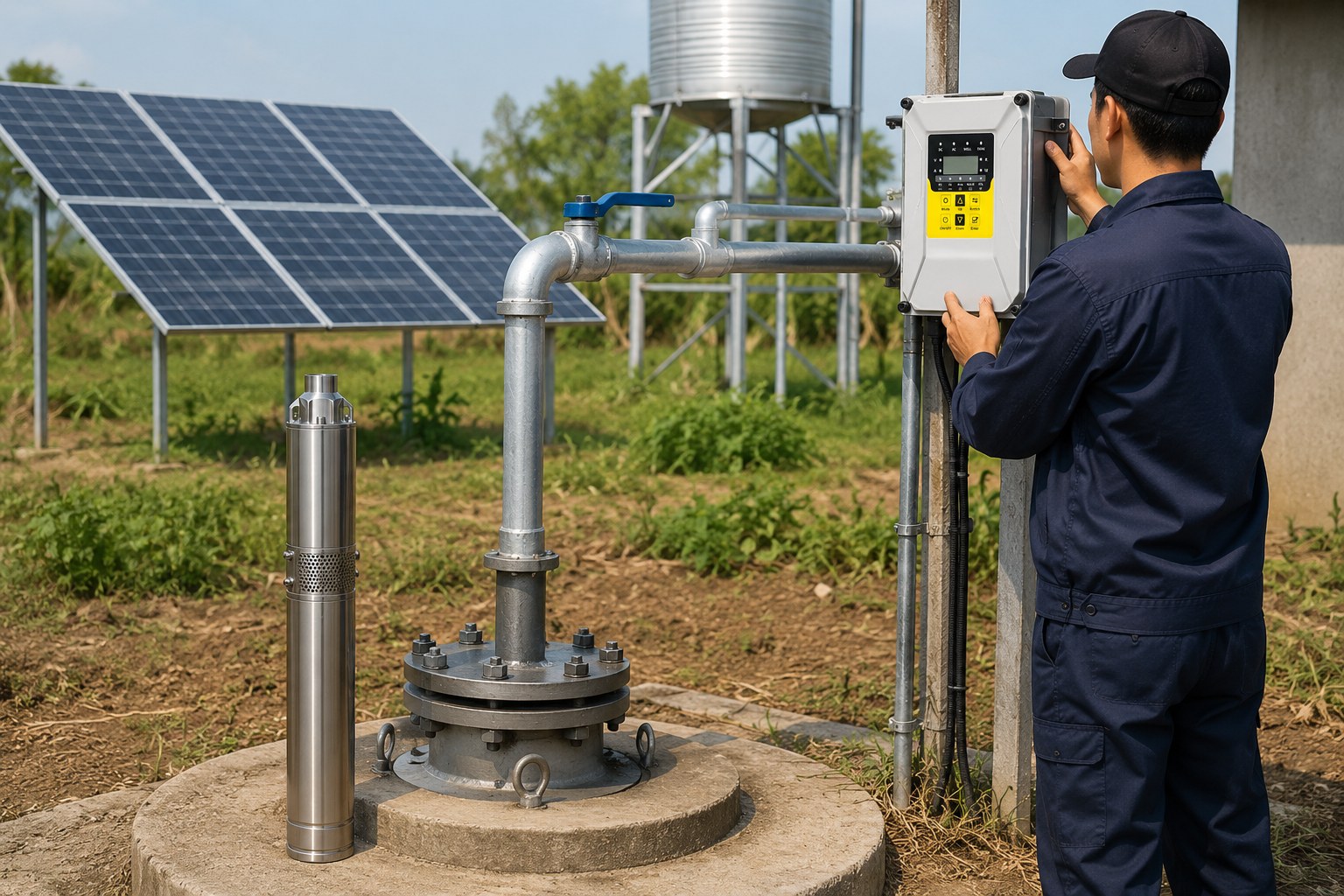
You have to consider not just the pump itself, but the motor that drives it and the controller that manages it.
Understanding how these three components work together is the key to building a reliable and efficient water system.
This guide will break down the essential pump types, the core motor technology, and the intelligent control systems that define the best solar well pumps on the market today.
We will provide clear comparisons and data to help you, as a distributor or importer, make the most informed decision for your customers.
The Core of Performance: High-Efficiency BLDC Motors
Inefficient pump motors waste precious solar energy.
This inefficiency forces you to buy more solar panels, driving up system costs by 20-40%.
High-efficiency Brushless DC (BLDC) motors solve this by maximizing every watt of power.
The heart of any top-tier solar pump is its motor.
A high-efficiency BLDC permanent magnet motor offers over 90% operational efficiency.
This superior performance reduces the required number of solar panels, lowers operational costs, and ensures a longer, maintenance-free service life for the entire system.
A BLDC motor is the strategic core of a competitive solar water pump system.
Its efficiency directly impacts the overall performance, cost, and reliability of the water solution you provide to your customers.
Understanding its value is crucial for sourcing and distributing high-performance solar pumps.
What Makes BLDC Motors Superior?
The key advantage of a BLDC motor lies in its design.
Unlike traditional brushed motors that rely on physical contact to transfer power, BLDC motors use an electronic controller.
This eliminates friction, which is a primary source of energy loss and mechanical wear.
The result is a motor that runs cooler, quieter, and lasts significantly longer.
Furthermore, the rotor in these advanced motors is constructed from high-strength permanent magnets, such as 40SH neodymium iron boron.
This material produces a powerful magnetic field, delivering high torque even at low speeds.
This high torque density means the motor can start pumping water effectively even in low-light conditions, extending the pump's operational hours each day.
Quantifiable Advantages in Pumping Systems
The technical superiority of BLDC motors translates into tangible benefits for both distributors and end-users.
Their compact and lightweight design simplifies logistics, reduces shipping costs, and makes installation far easier, especially in remote locations.
For the end-user, the primary benefit is a drastic reduction in the total cost of ownership.
| Feature | BLDC Motor | Conventional AC/DC Motor |
|---|---|---|
| Efficiency | >90% | 60-75% |
| Solar Panel Requirement | Reduced by up to 30% | Higher |
| Size vs. Power | 47% smaller on average | Larger and bulkier |
| Weight vs. Power | 39% lighter on average | Heavier |
| Lifespan | 10+ years, maintenance-free | 3-5 years, requires brush replacement |
| Heat Generation | Minimal | Significant |
As the table shows, the investment in a BLDC-powered pump pays off quickly.
The higher initial efficiency means the system requires fewer solar panels for the same water output, immediately lowering the upfront cost.
Over the long term, its maintenance-free design and extended lifespan provide a reliable water source without the recurring costs and downtime associated with replacing brushes or entire motors.
For Deep Wells & High Head: The Solar Screw Pump
Your well is over 100 meters deep.
Standard centrifugal pumps just don't have the power to lift water from such depths, leaving you without a reliable water source.
Solar screw pumps are engineered specifically for these high-head, deep-well applications.
The solar screw pump, also known as a progressing cavity pump, is the best choice for high-head, low-flow situations.
Its unique design efficiently pushes water from depths exceeding 200 meters (650+ feet), making it perfect for domestic water supply and livestock watering in regions with deep water tables.
This pump type represents a critical solution for arid and mountainous regions where groundwater is the only viable source but is difficult to access.
Its ability to perform reliably under demanding conditions makes it a cornerstone of any comprehensive solar pump portfolio.
For distributors, offering a robust screw pump opens up markets that are inaccessible with standard pump technologies.
How a Screw Pump Works
The mechanism of a screw pump is simple yet highly effective.
It consists of just two main parts: a helical rotor made of stainless steel and a double-helical stator made of resilient rubber.
As the rotor turns inside the stator, it forms a series of sealed cavities.
These cavities "progress" from the pump's inlet to its outlet, carrying a fixed volume of water with each rotation.
This positive displacement action is what allows the pump to generate immense pressure, pushing the water column up from extreme depths.
A key benefit of this design is its exceptional resistance to sand and silt.
Unlike centrifugal pumps whose impellers can be quickly eroded by abrasives, the gentle pushing action of a screw pump can handle harsher water conditions without rapid wear, ensuring a longer service life in challenging wells.
Key Application and Performance Metrics
The screw pump is a specialist, not a generalist.
Its design is optimized for lifting water high, not for moving large volumes of it quickly.
This makes it the perfect fit for applications where consistent, reliable pressure from a deep source is more important than a high flow rate.
This includes filling a storage tank for an off-grid home, supplying drinking troughs for livestock, or micro-irrigation systems.
| Feature | Specification | Ideal Application |
|---|---|---|
| Flow Rate | Low (e.g., 0.5-4 GPM / 2-15 LPM) | Domestic Water, Livestock |
| Head (Lift) | Very High (up to 230m / 750 ft) | Deep Borehole Wells |
| Sand Resistance | Excellent | Wells with silt/sand content |
| Limitations | Limited Flow Volume | Not for large-scale flood irrigation |
Its performance profile makes it an indispensable tool in regions across Africa, Latin America, and parts of Asia where deep wells are common.
For an end-user, it means gaining access to a life-sustaining resource that was previously out of reach.
For a distributor, it means providing a solution that genuinely solves one of the toughest water access problems.
For High Flow & Irrigation: The Solar Plastic Impeller Pump
You need to irrigate several acres of crops or water a large herd of livestock.
A low-flow pump would take days to do the job, risking the health of your crops and animals.
High-flow solar impeller pumps are designed to move large volumes of water efficiently.
For any application demanding high water volume, such as farm irrigation, pasture management, or large garden water features, the solar plastic impeller pump is the best option.
This multi-stage centrifugal pump is engineered to deliver high flow rates at a medium head, providing a wear-resistant and highly economical solution.
This pump is the workhorse of the solar pumping world.
It addresses the most common needs in agriculture and large-scale residential water management.
Its balance of performance, durability, and cost-effectiveness makes it a high-volume seller in markets across the Americas, Africa, and Australia.
It empowers farmers to increase crop yields and manage livestock more effectively, all while using sustainable solar energy.
The Power of Multi-Stage Centrifugal Design
Unlike the screw pump that pushes water, a centrifugal pump uses rotational energy to move it.
A rapidly spinning impeller draws water into its center and throws it outward with centrifugal force.
In a multi-stage pump, several of these impellers are stacked in series within the pump housing.
Each stage adds pressure to the water, boosting the overall flow and head.
The impellers in these pumps are often made from high-strength, wear-resistant engineering plastics.
This material choice offers several advantages.
It provides excellent resistance to abrasion from fine sand, which is a common issue in agricultural wells.
It is also lightweight, reducing the overall weight and cost of the pump, making it easier to install and more affordable for the end-user.
Performance Profile for Agriculture
The plastic impeller pump is designed to find the sweet spot between flow rate and head for most agricultural and community water supply needs.
It provides enough pressure to lift water from shallow to medium-depth wells (typically up to 100 meters) and deliver it in quantities sufficient for sprinklers, drip irrigation, or filling large troughs and tanks.
Its cost-effective design makes large-scale solar irrigation projects financially viable.
| Feature | Specification | Ideal Application |
|---|---|---|
| Flow Rate | High (e.g., 10-40 GPM / 40-150 LPM) | Farm Irrigation, Ranching |
| Head (Lift) | Medium (up to 100m / 330 ft) | Shallow to Medium Wells |
| Durability | Lightweight, Economical, Wear-Resistant | General Agriculture, Community Water |
| Limitations | Not for extremely deep wells or corrosive water | Plastic may degrade in harsh chemical environments |
This pump is the go-to solution for converting diesel- or grid-powered irrigation systems to solar.
The fuel and electricity savings alone often provide a return on investment in just a few years.
For a distributor, this pump type represents the largest segment of the solar pumping market, offering significant sales volume potential.
For Durability & Corrosive Water: The Solar Stainless Steel Impeller Pump
The water in your well is acidic, alkaline, or has high salinity.
Standard pumps made of cast iron or plastic will corrode and fail in a matter of months, leading to costly and frequent replacements.
A solar pump with stainless steel components is the only long-term, reliable solution.
The best pump for aggressive and corrosive water is, without question, the solar stainless steel impeller pump.
Constructed with a full SS304 stainless steel pump body, impeller, and components, it offers maximum resistance to corrosion, rust, and chemical degradation, ensuring exceptional durability and a long service life.
This pump is a premium, specialized product designed for environments where other pumps simply cannot survive.
It is an investment in reliability and peace of mind.
For distributors, offering this pump demonstrates a commitment to quality and an ability to solve the most challenging water problems for high-value customers in agriculture, industry, and high-end residential markets.
The Advantage of SS304 Construction
SS304 is a grade of stainless steel known for its excellent corrosion resistance and durability.
It contains high amounts of chromium and nickel, which form a passive, non-reactive layer on the surface of the metal.
This layer protects the underlying steel from reacting with acidic, alkaline, or saline water that would quickly destroy lesser materials.
In a pump, this means every component that touches the water—from the outer casing to the impellers and shaft—is protected.
This not only prevents pump failure due to corrosion but also ensures the purity of the water being pumped.
Unlike corroding iron pumps that can leach rust into the water supply, stainless steel is hygienic and safe for potable water applications.
When to Choose a Premium Solution
While it comes at a higher initial cost, the stainless steel impeller pump is the most cost-effective choice in the long run for specific applications.
It is the definitive solution for wells in coastal areas with saltwater intrusion, agricultural regions with alkaline soil (like parts of Australia), mining operations, and industrial sites dealing with chemical-laden water.
It is also the preferred choice for high-end homes and ranches where water quality and system reliability are paramount.
| Feature | Specification | Ideal Application |
|---|---|---|
| Flow Rate | High (e.g., 10-40 GPM / 40-150 LPM) | High-end Homes, Special Ranches, Industry |
| Head (Lift) | Medium to High (up to 150m / 500 ft) | Medium to Deep Wells |
| Durability | Maximum Corrosion & Rust Resistance | Acidic, Alkaline, or Saline Water |
| Limitations | Higher Initial Cost & Weight | Over-specified for non-corrosive environments |
Choosing this pump is a strategic decision.
It is for customers who understand the cost of failure and prioritize long-term, trouble-free operation over short-term savings.
For a distributor, it is a high-margin product that builds a reputation for providing robust, top-tier solutions.
Ensuring 24/7 Water: The Role of Intelligent Controllers
Solar pumps are great, but the sun isn't always shining.
A cloudy day or the arrival of night could mean a complete shutdown of your water supply, disrupting irrigation schedules and leaving livestock thirsty.
An intelligent hybrid controller eliminates this risk by providing a seamless, 24-hour water supply.
The very best solar pump systems are defined by their intelligence.
This comes from a sophisticated controller.
An MPPT controller can boost solar energy utilization by over 25%.
An AC/DC hybrid controller goes further, automatically switching between solar, grid, or generator power to guarantee a reliable, uninterrupted water supply, 24/7.
The controller is the brain of the solar pumping system.
It does more than just turn the pump on and off; it optimizes performance, protects the equipment, and provides unparalleled flexibility.
For distributors, a system with a powerful hybrid controller is a massive competitive advantage.
It directly answers the most common customer concern: "What happens when there's no sun?"
Maximizing Solar Power with MPPT
MPPT stands for Maximum Power Point Tracking.
It is a sophisticated electronic algorithm that continuously adjusts the electrical operating point of the pump motor to extract the maximum available power from the solar panels at any given moment.
Solar panels have a complex relationship between voltage and current, which changes with sunlight intensity and temperature.
The MPPT algorithm constantly scans this relationship to find the "sweet spot"—the maximum power point—and forces the motor to operate there.
Compared to a simple controller that connects the panels directly to the pump, an MPPT controller can boost the total water output by up to 30% over the course of a day.
This means more water pumped, especially during the crucial early morning and late afternoon hours when sunlight is less intense.
The Hybrid Advantage: AC/DC Functionality
The ultimate evolution of the solar pump controller is the AC/DC hybrid model.
This technology provides true energy independence and total water security.
The controller is designed with inputs for both DC power from solar panels and AC power from the grid or a backup generator.
The system's logic is designed for maximum efficiency and reliability:
- Solar Priority: When there is sufficient sunlight, the controller powers the pump exclusively with free solar energy.
- Hybrid Blending: On overcast days when solar power is reduced, the controller intelligently blends the available solar energy with AC power, ensuring the pump runs at the desired speed while still prioritizing and maximizing the use of solar.
- Automatic AC Takeover: When the sun goes down or if there is no solar input, the controller automatically switches to the AC power source to ensure the pump can run at any time, day or night.
This seamless, automatic switching means the end-user never has to worry about their water supply.
It's a worry-free, 24-hour solution that combines the sustainability of solar with the reliability of conventional power.
Conclusion
The best solar pump combines the right pump type with a high-efficiency motor and an intelligent controller.
This ensures a reliable, cost-effective, and sustainable water solution for any application.
FAQs
How deep will a solar water pump work?
It depends on the pump type.
Solar screw pumps are designed for extreme depths, often exceeding 200 meters (650 feet), while impeller pumps are typically used for wells up to 150 meters deep.
Do solar well pumps work on cloudy days?
Yes, but at reduced output.
Systems with high-efficiency motors and MPPT controllers perform better in low light.
AC/DC hybrid systems guarantee full performance by automatically blending in grid or generator power.
How long do solar well pumps last?
A well-maintained system can last for decades.
Solar panels are often warrantied for 25 years, while high-quality BLDC motors can operate maintenance-free for over 10 years, far outlasting traditional motors.
How many solar panels are needed for a well pump?
This depends on the pump's power, the well's depth (head), and the desired flow rate.
A small domestic system might need 2-3 panels, while a large irrigation pump could require 6 or more.
What maintenance do solar pumps require?
Solar pump systems are very low-maintenance.
Periodically wipe down solar panels and check pump inlets for debris.
Systems with brushless motors require no motor maintenance at all.
Can a solar pump fill a water tank?
Yes, this is a primary application.
The system can be paired with a float switch in the tank, which automatically turns the pump off when the tank is full and on when it needs water.
Are solar water pumps a good investment?
Absolutely.
They eliminate electricity or fuel costs, offering a return on investment within a few years.
They also provide water security, making you independent of grid failures or fuel shortages.
How do I choose between a plastic and stainless steel impeller?
Choose a plastic impeller for general-purpose use with normal water quality; it's cost-effective and sand-resistant.
Choose a stainless steel impeller if your water is acidic, alkaline, or saline to prevent corrosion and ensure long-term durability.