Struggling to get water in remote locations without a reliable power grid?
You need a solution that works anywhere, anytime.
A solar pump's depth capability depends on its design and power. Some specialized solar pumps can handle a total pump head of up to 1,000 feet (about 305 meters). This is different from how deep the pump can be submerged, which is typically around 400 feet (122 meters).
Understanding a solar pump's depth is more than just one number.
It involves a combination of the pump's physical limits, the power of its motor, and the specific conditions of your well.
Simply picking a pump rated for "1,000 feet" might not work if your water needs and well characteristics aren't factored in.
This guide will break down everything you need to know, from how these systems work to choosing the perfect pump type for your specific depth and water volume requirements.
Let's explore what makes a solar pump the right choice for your deep-water needs.
Solar Pumping Explained: What Are Solar Pumps & How They Work?
Confused by the components and technology behind solar pumping?
You need a simple explanation of how sunlight is turned into flowing water.
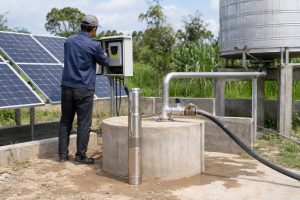
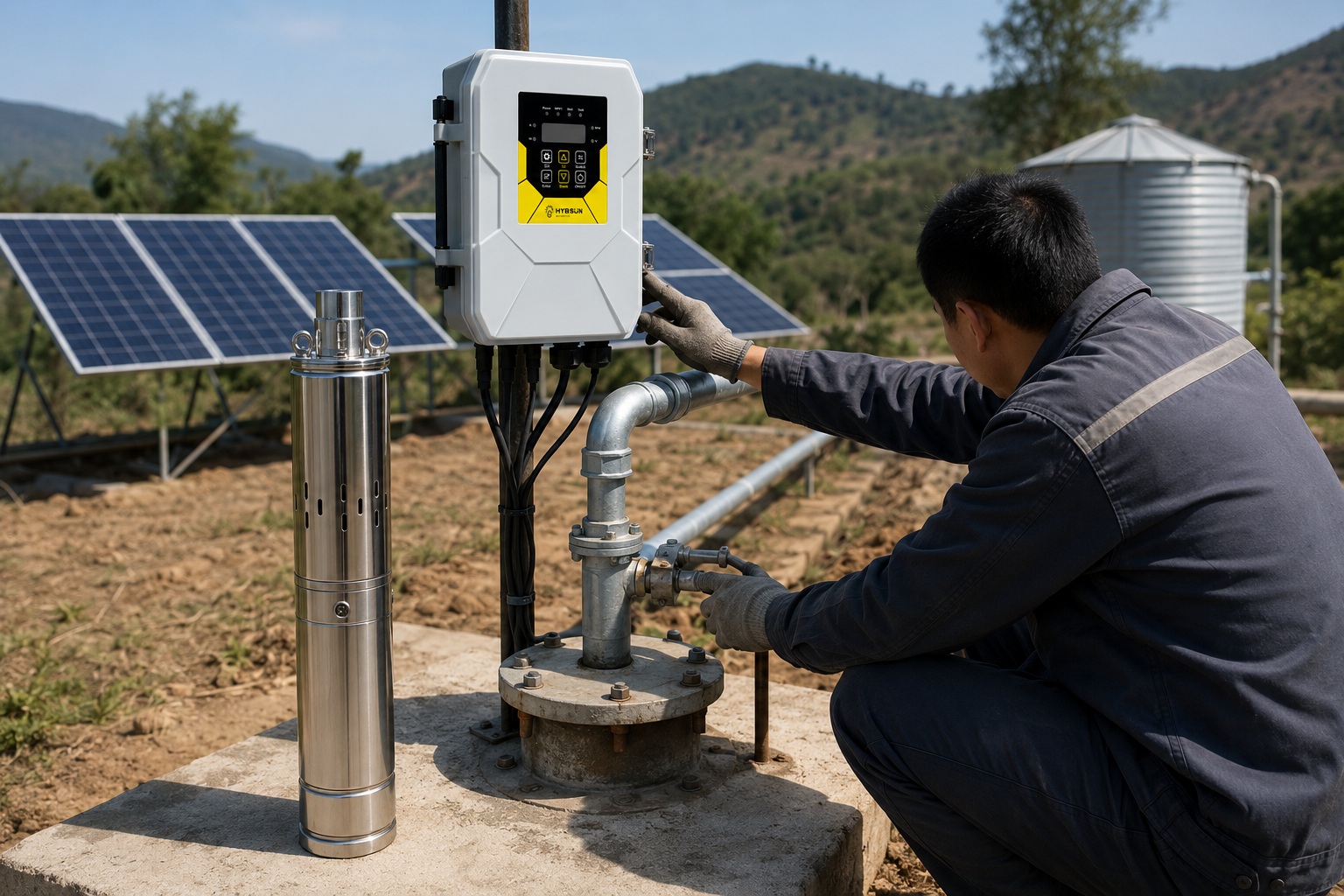
A solar pumping system works by converting sunlight into electricity using photovoltaic (PV) panels. This DC electricity powers a motor, which drives a pump to move water from a source like a well or pond. An inverter is used if the motor requires AC power instead of DC.
To truly grasp how deep a solar pump can work, you first need to understand its core components.
Each part plays a critical role in the system's overall efficiency and power, directly impacting its ability to lift water from significant depths.
The magic isn't just in the pump itself, but in how the entire system works together seamlessly.
The Core Components of a Solar Pumping System
A solar pump system is more than just a pump.
It is an integrated solution designed for maximum efficiency.
-
Solar Panels (PV Array): These are the power source. They capture photons from sunlight and convert them into direct current (DC) electricity. The more panels you have, the more power you generate, which is crucial for deeper wells.
-
Pump Controller (Inverter): This is the brain of the system. It regulates the power from the solar panels to the motor. Modern controllers use Maximum Power Point Tracking (MPPT) to optimize the power output, increasing water delivery by up to 30% compared to systems without it. Some controllers also convert DC to AC power for certain motors.
-
Water Pump Motor: This is the heart of the pump. High-efficiency Brushless DC (BLDC) motors are the industry standard. They convert electrical energy into the mechanical energy needed to drive the pump.
-
The Pump End: This is the part that actually moves the water. It can be a screw, centrifugal impeller, or other type of mechanism, each designed for different flow and head characteristics.
The Power of the BLDC Permanent Magnet Motor
The motor is arguably the most critical component for deep-well applications.
A Brushless DC (BLDC) permanent magnet motor is the core technology that enables solar pumps to be so effective.
These motors achieve efficiencies exceeding 90%, a significant jump from traditional AC motors or brushed DC motors.
This high efficiency means more of the sun's energy is converted into water pumping power, rather than being lost as heat.
The rotor is often made of high-grade neodymium iron boron magnets, providing strong torque in a compact size.
Compared to traditional motors, a BLDC motor can be up to 47% smaller and 39% lighter, which simplifies installation and reduces material costs.
This efficiency directly translates to cost savings, as it reduces the number of solar panels needed to achieve the same performance.
The Role of the MPPT Controller
The MPPT controller is the smart link between the panels and the motor.
Solar panel output fluctuates with sun intensity.
An MPPT controller constantly adjusts the electrical load to find the "maximum power point" of the panels.
This ensures the motor receives optimal voltage and current throughout the day, even in lower light conditions like early mornings, late afternoons, or on cloudy days.
It maximizes daily water output and protects the pump motor from electrical irregularities, extending its lifespan.
| Component | Primary Function | Impact on Pumping Depth |
|---|---|---|
| Solar Panels | Generate DC electricity from sunlight. | More panels provide more power for lifting water from greater depths. |
| MPPT Controller | Optimizes power from panels to motor. | Increases daily water volume by up to 30%; crucial for deep wells. |
| BLDC Motor | Converts electricity to mechanical power. | High efficiency (>90%) means less power is wasted, enabling higher head. |
| Pump End | Moves the water. | Design (screw vs. impeller) determines the balance of flow vs. head. |
Sizing Your Pump: It's More Than Just Depth
Choosing the wrong pump size can lead to system failure or an empty tank.
You need to match the pump to your well's unique characteristics and your water needs.
Properly sizing a solar pump involves calculating your Total Pump Head (TPH) and the required water volume in Gallons Per Minute (GPM). TPH is not just the well depth; it includes the static water level, elevation changes, and any pressure requirements.
A pump's performance is shown on a "pump curve," which plots its flow rate against the total head it's working against.
To pick the right pump, you must first calculate your total head and determine your daily water needs.
Ignoring these calculations is a common mistake that leads to disappointment and wasted money.
Let's break down how to get the numbers you need for a perfect match.
Calculating Total Pump Head (TPH)
Total Pump Head is the total equivalent height that water has to be moved.
It is the most critical factor in pump sizing.
It is a sum of several factors:
-
Static Water Level: This is the distance from the ground surface down to the top of the water in your well when the pump is not running. This is your primary lift requirement.
-
Elevation Rise: If you are pumping water uphill from the wellhead to a storage tank, you must add this vertical distance to your calculation. For example, if your tank is on a hill 50 feet higher than the well, you add 50 feet to your TPH.
-
Pipe Friction Loss: Water moving through pipes loses pressure due to friction. This loss depends on the pipe's diameter, length, and the flow rate. Longer, narrower pipes create more friction loss, which is added to the TPH.
-
Pressure Requirements: If you are pumping into a pressure tank, you must convert the tank's pressure setting (in PSI) into an equivalent head. To do this, multiply the pressure in PSI by 2.31. A standard 40/60 PSI pressure tank adds about 92 feet (40 psi x 2.31) to your TPH.
Determining Your Required Flow Rate
Once you know your TPH, you need to figure out how much water you need.
This is usually measured in gallons per day (GPD) and then converted to gallons per minute (GPM) for pump sizing.
-
For Livestock: Calculate the total daily water consumption for all your animals. A cow might drink 15 gallons a day, while a sheep drinks 2.
-
For Irrigation: This depends on the type of crops, climate, and irrigation method. Drip irrigation for a 1-acre garden might require 600-800 GPD.
-
For Off-Grid Living: A typical person uses 40-50 gallons per day for all household needs. A family of four would need around 200 GPD.
To convert GPD to the GPM your pump needs, you divide the daily total by the number of peak sun hours.
A conservative estimate is 6 hours.
So, if you need 1,200 GPD:
1,200 GPD / 6 hours = 200 Gallons Per Hour (GPH)
200 GPH / 60 minutes = 3.33 Gallons Per Minute (GPM)
Your goal is to find a pump that delivers at least 3.33 GPM at your calculated TPH.
| TPH Calculation Component | Description | Example |
|---|---|---|
| Static Water Level | Depth from ground to water surface. | 200 feet |
| Elevation Rise | Vertical height from wellhead to tank. | 50 feet |
| Friction Loss | Pressure loss from pipe friction. | 15 feet (for a long pipe run) |
| Pressure Head | For filling a pressure tank (PSI x 2.31). | 92 feet (for 40 PSI) |
| Total Pump Head | Sum of all components. | 357 feet |
Solar Screw Pump: The Deep Well Specialist
Need to pull water from an extremely deep well but don't need massive flow?
A standard pump might not provide enough pressure to lift water from that depth.
A solar screw pump excels at creating very high head (pressure) with low flow. Using a stainless steel screw inside a rubber stator, it's perfect for domestic water, livestock, and deep wells where sand is a problem.
The screw pump, also known as a progressing cavity pump, operates on a different principle than common centrifugal pumps.
Instead of flinging water outwards with an impeller, it uses a helical rotor that turns within a flexible stator.
This creates sealed cavities of water that are pushed upwards along the pump's axis.
This design is what allows it to generate immense pressure, making it the go-to choice for some of the most challenging deep-well applications.
How a Screw Pump Generates High Head
The power of a screw pump lies in its positive displacement action.
As the metal screw (rotor) turns inside the rubber stator, it forms a series of sealed pockets.
With each rotation, these pockets "progress" up the length of the pump.
Because the pockets are sealed, the pump can build pressure that is directly proportional to its length, not its rotational speed.
This allows it to lift water from depths exceeding 700 feet or more, a feat that is difficult for many centrifugal pumps of the same size.
This mechanism is also highly resistant to abrasion from sand and sediment, as the rubber stator can flex to pass small particles without damage.
This makes it exceptionally durable in wells that are not perfectly clean.
Key Applications and Ideal Markets
The screw pump's unique characteristics make it ideal for specific scenarios.
Its primary strength is providing a steady, reliable water supply from very deep sources.
-
Domestic Water Supply: For off-grid homes with deep wells, a screw pump can reliably fill a storage tank, providing enough water for daily household needs.
-
Livestock Watering: It's perfect for watering troughs in remote pastures where well depths can be substantial. The lower flow rate is often sufficient for this purpose.
-
Small-Scale Irrigation: While not suitable for large-scale farming, it can support drip irrigation for small gardens or orchards.
Geographically, these pumps are extremely popular in regions like Africa and Latin America, where access to the grid is limited and groundwater sources are often very deep.
Their simplicity and durability make them a lifeline in these areas.
| Feature | Advantage | Best Use Case |
|---|---|---|
| High Head (Pressure) | Can pump from wells over 700 ft deep. | Deep domestic or livestock wells. |
| Low Flow Rate | Provides a steady, consistent water supply. | Filling storage tanks over time. |
| Sand Resistance | Rubber stator can pass sand and grit. | Wells with higher sediment content. |
| Positive Displacement | Flow is consistent regardless of head. | Predictable water delivery. |
Solar Plastic Impeller Pump: The High-Volume Workhorse
Need to move a lot of water for your farm or ranch?
A low-flow pump won't keep up with the demands of irrigation or large herds.
Solar plastic impeller pumps are multi-stage centrifugal pumps designed for high flow and medium head. They are a lightweight, economical, and wear-resistant solution for farm irrigation, pasture water supply, and filling ponds.
When your priority is volume over extreme depth, a centrifugal pump with plastic impellers is often the best choice.
These pumps use a series of spinning impellers to accelerate water outwards, converting velocity into pressure.
Each impeller and diffuser combination is called a "stage," and by stacking multiple stages, the pump can achieve higher pressure (head) while maintaining a high flow rate.
The use of engineered plastics for the impellers makes them highly resistant to wear from fine sand and keeps the cost and weight down.
The Advantage of a Multi-Stage Centrifugal Design
Unlike a screw pump that pushes a single column of water, a centrifugal pump adds energy to the water in increments.
Water enters the first stage at the eye of the impeller and is thrown outward by centrifugal force.
A diffuser then collects this high-velocity water, slows it down, and directs it into the next stage's impeller.
This process is repeated through each stage, with the pressure increasing every time.
A pump with 10 stages can generate 10 times the pressure of a single-stage pump with the same impeller design.
This design allows for a wide range of performance characteristics.
By varying the number of stages and the impeller shape, manufacturers can create pumps optimized for high flow at lower heads (e.g., RPS800V) or moderate flow at higher heads.
Why It's a Top Choice for Agriculture
The plastic impeller pump hits a sweet spot for agricultural and high-volume residential use.
-
High Water Output: These pumps can deliver from 10 to over 100 gallons per minute, making them perfect for irrigating fields, supplying water to large livestock operations, or quickly filling large ponds.
-
Cost-Effectiveness: Using high-strength, molded plastic impellers is more economical than using stainless steel. This makes the initial investment significantly lower, which is a major benefit for farmers and ranchers.
-
Wear Resistance: Modern engineered plastics are surprisingly durable and have excellent resistance to abrasion from the fine sand often found in agricultural wells. They often outperform stainless steel in these specific conditions.
-
Lightweight: The lighter weight makes installation easier and less expensive, often allowing a single person to handle the pump.
These pumps are widely used across the Americas and Africa for their balance of performance, durability, and price.
| Feature | Advantage | Best Use Case |
|---|---|---|
| High Flow Rate | Moves large volumes of water quickly. | Farm irrigation, filling large ponds. |
| Medium Head | Suitable for wells up to 300-400 feet. | Most agricultural and residential wells. |
| Economical | Lower initial cost than steel models. | Budget-conscious projects. |
| Lightweight | Easier and cheaper to install. | DIY installations or remote locations. |
Solar Stainless Steel Impeller Pump: The Premium Durability Option
Is your water acidic, alkaline, or corrosive?
Standard pumps can fail quickly in harsh water conditions, leading to costly replacements.
A solar stainless steel impeller pump uses SS304 or higher-grade materials for the pump body and impellers. It is designed for maximum corrosion resistance and longevity in aggressive water environments, while still offering high flow and medium-to-high head.
For applications where water quality is a concern, durability becomes the top priority.
While plastic impellers are great for abrasion resistance, they can be vulnerable to chemical attack in highly acidic or alkaline water.
This is where the stainless steel impeller pump shines.
Built with SS304 or even marine-grade SS316 stainless steel, these pumps are engineered to withstand the test of time in the toughest water conditions, making them a premium choice for high-end homes, critical infrastructure, and specific geographic regions.
When is Stainless Steel Necessary?
The choice to invest in a stainless steel pump is driven by your water chemistry.
Standard iron or plastic components can corrode and degrade rapidly when exposed to certain elements.
You should consider a stainless steel pump if your water has:
- Low pH (Acidic Water): Acidic water can leach metals from plumbing and aggressively attack pump components.
- High pH (Alkaline Water): Highly alkaline water can also be corrosive to certain materials.
- High Salinity: Saltwater or brackish water requires the superior corrosion resistance of stainless steel, often SS316.
- High Dissolved Minerals: Water in some regions, like the alkaline soil areas of Australia, contains minerals that are corrosive over time.
While the initial cost is higher, a stainless steel pump can be more economical in the long run by avoiding multiple replacements of cheaper pumps.
It represents an investment in reliability and peace of mind.
Target Markets and Applications
The market for stainless steel pumps is more niche but critically important.
They are the preferred solution for:
- High-End Homes and Ranches: Owners who want the most durable, "set-it-and-forget-it" water system often opt for stainless steel for maximum reliability.
- Coastal Regions: Pumping from wells near the coast where saltwater intrusion is a risk.
- Specific Agricultural Areas: Regions with known aggressive water tables, such as parts of the American West or Australia.
- Industrial or Municipal Applications: Small-scale water supply projects where long-term reliability is a non-negotiable requirement.
The reputation for longevity and robust performance makes the stainless steel pump a flagship product, demonstrating a commitment to quality for the most demanding customers.
| Feature | Advantage | Best Use Case |
|---|---|---|
| High Corrosion Resistance | Extremely long service life. | Acidic, alkaline, or saline water. |
| High Reliability | Fewer failures and less maintenance. | Critical water supply, high-end homes. |
| Structural Integrity | Resists wear and damage in deep wells. | Demanding and long-term installations. |
| Premium Quality | Maintains performance over many years. | Investment in long-term infrastructure. |
The Future of Pumping: Hybrid AC/DC Systems
What happens when the sun doesn't shine but you still need water?
Relying solely on solar means no water at night or on heavily overcast days.
Hybrid AC/DC solar pump controllers solve this problem by allowing two power inputs. The system automatically uses solar power when available but can seamlessly switch to an AC source (grid or generator) when solar is insufficient, ensuring a 24/7 water supply.
The biggest limitation of a traditional solar pump is its dependence on the sun.
This can be a significant issue for critical applications like household water or commercial irrigation, where an uninterrupted supply is essential.
The development of intelligent AC/DC hybrid controllers represents a major leap forward, combining the cost-saving benefits of solar with the reliability of a conventional power grid.
This technology offers the best of both worlds, providing water security around the clock.
How Hybrid Controllers Prioritize Solar Energy
The intelligence of a hybrid system lies in its power management logic.
The controller is connected to both the solar panel array and an AC power source simultaneously.
Its primary goal is to use as much free solar energy as possible.
When the sun is shining brightly, the controller draws 100% of the pump's power requirement from the solar panels.
As clouds pass over or as evening approaches, the solar input drops.
Instead of shutting off, the controller begins to blend AC power with the available DC power to maintain the pump's speed and water flow.
It only switches to 100% AC power when there is no solar input at all, such as at night.
This "solar-first" approach maximizes your savings on electricity bills while eliminating the risk of running out of water.
The Benefit of an Uninterrupted Water Supply
The practical advantage of a hybrid system is total water security.
-
For Households: You can take a shower, do laundry, or water your garden at any time of day or night, just as you would with a conventional grid-powered well pump.
-
For Agriculture: Critical irrigation schedules can be maintained regardless of weather conditions, protecting crops from drought stress and maximizing yields.
-
For Livestock: Animals have constant access to drinking water, which is essential for their health and productivity, especially during heatwaves.
This technology bridges the gap between off-grid independence and on-grid convenience.
It makes solar pumping a viable and superior alternative to traditional pumps in almost any setting, not just in remote, off-grid locations.
It provides a robust, worry-free water solution for any user who demands absolute reliability.
| Power Source Condition | Controller Action | Result |
|---|---|---|
| Full Sunlight | Uses 100% DC power from solar panels. | Zero-cost water pumping. |
| Partial Sunlight / Clouds | Blends DC power with AC power. | Consistent water flow, maximizing solar use. |
| No Sunlight (Night) | Automatically switches to 100% AC power. | Uninterrupted 24/7 water supply. |
| AC Power Outage (Day) | Continues to run on available solar power. | Water access during grid failures. |
Conclusion
Choosing the right solar pump depends on your depth, water needs, and water quality.
The true advantage lies in combining an efficient motor with the correct pump type and an intelligent controller.
FAQs
How deep can a 1 hp solar pump?
A 1 HP solar pump's depth varies by model.
A high-head screw pump might reach 500 feet, while a high-flow centrifugal pump may be limited to 200 feet.
How long do solar water pumps last?
A quality solar pump system can last for many years.
The solar panels are often rated for 25 years, while the pump and motor can last 10-15 years before needing major service.
Do solar water pumps work on cloudy days?
Yes, but at a reduced flow rate.
Modern systems with MPPT controllers can still operate in low-light conditions, though output will be lower than on a bright, sunny day.
Can a solar pump fill a tank?
Yes, this is one of their most common applications.
Pumping to a non-pressurized storage tank is the most energy-efficient way to use a solar pump system.
What is the disadvantage of a solar water pump?
The main disadvantage is the high initial investment cost.
They also do not pump water at night unless paired with batteries or a hybrid AC/DC controller.
How many solar panels does it take to run a well pump?
This depends on the pump's horsepower and the well's depth.
A small 1/2 HP pump may only need 2-4 panels, while a 3 HP pump could require 12 or more.
Can you run a well pump directly from solar panels?
Yes, with a proper controller.
The controller manages the variable power from the panels to safely run the pump's motor without needing batteries.
How much does a solar well pump cost?
Costs range from under $1,000 for small, shallow-well kits to over $10,000 for powerful deep-well systems for agriculture.
The price depends on depth, flow rate, and pump type.