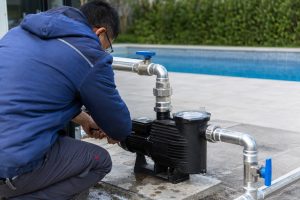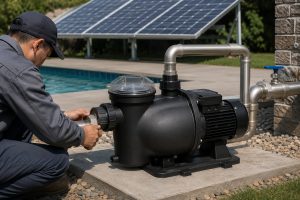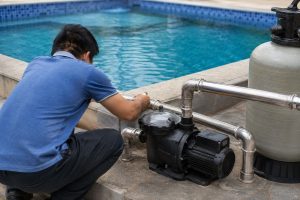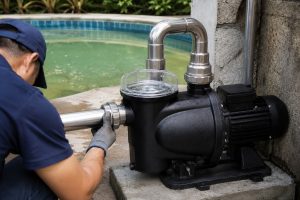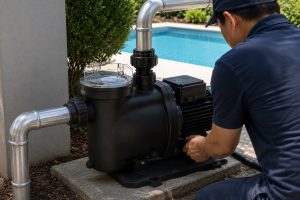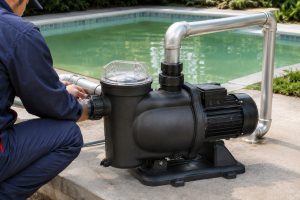
Your pool pump is broken, but the water is turning stagnant.
You need to circulate water to mix chemicals or prevent algae, but the main system is down.
You can temporarily circulate water using your pump motor's "Recirculate" setting, which bypasses the filter.
For cartridge filters, removing the filter element achieves a similar result.
This keeps water moving for essential tasks.
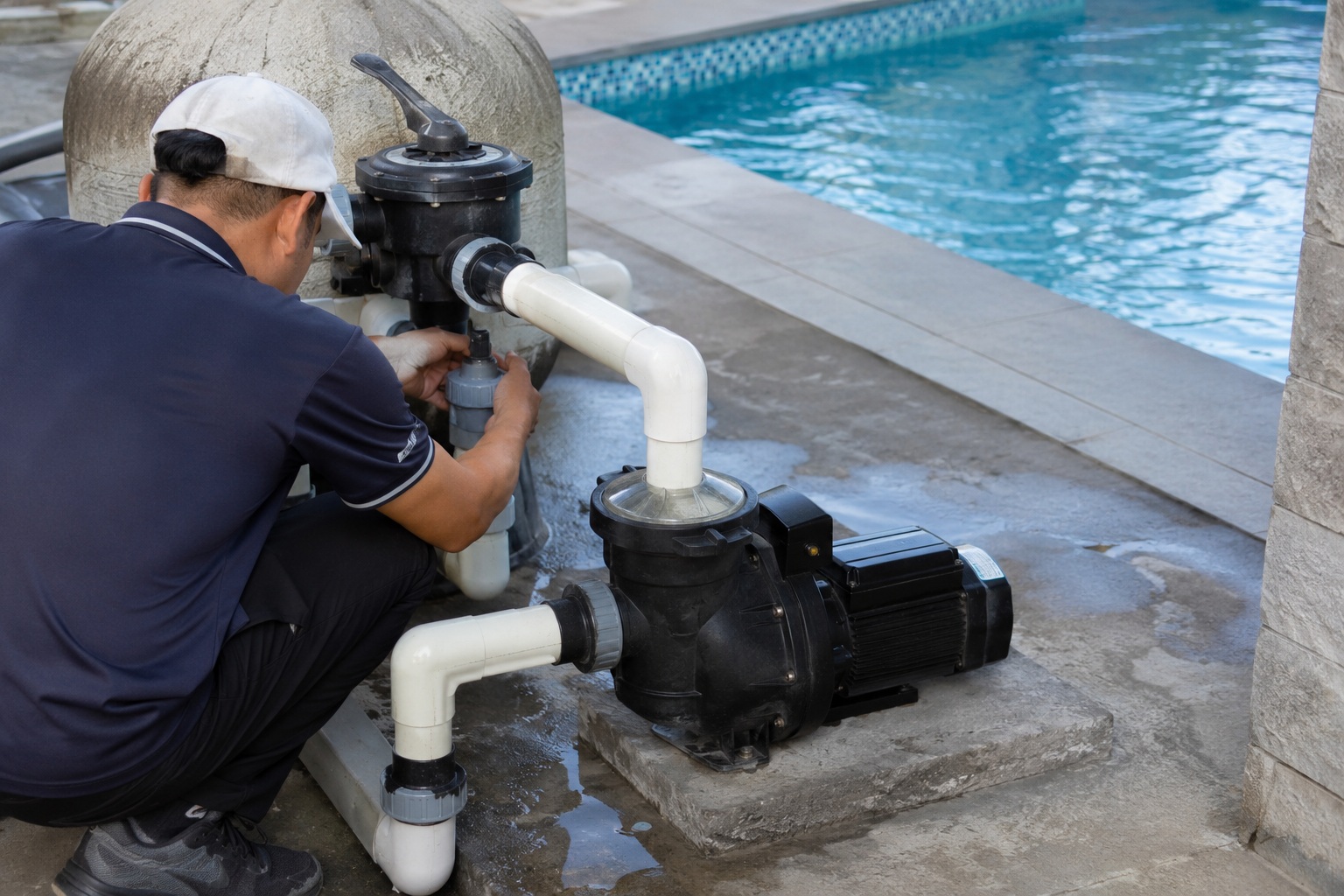
These methods are temporary fixes when your pump motor is working but the filter is not.
They are crucial for short-term pool maintenance, like distributing chemicals or troubleshooting a filter issue.
But what if your pump is completely non-functional?
The challenge then shifts from circulation to simple water movement, such as draining for repairs.
This guide will cover both scenarios.
We will explore how to circulate water with a working motor and how to move water when the pump is entirely out of commission.
We'll also look at the modern, reliable pumping solutions that can prevent these problems in the first place.
Use the Recirculate Setting (For Multiport Valves)
You just shocked the pool, but your filter pressure is already sky-high.
Forcing cloudy, algae-filled water through it will only cause clogs and reduce flow.
You need a way to mix the chemicals without stressing the filter.
The "Recirculate" setting on a multiport valve is the ideal solution. It uses the pump to circulate water throughout the pool, completely bypassing the filter media. This ensures rapid chemical distribution and keeps water moving during filter maintenance.
The "Recirculate" or "Whirlpool" function is an essential tool for any pool owner with a sand or D.E. filter.
It separates the function of water movement from water filtration.
This is critical in several situations.
Why Bypassing is Better Sometimes
When you add flocculants or heavy doses of algaecide, the goal is to make small particles clump together.
Sending these clumps directly into your filter sand or grids can clog them almost instantly, requiring immediate backwashing or cleaning.
By using "Recirculate," you allow these chemicals to mix thoroughly for several hours.
The clumps can then settle to the bottom of the pool, where they can be vacuumed to "Waste" later.
This two-step process is far more effective and less stressful on your equipment.
The Power Behind the Pump
This entire process relies on a functional motor.
If the motor itself is inefficient or failing, even simple recirculation is compromised.
The efficiency of a pump's motor is a major factor in its overall performance and lifespan.
Many older pool pumps use standard AC induction motors, which often operate at efficiencies between 30% and 70%.
In contrast, modern pumps are shifting towards superior motor technology.
For example, a Brushless DC (BLDC) permanent magnet motor can achieve efficiencies exceeding 90%.
This isn't just a small improvement; it's a fundamental change in performance.
A motor that is 90% efficient converts more electrical energy into pumping power, wasting very little as heat.
This leads to significantly lower operating costs and a cooler-running motor, which extends its service life.
Motor Efficiency Comparison
| Feature | Standard AC Induction Motor | Modern BLDC Permanent Magnet Motor |
|---|---|---|
| Operating Efficiency | 30% - 70% | > 90% |
| Energy Waste | High (lost as heat) | Very Low |
| Operating Temperature | Higher | Lower |
| Lifespan | Shorter | Longer |
| Size & Weight | Larger and Heavier | Up to 47% smaller & 39% lighter |
| Maintenance | Brushes may need replacement | Maintenance-Free (Brushless) |
Investing in a system with a high-efficiency motor means fewer operational headaches.
It reduces the likelihood of failures that force you to use temporary bypass settings and ultimately provides a more reliable and cost-effective pool circulation system.
Use a Garden Hose Siphon (for Draining or Lowering Water)
Your pool pump is completely dead.
You need to lower the water level for a repair or to close it for the winter, but you don't want to rent expensive equipment for a simple task.
There is a basic, physics-based solution.
A standard garden hose can act as a siphon to drain water from your pool. Simply fill the hose with water to remove air, keep one end submerged in the pool, and place the other end at a lower elevation. Gravity will do the work, draining the water slowly but steadily.
Siphoning is a fantastic method for moving water without any electricity.
It relies purely on gravity and a difference in elevation.
However, its effectiveness is directly related to the hose's diameter and the vertical drop.
This method is not for circulation; it is strictly for water removal.
The Speed of a Siphon
The flow rate of a siphon is limited.
While simple and cheap, it is also very slow.
A wider hose will always drain water faster than a narrower one because it faces less resistance and can carry a greater volume of water.
Let's compare two common siphon tools.
| Siphon Tool | Typical Diameter | Approximate Flow Rate | Time to Drain 10,000 Liters |
|---|---|---|---|
| Garden Hose | 1.5 cm (5/8 inch) | ~750 Liters per Hour (LPH) | ~13.3 hours |
| Pool Vacuum Hose | 3.8 cm (1.5 inch) | ~2,800 Liters per Hour (LPH) | ~3.6 hours |
As the data shows, using a pool vacuum hose as a siphon can drain the water almost four times faster than a standard garden hose.
Even so, for a large residential pool of 50,000 liters, you're still looking at a full day of draining.
When Siphoning Isn't Enough: The Need for a Pump
The slowness of siphoning highlights the incredible work a real pump does.
A small, dedicated pump can move water volumes that are impossible with siphoning.
This is especially true in scenarios where you need to move water without access to grid electricity.
This is where solar-powered water pumps become an invaluable asset.
A modest solar pump can easily achieve flow rates of 5,000 to 10,000 LPH, turning a day-long draining job into a task of just a few hours.
They provide a powerful, independent solution for water management.
For instance, if you need to drain a pool but also lift the water to a distant location or over a rise in the terrain, a siphon will fail.
A pump is required.
In this case, a solar screw pump would be an excellent choice.
It is designed for high-head applications, meaning it can push water very high vertically, even if its flow rate is lower.
This makes it perfect for deep wells or challenging drainage situations where gravity alone is not enough.
It demonstrates a core principle: for serious water management, you need the right tool, and often, that tool is a pump.
Rent a Trash Pump If Your Pool Pump Is Broken
The siphon method is far too slow for your needs.
A storm is coming, or you have a contractor scheduled for a repair, and the pool must be empty now.
You need speed and power without committing to a new pool pump just yet.
Renting a gas-powered trash pump or an electric submersible pump is the fastest method for draining a pool when the main pump is broken. These high-volume pumps can remove water at a rate of 30,000 LPH or more, emptying a typical pool in just 1-3 hours.
Renting equipment is a practical solution for a one-time, urgent need.
A trash pump is particularly useful because it is designed to handle water with some debris, like leaves or dirt, without clogging.
This makes it superior to a standard submersible "sump" pump for draining a pool that hasn't been perfectly cleaned.
The True Cost of a "Temporary" Fix
While convenient, renting a pump has its own costs.
Daily rental fees can range from $50 to over $100, depending on the pump's size and your location.
If your repair project gets delayed or you need the pump for more than a day, these costs add up quickly.
Renting is a short-term expense for a problem that may indicate a need for a long-term, reliable solution.
If your main pump has failed, it's an opportunity to consider a more resilient and efficient replacement.
Investing in a Permanent, Independent Pumping Solution
Instead of viewing a broken pump as just a one-time problem, think of it as a chance to upgrade your entire water management strategy.
This is especially true for properties in rural areas, those with unreliable grid power, or anyone looking to reduce their energy costs.
Investing in a solar-powered water pump provides a permanent, independent solution.
Modern solar pump systems are not just for off-grid homes anymore.
They are a smart investment for anyone.
Consider the options:
- For Corrosive Water: If your pool uses saltwater or your local water has high mineral content, a pump built with superior materials is essential. A solar pump with a stainless steel (SS304) impeller and body offers maximum corrosion resistance. This ensures a much longer service life compared to standard pumps, making its higher initial cost a wise long-term investment over repeated replacements.
- For 24/7 Reliability: What if you need water on cloudy days or at night? Advanced systems now feature hybrid AC/DC controllers. These smart devices automatically draw power from solar panels when the sun is out. When sunlight is insufficient, they can blend in AC grid power or automatically switch to it entirely. This guarantees your pump runs 24/7 without any manual intervention, providing true water security.
| Solution | Best For | Key Advantage | Long-Term Value |
|---|---|---|---|
| Rental Trash Pump | Urgent, one-time draining | Speed (1-3 hours to drain) | None; purely a temporary expense |
| Stainless Steel Solar Pump | Saltwater/corrosive environments | Durability & long service life | Reduces replacement costs over time |
| Hybrid AC/DC Solar Pump | Uninterrupted water supply | 24/7 operation, automatic switching | Energy savings plus total reliability |
A rental pump solves today's problem.
A strategic investment in a modern pump system solves today's problem and prevents it from happening again.
How to Keep a Kiddie Pool Clean Without a Pump
You bought an inflatable pool for the kids, and they love it.
But after just a few days, the water is slimy and cloudy.
Constantly dumping and refilling it feels like a massive waste of water, time, and money.
You can easily keep a small inflatable pool clean for weeks without a pump. The simple system involves using a floating chlorine dispenser for sanitation, a hand skimmer for daily debris removal, and a tarp cover to protect the water when it's not in use.
This low-tech, low-cost system works because it addresses the three main enemies of clean pool water: bacteria, debris, and sunlight.
It's a miniature version of the principles used to maintain large, in-ground swimming pools.
Maintaining balance is key, even on this small scale.
The Three Pillars of a Pump-Free System
- Sanitization: A single 1-inch or 3-inch chlorine tablet in a floating dispenser slowly dissolves, releasing just enough sanitizer to prevent the growth of algae and bacteria. For a small body of water, a little chlorine goes a long way. Too much can cause skin and eye irritation.
- Manual Filtration: Debris like leaves, grass, and bugs are food for algae. Removing them quickly with a skimmer net prevents them from breaking down and clouding the water. Stirring the water to lift sunken debris to the surface makes it easier to skim.
- Protection: A simple plastic tarp does two crucial things. It keeps new debris out overnight and blocks direct sunlight. Sunlight rapidly breaks down chlorine, so covering the pool helps your sanitizer last much longer.
From a Backyard Trick to a Global Solution
This simple kiddie pool method is a perfect analogy for large-scale water management challenges faced globally, particularly in agriculture.
The core needs are the same: providing clean, reliable water where it's needed.
The kiddie pool system is manual.
For a farm or ranch, a pump is the automated heart of the system.
The type of pump must match the specific need, just as our simple tools match the kiddie pool's needs.
| Application | Primary Need | Recommended Solar Pump Solution |
|---|---|---|
| Kiddie Pool | Basic cleanliness | Manual skimming & chlorination |
| Deep Well for Home | Lift water from depth (High Head) | Solar Screw Pump: Low flow, but powerful lift. |
| Farm Irrigation | Move lots of water (High Flow) | Solar Plastic Impeller Pump: High volume, wear-resistant, and economical. |
| Ranch in Alkaline Area | Withstand corrosive water | Solar Stainless Steel Impeller Pump: High flow with maximum durability. |
The solar plastic impeller pump is a workhorse for agriculture.
It is a multi-stage centrifugal pump designed to deliver a high volume of water at a medium head.
Its durable plastic impellers offer excellent resistance to fine sand, making it a reliable and economical choice for farm irrigation and livestock water supply in regions across Africa, the Americas, and Asia.
It scales up the principle of "providing clean water" from a backyard toy to a vital tool for food production, all powered by a sustainable, cost-free energy source: the sun.
Conclusion
You can circulate water with a "Recirculate" setting or drain it with siphons.
But for true reliability and efficiency, a modern, dedicated pump is the best long-term investment.
FAQs
What is the easiest way to empty a pool without a pump?
The easiest method is using a garden or vacuum hose as a siphon. It requires no power, only gravity, but it can be very slow.
Can I drain a pool with a garden hose?
Yes, you can use a garden hose to create a siphon. Just fill the hose with water, submerge one end, and place the other end lower than the pool.
Is it safe to completely empty an in-ground pool?
It can be risky. An empty in-ground pool can be damaged or even lifted out of the ground by hydrostatic pressure from groundwater. Always consult a professional first.
How do you circulate pool water after adding chemicals without a pump?
If the motor works, use the "Recirculate" setting on your multiport valve. This bypasses the filter and mixes chemicals quickly and efficiently throughout the pool.
How long can pool water sit without a pump?
In warm weather, water can start to get cloudy and develop algae within 1-3 days. Circulation is key to keeping the water sanitized and clear.
What happens if you don't circulate pool water?
Without circulation, chemicals won't disperse evenly, sanitizer levels will drop in spots, and stagnant water will quickly become a breeding ground for algae and bacteria.
How do you remove the last few inches of water from a pool?
A wet-dry shop vacuum is perfect for the last few inches. You can also use buckets or push the remaining water to a low spot to remove it.
Can I run my pool pump without the filter cartridge?
Yes, for a short period. Removing the cartridge allows the water to circulate without being filtered, which is useful for distributing chemicals when the filter is being cleaned.