Is your pool pump working correctly or is it a disaster waiting to happen?
Knowing the signs of a healthy pump is key.
A properly running pool pump should sound like a consistent, low hum.
The pump basket should be completely full of water with no visible air bubbles.
Water should be flowing strongly out of your pool's return jets.
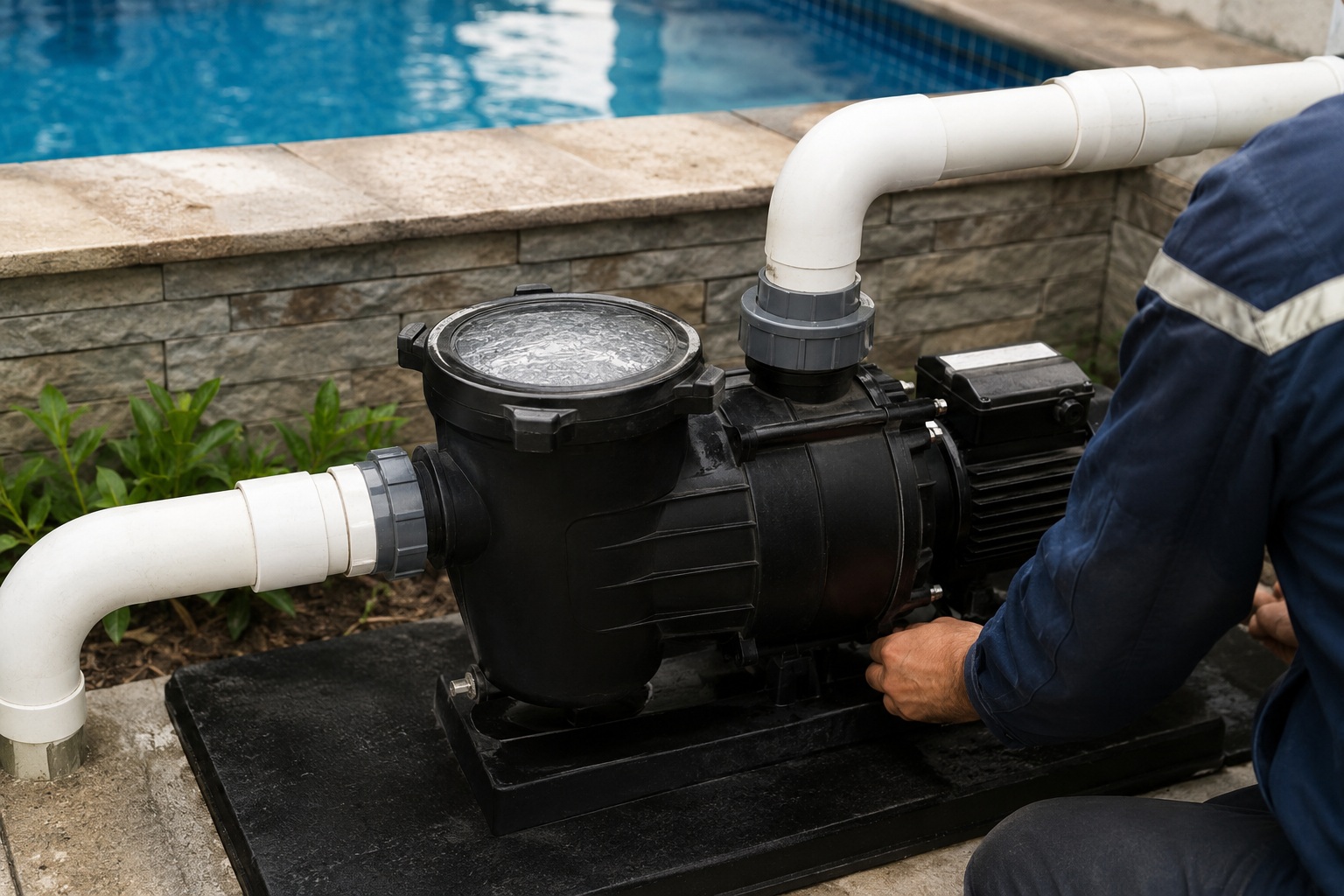
Understanding what a healthy, functioning pool pump looks and sounds like is the first step in pool maintenance.
Deviations from this normal state are early warnings that something is wrong.
Ignoring these signs can lead to cloudy water, equipment damage, and expensive repairs.
This guide will walk you through every aspect of your pump's operation, from ideal running conditions to troubleshooting common problems, ensuring your pool stays crystal clear and ready for fun.
Let's dive into what you need to know.
Pool Pumps: The Best Time to Run Your Pump
Struggling to keep your pool water clear?
Your pump's schedule might be the problem.
Choosing the right time to run your pump is crucial for a clean pool and an efficient system.
Running it during the day fights UV degradation of chlorine, while nighttime operation can save on energy costs, offering a trade-off between effectiveness and savings.
How Long Should I Run My Pump?
The goal is to circulate the entire volume of your pool's water through the filter at least once per day, a process called "turnover".
For most residential pools, an 8-hour run time is a standard recommendation.
However, this can change based on several factors.
Pools in hot climates, those with heavy use, or pools surrounded by trees may need run times of 10-12 hours to stay clean.
Conversely, a covered pool in a cooler climate might only need 6 hours.
To calculate your pool's required turnover time, you first need its volume in gallons.
Pool Volume Formulas:
- Rectangular: Length x Width x Average Depth x 7.5
- Circular: Diameter x Diameter x Average Depth x 5.9
- Oval: Length x Width x Average Depth x 5.9
Once you know the volume, you divide it by your pump's flow rate (gallons per minute, or GPM).
For a 20,000-gallon pool with a pump that moves 50 GPM, the calculation is 20,000 / 50 = 400 minutes, or about 6.7 hours for one turnover.
Running it for 8 hours provides a comfortable buffer.
When Should a Pump Run? Day or Night?
The debate between running your pump during the day versus at night involves a balance of chemistry, cleanliness, and cost.
Each has significant pros and cons that affect your pool's health and your wallet.
Running the pump during the day, especially from 10:00 am to 4:00 pm, directly counters the sun's impact.
UV rays can destroy up to 90% of your free chlorine in just a few hours.
Circulating the water helps distribute freshly generated or added chlorine, maintaining sanitation when the sun is at its strongest and when swimmers are most likely to be in the pool.
This keeps bacteria and algae from gaining a foothold.
Running the pump at night takes advantage of off-peak electricity hours, which can be 30-50% cheaper, significantly reducing your energy bills.
It also allows chemical treatments, like shocking the pool, to work uninterrupted by UV rays, making them more effective.
| Time | Pros | Cons |
|---|---|---|
| Day Time | - Combats UV chlorine degradation. - Keeps water clean during peak swim times. - Inhibits bacteria and algae growth in warm water. |
- Higher energy costs during peak hours. - Can be noisier during daytime activities. |
| Night Time | - Lower energy costs with off-peak rates. - More effective for overnight chemical treatments. - Quieter operation during the day. |
- Water is still during the hottest part of the day. - Algae and bacteria can grow faster in warm, stagnant water. |
How About a Hybrid Model?
Why not get the best of both worlds?
A hybrid schedule offers a comprehensive solution.
By splitting the total run time, you can gain the chemical benefits of daytime circulation and the cost savings of nighttime operation.
For an 8-hour total run time, you could set the timer for four hours during the peak sun period (e.g., 11:00 am to 3:00 pm) and another four hours during off-peak energy hours (e.g., 2:00 am to 6:00 am).
This approach ensures chlorine is distributed when UV rays are most destructive and your pool is in high use.
It then completes the filtration cycle when electricity is cheapest, ensuring a full turnover without the full daytime cost.
This strategy maximizes efficiency, keeps your pool consistently cleaner, and can save you up to 25% on pump-related energy costs compared to running it for 8 hours straight during the day.
Pool Pump Troubleshooting: Power Problems
You flip the switch to run your pump, but you're met with silence.
Power issues are common but can often be fixed easily.
A pump that won't start, shuts off immediately, or stops randomly points to an electrical issue.
This could be a tripped breaker, a bad timer, faulty wiring, or an internal component like a thermal overload switch protecting the motor from damage.
Pump Won’t Power Up
When your pump shows no signs of life, start with the simplest solutions first.
More than 50% of "dead pump" calls are resolved by checking the power source.
First, check the circuit breaker.
Breakers can trip for various reasons, so flip it firmly to the "off" position and then back to "on".
Next, inspect the pump timer.
Ensure it's set correctly and has power itself.
A common mistake is forgetting the pump is on a timer schedule and trying to operate it outside of that window.
If these checks don't work, turn off the breaker and perform a visual inspection of the wiring.
Rodents are known to chew on electrical wires.
Look for any frayed, disconnected, or damaged wires leading to the pump motor.
If everything appears normal and the pump still won't start, the issue could be an internal failure of the motor itself.
Pump Immediately Shuts Off
If your pump starts up for a few seconds and then dies, it's typically a sign of an electrical overload or a failing component.
The motor is trying to run but is being told to shut down.
A primary cause is a failing capacitor.
The start capacitor provides the initial electrical jolt to get the motor spinning.
If it's weak or has failed, the motor can't reach its operating speed, causing the system to overload and shut down.
This accounts for roughly 30% of immediate shut-off issues in pumps older than five years.
Another possibility, especially with a new installation, is incorrect voltage.
Pool pumps are designed for a specific voltage (115V or 230V).
If the wiring provides the wrong voltage, the motor will shut off to prevent damage.
Loose wiring connections can also cause intermittent power that leads to a shutdown.
Always have a licensed electrician handle voltage and wiring issues.
Pump Randomly Shuts Off
Your pump is running fine, and then, minutes or hours later, it shuts down for no apparent reason.
This is almost always due to overheating.
Pool pump motors are equipped with a thermal overload switch, a safety device that automatically cuts power if the motor temperature exceeds a safe limit (typically 150-165°F or 65-75°C).
The most common cause of overheating is a lack of ventilation.
If the pump is enclosed in a tight space or if its air vents are blocked by debris, it cannot cool itself effectively.
Direct, intense sunlight can also contribute, raising the motor's surface temperature by 20-30 degrees.
Other causes include low voltage, which makes the motor work harder and draw more current, or failing internal bearings that create excess friction and heat.
Once the motor cools down, the thermal overload switch will reset, and the pump may start again on its own, only to repeat the cycle.
Pool Pump Troubleshooting: Strange Sounds
Your pump is no longer making its familiar hum.
Instead, you hear a loud screech, a grinding roar, or a worrying vibration.
Any new or unusual noise is your pump's way of crying for help.
These sounds are symptoms of specific problems.
A humming noise suggests a jam or a failed capacitor, roaring indicates water starvation, and a high-pitched screeching is a tell-tale sign of bad motor bearings.
Humming Sounds
A humming sound without the pump starting means the motor is receiving power but the rotating assembly (the impeller and shaft) is stuck.
This can happen for two main reasons.
First, the impeller may be clogged with debris.
Small pebbles, twigs, or clumps of leaves can get past the pump basket and wedge the impeller, preventing it from spinning.
The motor tries to turn, creating the hum.
This is an easy fix: turn off the power, remove the pump basket, and use a tool or your fingers to clear the obstruction.
The second, more serious cause is a failed start capacitor.
The capacitor provides the torque to get the motor moving from a standstill.
When it fails, the motor has power but lacks the "kick" to start, resulting in a stationary hum.
Capacitor failure is responsible for over 60% of humming issues in pumps that are otherwise clear of debris.
Screeching or Roaring Sounds
Loud, abnormal noises during operation signal a serious problem that requires immediate attention.
Loud Roaring or Rumbling: This sound, often compared to rocks tumbling inside the pump, is caused by cavitation.
Cavitation occurs when the pump is "starved" for water.
With insufficient water supply, vacuum pockets form and then violently collapse, creating a loud roaring noise.
This is incredibly damaging to the impeller and other internal parts.
The cause is always a blockage or air leak on the suction side, such as a clogged skimmer basket, a low pool water level, or a stuck skimmer weir door.
High-Pitched Screeching or Squealing: This ear-piercing sound is the definitive sign of failing motor bearings.
The motor shaft spins on two sets of bearings.
When the mechanical seal fails, water leaks into the motor and washes the grease out of the bearings.
Without lubrication, the metal ball bearings grind against their housing, creating a high-frequency screech.
Continuing to run a pump with bad bearings will lead to complete motor seizure, a much more expensive repair.
Loud Vibrating Noises
While all pumps have some level of vibration, excessive or suddenly increased vibration is a warning sign.
This can shake plumbing fittings loose and damage the pump itself.
The simplest cause is an uneven base.
The pump should be on a solid, level pad.
Over time, the ground can shift, unbalancing the pump and causing it to vibrate loudly.
Worn motor bearings can also cause vibration.
As they wear out, they allow the motor shaft to wobble, creating an imbalance that translates into a noticeable vibration that worsens over time.
Finally, cavitation (water starvation) can cause severe vibration.
The mix of air and water hitting the impeller creates an erratic load, causing the pump to shudder and vibrate.
Addressing vibration is critical, as it can reduce the lifespan of your pump and plumbing by up to 50% if left unchecked.
Pool Pump Troubleshooting: Flow Problems
You look at your pool's return jets and see only a weak trickle of water, or you notice the pump basket isn't full.
Flow problems mean your water isn't circulating or filtering properly.
This quickly leads to a cloudy, unsanitary pool.
Most flow problems originate on the "suction side"—the plumbing between the pool and the pump.
Common culprits include a low water level, clogged baskets, or an air leak that allows the pump to suck air instead of water.
Pump is Sucking in Air
If you see air bubbles in your pump basket or flowing from your return jets, you have a suction-side air leak.
The pump is pulling in air along with water, which dramatically reduces its efficiency and can damage the motor.
Here's how to diagnose the cause:
Check Water Level: This is the cause of over 40% of air leak issues.
The pool water level must be at least halfway up the skimmer opening.
If it's too low, the skimmer will suck in air from the surface.
Check Skimmer and Pump Baskets: A full skimmer or pump basket acts like a clog, restricting water flow.
If the pump can't pull enough water, it will start to pull in air wherever it can.
Empty these baskets weekly.
Check Pump Lid O-Ring: The O-ring on your pump lid creates an airtight seal.
If it's dry, cracked, or has debris on it, it will allow air to be sucked into the pump.
This is a very common failure point.
Remove the O-ring, clean it, and lubricate it with a silicone-based O-ring lube.
If damaged, replace it immediately.
Water Flow is Low
Low water flow from the return jets is a clear sign that something is impeding the system.
This could be a problem on the suction side (preventing water from getting to the pump) or the pressure side (preventing water from leaving the filter).
We've covered suction-side issues like clogs and air leaks.
If you've ruled those out, the problem is likely on the pressure side.
Dirty Filter: This is the #1 cause of low flow on the pressure side.
As your filter traps dirt, the internal pressure rises and flow rate drops.
A filter that is 10 PSI above its clean starting pressure can reduce flow by up to 50%.
Backwash your sand or DE filter, or clean your cartridge filter.
Clogged Impeller: If debris gets past the pump basket, it can clog the eye of the impeller, physically blocking water from being pushed through the pump.
Pressure-Side Leaks: While less common, a leak in the plumbing between the filter and the pool will reduce the pressure and flow reaching the return jets.
Look for unexplained wet spots in the ground around your pool equipment or along the return lines.
Pump Basket Does Not Fill Up with Water
The clear lid on your pump is a diagnostic window.
During normal operation, the basket housing (the "pot") should be completely full of water.
If it's only half full or the water level is visibly churning with air, the pump is struggling to prime or is losing its prime.
This is a critical issue, as running a pump without a full prime will cause it to overheat and fail.
The cause is always a suction-side air leak.
The pump is pulling in so much air that it cannot create enough vacuum to draw a solid column of water from the pool.
The most common culprit, accounting for over 70% of priming issues, is a bad pump lid O-ring.
Check the O-ring for cracks, stretching, or debris.
Ensure the lid is screwed on tightly.
Other causes are the same as any suction-side leak: low water level, a cracked pump housing, or a leak in the underground suction plumbing.
If the pump won't prime at all, you may need to manually prime it by filling the pump pot with water from a hose before starting it.
Ultimate Guide to Maintaining Your Pool Pump
Your pool pump is the heart of your pool's circulation system, working tirelessly to keep your water clean.
Like any hard-working machine, it needs regular care.
Proactive maintenance prevents most common pump problems from ever starting.
Following a simple routine of cleaning, lubricating, and inspecting your pump will extend its life significantly.
A well-maintained pump can last 10-12 years, while a neglected one might fail in as little as 3-5 years.
Prime the Pump
Priming is the process of filling the pump and suction lines with water before it's turned on.
Running a pump "dry" without water will destroy the mechanical seal and damage the motor in under a minute.
While many modern pumps are "self-priming," this only works if the system is already mostly full of water.
After draining the pool, opening the system for repairs, or at the start of the season, you must manually prime the pump.
Steps to Manually Prime a Pump:
- Turn off all power to the pump at the circuit breaker.
- Set your multiport valve to "Recirculate" (if you have one).
- Remove the pump lid.
- Use a garden hose to fill the pump pot with water until it overflows.
- Replace the pump lid, ensuring the O-ring is clean and seated properly.
- Turn the power back on and start the pump. It should catch prime within 30-60 seconds.
Lubricate O-Rings
The O-ring under your pump lid is the most critical seal in the entire system.
It prevents air from being sucked in and water from leaking out.
Over time, it can dry out, crack, or get compressed.
To prolong its life and ensure a perfect seal, you should lubricate it 2-3 times per swimming season.
Use only a silicone-based lubricant specifically designed for pool O-rings.
Do not use petroleum-based products like Vaseline, as they will cause the rubber to swell and degrade, leading to premature failure.
A properly lubricated O-ring can last 3-5 years, while a dry one may fail in a single season.
Ensure Proper Air Circulation
Your pump's motor generates a significant amount of heat during operation.
It relies on the surrounding air and a built-in fan to stay cool.
If ventilation is restricted, the motor will overheat, triggering the thermal overload switch and shortening its lifespan.
Ensure there is at least 6 inches of clear space around all sides of the pump motor.
Keep the air vents on the motor casing clear of leaves, dirt, and spider webs.
If your pump is in direct sunlight, consider building a simple, well-ventilated cover.
A sunshade can lower the operating temperature of a motor by as much as 20°F, which can extend the life of its internal components by up to 25%.
Clean the Pump and Baskets
Your skimmer baskets and the pump's internal strainer basket are the first line of defense against debris.
If they become clogged, they starve the pump of water, causing it to work harder, overheat, and cavitate.
Weekly Maintenance Checklist:
- Empty Skimmer Baskets: Check and empty them at least once or twice a week, or daily if you have a lot of trees.
- Empty Pump Basket: Turn off the pump and empty the strainer basket. Check it for cracks or damage. A broken pump basket will allow debris to flow directly into the impeller, causing a clog or damage.
- Clean Pump Exterior: Brush any dirt or leaves off the motor housing to keep the vents clear.
Get an Annual Check-up
Just like a car, your pool pump benefits from an annual professional service.
A pool technician can spot developing problems that you might miss.
During a check-up, a technician will typically inspect the motor bearings for noise, check the capacitor's performance, test for any stray voltage, and inspect the seals and gaskets for wear.
This preventative maintenance is an investment.
Spending a small amount on an annual service can help you avoid a much larger bill for a full motor replacement down the line.
The best time for this service is in the spring, before you open your pool for the season.
Conclusion
A healthy pool pump is quiet, powerful, and leak-free.
Understanding these normal operating signs allows you to spot trouble early, saving you from costly repairs and ensuring a pristine pool.
FAQs
How do I know if my pool pump is working properly?
A properly working pump runs with a steady hum, the pump basket is full of water, and you can feel a strong flow from the return jets.
Any loud noises, air bubbles, or weak flow indicate a problem.
Should my pool pump basket be full of water?
Yes, the strainer basket housing should be completely full of water when the pump is running.
If it's not, you have an air leak on the suction side of the system that needs to be fixed.
What noise should a pool pump make?
A healthy pool pump should make a consistent, low humming or whirring sound.
Loud grinding, screeching, or rattling noises are signs of serious problems like bad bearings or debris in the impeller.
Why is my pool pump running but not pumping water?
This usually means the pump has lost its prime.
It could be due to a large air leak, a low water level in the pool, or a major clog in the suction line.
How can I tell if my pool pump motor is bad?
Signs of a bad motor include the pump tripping the breaker, making loud screeching or grinding noises, overheating and shutting off, or not starting at all.
These often point to failed bearings, windings, or capacitors.
Is it normal for a pool pump to be hot?
Pool pump motors do get warm to the touch, but they should not be too hot to briefly touch.
If it's sizzling or too hot to handle, it's overheating due to poor ventilation, low voltage, or internal friction.
Why is my pool pump leaking?
Leaks typically come from two places.
A leak from the main clamp between the pump halves indicates a bad body O-ring.
A leak from where the motor joins the pump signifies a failed mechanical shaft seal, which needs immediate replacement.