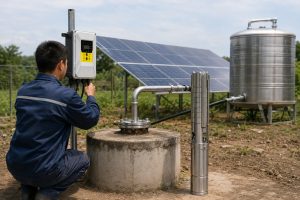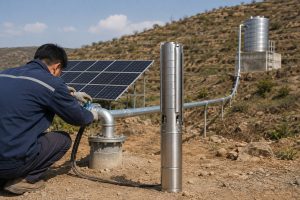
Struggling with unreliable water access in an off-grid area?
The high cost and hassle of traditional pumps can be frustrating, but a solar pump offers a sustainable solution.
Choosing a solar pump involves matching the pump's flow rate and head to your daily water needs.
Consider the pump type, motor efficiency, and whether you need a hybrid AC/DC system for 24/7 operation.
This ensures you get a reliable, cost-effective water solution.
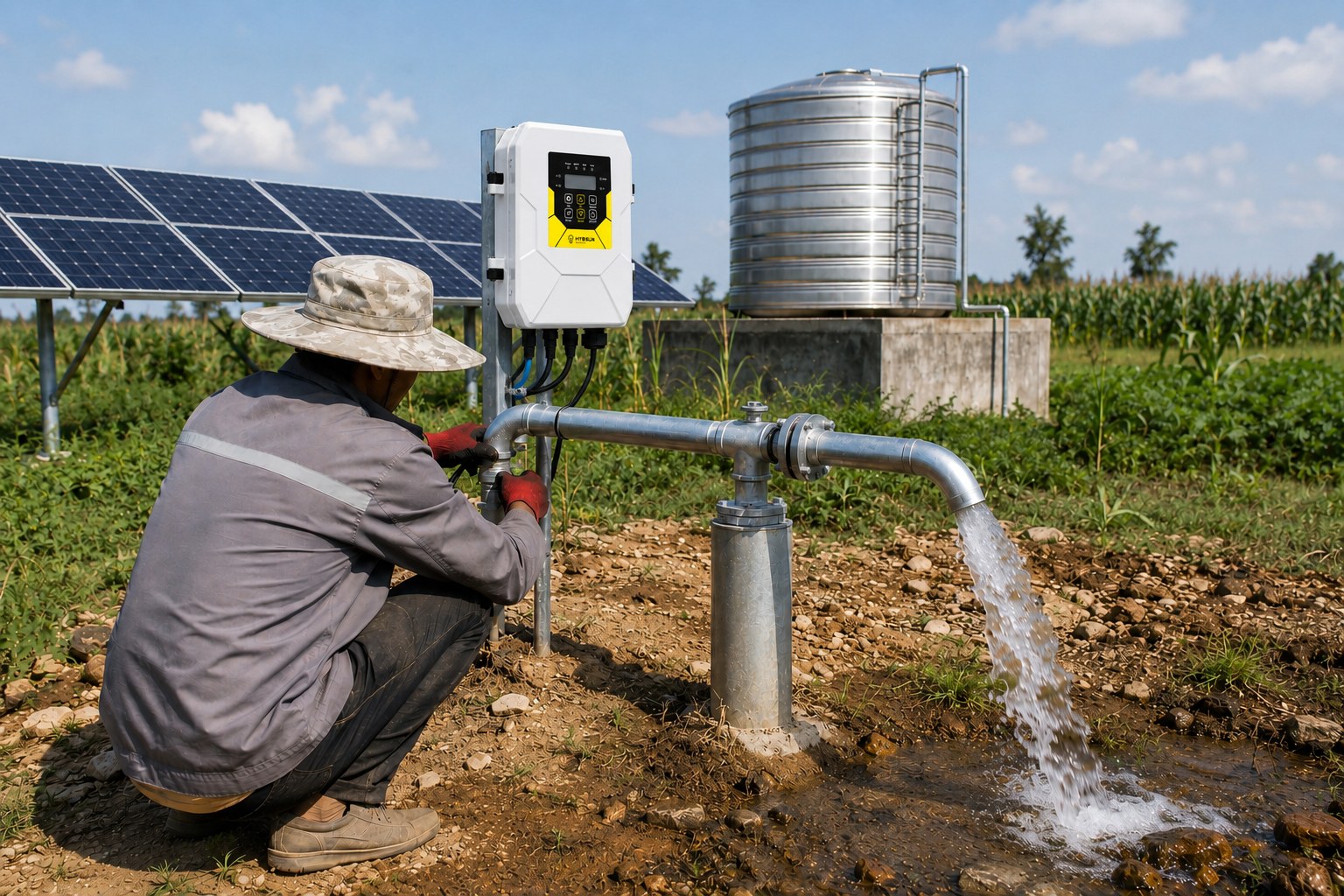
Choosing the right solar pump can feel complex.
You have to think about your water needs, the environment, and the technology itself.
This guide breaks down the process into simple, manageable steps.
We will cover everything from sizing your pump to understanding the core technology that drives it.
By the end, you will be able to select the perfect solar pump with confidence, ensuring you have a reliable water supply for years to come.
Let's dive in and find the right solution for your home, farm, or business.
First, What Size Solar Pump Do I Need?
Figuring out the right pump size feels daunting.
You worry that getting it wrong means either not enough water or a system that costs too much.
A properly sized pump is the key to an efficient and effective system.
The correct pump size depends on two main factors: the total volume of water you need daily and the total pumping head.
Calculating these two figures accurately is the first and most critical step in selecting a pump that will meet your demands without wasting energy or money.
To choose the right size, you must first understand your specific water requirements and the physical constraints of your location.
This involves a few calculations, but they are straightforward.
Getting this right ensures your pump can deliver the water you need, exactly where you need it, using only the power of the sun.
Calculating Your Daily Water Volume
The first step is to determine how much water you use each day.
This is measured in Gallons Per Day (GPD).
This figure varies greatly depending on the application.
For example, a household has different needs than a large farm.
Water loss, especially from open sources like ponds, is a major factor.
Most water loss in a well-constructed pond comes from evaporation.
Evaporation depends on the pond's surface area and the average daily temperature.
Summer months see the highest evaporation rates, so it's best to size your system for these peak conditions.
To find your daily water loss from evaporation, you can use online calculators or a simple formula based on your local climate data.
Once you have your total GPD, you need to convert it into a flow rate.
We use a conservative estimate of 6 peak sun hours per day for pumping.
So, you divide your total GPD by 6 to get the required Gallons Per Hour (GPH).
To get Gallons Per Minute (GPM), you divide the GPH by 60.
This GPM figure is the flow rate your pump must achieve.
| Application | Average Daily Water Need (Gallons) |
|---|---|
| Single Household (4 people) | 300 - 400 GPD |
| Beef Cattle (per head) | 15 - 20 GPD |
| Dairy Cattle (per head) | 30 - 40 GPD |
| Garden Irrigation (per 100 sq ft) | 62 GPD |
| Small Pond (1/4 acre) | 5,000 - 10,000 GPD (evaporation) |
Understanding Total Pumping Head
The second part of the equation is the total pumping head.
This is the total vertical distance the water needs to be lifted from the source to the destination.
It's not just the depth of your well or pond.
You must measure from the surface of the water in your source (like a well, stream, or pond) up to the final discharge point.
This vertical lift is the primary component of the total head.
For example, if your well water level is 100 feet below the ground and you are pumping into a tank whose inlet is 10 feet above the ground, your static head is 110 feet.
However, total head also includes friction loss.
Friction loss occurs as water moves through pipes and fittings.
The longer the pipe and the higher the flow rate, the greater the friction loss.
This can add another 5% to 20% to your total head calculation.
Failing to account for friction loss can result in a pump that doesn't deliver water to the destination.
Most pump manufacturers provide charts to help you calculate friction loss based on pipe diameter and flow rate.
For most small to medium ponds, a pump capable of moving 10 to 25 GPM is often sufficient.
Larger ponds, from one to five acres, may require a pump in the 50 to 100 GPM range to keep up with summer evaporation.
Second, Which Type of Solar Pump is Right for You?
With different pump types available, choosing the right one can be confusing.
You might pick a pump that can't handle your water conditions, leading to premature failure and costly replacement.
Understanding the main types helps you match the pump to your specific needs.
The right choice depends on your water source, water quality, and performance requirements.
Key types include submersible and surface pumps, with further specialization in deep well pumps like screw, plastic impeller, and stainless steel impeller models.
Each is designed for different applications and environments.
Selecting the correct pump type is as important as getting the size right.
A pump designed for clean water will quickly fail in a sandy well, while a low-flow pump won't work for large-scale irrigation.
Let's explore the different designs to help you make an informed decision.
Submersible vs. Surface Pumps
The first major distinction is between submersible and surface pumps.
Submersible pumps are designed to be placed entirely underwater in your well, pond, or tank.
They push water to the surface, which is more efficient than pulling it.
This makes them ideal for deep wells and boreholes where the water level is far below the ground.
Because they are submerged, they are self-priming and tend to run more quietly.
Surface pumps are placed on land, at or near the water level.
They work by pulling water from the source, such as a shallow well, pond, stream, or storage tank.
They are easier to access for maintenance but are limited in how high they can lift water from the source (their suction lift is typically less than 25 feet).
They are perfect for applications like boosting pressure from a tank, irrigating a garden, or circulating water in a pond.
The Deep Well Pump Portfolio
For deep wells, submersible pumps are the standard.
Within this category, the internal mechanism defines the pump's performance.
Here are three popular types.
1. Solar Screw Pump (Low Flow, High Head)
This pump uses a helical rotor (a stainless steel screw) that turns inside a rubber stator.
This action creates sealed cavities that move water upward with each rotation.
It's a type of positive displacement pump.
- Best For: Deep wells (over 300 feet), domestic water supply, and livestock watering where high lift is needed but high volume is not.
- Advantages: Excellent at handling sandy or silty water, with sand resistance up to 5%. It can generate very high pressure, making it perfect for deep boreholes.
- Limitations: The flow rate is relatively low, typically under 20 GPM, making it unsuitable for large-scale irrigation.
2. Solar Plastic Impeller Pump (High Flow, Wear-Resistant)
This is a multi-stage centrifugal pump.
It uses a series of impellers and diffusers to build pressure and move water.
The impellers are made from durable, engineered plastics.
- Best For: Farm irrigation, pasture water supply, and filling large tanks where high flow rates are essential. It works best in wells with moderate depth.
- Advantages: Delivers significantly higher flow rates compared to screw pumps. The plastic material offers good resistance to abrasion from fine sand and is more economical.
- Limitations: Not ideal for very deep wells or highly corrosive water, where the materials may degrade over time.
3. Solar Stainless Steel Impeller Pump (Premium Quality, Corrosion Resistance)
This pump is structurally similar to the plastic impeller model but uses SS304 or SS316 stainless steel for the impellers and pump housing.
This makes it a premium, highly durable option.
- Best For: Water sources with corrosive properties, such as acidic or alkaline water. It's also used in high-end residential systems and applications demanding maximum reliability.
- Advantages: Superior resistance to corrosion and abrasion, ensuring a very long service life even in harsh water conditions. It can handle high flow and medium-to-high head.
- Limitations: This is the most expensive option of the three, and its heavier weight can make installation more challenging.
| Pump Type | Best Application | Max Head | Max Flow | Sand Resistance |
|---|---|---|---|---|
| Screw Pump | Deep Well, Domestic Use | Very High | Low | Excellent (up to 5%) |
| Plastic Impeller | Farm Irrigation, High Volume | Medium | High | Good (fine sand) |
| Stainless Steel Impeller | Corrosive Water, Premium Use | Medium-High | High | Very Good |
Third, How Many Solar Panels Will You Need?
You want to power your pump effectively, but buying too many solar panels is a waste of money.
Under-powering the pump means it won't perform when you need it most, especially on less sunny days.
The key is to balance pump power with solar array size.
The number of panels needed depends directly on the pump's power consumption (in watts) and the amount of peak sunlight your location receives.
A larger, more powerful pump requires a larger solar array to run efficiently.
Sizing the array correctly ensures reliable operation and maximizes your investment.
Calculating your solar panel needs is a crucial step that directly impacts your system's performance and cost.
It's not just about the number of panels, but their total wattage output.
Let's break down how to determine the right size for your solar array.
Understanding Pump Power Ratings
Solar pumps are rated in either horsepower (HP) or watts (W).
One horsepower is approximately equal to 746 watts.
Pumps designed specifically for solar (DC pumps) range from small 1/4 HP models (around 200W) to larger 1 HP models (around 800-1200W).
Larger AC pumps, which can also be run on solar with an inverter, start at 1/2 HP and can go up to 100 HP or more.
The power rating tells you how much energy the pump needs to operate at its full capacity.
You can find this information on the pump's specification sheet.
Sizing Your Solar Array
Once you know the pump's wattage, you can size the solar array.
The goal is to have the solar panels produce at least the same amount of power as the pump requires.
However, it's a best practice to oversize the solar array by about 20-30%.
This "over-paneling" helps the pump start earlier in the day, run later in the evening, and perform better during overcast conditions.
For example, a 1/2 HP pump (approximately 375W) would run well with about 800W of solar panels.
A larger 7.5 HP pump (around 5600W) would require a much larger array, perhaps around 7000W.
The number of panels depends on the wattage of each individual panel.
Panels typically range from 100W to over 400W.
| Pump Horsepower (HP) | Approximate Watts | Recommended Solar Array (Watts) | Example Panel Configuration |
|---|---|---|---|
| 1/4 HP | 200 W | 250 - 300 W | 2 x 150W Panels |
| 1/2 HP | 375 W | 800 W | 8 x 100W Panels |
| 1 HP | 750 W | 1000 - 1200 W | 4 x 300W Panels |
| 3 HP | 2200 W | 2800 - 3000 W | 8 x 375W Panels |
| 10 HP | 7500 W | 9000 - 10000 W | 25 x 400W Panels |
The Importance of Peak Sun Hours
The calculations above assume ideal conditions.
The actual power output of your solar panels depends on the "peak sun hours" in your location.
A peak sun hour is an hour during which the intensity of sunlight is 1,000 watts per square meter.
Regions closer to the equator get more peak sun hours than those further away.
Most system sizing calculations use a conservative estimate of 5-6 peak sun hours.
This ensures the pump has enough power to meet the daily water volume requirement even on days that are not perfectly sunny.
Using a local solar irradiance map can help you find a more precise number for your area.
Fourth, What is the Core Technology Driving Your Pump?
You see many pumps that look similar, but their performance and lifespan vary dramatically.
Choosing a pump with an inefficient motor means you'll need more solar panels, increasing your initial cost and system complexity.
The motor is the heart of your solar pump system.
The efficiency of the motor determines the overall efficiency of the entire system.
High-efficiency motors require less power to do the same amount of work, which translates directly into needing fewer solar panels and lower operating costs over the pump's lifetime.
The hidden component that dictates a pump's performance is its motor.
While the pump end (screw or impeller) moves the water, the motor provides the power.
Understanding motor technology is key to choosing a truly efficient and reliable solar pump.
The Power of BLDC Motors
The most advanced solar pumps today are driven by a Brushless DC (BLDC) permanent magnet motor.
Unlike traditional motors that use brushes to conduct electricity, BLDC motors use electronics.
This design eliminates friction and energy loss associated with brushes.
The rotor in these motors is made from powerful permanent magnets, such as neodymium iron boron.
This technology results in a motor that is incredibly efficient, with efficiency ratings often exceeding 90%.
In contrast, standard DC or AC motors may have efficiencies closer to 60-75%.
Key Advantages of High-Efficiency Motors
Choosing a pump with a high-efficiency BLDC motor offers several significant benefits.
-
Reduced Power Consumption: A 90% efficient motor uses almost all the incoming solar energy to pump water. This means you can achieve your desired flow rate and head with significantly less power.
-
Smaller Solar Array: Because the motor needs less power, you can use a smaller, less expensive solar array. This can reduce the total initial system cost by 15-25%.
-
Compact and Lightweight Design: BLDC motors are much more compact and lighter than traditional motors of the same power output. Some designs are up to 47% smaller and 39% lighter, making installation easier and less costly.
-
Higher Torque and Better Performance: These motors provide high torque even at low speeds. This allows the pump to start easily in low-light conditions and maintain consistent performance throughout the day.
-
Longer Lifespan and No Maintenance: The absence of brushes means there are no parts to wear out and replace. This results in a virtually maintenance-free motor with a much longer operational lifespan.
The Role of the MPPT Controller
To get the most out of a BLDC motor and solar array, the system needs an intelligent controller.
A Maximum Power Point Tracking (MPPT) controller constantly monitors the output of the solar panels and the power requirements of the motor.
It adjusts the electrical load to ensure the panels are always operating at their peak efficiency, or "maximum power point."
This can boost the overall water output of the system by up to 30% compared to a system without an MPPT controller.
It acts as the brain, perfectly matching the power source to the motor for optimal performance all day long.
Finally, Do You Need a Hybrid AC/DC System?
Solar power is great, but what happens on cloudy days or at night when you still need water?
Relying solely on solar can leave you without water during critical times, disrupting your home, livestock, or crops.
This is a major concern for applications that require a 24/7 water supply.
A hybrid AC/DC solar pump system solves this problem.
It combines the free energy of solar with the reliability of a backup power source.
These systems can automatically switch between DC power from your solar panels and AC power from the grid or a generator, ensuring you have water whenever you need it.
For many, water is not just a daytime need.
A hybrid system offers the best of both worlds: the cost savings and sustainability of solar, plus the peace of mind of a constant, reliable water supply.
Let's explore how this technology works and why it might be the perfect solution for you.
The Limitation of Solar-Only Systems
A standard solar pump system is beautifully simple.
When the sun shines, the pump works.
When the sun goes down or is obscured by heavy clouds, the pump stops.
For many applications, like filling a large storage tank during the day for later use, this is perfectly fine.
However, for direct irrigation, household water pressure, or any process that cannot be interrupted, this limitation is a significant drawback.
Storing large amounts of water can also be expensive and require a lot of space.
How AC/DC Hybrid Controllers Work
A hybrid system adds an intelligent controller that can accept two power inputs simultaneously: DC from solar panels and AC from an external source.
The controller is programmed with a clear priority.
-
Solar First: As long as the solar panels are producing enough power to run the pump, the controller will use 100% solar energy. This is the default and most cost-effective mode.
-
Hybrid Blending: If solar power drops due to cloud cover, the controller can blend in AC power to make up the difference. It maximizes the use of free solar energy before drawing from the grid.
-
AC Backup: When there is no solar input at all (e.g., at night), the controller will automatically switch over to the AC power source to keep the pump running.
This entire process is seamless and automatic.
You don't have to manually switch anything.
The controller manages the power sources to provide uninterrupted water flow while minimizing electricity costs.
Benefits of a Hybrid System
Investing in a hybrid system provides several key advantages.
- Uninterrupted Water Supply: Guarantees water access 24 hours a day, 7 days a week, regardless of weather conditions.
- Maximum Cost Savings: Prioritizes free solar energy, only using paid AC power when absolutely necessary.
- Increased System Flexibility: Allows you to run the pump at full capacity anytime, which is useful for emergency water needs.
- Peace of Mind: Eliminates the worry of running out of water, which is critical for livestock, sensitive crops, and residential use.
This makes a hybrid system an ideal choice for anyone who needs the reliability of a traditional electric pump but wants the environmental and financial benefits of solar power.
Conclusion
Choosing the right solar pump means balancing size, type, and technology.
A well-chosen system provides a durable, cost-effective, and sustainable water solution for any off-grid need.
FAQs
How deep can a solar pump work?
Solar pumps can work in a wide range of depths.
Screw pumps are designed for very deep wells, often exceeding 300 feet, while centrifugal pumps are better for moderate depths.
Can a solar pump run without a battery?
Yes, most solar pumps are designed to run directly from solar panels during the day.
A battery is only needed if you require water at night or during extended cloudy periods.
How long do solar water pumps last?
A quality solar pump system can last for many years.
The solar panels often have a 25-year warranty, and a brushless motor can last over 10 years with minimal maintenance.
How much does a solar water pump system cost?
Costs vary widely based on pump size, depth, and panel requirements.
Small fountain pumps can be under $100, while large agricultural systems can cost thousands of dollars.
Can a solar pump fill a tank?
Absolutely.
A common application is to use a solar pump to fill a storage tank during the day.
The stored water can then be used anytime via gravity or a booster pump.
What maintenance do solar pumps require?
Solar pump systems are very low-maintenance.
You should periodically clean the solar panels and check the pump's intake for debris, but brushless motors require no regular servicing.