Struggling to get water across your property?
Pumps designed for vertical wells often fail when pushing water long distances horizontally, leading to frustration and system failure.
Yes, a borehole pump can work horizontally, but its effectiveness depends on a complex calculation involving pump power, pipe diameter, and friction loss. While designed for vertical depth, a properly sized pump can push water thousands of feet horizontally on flat ground.
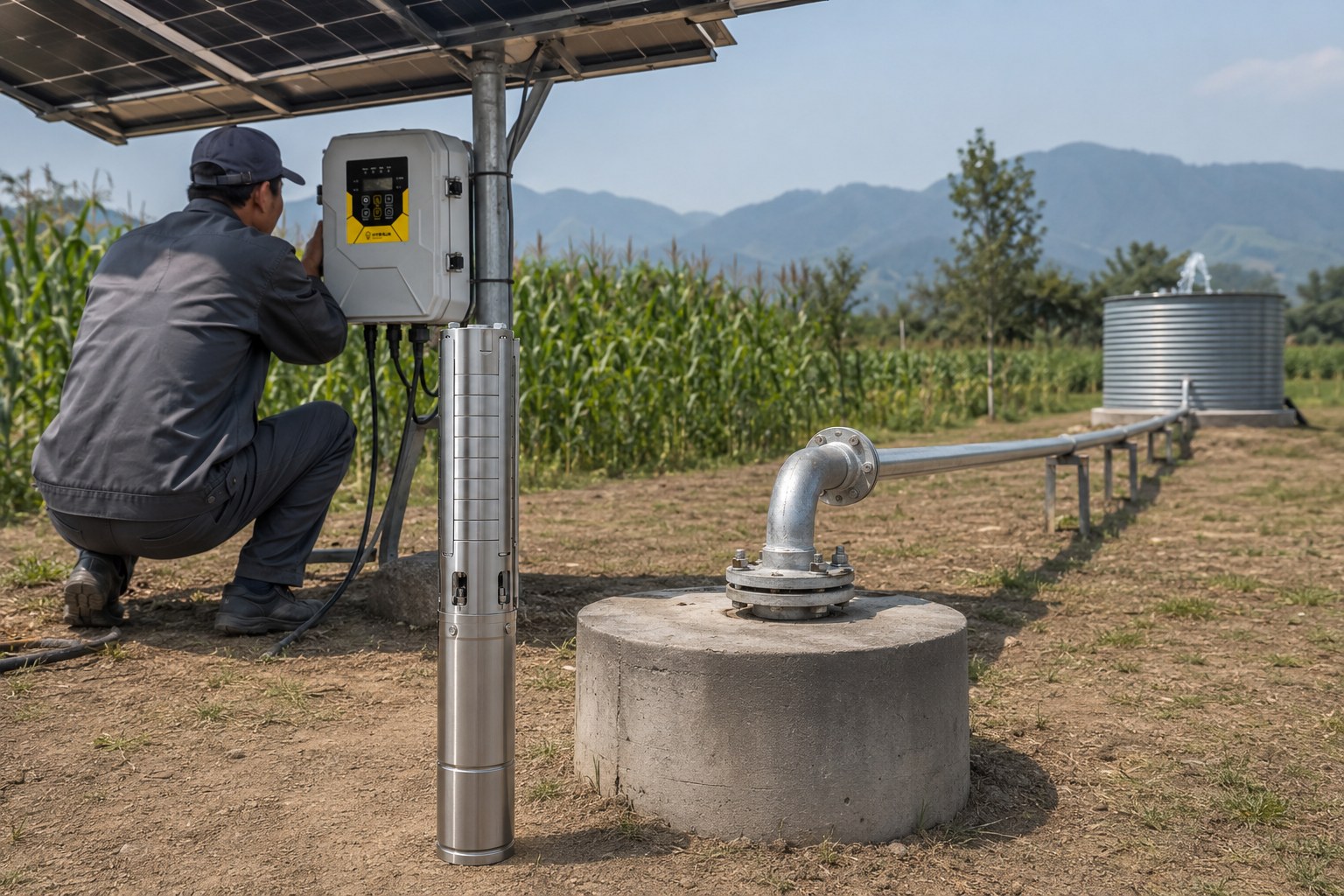
While we often call them "borehole" or "submersible" pumps, their primary job is to create pressure.
This pressure can lift water up, but it can also push it sideways.
The real question isn’t if it can work horizontally, but how far and under what conditions.
Understanding this is the key to designing a water system that works reliably and efficiently, whether for a farm, a home, or an industrial site.
This guide will break down the science, the key components, and the pump types you need to know to make an informed decision for your project.
Understanding The Physics: Vertical Lift vs. Horizontal Push
Are you confused by pump specifications?
Many people focus only on how deep a pump can go, not realizing that horizontal distance follows its own complex set of rules.
The ability of a pump to move water is defined by its Total Dynamic Head (TDH). This single value combines the vertical lift, the horizontal distance (as friction), and the pressure needed at the end, telling you the pump's true workload.
A pump doesn't know the difference between lifting water 10 feet straight up or overcoming the friction equivalent of pushing it hundreds of feet horizontally.
It only feels the total pressure it has to generate, which we call Total Dynamic Head (TDH).
This concept is the foundation for understanding any water pump system.
By calculating your system's TDH, you can match it to the right pump, ensuring you get the flow you need at the distance you require.
Let's explore the components of TDH in more detail.
What is Total Dynamic Head (TDH)?
TDH is the total workload placed on your pump.
It's measured in feet or meters of head.
This measurement includes several key factors.
First is the static lift.
This is the vertical distance from the water source's surface to the highest point in your discharge pipe.
Second is the friction loss.
This is the pressure lost as water moves through pipes and fittings.
Third is the discharge pressure.
This is the pressure you need at the end of the pipe, for example, to run a sprinkler.
You calculate your system's TDH by adding these three components together.
A safety margin of 10-20% is often added to account for pipe aging and unforeseen factors.
Pump manufacturers provide performance curves that show how much water a pump can move at a given TDH.
The Role of Friction Loss
Friction loss is the invisible enemy of horizontal water transfer.
As water flows through a pipe, it rubs against the inner walls.
This friction creates resistance, which the pump must overcome by generating extra pressure.
This lost pressure is converted into a small amount of heat.
Several factors influence the amount of friction loss.
A higher flow rate dramatically increases friction.
In fact, doubling the flow rate can increase friction loss by nearly four times.
Pipe diameter is also critical.
A smaller pipe forces water to move faster for the same flow rate, leading to significantly higher friction.
The material and condition of the pipe matter too.
A smooth PVC pipe has about 30-40% less friction than an older, rougher cast iron pipe of the same size.
Pump Power and PSI Explained
Pressure is the force that moves water.
It's commonly measured in pounds per square inch (PSI).
There's a direct relationship between pressure and head.
One PSI of pressure can lift a column of water approximately 2.31 feet vertically.
This means a pump rated for 50 PSI can, in a frictionless world, lift water 115.5 feet high.
When pushing water horizontally, this pressure is used to overcome friction loss instead of gravity.
A pump's horsepower (HP) rating is a general indicator of its ability to produce pressure and flow.
A 1/2 HP pump might generate 40-60 PSI, while a more powerful 2 HP pump could produce over 100 PSI.
This higher pressure allows the 2 HP pump to overcome more friction and therefore push water much farther horizontally.
| Pipe Diameter (inches) | Friction Loss (feet of head) per 100 feet of pipe @ 20 GPM |
|---|---|
| 1.5" PVC (Schedule 40) | ~9.9 feet |
| 2" PVC (Schedule 40) | ~3.1 feet |
| 3" PVC (Schedule 40) | ~0.6 feet |
| 4" PVC (Schedule 40) | ~0.2 feet |
This table shows how dramatically friction loss decreases as pipe diameter increases for the same flow rate.
Key Factors That Determine Horizontal Pumping Distance
Are you planning a system but unsure if your pump is strong enough?
Choosing the wrong components can lead to low pressure, insufficient flow, or a pump that burns out prematurely.
Your pump's horizontal reach is determined by its horsepower, the diameter and material of your pipes, your required flow rate, and any changes in elevation along the path. Each factor significantly impacts the final performance.
Achieving the maximum horizontal distance from your submersible pump isn't about just one factor.
It's a balancing act between four interconnected variables.
Think of your pump's power as your budget.
Every foot of pipe, every gallon per minute of flow, and every inch of elevation gain "spends" some of that power.
Understanding how to manage this budget is the difference between a successful project and a costly failure.
Let's break down each of these critical factors.
Pump Horsepower (HP) and Pressure (PSI)
The engine of your system is the pump's motor.
Its power, measured in horsepower (HP), directly correlates with its ability to generate pressure (PSI).
More horsepower generally means more pressure.
This higher pressure allows the pump to overcome more friction over a longer horizontal distance.
For example, a typical 1/2 HP residential submersible pump might push water 800-1,200 feet under ideal conditions.
Upgrading to a 1 HP unit, which produces more pressure, could extend that reach to 1,500-2,000 feet.
Large 5 HP agricultural pumps can push water 5,000 feet or more.
It's a direct trade-off: more distance requires more power.
The Critical Impact of Pipe Diameter
This is often the most overlooked but most impactful factor.
Using a pipe that is too small is like trying to breathe through a coffee straw.
It creates massive resistance, or friction loss.
Increasing pipe diameter is the single most effective way to reduce friction and extend horizontal reach.
For a flow rate of 20 gallons per minute (GPM), a 2-inch pipe has over 3 times less friction than a 1.5-inch pipe.
Moving up to a 4-inch pipe reduces that friction by over 95% compared to the 1.5-inch pipe.
While larger pipes have a higher upfront cost, they can dramatically reduce the required pump size and long-term energy consumption, often saving money over the life of the system.
Balancing Flow Rate and Distance
How much water do you need, and how fast do you need it?
This is your flow rate, measured in gallons per minute (GPM) or liters per minute (LPM).
There is an inverse relationship between flow rate and horizontal distance.
For a given pump and pipe size, a lower flow rate will travel much farther than a high flow rate.
This is because higher flow rates create exponentially more friction.
If your system isn't delivering water far enough, one solution is to reduce the flow at the destination.
This will lower the system's friction loss, allowing the pump's pressure to push the water a greater distance.
You must balance your need for volume against your need for distance.
Don't Forget Elevation Changes
Even a "horizontal" pipe run is rarely perfectly flat.
Small, gradual inclines can have a huge impact on pump performance.
Every foot of vertical rise along the pipe's path consumes 0.433 PSI of the pump's pressure.
This is pressure that can no longer be used to overcome friction.
A pipe run that rises just 20 feet over a distance of 1,000 feet will consume an extra 8.66 PSI, which is equivalent to the friction loss of hundreds of feet of additional pipe.
Conversely, a downhill slope can help the pump by adding pressure through gravity, potentially extending its reach.
Always survey your pipe route for elevation changes.
| Pump Power (HP) | Typical Horizontal Distance (with 3-4" pipe, moderate flow) |
|---|---|
| 1/2 HP | 800 - 1,200 feet |
| 1 HP | 1,500 - 2,000 feet |
| 2 HP | 3,000 - 4,000 feet |
| 5 HP | 5,000 - 8,000 feet |
These are estimates. Actual performance depends heavily on all the factors discussed.
Choosing the Right Pump Type for Your Needs
Overwhelmed by the different types of pumps on the market?
Selecting a pump based only on price or horsepower can lead to poor performance and a short lifespan if it's not suited to your water conditions.
The best pump is a match for your specific application, balancing flow, head (pressure), and water quality. Solar-powered screw, plastic impeller, and stainless steel impeller pumps offer a portfolio of solutions for diverse needs.
Once you understand the physics of your water system, the next step is selecting the right tool for the job.
With the rise of sustainable energy, solar-powered deep well pumps have become a leading choice in off-grid areas across the globe.
They offer energy independence and cost-effective operation.
Within this category, three main types have emerged to cover nearly every application, each with a distinct set of strengths.
Understanding the difference between them is crucial for building a durable and efficient system.
The Specialist: Low Flow, High Head Screw Pumps
This pump type is a specialist for deep wells.
It doesn't use a traditional impeller.
Instead, it uses a single rotating stainless steel screw (rotor) inside a rubber housing (stator).
As the screw turns, it creates sealed cavities of water that are pushed progressively up the pump.
This design is incredibly efficient at creating high pressure.
This allows it to pump from very deep wells (high head) with very little power.
However, this design limits the volume of water it can move (low flow).
It's an ideal choice for domestic water supply, livestock troughs, or small-scale drip irrigation where depth is more important than volume.
A key advantage is its exceptional resistance to sand and grit, as the rubber stator can tolerate abrasive particles that would destroy a centrifugal pump.
The Workhorse: High Flow, Wear-Resistant Plastic Impeller Pumps
This is the most common type of multi-stage centrifugal pump.
It uses a series of impellers and diffusers stacked on top of each other.
Each stage adds a little more pressure to the water.
Modern versions often use durable, engineered plastic (like Noryl) for the impellers.
This material offers excellent wear resistance against fine sand, is lightweight, and is very cost-effective.
These pumps are workhorses designed to deliver high volumes of water at medium head.
This makes them perfect for farm irrigation, large-scale livestock water supply, and filling storage tanks quickly.
They offer the best balance of performance, durability, and price for a wide range of general applications.
Their main limitation is in highly corrosive water or extreme-depth wells where a more robust material is needed.
The Premium Choice: Corrosion-Resistant Stainless Steel Impeller Pumps
When water quality is harsh or reliability is paramount, stainless steel is the answer.
This pump is structurally similar to the plastic impeller pump, but its key components—the impellers, diffusers, and pump body—are made from high-grade stainless steel (often SS304 or SS316).
This construction provides superior resistance to corrosion from acidic or alkaline water.
It also offers greater structural integrity for very deep well applications.
These pumps are designed for longevity in challenging environments.
They are the go-to solution for water supplies in coastal regions, areas with acidic groundwater, or high-end residential and commercial projects where long-term reliability is the top priority.
While they have a higher initial cost, their extended service life in harsh conditions often makes them the most economical choice over time.
| Pump Type | Primary Strength | Best Application | Key Limitation |
|---|---|---|---|
| Solar Screw Pump | Very High Head / Pressure | Deep domestic wells, livestock water | Limited flow rate |
| Solar Plastic Impeller Pump | High Flow / Wear-Resistance | Farm irrigation, general purpose | Less durable in corrosive water |
| Solar Stainless Steel Impeller Pump | Corrosion Resistance / Durability | Acidic/alkaline water, high-end homes | Higher initial cost and weight |
The Engine Behind the Pump: Why Motor Efficiency Matters
Do you assume all pump motors are created equal?
The motor is the single biggest consumer of energy in your pump system, and an inefficient motor can double your operating costs or solar panel requirements.
The heart of a modern solar pump is a high-efficiency brushless DC (BLDC) permanent magnet motor. Its efficiency, often exceeding 90%, directly reduces the number of solar panels needed and lowers overall system cost.
You can have the most perfectly designed pump end, but if the motor driving it is inefficient, the whole system suffers.
The motor's job is to convert electrical energy into the mechanical energy that spins the pump.
How well it does this is called motor efficiency.
A 10% or 20% improvement in motor efficiency doesn't just save a little power; it has a cascading effect that reduces the cost and complexity of the entire solar-powered system.
This is why the transition to advanced motor technology has been a game-changer for the solar pumping industry.
What is a BLDC Permanent Magnet Motor?
A Brushless DC (BLDC) motor is a major leap forward from older AC or brushed DC motors.
Instead of using carbon brushes that wear out, it uses an electronic controller to switch the motor's magnetic field.
The rotor—the part that spins—is made with powerful, high-grade permanent magnets, often neodymium iron boron.
This design eliminates the friction and energy loss associated with brushes.
It also allows for a much more compact and powerful motor.
Compared to a traditional motor of the same power output, a BLDC motor can be up to 47% smaller and 39% lighter, which simplifies installation and handling.
Technical Advantages of High-Efficiency Motors
The primary advantage is, of course, efficiency.
A standard AC motor might have an efficiency of 60-75%.
A well-designed BLDC motor consistently operates at efficiencies above 90%.
This means more of the precious power generated by your solar panels is converted into useful water pumping work.
This high efficiency is maintained across a wider range of speeds, which is crucial for solar applications where sunlight intensity varies.
They also generate less waste heat, which contributes to a longer service life.
Furthermore, they produce higher torque at low speeds, allowing them to start easily even under heavy load.
The Market Value of an Efficient Motor
For an end-user, the value is clear and immediate.
A pump system with a 90% efficient motor requires roughly 20-25% fewer solar panels to do the same job as a system with a 70% efficient motor.
Fewer panels mean a lower initial investment, a smaller installation footprint, and simpler wiring.
For distributors and installers, offering products with high-efficiency motors is a powerful competitive advantage.
It allows you to sell a more cost-effective, reliable, and technologically advanced solution.
It positions your brand as a provider of premium, energy-saving technology.
The motor is the strategic core of the pump system; its efficiency dictates the performance and economic viability of the entire package.
| Feature | Standard AC Induction Motor | High-Efficiency BLDC Motor | Advantage |
|---|---|---|---|
| Peak Efficiency | 60% - 75% | > 90% | ~25% less energy used |
| Brushes | Yes (in some types) or Slip Rings | No (Brushless) | No maintenance, longer life |
| Rotor Type | Wound Copper or Aluminum | Permanent Magnets (Neodymium) | Higher torque, more compact |
| Size & Weight | Larger and Heavier | Up to 39% lighter, 47% smaller | Easier installation, less material |
| Heat Generation | Higher | Lower | Improved longevity and reliability |
| Speed Control | Complex (Requires VFD) | Simple (Built into controller) | Better performance in variable sun |
Advanced Control Systems for 24/7 Water Access
Worried about not having water on cloudy days or at night?
Traditional solar pumps stop working when the sun goes down, leaving you without water when you might need it most.
Modern hybrid controllers solve this problem by intelligently blending power sources. They can automatically switch between solar panels, grid electricity, or a generator, ensuring a reliable water supply 24 hours a day.
A solar water pump is only as smart as its controller.
The controller is the brain of the system.
It manages the flow of power from the solar panels to the motor, protects the pump from damage, and maximizes water output.
Early controllers were simple on/off switches.
Today's advanced controllers are sophisticated electronic devices that can dramatically improve the performance, reliability, and versatility of a solar pumping system, even extending its operation beyond daylight hours.
Maximizing Solar Power with MPPT
Maximum Power Point Tracking (MPPT) is a standard feature in all quality solar pump controllers.
Solar panels have a specific voltage and current at which they produce the most power.
This "maximum power point" changes constantly with sunlight intensity and temperature.
An MPPT controller continuously monitors the panels and adjusts the electrical load to ensure the motor is always receiving the maximum possible power.
This technology can boost the daily water output of a system by up to 30% compared to a system without MPPT, especially on cloudy days or during early morning and late afternoon.
It ensures you get the most out of your solar panel investment.
The Rise of AC/DC Hybrid Controllers
The biggest limitation of a pure solar system is its dependence on the sun.
Hybrid AC/DC controllers remove this limitation.
These advanced controllers are designed with multiple power inputs.
You can have your solar panels (DC power) and your utility grid or a generator (AC power) connected at the same time.
The controller's internal logic prioritizes solar power.
When the sun is shining brightly, the pump runs entirely on free energy from the panels.
How Hybrid Systems Work
The intelligence of a hybrid controller lies in its automatic switching and blending capabilities.
As clouds pass over or as the sun begins to set, the solar power input will drop.
The controller detects this and seamlessly supplements the solar power with just enough AC power to keep the pump running at the desired speed.
It maximizes the use of every available watt of solar energy before drawing from the grid.
When there is no solar input at all, such as at night, the controller automatically switches over to run the pump entirely on AC power.
This guarantees you have a worry-free water supply around the clock, without having to manually switch power sources.
Benefits for Off-Grid and Rural Users
For homes, farms, and communities in rural or off-grid areas, this technology is transformative.
It provides the reliability of a grid-connected pump with the low operating costs of a solar pump.
You can run irrigation systems at night to reduce evaporation.
You can ensure livestock always have water, regardless of the weather.
You can have household water pressure 24/7.
It provides the ultimate in flexibility and water security, combining the best of both worlds: the sustainability of solar and the on-demand reliability of the grid.
Conclusion
Properly sizing a pump for horizontal use involves calculating TDH and selecting the right pump and pipe.
Advanced solar pumps with efficient motors and hybrid controllers offer robust, 24/7 water solutions.
FAQs
How far can a 1 HP submersible pump push water horizontally?
A 1 HP pump can typically push water 1,500-2,000 feet horizontally, assuming a 3-4 inch pipe and moderate flow. This distance decreases with smaller pipes or higher flow rates.
Does pipe size affect how far a pump can push water?
Yes, dramatically. Doubling the pipe diameter can reduce friction loss by over 75%, allowing the same pump to push water significantly farther. It's often the most critical factor.
Can a submersible pump run horizontally?
While the pump itself is installed vertically in a well, the water it pushes can be piped horizontally for very long distances. The system must be designed for the resulting friction loss.
What is the 10/20 rule for pumps?
A general guideline stating you should add a 10% to 20% safety margin to your Total Dynamic Head (TDH) calculation. This accounts for pipe aging and other real-world inefficiencies.
How do you calculate horizontal pump distance?
You don't calculate the distance directly. You calculate the friction loss for a desired distance and flow rate, add it to your vertical lift, and see if the total matches your pump's capabilities.
What happens if your pump is too small for the horizontal distance?
The pump will struggle, resulting in very low flow and pressure at the destination. The motor may run continuously without shutting off, leading to overheating and premature failure.
Can I use a borehole pump for irrigation?
Absolutely. Borehole pumps, especially high-flow centrifugal models, are ideal for agricultural irrigation, providing a reliable water source for crops and livestock directly from a deep well.
What is the difference between a borehole pump and a submersible pump?
A borehole pump is a specific type of submersible pump engineered for the high-pressure, small-diameter environment of a deep well or borehole, often featuring a long, thin profile.