Running a pool pump spikes your electricity bill.
This constant expense feels wasteful, both for your wallet and the environment, but you need a clean pool.
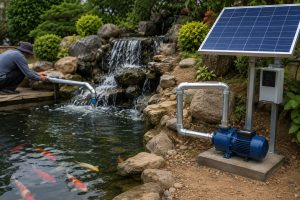
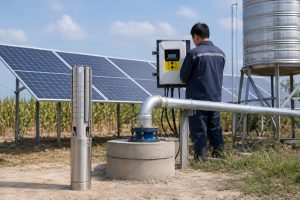
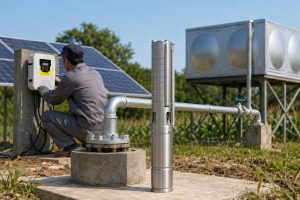
Yes, a pool pump can absolutely run on solar power. By installing solar panels, you can power a dedicated DC solar pump or a traditional AC pump via an inverter. This significantly reduces or even eliminates the pump's running costs, saving you money while using clean, renewable energy.
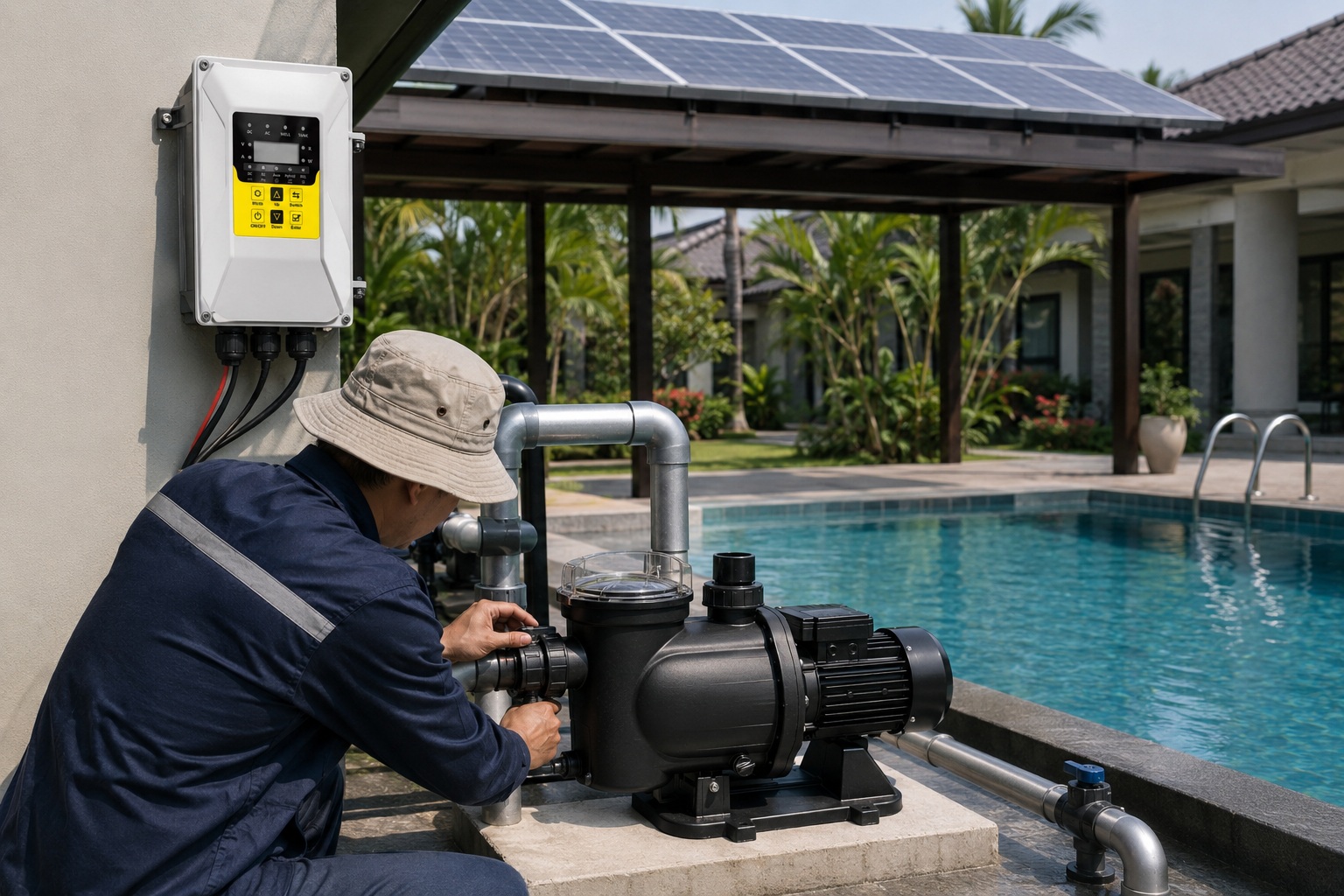
The idea of powering your pool with free energy from the sun is compelling.
It promises lower bills, a smaller carbon footprint, and energy independence.
But turning this idea into a reality requires some planning.
Understanding your energy needs, the components involved, and the potential return on investment is crucial to building a system that works efficiently for years to come.
Let's dive into the details of what it takes to make the switch.
How Many Solar Panels to Run a Pool Pump?
Confused about sizing a solar system for your pump?
It seems complex. Get it wrong, and you could waste money on too many panels or end up with an underpowered system that can't keep your pool clean.
To find the right number of panels, first calculate your pump's daily energy use in watt-hours (watts x hours). Then, divide this by your location's daily peak sun hours and the wattage of your chosen solar panels to determine the exact number of panels needed.
Calculating the right number of solar panels is the most critical step in designing an effective solar pool pump system.
This isn't a one-size-fits-all solution.
The final number depends on your specific pump, your geographic location, and the efficiency of the panels you choose.
Getting this calculation right ensures your pump has enough power to run effectively throughout the day, keeping your pool sparkling clean without relying on the grid.
Let's break down the process into five simple, manageable steps.
Step 1: Calculate Your Pool Pump's Energy Consumption
First, you need to know how much energy your pump uses.
This figure is usually rated in horsepower (HP) or watts.
If you only have the horsepower rating, you can easily convert it to watts.
One horsepower is equal to 745.7 watts.
For example, a common 1.5 HP pool pump would use:
1.5 HP × 745.7 watts/HP = 1,118.55 watts
Next, determine how many hours you run your pump each day.
Most residential pools require 6 to 8 hours of filtration time for proper water turnover.
Let's use 8 hours for our example.
Now, calculate the total daily energy consumption in watt-hours (Wh):
1,118.55 watts × 8 hours = 8,948.4 Wh
To make this number easier to work with, we convert it to kilowatt-hours (kWh) by dividing by 1,000.
8,948.4 Wh / 1,000 = 8.95 kWh per day
This is your daily energy target.
Step 2: Determine Your Location's Peak Sun Hours
"Peak sun hours" is a crucial metric for any solar project.
It does not refer to the total number of daylight hours.
Instead, it represents the number of hours per day when the sun's intensity is at its peak, averaging 1,000 watts per square meter.
This value varies significantly based on your geographic location and the time of year.
Regions closer to the equator receive more peak sun hours.
For example, Arizona in the U.S. might get over 5.75 peak sun hours, while a state like Maine might only get 4.
Knowing this number for your area is essential for accurate system sizing.
| Region/Country | Average Peak Sun Hours (Daily) |
|---|---|
| North America | |
| Arizona, USA | 5.25 - 6.0+ |
| California, USA | 4.0 - 5.75 |
| Florida, USA | 4.75 - 5.5 |
| Texas, USA | 4.5 - 5.75+ |
| Mexico | 5.0 - 6.0 |
| Australia | |
| Northern Territory | 5.5 - 6.0 |
| Queensland | 5.0 - 5.5 |
| Western Australia | 5.0 - 6.0+ |
| Africa | |
| South Africa | 5.0 - 6.5 |
| Kenya | 5.5 - 6.5 |
| Nigeria | 4.5 - 6.0 |
Data is an approximation and can vary by specific location and season.
Step 3: Sizing the Solar System
With your daily energy needs and peak sun hours, you can calculate the required size of your solar panel array in kilowatts (kW).
The formula is straightforward:
Required System Size (kW) = Daily Energy Consumption (kWh) / Peak Sun Hours
Using our example from Step 1 (8.95 kWh/day) and assuming you are in a location with 5 peak sun hours:
8.95 kWh / 5 hours = 1.79 kW
This means you need a solar panel system capable of generating at least 1.79 kW of power.
Step 4: Account for System Inefficiencies
No solar system is 100% efficient.
Power is lost due to factors like dust on panels, high temperatures, wiring resistance, and the angle of the panels.
Professionals typically add a buffer of 15-25% to compensate for these real-world losses.
Let's add a conservative 20% to our required system size.
Adjusted System Size = 1.79 kW × 1.20 = 2.15 kW
This adjusted size ensures your pump receives enough power even on days that are not perfectly sunny.
Step 5: Calculate the Number of Panels
Finally, you can determine how many individual solar panels you need.
Residential solar panels typically range from 300 to 450 watts.
Let's assume you choose 400-watt panels.
First, convert the panel wattage to kilowatts: 400 watts = 0.4 kW.
Now, divide your adjusted system size by the panel's power rating:
Number of Panels = Adjusted System Size (kW) / Panel Power (kW)
2.15 kW / 0.4 kW = 5.375 panels
Since you can't buy a fraction of a panel, you must round up.
In this case, you would need 6 solar panels of 400 watts each to reliably power your 1.5 HP pool pump.
What Are the Different Types of Solar Pool Pumps?
Overwhelmed by all the pump options?
You hear terms like single-speed, variable-speed, DC, and AC, making it hard to know what's best. Choosing the wrong type can lead to poor performance and higher long-term costs.
Solar pool pumps are primarily either DC (direct current) or AC (alternating current). DC pumps are purpose-built for solar, running directly from panels with high efficiency. AC pumps are standard grid pumps that need an inverter, which adds cost and a point of potential failure.
When you decide to power your pool with the sun, you'll encounter a few key choices.
The most fundamental is the type of pump motor: AC or DC.
This choice has significant implications for efficiency, system complexity, and long-term durability.
Furthermore, pumps are categorized by their speed capabilities—single, dual, or variable—which directly impacts energy consumption and performance.
Understanding these distinctions is essential for selecting a pump that not only works with solar but also maximizes your investment by delivering reliable performance for years to come.
DC vs. AC Pumps: The Core Difference
The heart of any solar pump system is its motor.
-
DC (Direct Current) Pumps: These are the true solar-native pumps. Solar panels naturally produce DC electricity, so a DC pump can be powered directly without any conversion loss. They are engineered with highly efficient Brushless DC (BLDC) motors. These motors lack the friction-inducing brushes of older designs, allowing them to achieve over 90% efficiency. This means more of the sun's energy is converted into water movement. The lack of brushes also gives them an exceptionally long lifespan, often rated for 20,000 to 30,000 hours of operation—over a decade of typical use.
-
AC (Alternating Current) Pumps: These are the standard pumps designed to run on grid electricity. To power an AC pump with solar, you need an inverter. This device converts the DC power from your panels into AC power. However, this conversion process is not perfectly efficient; about 10-15% of the energy can be lost as heat. While using an existing AC pump might seem cheaper initially, the lower overall system efficiency and the added cost and failure point of an inverter make it a less optimal long-term solution.
| Feature | DC Solar Pump | AC Pump (with Solar Inverter) |
|---|---|---|
| Efficiency | Very High (90%+) | Moderate (75-85% after inversion) |
| Motor Type | Brushless DC (BLDC) | Induction AC |
| Lifespan | 20,000 - 30,000+ hours | 5,000 - 10,000 hours |
| Components | Panels, Controller, Pump | Panels, Inverter, Pump |
| Complexity | Simpler, fewer components | More complex, extra failure point |
| Best Use | New off-grid or hybrid systems | Adapting an existing grid-tied pump |
Pump Speed Types: The Key to Solar Efficiency
The way a pump operates throughout the day is just as important as its motor type.
-
Single-Speed Pumps: These are the most basic and least efficient option. They run at one constant, high speed. This is like driving your car with the accelerator pushed to the floor all the time. They are being phased out in many regions due to their high energy consumption.
-
Dual-Speed Pumps: An improvement over single-speed, these pumps offer a high and a low speed setting. You can run it on low for general filtration and switch to high for cleaning or running water features. This offers some energy savings but lacks intelligent control.
-
Variable-Speed Pumps (VSP): This is the gold standard for any pool pump, especially solar-powered ones. A VSP allows the motor's speed to be precisely adjusted. When paired with a smart solar controller, the pump can automatically speed up in full sun and slow down during cloudy periods. This ability to adapt to available solar energy is critical. It ensures the pump runs for the longest possible duration each day, maximizing water turnover and preventing the system from shutting down completely in low light. This "soft" operation also dramatically reduces stress on the motor, further extending its lifespan.
A Note on Pump Construction
Just as important as the motor is the physical construction of the pump itself.
The materials used in the pump housing and impellers determine its durability, especially in the harsh environment of a swimming pool.
-
Plastic Impellers: Many pumps use high-grade, wear-resistant plastic (like Noryl) for their impellers. This material offers a great balance of performance and cost-effectiveness. It is lightweight and demonstrates excellent resistance to the fine sand and debris commonly found in pool water.
-
Stainless Steel Impellers: For ultimate durability and longevity, especially in saltwater pools or areas with aggressive water chemistry, pumps with stainless steel impellers (such as SS304) are the premium choice. Stainless steel provides superior resistance to corrosion and abrasion, ensuring the pump maintains its performance and efficiency for many years. While the initial cost is higher, the extended service life often makes it a worthwhile investment for high-end applications.
Is a Solar Pool Pump a Good Investment?
Worried about the high upfront cost of a solar pool pump?
It can seem like a large, intimidating investment for your home. You might wonder if the long-term savings are real or just a marketing promise.
Yes, a solar pool pump is an excellent investment. While the initial purchase price is higher than a conventional pump, the savings on electricity are substantial. Most systems pay for themselves within 3 to 5 years, after which you enjoy decades of free energy.
Moving to a solar-powered pool pump is a financial decision as much as an environmental one.
The initial outlay for panels, a high-quality DC pump, and a controller is not trivial.
However, to properly evaluate the investment, you must look beyond the initial price tag and consider the total cost of ownership over the system's life.
When you factor in the elimination of daily electricity costs, the long-term savings become incredibly compelling.
Let's break down the numbers to see how quickly a solar pump can pay for itself and start generating a positive return.
Calculating Your Return on Investment (ROI)
The ROI is the time it takes for your accumulated energy savings to equal your initial investment.
Let's run a typical scenario.
1. Calculate Annual Running Cost of an AC Pump:
First, let's figure out what a standard 1.5 HP (1.12 kW) AC pump costs to run per year.
- Daily run time: 8 hours
- Energy consumption:
1.12 kW * 8 hours = 8.96 kWh/day - Average electricity price: Let's use $0.22/kWh (a common rate in many developed areas).
- Daily cost:
8.96 kWh * $0.22/kWh = $1.97 - Annual cost:
$1.97 * 365 days = $719.05
This is the money you are currently spending each year just to filter your pool.
2. Calculate the Initial Investment:
The cost of a solar system can vary, but here's a realistic estimate for a quality setup.
- Six 400W Solar Panels:
6 * $200/panel = $1,200 - High-Efficiency DC Solar Pump & Controller:
$500 - Cabling, Mounts, and Miscellaneous:
$300 - Total Initial Investment:
$2,000
3. Determine the Payback Period:
With a solar pump, your annual running cost for electricity becomes $0.
Your annual savings are therefore equal to the old running cost: $719.05.
- Payback Period = Total Investment / Annual Savings
$2,000 / $719.05 = 2.78 years
In this realistic scenario, the entire system pays for itself in under three years.
After that, you save over $700 every year for the 25+ year lifespan of the solar panels. The total lifetime savings can easily exceed $15,000.
The Hidden Problem with Low-Quality Imports
While the ROI is attractive, it hinges on the system's reliability.
Many negative reviews for solar pumps stem from a common technical flaw in cheap, imported models: poor power management.
On partly cloudy days, as sunlight fluctuates, these basic systems react abruptly.
The pump will run for a few seconds in the sun, then shut off completely for 10-20 seconds when a cloud passes, then violently restart.
This constant, rapid on-off cycling places immense stress on the DC motor's bearings and electronics.
It's the primary reason these units fail prematurely, sometimes within a few months, completely destroying any potential return on investment.
A quality system should never behave this way.
The Solution: Intelligent Pump Controllers
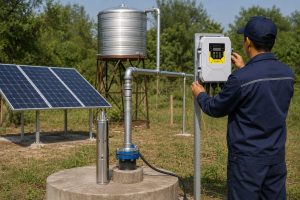
This is where the quality of the system's "brain"—the solar pump controller—becomes paramount.
High-quality systems don't just connect a pump to a panel.
They use advanced controllers with Maximum Power Point Tracking (MPPT) technology.
An MPPT controller constantly analyzes the voltage and current from the solar panels and adjusts the electrical load to extract the absolute maximum amount of power available at any given moment.
Crucially, instead of shutting off in low light, a smart controller will simply slow the pump down, maintaining circulation and avoiding the damaging on-off cycling.
The most advanced systems take this a step further with AC/DC hybrid controllers.
These innovative controllers have inputs for both solar (DC) and grid (AC) power.
- On sunny days, the pump runs 100% on free solar energy.
- On overcast days, the controller can blend solar power with a small amount of grid power to maintain optimal pump speed. This maximizes the use of free solar energy before drawing from the grid.
- At night, or when solar is unavailable, the controller can automatically switch over to full AC power, ensuring your pool's filtration schedule is never compromised.
This hybrid approach offers the best of both worlds: maximum energy savings from solar and the 24/7 reliability of the grid, all managed automatically for a truly worry-free experience.
Conclusion
Switching to a solar pool pump is a smart, forward-thinking decision.
It dramatically cuts your electricity costs and reduces your environmental impact.
The key to success is choosing a high-quality, complete system with an intelligent controller to ensure decades of reliable, free performance.
FAQs
How many solar panels do I need for a 1.5 HP pool pump?
For a typical 1.5 HP pump, you will generally need 5 to 7 solar panels, each around 400 watts. The exact number depends on your location's sun exposure and pump efficiency.
Can solar panels run a pool pump at night?
Not directly from the sun. However, a hybrid AC/DC system can automatically switch to grid power at night, or you can add a battery storage system to store excess solar energy for nighttime use.
Do solar pool pumps work on cloudy days?
Yes, but at a reduced output. High-quality systems use smart controllers that slow the pump down to match the available energy, ensuring it continues to run efficiently without shutting off.
What is the lifespan of a solar pool pump?
A quality DC brushless solar pump can last 20,000 to 30,000 hours, which can translate to over 10-15 years of typical seasonal use. This is significantly longer than standard AC pumps.
Is a DC or AC solar pool pump better?
A DC pump is purpose-built for solar and is far more efficient. An AC pump requires an inverter, which adds cost, complexity, and reduces overall system efficiency by 10-15%.
How much does it cost to run a pool pump on solar?
After the initial installation cost, the energy from the sun is free. Therefore, the ongoing electricity cost to run the pump is effectively zero, aside from minor potential maintenance.
What size solar pump do I need for my pool?
The pump size depends on your pool's volume. A pump should be able to circulate the entire volume of water in about 8 hours. Consult a flow rate chart to match a pump to your pool size.
Can I use my existing pool pump with solar panels?
Yes, you can power a standard AC pool pump using solar panels and an inverter. However, this setup is less efficient and more complex than using an integrated DC solar pump system.