Tired of your pool pump driving up your energy bill?
You know it's a major power hog, but you can't just turn it off.
What if you could power it without the grid?
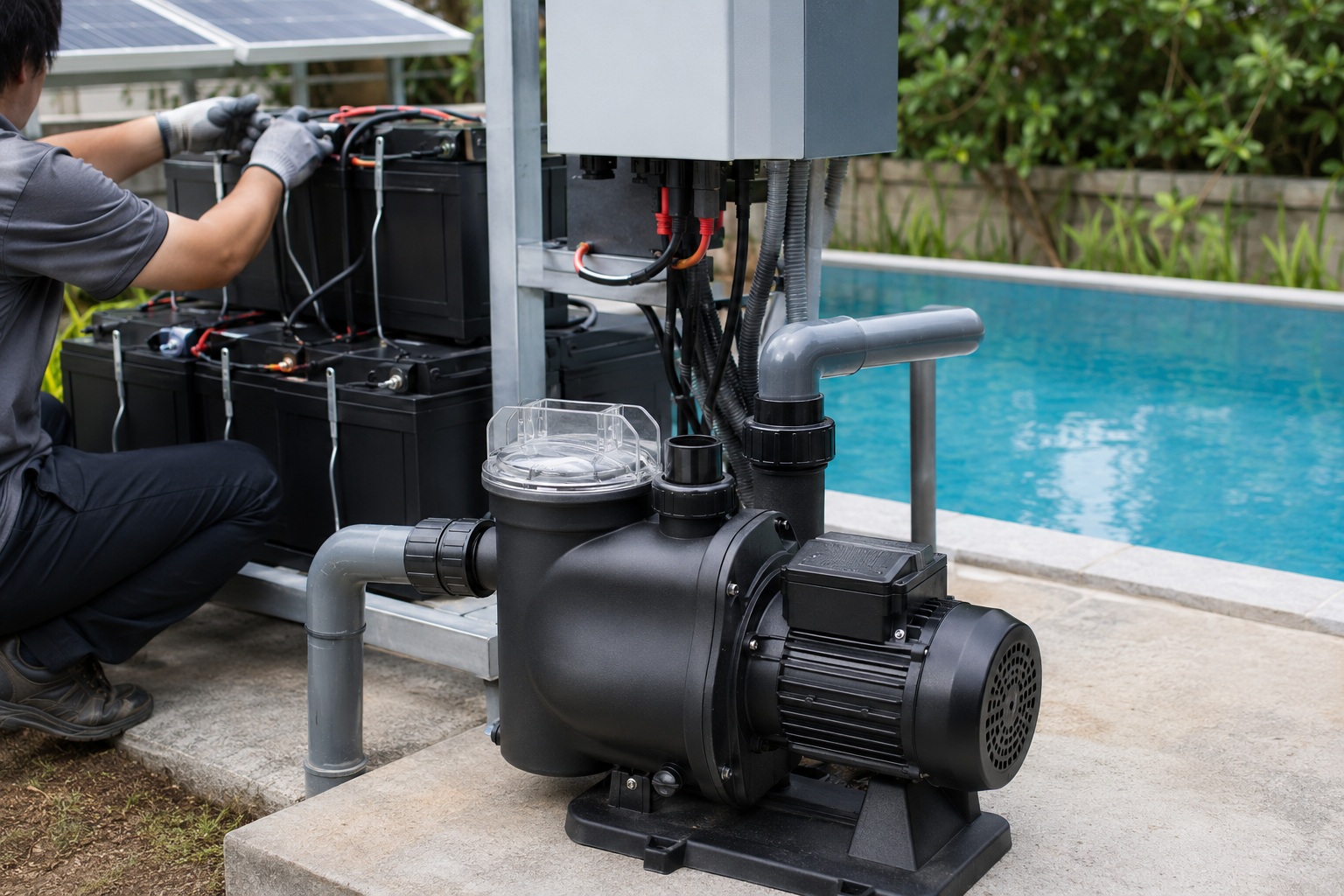
Yes, you can run a pool pump on a battery system.
This approach provides consistent power, solving issues like cloud cover interruptions and allowing for nighttime operation.
However, the high upfront cost of batteries can extend the return on investment period significantly compared to other solar-powered solutions.
The question of using a battery is a great starting point.
It shows you're thinking about energy independence and cost savings for your pool.
But is it the most practical or financially savvy choice?
The answer depends on your goals.
Are you aiming for 100% off-grid operation, or are you seeking the smartest way to reduce costs while ensuring your pool stays clean 24/7?
Let's explore the different ways to power your pool pump, from the grid to the sun, and find the best fit for you.
Why Consider Alternatives to Grid Power for Your Pool Pump?
Your pool is a luxury, but its running costs feel like a penalty.
Your electricity bill spikes in the summer, and you know the pump is the main culprit.
This forces you to choose between a clean pool and a manageable budget.
A standard pool pump is often the second-largest energy user in a home.
It can consume 3,000 to 5,000 kWh per year.
With average electricity rates, this can add $500 to over $870 to your annual bills, just for pool filtration.
Breaking Down the High Cost of Traditional Pool Pumps
The heart of the problem lies with traditional single-speed pumps.
These pumps are relics of a time when energy efficiency wasn't a primary concern for homeowners.
They operate on a simple but wasteful principle.
A single-speed pump runs at a constant, high speed.
This speed is typically around 3,450 revolutions per minute (RPM).
This maximum power is necessary for demanding tasks like running a pool cleaner or a water feature.
However, it's complete overkill for the main job: daily water circulation.
Filtration only requires about half the flow rate of cleaning.
This means for the majority of its 8-hour daily runtime, your pump is wasting a tremendous amount of energy.
It's like driving your car everywhere in first gear.
You get where you're going, but you burn an excessive amount of fuel.
The Inefficiency of Oversized Pumps
To make matters worse, many pools are equipped with pumps that are oversized for their volume.
Installers often recommend a more powerful pump to be "safe."
This leads to over-filtration.
It pushes more water than necessary through the system.
This doesn't improve water quality beyond a certain point.
Instead, it just increases energy consumption.
It also puts unnecessary wear and tear on your entire filtration system, from the pump itself to the filter and plumbing.
This can lead to more frequent and costly repairs over the pump's lifespan.
The Rise of Energy-Saving Regulations
The inefficiency of single-speed pumps is so significant that governments are stepping in.
States like California have already banned the sale of most new single-speed pumps for pools.
They mandate the use of more efficient variable-speed models.
Other regions are expected to follow this trend.
This regulatory shift signals the end of the line for old, inefficient pump technology.
If you are still using a single-speed pump, you are likely paying hundreds of dollars more per year than you need to.
It's an outdated technology that costs you money every single day.
| Pump Type | Typical Annual Energy Use (kWh) | Estimated Annual Cost (at $0.17/kWh) | Key Limitation |
|---|---|---|---|
| Single-Speed Pump | 3,000 - 5,000 kWh | $510 - $850 | Runs at one high speed, wasting energy. |
| Variable-Speed Pump | 900 - 1,500 kWh | $153 - $255 | Higher initial cost. |
| Solar Pump (Direct) | 0 kWh (from grid) | $0 | Only runs when the sun is shining. |
This data clearly shows why homeowners are looking for alternatives.
The cost of doing nothing is simply too high.
Exploring options like solar, batteries, and hybrid systems is no longer just for the environmentally conscious; it's a financially smart decision.
The Direct Solar Solution: A Game-Changer with a Glitch?
Tired of high energy bills from your pool pump?
Direct solar power seems like the perfect, free energy solution.
But what happens when a cloud passes by, causing your pump to shut down repeatedly?
A direct solar pool pump runs entirely off energy from PV panels.
It offers a fantastic return on investment, with a potential payback period of under 4 years.
It's quiet, powerful, and eliminates the pump's electricity cost.
But it has a significant flaw.
The Promise of "Free" Energy
The concept of a direct solar-powered pool pump is incredibly appealing.
You connect photovoltaic (PV) panels directly to a special DC (Direct Current) pump.
When the sun shines, the pump runs.
When the sun goes down, the pump stops.
It is beautifully simple.
This setup completely removes the pump from your utility bill.
Consider the math from one user's real-world experience.
An old 1 HP AC pump running 7 hours a day costs around $248 annually.
A new DC solar pump system might have an initial investment of around $881.
- Two 400-watt PV panels: $440
- Cabling for PV: $25
- 500-watt DC Pool Pump: $341
- Circuit Shut off/timer: $75
- Total Initial Investment: $881
With an annual saving of $248, the system pays for itself in just 3.55 years.
This is a remarkably short payback period for a home energy upgrade.
After that, you are getting free pool filtration for the life of the system.
This is a massive financial incentive.
The Hidden "Cycling" Glitch
So why aren't these pumps everywhere?
The problem lies in how many current models handle inconsistent sunlight.
These pumps often lack "soft" power transitions.
The controller's simple circuit board responds instantly to voltage drops.
On a partly cloudy day, this creates a damaging cycle.
The pump will run for a few seconds when the sun is out.
A cloud passes, the voltage drops, and the pump shuts off abruptly.
The sun returns, and the pump jerks back to life.
This on-off-on-off pattern can repeat every 10 to 20 seconds.
This rapid, repetitive stress is terrible for any electric motor.
It can lead to premature failure, turning a great investment into a frustrating waste of money.
This is likely the reason for many negative reviews claiming these imported pumps fail after just a few months.
The Market Gap
The core technology is sound.
A brushless DC motor, which these pumps use, should last 20,000 to 30,000 hours.
This is 6 to 10 times longer than a traditional brushed AC motor.
The issue is not the motor itself, but the unsophisticated controller that manages the power from the solar panels.
It's an engineering oversight.
The pump needs a buffer or a smarter way to handle slight dips in solar power.
This is where the idea of adding a battery comes from.
A battery could provide that stable, uninterrupted power source the pump needs to avoid the damaging cycling.
However, this introduces another layer of cost and complexity.
The Battery Option: Consistent Power at a High Price?
You love the idea of solar, but hate the thought of your pump stuttering on cloudy days.
A battery seems like the obvious fix, providing smooth, reliable power.
But this reliability comes at a steep price that can cripple your return on investment.
Yes, adding a battery bank to a solar pump system solves the consistency problem.
It ensures the pump receives stable voltage, protecting the motor from cycling damage and allowing it to run at night.
However, this dramatically increases the initial cost and complexity of the system.
How a Battery Solves the Cycling Glitch
A battery acts as an energy reservoir.
Solar panels charge the battery during peak sunlight.
The pump then draws a steady, clean stream of power from the battery, not directly from the fluctuating panels.
This completely eliminates the on-off cycling issue.
The pump's motor receives a consistent voltage, allowing it to run smoothly regardless of passing clouds.
This protects the motor and ensures it reaches its expected 20,000+ hour lifespan.
Furthermore, a battery bank enables nighttime operation.
You can store excess solar energy generated during the day.
Then, you can run your pool pump for a few hours after sunset.
This is particularly useful if you have a Time-Of-Use (TOU) electricity plan where daytime electricity is more expensive.
Running the pump on "free" stored solar energy at night could offer additional savings.
The Crippling Effect on ROI
The downside is purely financial.
Batteries are expensive.
Adding a suitably sized battery bank to your solar pump system can easily double or triple the initial investment.
Let's revisit our earlier calculation.
| System Component | Direct Solar Cost | Solar + Battery Cost |
|---|---|---|
| PV Panels, Pump, & Hardware | $881 | $881 |
| Battery Storage System | $0 | $2,000 - $5,000+ |
| Total Initial Investment | $881 | $2,881 - $5,881+ |
The annual energy savings remain the same, at approximately $248 per year.
Now, let's see what that does to the payback period.
- Payback for Direct Solar: $881 / $248 = 3.55 years
- Payback for Solar + Battery: $2,881 / $248 = 11.6 years (at minimum)
A payback period of nearly 12 years is far less compelling than one under 4 years.
The battery also adds another component that will eventually need replacement.
Most solar batteries have a warranty of around 10 years.
It's possible you would need to replace the battery before the system has even paid for itself.
This financial reality "greatly weakens the ROI incentive," as experts note.
You are spending a lot of extra money just to solve a problem that could be addressed more intelligently.
Is there a way to get 24/7 reliability without the prohibitive cost of batteries?
The Hybrid System: The Best of Both Worlds?
You need your pool filtered, rain or shine, day or night.
Direct solar is unreliable, and adding batteries is too expensive.
This dilemma forces you to choose between inconsistent cleaning and a massive upfront cost.
A hybrid AC/DC solar pump system offers a third, more practical solution.
It intelligently uses free solar energy whenever available.
It then automatically switches to your home's AC grid power when the sun isn't strong enough, ensuring uninterrupted operation without needing expensive batteries.
Intelligent Power Management
A hybrid system is built around a sophisticated controller.
This controller is the brain of the operation.
It has two power inputs: one for DC power from your solar panels and one for AC power from the grid.
The system is programmed with a simple, brilliant logic: solar power is always the priority.
When there is enough sunlight, the controller draws 100% of the pump's power from the PV panels.
Your pump runs for free, just like a direct solar setup.
You are taking full advantage of the sun's energy to keep your pool clean.
Seamless, Automated Backup
Here is where the hybrid system outshines both direct solar and battery systems.
As clouds roll in or as evening approaches, the solar power input diminishes.
The intelligent controller detects this drop in voltage.
Instead of shutting the pump off and causing damaging cycling, it automatically supplements or switches over to the AC grid power.
It can even blend the power sources.
If the panels are producing 50% of the needed power, it will only draw the remaining 50% from the grid, maximizing your use of free energy.
When the sun is gone completely at night, it will run entirely on AC power if you have it programmed to do so.
This transition is seamless and fully automatic.
You get guaranteed, 24/7 pool filtration without any manual intervention.
The Smart Alternative to Batteries
This approach provides the reliability of a battery system without the prohibitive cost and complexity.
| Feature | Solar + Battery System | Hybrid AC/DC System |
|---|---|---|
| 24/7 Operation | Yes | Yes |
| Handles Cloudy Days | Yes | Yes |
| Upfront Cost | Very High | Moderate |
| ROI Period | Very Long (10+ years) | Short (similar to direct solar) |
| Maintenance | Pump + Battery replacement | Pump only |
| Complexity | High (more components, wiring) | Low (integrated controller) |
The hybrid system acknowledges a simple reality: you are likely already connected to the grid.
It uses that grid connection as the most affordable and reliable "battery" you could ask for.
You avoid thousands of dollars in battery costs, eliminate a future replacement headache, and still achieve your primary goals.
You maximize savings by using solar power whenever possible.
You maintain a perfectly clean pool with uninterrupted filtration.
For most residential pool owners, the hybrid AC/DC system represents the true sweet spot of performance, reliability, and financial sense.
Choosing the Right Pump: The Engine Behind the Savings?
You've decided on a solar or hybrid system, but a cheap pump could fail prematurely.
You're worried that a poor-quality motor will undermine your entire investment.
How do you ensure your system is built on a foundation of reliability and efficiency?
The true heart of any energy-efficient pump system is its motor.
A high-efficiency Brushless DC (BLDC) permanent magnet motor is the key.
With efficiencies over 90%, this core technology determines the system's overall performance, reliability, and long-term value for money.
The Power of the BLDC Motor
Regardless of whether you choose a direct solar, battery, or hybrid system, the pump itself is crucial.
The most significant innovation in modern pumps is the move to BLDC permanent magnet motors.
This is the same technology found in electric vehicles.
It's a world away from the old, inefficient motors in standard pumps.
Technical advantages of a quality BLDC motor include:
- High Efficiency: They can convert over 90% of electrical energy into mechanical power. Traditional motors are often in the 60-70% range. This means you need fewer solar panels to achieve the same water flow, reducing the system's total cost.
- Long Lifespan: With no brushes to wear out, these motors are virtually maintenance-free and can last for 20,000-30,000 hours. That's up to 10 times longer than their brushed counterparts.
- Compact & Lightweight: Advanced designs can be up to 47% smaller and 39% lighter than old motors of similar power, simplifying installation.
- High Torque: They provide strong starting power, which is essential for moving water efficiently through the plumbing system.
Investing in a system with a superior BLDC motor is the single most important decision.
It directly impacts how much you save and how long your system will last.
Matching the Pump Type to Your Needs
Beyond the motor, the "wet end" of the pump—the part that actually moves the water—is also critical.
Different designs are optimized for different tasks.
For a B2B distributor, having a portfolio that covers these diverse needs is essential for capturing the market.
Three Key Solar Pump Designs
-
Solar Screw Pump (Low Flow, High Head):
This design uses a stainless steel screw rotating inside a rubber stator.
It's excellent at pushing water from very deep sources.
It's ideal for deep wells, livestock watering, and situations where water needs to be lifted a great height.
It's also highly resistant to sand. -
Solar Plastic Impeller Pump (High Flow, Medium Head):
This is a multi-stage centrifugal pump.
It uses a series of durable plastic impellers to move a large volume of water.
This is the most common type for pool filtration, farm irrigation, and garden water supply.
It offers a great balance of high flow, good wear resistance, and cost-effectiveness. -
Solar Stainless Steel Impeller Pump (High Flow, Corrosion Resistance):
This is a premium centrifugal pump.
It uses an SS304 stainless steel impeller and pump body.
It's designed for harsh water conditions, such as acidic or alkaline water.
It offers maximum durability and reliability but comes at a higher price point. It's perfect for high-end applications or areas with known water quality issues.
For a pool, the plastic or stainless steel impeller pump is the correct choice.
The selection between them depends on your pool's chemistry and your budget.
A system integrator or distributor must understand these differences to provide the right solution for their customers.
Conclusion
While you can run a pool pump with a battery, it's not the most cost-effective path.
Hybrid AC/DC systems, powered by efficient BLDC motors, offer a smarter, more affordable solution for reliable, 24/7 pool filtration.
FAQs
How many solar panels do I need to run a pool pump?
This depends on the pump's wattage and your location.
Typically, a .67 HP (500W) pump runs well on two 400-watt panels, providing 800 watts of potential power.
Can you run a variable speed pump on solar power?
Yes, many modern variable speed pumps (VSPs) are designed to be compatible with solar power, often through a dedicated solar-ready controller or inverter.
Is it cheaper to run a pool pump at night?
It can be cheaper if your utility offers a Time-of-Use (TOU) plan with lower off-peak rates at night.
A hybrid or battery system lets you take advantage of this.
How long do solar pool pumps last?
The pump, if it uses a quality brushless DC motor, can last 20,000 hours or about 8-10 years of typical use.
The solar panels themselves often have a 25-year performance warranty.
What size pump do I need for my pool?
You need a pump that can turn over your pool's entire water volume in about 8 hours.
Bigger is not better, as oversized pumps waste energy.
Can a pool pump run on an inverter?
Yes, an inverter can convert DC power from solar panels or batteries into AC power to run a standard AC pool pump, though using a native DC pump is more efficient.
How much does a solar pool pump save?
An ENERGY STAR certified solar pump can save up to $290 over its lifetime by eliminating the electricity costs associated with filtration, paying for itself in under 4 years.
Do solar pool pumps work on cloudy days?
They can work at reduced speed on overcast days.
However, a hybrid AC/DC system is needed to ensure full power and consistent operation during heavy cloud cover or rain.