Finding reliable water for off-grid properties can be a constant struggle.
Traditional solutions are expensive and fail, but modern solar pumps offer a cost-effective, dependable answer to your water needs.
The best solar pump brands are defined not by a single product, but by a comprehensive portfolio. They offer a range of specialized pumps—like screw and centrifugal types—all powered by high-efficiency BLDC motors and intelligent controllers. This allows them to provide the perfect solution for any water depth or volume requirement.
Choosing the right solar pump system can feel overwhelming.
It's not just about the pump itself.
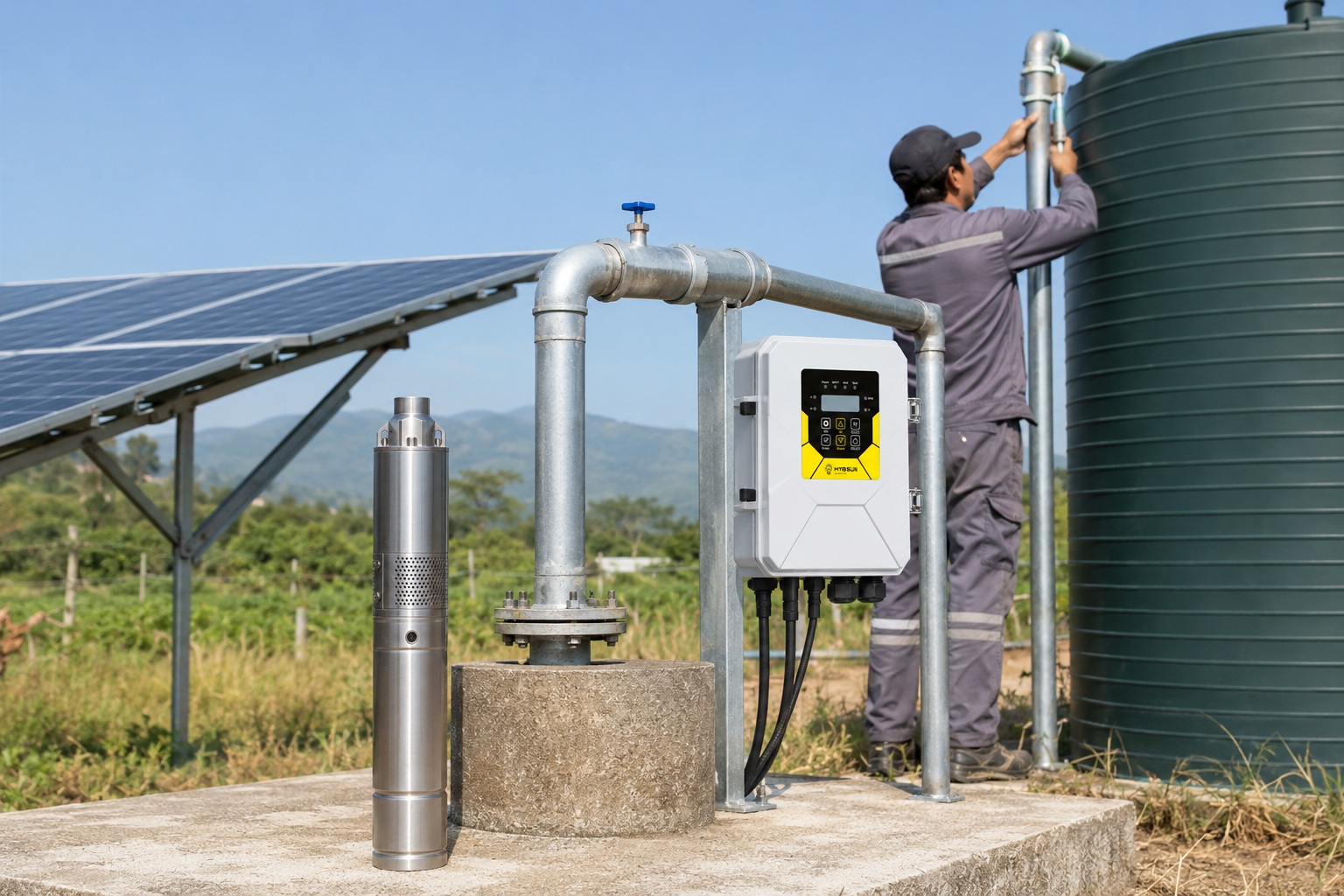
The motor, the controller, and the pump-end design all play a crucial role in performance, reliability, and long-term cost.
A top-tier brand understands that a one-size-fits-all approach doesn't work for water solutions.
The needs of a deep domestic well in Africa are vastly different from those of a large-scale irrigation project in the Americas.
This guide will break down the core components that make up a superior solar water pump system.
We will explore the different types of pumps, the critical importance of motor efficiency, and the advanced controller features that ensure you have water whenever you need it.
By understanding these technologies, you can confidently identify a high-quality solar pump brand that delivers true value and reliability.
Why are Solar Screw Pumps the Go-To for Deep Wells?
Struggling to lift water from a very deep well?
Many pumps simply can't generate enough pressure, leaving you without a reliable water source.
Solar screw pumps solve this problem efficiently.
Solar screw pumps, or progressing cavity pumps, are specialists in high-head, low-flow situations. Using a helical rotor, they excel at pushing water from extreme depths (over 100 meters), making them the ideal choice for domestic wells, livestock watering, and small-scale drip irrigation in remote areas.
Solar screw pumps operate on a principle of positive displacement, which is fundamentally different from a centrifugal pump.
This unique design gives them a distinct set of advantages, particularly for challenging well conditions.
Instead of flinging water outwards with an impeller, a screw pump uses a single helical rotor (a stainless steel screw) that turns inside a flexible rubber stator.
This action creates a series of sealed cavities that "progress" from the pump's inlet to its outlet, pushing the water ahead of them.
This mechanism is incredibly effective at building high pressure, allowing the pump to overcome the massive head pressure associated with very deep wells.
Even with limited power from solar panels, it can consistently deliver water to the surface.
How They Work: The Power of Positive Displacement
The magic of the screw pump is its ability to maintain a nearly constant flow rate regardless of the discharge pressure or head.
As the rotor turns, it traps a specific volume of water in each cavity and forces it upwards.
This makes them highly efficient for their intended purpose.
While a centrifugal pump's flow rate drops dramatically as the head increases, a screw pump's flow remains relatively stable.
This reliability is crucial for applications where a consistent, albeit small, supply of water is essential for daily life or livestock survival.
Furthermore, this design gives screw pumps an exceptional ability to handle water with higher concentrations of sand or silt compared to many centrifugal models.
The gentle pushing action is less susceptible to the abrasive wear that can quickly destroy a high-speed impeller.
| Feature | Solar Screw Pump | Solar Centrifugal Pump |
|---|---|---|
| Principle | Positive Displacement | Centrifugal Force |
| Best For | High Head, Low Flow | High Flow, Medium Head |
| Typical Head | 100m - 300m | 20m - 150m |
| Typical Flow | 1 - 10 GPM | 10 - 70+ GPM |
| Sand Handling | Excellent | Good to Fair (depends on impeller) |
| Ideal Use | Deep domestic wells, livestock | Irrigation, tank filling |
Key Applications and Target Markets
The unique characteristics of solar screw pumps make them indispensable in specific regions and for certain applications.
They are a lifeline in many parts of Africa and Latin America, where deep boreholes are common and grid power is a luxury.
- Deep Well Domestic Water: For homesteads and villages relying on wells deeper than 80-100 meters, screw pumps are often the only viable solar-powered option.
- Livestock Watering: A single screw pump can reliably fill a stock tank or trough throughout the day, ensuring animals have access to water even in remote pastures.
- Small-Scale Drip Irrigation: While not suited for flood irrigation, the consistent, low-volume output is perfect for supplying water to precise drip irrigation systems for high-value crops.
Advantages and Limitations
For a distributor, understanding the trade-offs is key to positioning the product correctly.
The primary advantage is unmatched high-head capability.
No other common solar pump type can lift water as efficiently from such great depths.
Their superior resistance to sand and solids also means a longer operational life and less maintenance in wells with less-than-ideal water quality.
However, the main limitation is their inherently low flow rate.
They are not designed to move large volumes of water quickly.
Trying to use a screw pump for large-scale farm irrigation or filling a swimming pool would be an exercise in frustration.
They are precision tools for a specific, challenging job.
What Makes Impeller Pumps Best for High-Volume Needs?
Need to irrigate fields or fill a large tank fast?
Low-flow pumps won't cut it, and you need a solution that can move a serious amount of water each day.
This is where impeller pumps shine.
Solar centrifugal pumps use a series of spinning impellers to generate high flow rates. They are the workhorses for agriculture, large-scale livestock operations, and pond management, capable of moving over 65 gallons per minute (GPM) to efficiently handle high-volume water demands.
Unlike screw pumps that push water, centrifugal pumps use rotational energy to move it.
At the heart of the pump is an impeller, a rotor with vanes that spins at high speed.
Water is drawn into the center of the spinning impeller and is thrown outward by centrifugal force.
This action increases the water's velocity and pressure, forcing it out of the pump's discharge outlet.
Many solar submersible pumps are "multi-stage," meaning they contain a stack of several impellers, each one feeding into the next.
Each stage adds more pressure, increasing the total head the pump can overcome.
This design allows for a wide range of pump configurations that can be optimized for either higher flow or higher head, making them incredibly versatile.
Plastic vs. Stainless Steel Impellers: A Critical Choice
The material of the impeller is a critical design choice that directly impacts the pump's durability, cost, and ideal application.
A quality brand will offer options to suit different market needs.
Plastic Impellers: Modern engineered plastics (like polyoxymethylene or POM) are not the cheap plastics of the past.
They offer excellent resistance to abrasion from fine sand and are more economical to produce.
This makes pumps with plastic impellers a fantastic, cost-effective choice for general farm irrigation and residential use where the water isn't highly corrosive.
They are lightweight, which can also simplify installation.
Stainless Steel Impellers: For the ultimate in durability and longevity, stainless steel (like SS304) is the premium choice.
Stainless steel impellers offer superior resistance to corrosion from acidic or alkaline water.
They are also more robust and can withstand harsher conditions and deeper well installations without the risk of cracking or warping.
This makes them essential for high-end applications, coastal areas with saline intrusion, or regions with known aggressive water chemistry, such as parts of Australia.
| Impeller Material | Plastic (Engineered) | Stainless Steel (SS304) |
|---|---|---|
| Cost | Lower | Higher |
| Wear Resistance | Excellent (for fine sand) | Very Good |
| Corrosion Resistance | Moderate | Excellent |
| Weight | Lighter | Heavier |
| Ideal Application | Farm irrigation, budget-conscious projects | Corrosive water, deep wells, premium homes |
Performance Metrics: GPM vs. Head
Understanding a pump's performance curve is essential.
Every centrifugal pump has an inverse relationship between its flow rate (measured in Gallons Per Minute, GPM) and its total dynamic head (the total height and friction loss it has to overcome).
- At zero head (pumping horizontally at the source), the pump will achieve its maximum flow rate.
- As the head increases (lifting water higher), the flow rate decreases.
- The maximum head (or "shut-off head") is the point where the pump can no longer lift water, and the flow rate is zero.
A high-quality pump like a 1.5 HP model might deliver 65 GPM at 50 feet of head, but that flow could drop to 30 GPM at 150 feet of head.
A smaller pump might offer 15 GPM at a shallow depth, making it a "fast tank filler" for a stock tank but unsuitable for a deep well.
Brands provide performance charts that allow users to select the exact pump that will operate most efficiently for their specific head and flow requirements.
Target Applications for Distributors
As a distributor, having both plastic and stainless steel impeller options in your portfolio is a strategic advantage.
The plastic impeller models serve the large, price-sensitive agricultural market.
The stainless steel models allow you to capture the high-end, premium market where reliability and longevity are the top priorities.
This dual offering enables you to meet over 90% of the market's needs for high-volume solar pumping.
Why is the BLDC Motor the Heart of a Great Solar Pump?
A pump is just a metal and plastic housing without a motor.
The motor's efficiency is the single most important factor determining the system's overall performance and cost.
A bad motor wastes precious solar energy.
A Brushless DC (BLDC) permanent magnet motor is the undisputed core of any modern, high-performance solar pump. With efficiencies exceeding 90%, it drastically reduces solar panel requirements, which lowers the total system cost, simplifies installation, and ensures reliable operation even in low light.
The motor's job is to convert electrical energy from the solar panels into the mechanical energy needed to turn the pump.
How efficiently it does this has massive downstream effects.
For decades, pumps used less efficient brushed DC motors or required complex and costly inverters to run standard AC motors.
The arrival of affordable, powerful BLDC motors revolutionized the solar pumping industry.
These motors are fundamentally more efficient, more reliable, and longer-lasting than their predecessors.
The Technical Edge of BLDC Motors
The superiority of BLDC motors comes from their design.
Unlike brushed motors that rely on physical carbon brushes to transfer power—a component that wears out and creates friction—BLDC motors are controlled electronically.
They use powerful permanent magnets, often made from rare-earth materials like Neodymium iron boron (NdFeB), on the rotor.
This design eliminates the friction and energy loss associated with brushes, leading to several key advantages:
- High Efficiency: While a brushed motor might be 60-75% efficient, a quality BLDC motor can achieve efficiencies of 85-92%. This is a massive 15-25% improvement in converting electricity to work.
- Longer Lifespan: With no brushes to wear out, the primary wear components are the bearings, which are designed to last for tens of thousands of hours. The operational life is significantly longer.
- Less Heat: Higher efficiency means less energy is wasted as heat. This allows the motor to run cooler, which further extends its lifespan and makes it more reliable in hot climates and deep wells.
- Compact & Powerful: BLDC motors deliver more power and torque for their size. A modern BLDC motor can be up to 47% smaller and 39% lighter than an older motor with the same power output, making the entire pump easier to handle and install.
| Motor Type | Typical Efficiency | Lifespan | Maintenance |
|---|---|---|---|
| BLDC (Brushless DC) | 85-92% | Excellent (20,000+ hrs) | Virtually None |
| Brushed DC | 60-75% | Fair (3,000-5,000 hrs) | Requires Brush Replacement |
| AC Induction (w/ Inverter) | 75-85% (system) | Very Good | None (but inverter adds complexity) |
The Role of the MPPT Controller
A BLDC motor cannot function without an intelligent controller.
This controller is the brain of the system, and the most critical feature it must have is Maximum Power Point Tracking (MPPT).
Solar panel output (voltage and current) fluctuates constantly with changing sunlight intensity.
The MPPT algorithm continuously monitors the panel's output and adjusts the electrical load to ensure the motor is always drawing the absolute maximum amount of power available at any given moment.
A system with MPPT can produce up to 30% more water over the course of a day compared to a system without it, especially during early morning, late afternoon, and on overcast days.
It is not a luxury feature; it is an essential component for maximizing the return on investment in a solar pumping system.
How Do Hybrid Controllers Guarantee Water 24/7?
Solar power is fantastic, but the sun isn't always shining.
What happens on a string of cloudy days, or when you need to irrigate at night?
Relying solely on the sun can be a risk for critical water needs.
AC/DC hybrid controllers provide total water security by intelligently managing power sources. They default to using free solar energy but can automatically blend in or switch to an AC power source (grid or generator) when sunlight is insufficient, ensuring a reliable water supply 24/hours a day.
For many off-grid applications—like a primary home water supply, critical crop irrigation, or a large dairy operation—a 100% solar-only system introduces an element of risk.
A few days of bad weather could mean no water.
Historically, the solution was to install a completely separate, grid-powered backup pump, which is expensive and complex.
The modern solution is a single pump system managed by a sophisticated AC/DC hybrid controller.
This "best of both worlds" approach combines the economic and environmental benefits of solar with the rock-solid reliability of a traditional power source.
The Logic of Hybrid Power
A well-designed hybrid controller manages the power flow seamlessly and automatically, so the user doesn't have to do anything.
The internal logic prioritizes the cheapest power source first: the sun.
- Full Sun: The controller powers the pump exclusively from the solar panels. The AC input is on standby.
- Low Light (Clouds/Evening): If solar power drops below what's needed to run the pump at a desired speed, the controller will start to blend in power from the AC source. It uses as much solar as possible and only supplements with the necessary amount of AC power. This maximizes the use of free solar energy.
- No Sun (Night/Heavy Overcast): When there is no usable photovoltaic input, the controller will automatically switch over completely and run the pump from the AC power source.
This intelligent blending and switching ensures the pump is always ready to deliver water, day or night, rain or shine.
It removes all weather-related anxiety from the water supply.
Essential Protection Features
Beyond hybrid capability, a top-tier controller is also the system's primary protector.
It's a hub for sensors that safeguard the pump, motor, and well.
Look for controllers that include inputs and logic for:
- Dry Run Protection: A sensor placed in the well detects if the water level drops too low. The controller then shuts off the pump to prevent it from running dry, which can quickly destroy the pump end and motor.
- Tank Full Shut-Off: A float switch or sensor in a storage tank tells the controller when the tank is full. The controller stops the pump, preventing water waste and overflows, and automatically restarts it when the water level drops.
- Soft Start & Stop: Instead of slamming the motor with full power instantly, the controller gradually ramps up the speed. This reduces mechanical stress on the pump and pipes and electrical stress on the motor, extending the life of the entire system.
- Comprehensive Fault Protection: The controller should also protect against over-voltage, under-voltage, over-current, and overheating, providing a complete safety net for your investment.
The Value Proposition for Off-Grid Living
For residential and agricultural users, the hybrid controller is a game-changing feature.
It transforms a solar pump from a "daytime-only" device into a full-time, on-demand water utility.
It provides the peace of mind that is essential for a primary residence or a commercial farming operation.
For a distributor, offering systems with advanced hybrid controllers opens up a more demanding, premium segment of the market that values reliability above all else.
Conclusion
The best solar pump brands deliver a complete, reliable, and cost-effective water solution.
They achieve this with a versatile product portfolio, high-efficiency motors, and intelligent, feature-rich controllers.
FAQs
How long do solar water pumps last?
A quality solar pump system, featuring a brushless motor and robust pump end, can last for 10 to 20 years.
The solar panels themselves are typically warrantied for 25 years of output.
How deep can a solar pump pull water?
It depends on the pump type.
Solar screw pumps are designed for deep wells and can lift water from over 300 meters (about 1,000 feet).
Centrifugal pumps are better for shallower wells, typically up to 150 meters.
Can a solar pump run without batteries?
Yes, most modern solar pumps are designed to run directly off solar panels during the day without batteries.
Pumping water into a storage tank is a more cost-effective "battery" than using electrical ones.
Do solar pumps work on cloudy days?
Yes, they do, but at a reduced flow rate.
Systems with efficient MPPT controllers are much better at extracting available power from the low, diffuse light on overcast days, allowing them to continue pumping.
What is the difference between a solar well pump and a solar fountain pump?
A solar well pump is a high-performance machine designed to lift water from deep underground.
A solar fountain pump is a much smaller, low-power decorative device for circulating water in a pond or birdbath.
How many solar panels do I need for a water pump?
This depends on the pump's power (wattage) and your location's sun hours.
An efficient pump requires fewer panels.
For example, a 750W (1 HP) pump might need three to four 330W panels.
What maintenance do solar pumps require?
They are very low-maintenance.
The main task is to periodically clean the solar panels of dust or snow.
The pump and motor are sealed and require no regular servicing.
Can you run a solar pump at night?
Only if the system includes batteries or an AC/DC hybrid controller connected to the grid or a generator.
A standard, direct-drive system only operates when the sun is shining on the panels.