Struggling to calculate the solar panels for your 3 HP pump?
Inaccurate sizing leads to system failure and wasted investment.
Get the right numbers here.
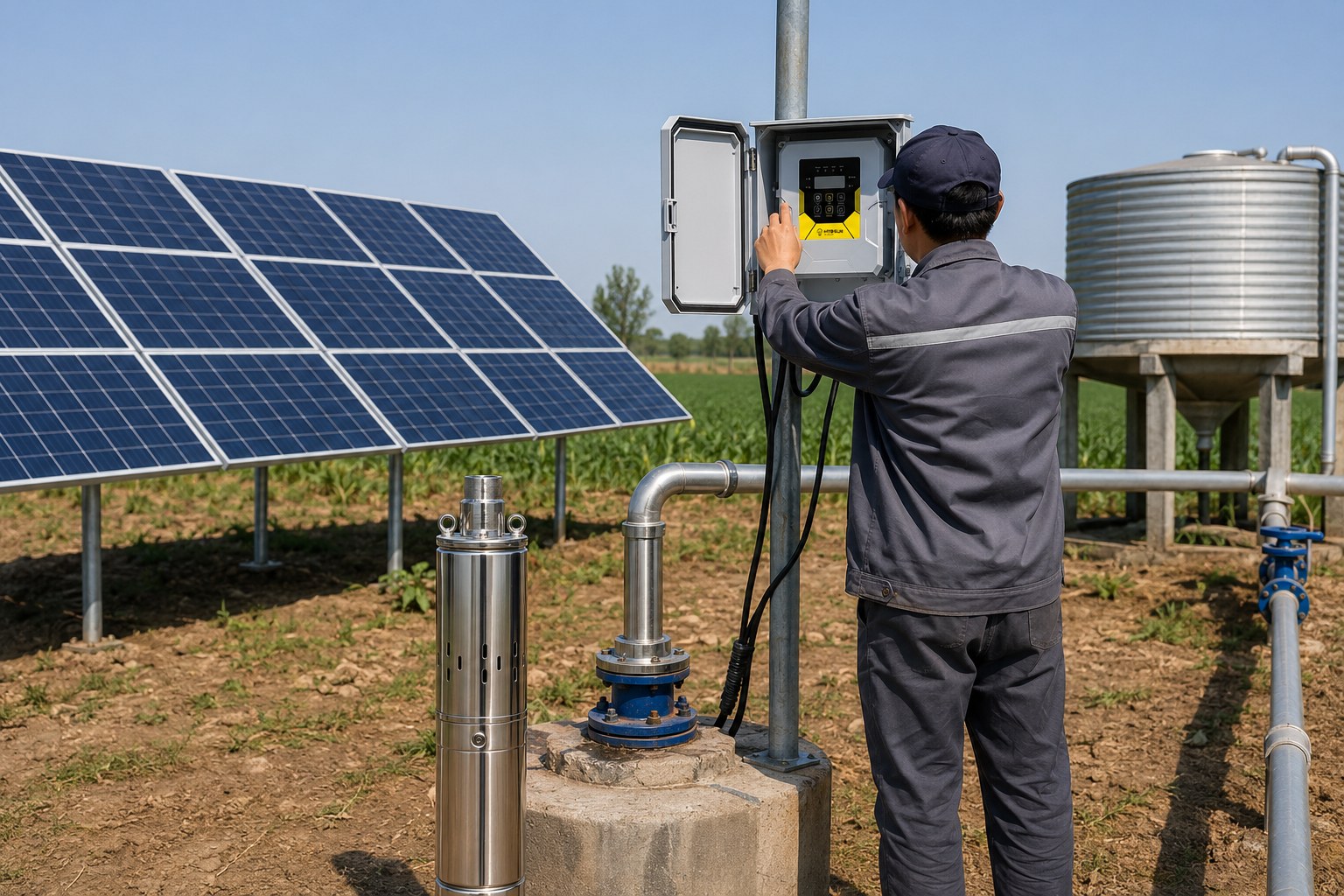
A 3 HP pump typically requires about 2,500 to 3,000 watts of solar panels. This usually means using 8 to 10 panels, each rated around 330-375 watts, depending on pump efficiency and local solar irradiance.
Getting the panel count right is crucial.
But it's only part of the story.
The type of pump you use dramatically changes the equation.
Let's explore why this matters for your system's performance and long-term cost.
Two Main Classes of Solar Pumps
Choosing between a solar-native pump and a standard AC pump can be confusing.
The wrong choice impacts efficiency and the number of panels you need.
This decision affects your initial cost and long-term savings.
Solar-specific pumps are highly efficient and need fewer panels, often running on just 200 to 1200 watts. Classic AC pumps are more powerful but require larger solar arrays and specialized controllers to operate, starting from 800 watts for just a 1/2 HP model.
The choice between these two pump classes is the first and most important step in designing an effective solar water system.
It defines the architecture of your entire setup, from the number of panels to the type of controller you will need.
Understanding their fundamental differences is key to making a smart investment that provides reliable water for years.
Each class has its own strengths and is suited for different applications and scales.
Let's break down the details of each type.
Pumps Designed Specifically for Solar
These pumps are the champions of efficiency.
They are engineered from the ground up to run on direct current (DC) power from solar panels.
This direct compatibility eliminates significant energy losses that occur when converting power.
Typically, these pumps use advanced motors, like Brushless DC (BLDC) motors, which can achieve efficiencies over 90%.
Because they are so efficient, they require much less power to operate.
A small system can start with as little as 200 watts, which is just two 100-watt panels.
Even the more powerful models in this class, around one horsepower, might only require 800 to 1,200 watts.
This translates directly to fewer solar panels, a smaller mounting footprint, and lower initial costs for the solar array.
They are perfect for off-grid homes, livestock watering, and small-scale irrigation where power conservation is paramount.
Adapting Classic AC Pumps for Solar
Many installations need to power existing alternating current (AC) pumps or require horsepower ratings above what typical solar-native pumps offer.
You can run a standard AC pump, from a small 1/2 HP unit to a massive 200 HP industrial pump, using solar.
This is achieved with a specialized solar controller.
These controllers, often called solar Variable Frequency Drives (VFDs), take the DC power from the solar panels and convert it into AC power that the pump can use.
While this solution is incredibly versatile, it comes at the cost of efficiency.
The power conversion process itself consumes energy.
As a result, an AC pump will always require more solar panels than a DC pump of the same horsepower rating.
For example, a 1/2 HP AC pump needs about 800 watts (eight 100-watt panels), whereas a 1/2 HP DC pump might only need 400-500 watts.
The difference grows with size.
A 100 HP AC pump requires a staggering 120,000 watts, or about 320 panels rated at 375 watts each.
Comparison Table: Solar-Native vs. Adapted AC Pumps
| Feature | Pumps Designed for Solar (DC) | Classic AC Pumps (Adapted) |
|---|---|---|
| Efficiency | Very High (often >90% motor efficiency) | Moderate (energy lost in DC to AC conversion) |
| Panel Count | Fewer panels required per horsepower | At least 30-50% more panels per horsepower |
| Controller | Simple MPPT controller often integrated | Specialized Solar VFD or large inverter system |
| Power Range | 0.25 HP - 3 HP (typically) | 0.5 HP - 200+ HP |
| Initial Cost | Pump may be more expensive, but solar array is cheaper | Pump may be cheaper, but controller and array are expensive |
| Best Use Case | Off-grid systems, smaller water needs, high efficiency focus | Large-scale irrigation, high-power industrial needs, retrofitting |
Sizing Panels for Your Specific Pump Type
You have a pump, but how do you match it with panels?
Guesswork leads to underperformance on cloudy days.
Oversizing the array results in a costly, inefficient system.
The pump's design dictates its power appetite.
For a solar-designed 1 HP pump, you might need 800-1200 watts of panels. For a classic 1 HP AC pump, you'll likely need 1500 watts or more. The difference in efficiency directly translates to your panel budget and land use.
The pump's internal mechanics, whether it's a screw or a centrifugal impeller, play a massive role in its performance characteristics.
This isn't just about horsepower; it's about matching the pump's flow and head capabilities to your specific water source and needs.
A deep well requires a completely different pump and power strategy than a shallow pond used for irrigation.
Let's dive into three popular types of solar deep well pumps to see how their design impacts the required solar array.
Each is tailored for a specific job, and understanding them helps you choose wisely.
The Solar Screw Pump (Low Flow, High Head)
This pump is a specialist for deep wells.
It uses a simple, robust mechanism: a single helical screw (the rotor) spins inside a rubber housing (the stator).
This action traps and pushes pockets of water upward.
The design creates immense pressure, allowing it to achieve a very high head, meaning it can lift water from great depths.
However, this high-pressure capability comes with a trade-off: a lower flow rate.
These pumps are ideal for applications like domestic water supply for a home, livestock drinking troughs, or small-scale drip irrigation where consistent pressure from a deep source is more important than massive volume.
A key advantage is their incredible resistance to sand and silt, as the screw mechanism can handle abrasive particles better than delicate impellers.
For solar applications, their focused design can be very efficient.
A 1 HP screw pump might efficiently lift water from 150 meters (nearly 500 feet) using just 1200 watts of solar panels, a task that would challenge other pump types.
The Plastic Impeller Pump (High Flow, Wear-Resistant)
This is the workhorse for high-volume applications.
It is a multi-stage centrifugal pump.
Inside, a series of stacked plastic impellers spin at high speed, pushing water outwards and upwards through each stage.
This design is optimized for moving a lot of water at low to medium head.
It is the perfect choice for farm irrigation, filling large tanks or reservoirs, and watering large pastures.
The use of engineered, wear-resistant plastic for the impellers offers two main benefits.
First, it provides excellent resistance to fine sand, which can quickly erode softer materials.
Second, it makes the pump significantly lighter and more economical than its stainless steel counterpart.
Due to their focus on high flow rates, these pumps require more power.
A 3 HP plastic impeller pump designed for irrigation might need 3,000 watts of solar panels to achieve its peak flow rate of, for example, 100 gallons per minute at a 150-foot head.
The Stainless Steel Impeller Pump (Premium & Corrosion-Resistant)
This is the premium, long-lasting option.
This pump is structurally similar to the plastic impeller model but built for harsh environments.
Both the impellers and the pump housing are constructed from SS304 or even higher-grade SS316 stainless steel.
This makes it exceptionally resistant to corrosion.
It is the only choice for pumping water with high or low pH levels, such as in acidic or alkaline soil regions found in parts of Australia and the Americas.
It's also the go-to pump for high-end residential water supplies or commercial operations where reliability and water purity are non-negotiable.
While it delivers similar high-flow, medium-to-high head performance as the plastic version, its main advantage is its extreme durability and long service life.
This premium quality comes at a higher initial cost and greater weight.
The power requirements are similar to the plastic impeller models; a 3 HP stainless steel pump would also require around 3,000 watts for optimal performance.
The extra investment is justified by its ability to last for decades in conditions that would destroy other pumps in a matter of months.
The Engine Driving Efficiency: The BLDC Motor
Why do some solar pumps outperform others with the same horsepower?
The secret lies in an overlooked component.
It is the motor.
An inefficient motor wastes precious solar energy every second it runs.
High-efficiency Brushless DC (BLDC) permanent magnet motors are the core of modern solar pumps. With efficiencies over 90%, they can reduce the number of solar panels needed by up to 25% compared to systems using standard AC or brushed DC motors.
The motor is the heart of your solar pump system.
Its efficiency determines how effectively your solar panel investment is converted into pumped water.
A less efficient motor acts like a leak in your power pipeline, forcing you to overcompensate by buying more solar panels.
The development of cost-effective, powerful BLDC motors has been a revolutionary step for the solar pumping industry.
Let's examine why this technology is so critical.
What is a BLDC Permanent Magnet Motor?
A Brushless DC (BLDC) motor is a marvel of modern engineering.
Unlike traditional motors that use carbon "brushes" to transmit power to the spinning rotor, a BLDC motor has no physical contact points.
Power is delivered to the stationary coils (the stator) and controlled electronically.
The rotor itself is made of powerful permanent magnets, often from rare-earth materials like neodymium iron boron.
Because there are no brushes to wear down or create friction, these motors are incredibly efficient and virtually maintenance-free.
This design eliminates the primary source of energy loss and mechanical failure found in older motor types.
The electronic controller precisely manages the flow of electricity, ensuring the motor runs at optimal speed and torque for the available solar power.
Technical Advantages in Numbers
The benefits of a BLDC motor are not just theoretical; they are measurable and significant.
- Superior Efficiency: A high-quality BLDC motor can convert over 90% of the electrical energy it receives into mechanical power. In contrast, a comparable AC induction motor might only be 75% efficient, and a brushed DC motor could be even lower. This 15%+ efficiency gain is enormous in a solar-powered system.
- Compact and Lightweight: The high power density of permanent magnets means BLDC motors are much smaller and lighter. They can be up to 47% smaller and 39% lighter than a traditional motor with the same power output. This makes installation easier, especially in deep wells, and reduces shipping costs.
- High Starting Torque: BLDC motors deliver high torque from a standstill. This is crucial for pumps, which need a strong initial push to start moving a column of water.
Market Value and Return on Investment
The most compelling argument for BLDC motors is economic.
A more efficient motor directly reduces the size and cost of the required solar array.
Let's consider our 3 HP (approximately 2,200 watts) pump.
If a BLDC motor is 90% efficient, the pump needs about 2,450 watts of input power.
If a standard AC motor is only 75% efficient, it would need nearly 3,000 watts of input power for the same water output.
That difference of 550 watts is equivalent to one and a half large solar panels.
Over the lifetime of the system, this adds up.
The maintenance-free design and longer service life of a BLDC motor further enhance the return on investment, providing a more reliable and cost-effective water solution.
Ensuring All-Day Water: AC/DC Hybrid Systems
Solar pumps are great, but what happens on cloudy days?
What if you need water at night?
Your water supply shouldn't depend solely on perfect weather.
Relying only on solar can create uncertainty for critical water needs.
AC/DC hybrid controllers solve this problem. They automatically switch between solar power and a secondary source like the grid or a generator. The system intelligently prioritizes free solar energy, ensuring a reliable 24/7 water supply without compromise.
The sun is a powerful energy source, but it isn't always available.
For many applications, from providing drinking water for livestock to running a household, a water shortage is not an option.
This is where hybrid technology transforms a solar pump from a daytime-only tool into a complete, uninterrupted water management solution.
It provides peace of mind and operational flexibility that solar-only systems cannot match.
Understanding how these systems work reveals their immense value.
How Hybrid Controllers Work
A hybrid controller is the brain of a versatile water pump system.
It is designed with two separate power inputs: one for the DC power from your solar panels and another for AC power from the utility grid or a generator.
The controller's internal logic constantly monitors the solar panel input.
When the sun is shining brightly and producing enough power, the controller directs that clean, free DC energy straight to the pump motor.
The AC input remains on standby.
If the solar energy disappears, for example after sunset, the controller automatically and instantly switches over to the AC power source.
The pump continues to run without interruption, providing water whenever you need it.
The "Hybrid" Blending Function Explained
The smartest controllers offer more than just a simple switchover.
They feature a true "hybrid" or blending function.
This is especially useful during periods of intermittent sunlight, like on a partially cloudy day.
Instead of shutting off when solar power dips below the pump's requirement, the controller supplements the available solar energy with a small amount of AC power.
It blends the two sources to meet the pump's needs precisely.
This maximizes the use of every single watt of solar energy produced.
Compared to a basic switchover system that would run entirely on AC power in such conditions, a blending function can reduce grid consumption by up to 80% on partly sunny days.
It ensures you get the most value from your solar investment while still guaranteeing performance.
The Value of an Uninterrupted Water Supply
The ability to provide water 24/7 is a game-changer for many users.
- Livestock Farming: Animals require a constant supply of drinking water, regardless of the weather. A hybrid system eliminates the risk of dehydration and ensures herd health.
- Household Water: For off-grid homes or areas with unreliable power, a hybrid pump guarantees consistent water pressure for showers, laundry, and drinking water, day and night.
- Critical Irrigation: Some crops may require watering schedules that fall outside of peak sun hours, such as overnight or in the early morning, to minimize evaporation. A hybrid system makes this possible without relying entirely on a costly generator or grid connection.
Conclusion
Sizing panels for a 3 HP pump involves more than wattage.
Consider the pump type, motor efficiency, and hybrid options to build a truly reliable and cost-effective system.
FAQs
How many solar panels for a 2 hp pump?
A 2 HP pump typically needs around 2,000 watts of solar panels. This usually means using 6 or 7 panels rated at 330-375 watts each.
Can I run a 3 phase pump on solar?
Yes, you can run a 3-phase AC pump on solar using a solar VFD. This device converts DC power from panels into 3-phase AC power.
How deep can a 3hp solar pump go?
This depends on the pump type. A 3 HP solar screw pump can lift water from over 200 meters, while a centrifugal pump is better for shallower depths.
How many GPM can a 3hp solar pump produce?
Flow rate (GPM) varies widely. It could be over 100 GPM at a low head (height) or as low as 10 GPM at a very high head.
Do solar pumps need batteries?
Most solar pumps do not need batteries and operate only during the day. For 24/7 water, an AC/DC hybrid controller is a more common solution.
How long do solar water pumps last?
A high-quality solar pump system with a BLDC motor can last over 10 years. The solar panels themselves are often warrantied for 25 years.
Can I use my existing AC pump with solar panels?
Yes. You can power an existing AC pump with solar by adding a specialized solar VFD controller, which is designed to run the motor efficiently.
What is an MPPT controller?
MPPT stands for Maximum Power Point Tracking. It's an electronic device that optimizes the power from the solar panels to run the pump motor most efficiently.