Choosing a water pump for an off-grid location can feel overwhelming.
You need a reliable water source, but traditional power is unavailable or too costly.
This guide will help you understand your solar pump options.
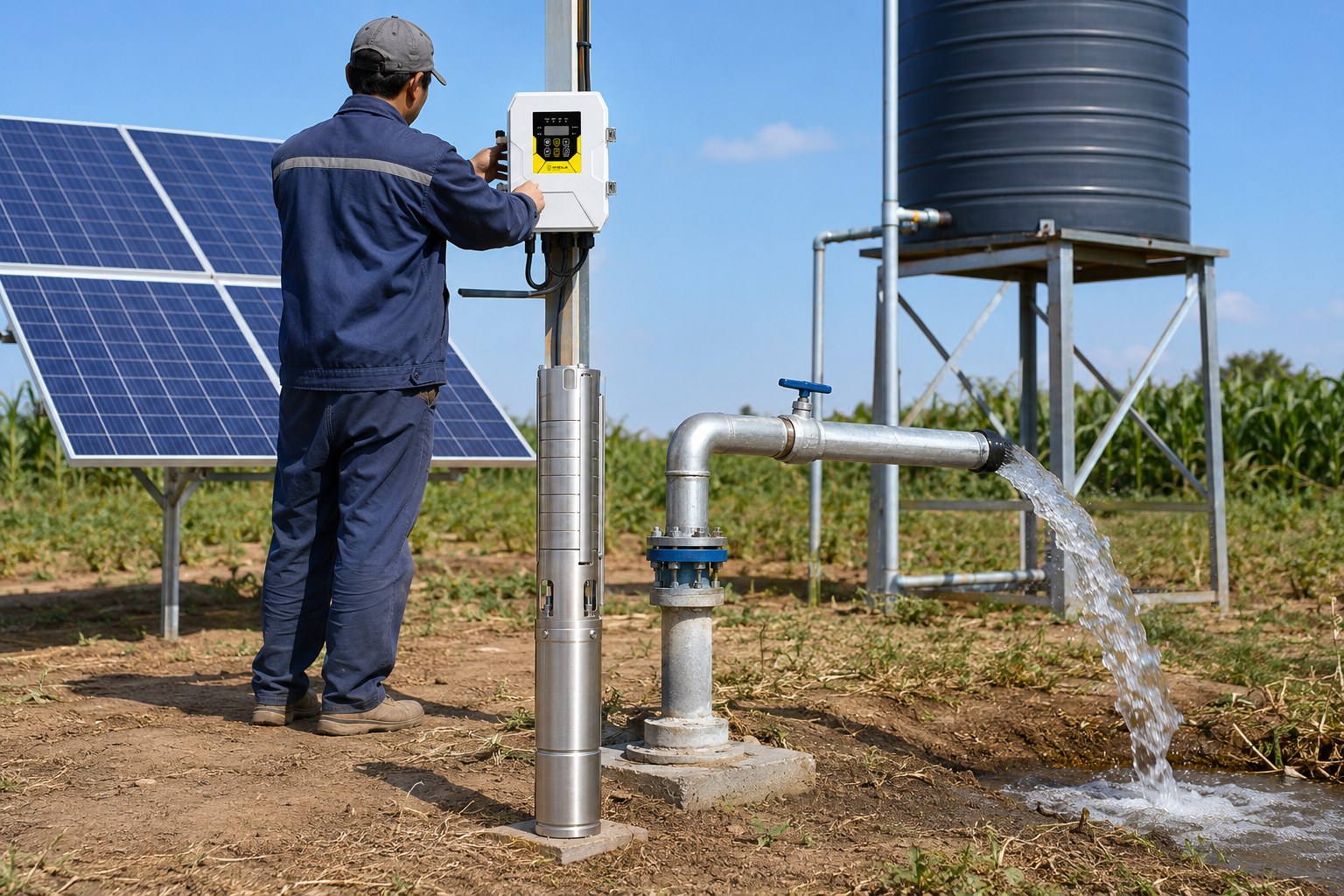
Solar pumps can be either DC (Direct Current) or AC (Alternating Current). DC pumps are generally more efficient for dedicated solar systems as they connect directly to panels via a controller, avoiding energy loss. AC pumps require an inverter but are suited for very large systems or hybrid applications.
The choice between AC and DC isn't just a technical detail.
It fundamentally impacts your system's efficiency, cost, and reliability.
While both can get water from the ground, the best choice depends entirely on your specific needs, from the depth of your well to your daily water requirements.
Understanding these differences is the first step toward designing a robust and cost-effective solar water system that will serve you for years to come.
Let's dive into the specifics to determine which path is right for you.
Differentiating AC from DC Solar Pumps
Choosing the right solar pump system can seem complex.
The technical difference between AC and DC can be confusing, leading to inefficient systems and wasted money.
Let's clarify this to help you avoid costly mistakes.
Fundamentally, DC pumps are ideal for pure off-grid solar systems, offering higher overall efficiency by eliminating the need for an inverter. AC pumps are better suited for very high-power needs or systems designed to integrate with existing grid power, despite the energy loss from the required inverter.
The decision between an AC and a DC solar water pump is one of the first and most critical you'll make.
It's a choice between two different philosophies of system design.
One path prioritizes maximum efficiency and simplicity for a dedicated solar setup.
The other provides flexibility and compatibility with conventional power sources, but at a cost.
To make the right choice, you need to look beyond the pump itself and consider the entire system, from the photons hitting the panel to the water flowing from your tap.
The Efficiency Equation: Direct vs. Inverted Power
The most significant difference between the two systems is the presence of an inverter in an AC setup.
An inverter's job is to convert the Direct Current (DC) electricity produced by solar panels into Alternating Current (AC) electricity that an AC pump motor can use.
This conversion process is never 100% efficient.
A good quality sine wave inverter will typically have a conversion efficiency of 85% to 95%.
This means that for every 100 watts of power coming from your solar panels, only 85 to 95 watts actually reach the pump motor.
Furthermore, inverters have a self-consumption, or "tare loss," which is the power they draw just by being turned on, even if the pump isn't running.
This can range from a few watts to over 50 watts for larger inverters.
In a small off-grid system, this constant drain can be the difference between having power through the night and waking up to dead batteries.
A DC pump system avoids this entirely.
The DC power flows from the panels, through a charge controller, and directly to the DC motor, eliminating both conversion and tare losses from an inverter.
This makes the entire system inherently more efficient, meaning you get more water for every watt of solar power generated.
System Components and Cost
At first glance, the components for both systems seem similar, but the inclusion of an inverter adds a critical point of complexity and cost to an AC system.
A DC system is beautifully simple:
- Solar Panels
- Solar Pump Controller (often with MPPT)
- DC Water Pump
An AC system requires an extra step:
- Solar Panels
- Solar Charge Controller (if batteries are used)
- Battery Bank (almost always necessary to handle motor start-up)
- Inverter
- AC Water Pump
The inverter is not just an additional component; it's an expensive one and another potential point of failure.
For an 1800-watt pump, the required pure sine wave inverter can cost several hundred to over a thousand dollars.
This adds a significant percentage to the total system cost.
In contrast, while high-quality DC pumps may have a higher upfront cost than a comparable AC pump motor alone, the total system cost for a small to medium DC setup is often lower because you don't need to purchase a large, powerful inverter.
| Feature | DC Solar Pump System | AC Solar Pump System |
|---|---|---|
| Energy Path | Solar Panels → Controller → DC Pump | Solar Panels → Controller → Inverter → AC Pump |
| Overall Efficiency | Higher (No inverter losses) | Lower (Inverter standby & conversion losses of 8-15%) |
| System Complexity | Simpler, fewer components | More complex, requires an inverter |
| Best For | Off-grid, small-to-medium scale, efficiency-critical applications | Large-scale irrigation, high head, hybrid grid/solar systems |
| Initial Cost | Potentially lower (no inverter cost) | Potentially higher (due to inverter cost) |
Voltage, Wire Size, and Distance
Power transmission is another area where AC and DC systems differ significantly.
One of the main challenges with DC power is voltage drop over distance, especially at lower voltages like 12V or 24V.
To move a certain amount of power (watts), a lower voltage requires a higher current (amps).
Higher current running through a wire generates more heat and results in a greater loss of voltage along its length.
To combat this, you must use thicker, more expensive copper wire.
For example, running a 12V DC pump that draws 10 amps over a distance of just 50 feet might require a 10 AWG wire to keep voltage drop under 3%.
Running that same pump 100 feet away could require a much thicker and costlier 6 AWG wire.
This is why very low-voltage (12V) systems are generally not recommended for anything more than very short wire runs.
Modern DC solar pump systems often solve this by operating at higher DC voltages (e.g., 48V, 72V, 96V, or even higher).
By doubling the voltage, you can halve the current for the same power output, which dramatically reduces voltage drop and allows for the use of smaller, less expensive wires.
AC power, particularly at standard voltages like 115V or 230V, transmits much more efficiently over long distances, which is why it's the standard for grid electricity.
This can be an advantage if the pump needs to be located hundreds of feet away from the power source (inverter and batteries).
The Core of Modern Solar Pumps: The BLDC Motor
You want to get the most water possible for every bit of sunlight.
An inefficient motor wastes precious solar energy and drives up the cost of your entire system.
The right motor technology is the key to unlocking true solar pumping potential.
Most modern, high-performance solar pumps use Brushless DC (BLDC) motors. These advanced motors offer over 90% efficiency, high starting torque, and a long, maintenance-free life, significantly outperforming older motor types and making the entire solar system more cost-effective.
The motor is the heart of any water pump.
In a solar-powered system, its efficiency is not just a feature—it is the single most important factor determining the system's performance and overall cost.
For years, the choice was between standard AC motors, which are reliable but require an inefficient inverter, or brushed DC motors, which are simple but require regular maintenance and have a limited lifespan.
The development of the high-efficiency Brushless DC (BLDC) motor has completely changed the game.
This technology combines the best attributes of both worlds: the high efficiency and direct-solar compatibility of DC power with the reliability and long life of AC motors.
Why Brushless is Better
The fundamental difference between brushed and brushless DC motors lies in how they create a rotating magnetic field.
A traditional brushed DC motor uses small carbon blocks, called brushes, to make physical contact with a spinning part of the motor (the commutator).
This contact delivers electricity to the coils, but it also creates friction, heat, and sparks.
The brushes are a wear-and-tear item; they wear down over time and must be replaced, typically every 2,000 to 5,000 hours of operation.
This requires maintenance and introduces a common point of failure.
A Brushless DC (BLDC) motor eliminates the brushes entirely.
Instead, it uses a sophisticated electronic controller to switch the direction of the current in the coils.
There are no parts making physical contact to transfer power, which leads to several major advantages:
- Higher Efficiency: With no friction from brushes, more of the electrical energy is converted directly into rotational force. BLDC motors regularly achieve efficiencies of over 90%, compared to 75-80% for brushed motors.
- Longer Lifespan: With no brushes to wear out, the operational lifespan of a BLDC motor is limited only by its bearings, which can last for 20,000 hours or more.
- No Maintenance: The lack of brushes means the motor is virtually maintenance-free.
- Quieter and Cooler Operation: The absence of friction and sparks makes BLDC motors run quieter and at lower temperatures, further improving longevity.
The Power of Permanent Magnets
Another key to the high efficiency of modern BLDC motors is the use of powerful permanent magnets.
The rotor—the part of the motor that spins—is constructed with high-strength rare-earth magnets, such as Neodymium iron boron (NdFeB).
These magnets create a powerful and constant magnetic field without consuming any electricity.
In contrast, other motor types have to use some of their input electricity to create this magnetic field in the rotor, which is a waste of energy.
By using permanent magnets, all the electrical power sent to the motor can be dedicated to the stator coils, which creates the rotating field that drives the rotor.
This results in higher torque (the rotational force needed to start and run the pump) and greater overall efficiency.
The high torque is especially important for water pumps, which need a strong initial push to overcome inertia and start moving water, particularly from a deep well.
Tangible Benefits of High Efficiency
The high efficiency of a BLDC motor has a ripple effect that makes the entire solar pumping system more affordable and effective.
Consider this: a pump system with a 90% efficient BLDC motor needs significantly less power to do the same amount of work as a system with a 75% efficient motor.
This efficiency gain of 15 percentage points means your solar panel array can be over 15-20% smaller to achieve the same water flow.
For a system requiring 1000 watts of power, choosing a BLDC motor could save you the cost of a 200-watt solar panel.
Over the life of the system, this translates into substantial savings on the initial purchase of panels.
Furthermore, because they are more efficient, BLDC motors can be made smaller and lighter for the same power output.
A modern BLDC motor can be up to 47% smaller and 39% lighter than a traditional motor with the same power rating, simplifying installation and reducing shipping costs.
| Feature | Brushless DC (BLDC) Motor | Brushed DC Motor | Standard AC Induction Motor |
|---|---|---|---|
| Typical Efficiency | >90% | 75-80% | 70-85% (plus inverter loss) |
| Lifespan | Very Long (20,000+ hrs) | Shorter (2,000-5,000 hrs) | Long (but inverter adds failure point) |
| Maintenance | None | Requires periodic brush replacement | None for motor; inverter may fail |
| System Cost Impact | Reduces required solar panel size | Requires larger panel array | Requires large inverter and panel array |
Matching the Pump to the Application
Not all water sources are the same, and neither are water needs.
A one-size-fits-all pump will inevitably be inefficient or ineffective for many situations.
Let's match the right pump technology to your specific source and use.
For deep wells with low-to-moderate flow needs, a solar screw pump is ideal. For high-volume farm irrigation from a shallower source, a plastic impeller centrifugal pump is a workhorse. For corrosive or harsh water, a durable stainless steel impeller pump is essential.
Once you've settled on a high-efficiency BLDC motor as the driving force, the next step is to choose the "wet end"—the pump mechanism itself.
The design of the wet end determines the pump's performance characteristics, specifically its relationship between flow rate (how much water it moves) and head (how high it can lift the water).
Different designs are optimized for different tasks.
Choosing the wrong one means you could have a pump that can't lift water from your deep well, or one that can't provide enough volume to irrigate your crops.
The three most common types of solar submersible pumps each fill a specific niche.
The Deep Well Specialist: Solar Screw (Progressive Cavity) Pumps
A screw pump, also known as a progressive cavity pump, operates very differently from a typical centrifugal pump.
It uses a single helical rotor (the screw) that rotates inside a flexible rubber housing (the stator).
As the screw turns, it forms a series of sealed cavities that move water upward, pushing it through the pump.
This mechanism is excellent at creating high pressure.
This means screw pumps can generate a very high head, allowing them to lift water from extremely deep wells—often 200 meters (over 650 feet) or more.
However, the trade-off for this high pressure is a relatively low flow rate.
These pumps are perfect for applications where the well is deep but the daily water requirement is moderate.
Key Characteristics:
- Performance: High Head, Low Flow.
- Applications: Domestic water supply for homes from deep boreholes, livestock drinking troughs, and small-scale, high-pressure drip irrigation.
- Advantage: They are exceptionally resistant to sand and sediment. The rubber stator can handle abrasive particles that would quickly destroy the tight tolerances of a centrifugal pump.
The High-Volume Workhorse: Solar Centrifugal Pumps (Plastic Impeller)
Centrifugal pumps are the most common type of pump in the world.
They use a spinning impeller to throw water outwards by centrifugal force.
A submersible centrifugal pump stacks multiple impellers and diffusers on top of each other in stages.
Each stage adds a bit more pressure, increasing the total head the pump can achieve.
Models with durable, engineered plastic impellers are the workhorses of the solar pumping world.
They are designed to produce a high flow rate at a medium head.
This makes them the perfect choice for moving large volumes of water for applications like flood irrigation, filling large storage tanks quickly, or supplying water for a large herd of livestock.
Key Characteristics:
- Performance: High Flow, Medium Head.
- Applications: Farm and ranch irrigation, pasture water supply, community water projects, and filling large reservoirs.
- Advantage: They provide the most water flow for the power consumed, making them highly economical for irrigation. They are also lightweight and have good resistance to fine sand.
The Durability Champion: Solar Centrifugal Pumps (Stainless Steel Impeller)
This pump is a premium version of the centrifugal pump.
While it operates on the same principle, its key components—the impellers, diffusers, and pump body—are constructed from high-grade SS304 or SS316 stainless steel.
This construction makes the pump exceptionally resistant to corrosion and abrasion.
It is the ideal choice for wells where the water is acidic, alkaline, saline, or has other corrosive properties that would quickly degrade a plastic impeller or a cast iron pump body.
They are built for maximum durability and reliability in the most challenging water conditions.
Key Characteristics:
- Performance: High Flow, Medium-to-High Head.
- Applications: Water supply in coastal regions with saltwater intrusion, areas with alkaline or acidic soil, high-end homes and ranches demanding maximum reliability, and mining or industrial applications.
- Advantage: Superior corrosion resistance and extremely long service life, even in harsh water environments.
| Pump Type | Best For (Head/Flow) | Primary Application | Key Advantage | Limitation |
|---|---|---|---|---|
| Solar Screw Pump | High Head, Low Flow | Deep wells, domestic water | Excellent sand resistance | Limited flow rate |
| Plastic Impeller Pump | Medium Head, High Flow | Farm/ranch irrigation | High volume, cost-effective | Less durable in corrosive water |
| Stainless Steel Impeller Pump | Med-High Head, High Flow | Corrosive water environments | Superior corrosion resistance | Higher initial cost |
Beyond the Pump: The Brains of the Operation
A powerful pump motor is useless without a smart controller.
You need a system that can squeeze every last watt from your solar panels and provide water whenever you need it.
Let's look at the controller's crucial role.
Modern solar pump systems use an MPPT (Maximum Power Point Tracking) controller to boost energy harvest from solar panels by up to 30%. For 24/7 reliability, advanced hybrid AC/DC controllers can automatically switch between solar and a grid/generator source, ensuring a constant water supply.
The pump and motor are the muscle of your solar water system, but the controller is the brain.
A modern solar pump controller does much more than simply turn the pump on and off.
It is a sophisticated piece of electronics designed to maximize performance, protect your investment, and in some cases, provide a level of flexibility that was previously impossible in an off-grid system.
The two most important technologies in a modern controller are Maximum Power Point Tracking (MPPT) and AC/DC hybrid capability.
The Power of MPPT
A solar panel's power output isn't fixed; it varies with sunlight intensity, temperature, and the electrical load placed upon it.
Maximum Power Point Tracking (MPPT) is a technology that constantly monitors the panel's voltage and current and adjusts the electrical load to ensure the panel is always operating at its "maximum power point"—the sweet spot where it produces the absolute most watts.
This is a stark contrast to older, simpler PWM (Pulse Width Modulation) controllers.
A PWM controller essentially just connects the panels to the pump (or batteries), forcing the panels to operate at the pump's voltage.
This is almost never the panel's ideal operating voltage, leading to significant power loss.
The difference is dramatic.
An MPPT controller can boost the energy harvested from your solar panels by 25-30% compared to a PWM controller.
For example, if you have a 400-watt solar array, a basic PWM controller might only be able to deliver 260-280 watts to your pump.
An MPPT controller will consistently deliver 350-390 watts under the same conditions.
This means more water pumped every day, better performance on cloudy days, and the ability to run your pump earlier in the morning and later in the evening.
The Best of Both Worlds: AC/DC Hybrid Systems
One of the biggest limitations of a purely solar-powered system is that it only works when the sun is shining.
What happens if you need water at night, or during a long stretch of cloudy, rainy weather?
This is where an AC/DC hybrid controller provides a game-changing solution.
These advanced controllers are designed with two separate power inputs: one for DC power from the solar panels and another for AC power from the utility grid or a backup generator.
The controller's logic is programmed to always prioritize the free energy from the sun.
- On a sunny day: The system runs 100% on solar power.
- On a partly cloudy day: The controller will use as much solar power as is available and seamlessly blend in just enough AC power to keep the pump running at the desired speed. This maximizes the use of free solar energy.
- At night or with no sun: The controller automatically switches over to run the pump entirely on the AC power source.
This ensures you have a reliable, 24/7 water supply without having to manually switch power sources or invest in a massive, expensive battery bank.
It gives you the cost savings of solar with the reliability of the grid.
System Safety and Protection
Beyond optimizing power, the controller also acts as a critical safety device for your entire system.
It constantly monitors operating conditions and will shut the pump down to prevent damage.
Key protective functions include:
- Dry Run Protection: The controller can detect when the water level in the well drops too low and the pump starts to draw less current. It will then stop the pump to prevent it from overheating and being destroyed by running dry.
- High/Low Voltage Protection: It protects the pump motor from damaging voltage spikes or sags from the power source.
- Full Tank Shut-off: The controller can be connected to a float switch or pressure sensor in a storage tank, automatically turning the pump off when the tank is full to prevent overflows and save energy.
- Overload Protection: If the pump motor is jammed or working too hard, the controller will cut power to prevent it from burning out.
Conclusion
The best solar pump choice hinges on the application, but high-efficiency BLDC motors and smart MPPT controllers are the modern standard.
A well-designed system ensures reliable, cost-effective water anywhere in the world.
FAQs
Can a DC solar pump run on AC power?
No, a standard DC pump cannot run directly on AC power. However, an AC/DC hybrid controller allows the system to automatically use AC power from the grid or a generator when solar is unavailable.
How long do solar water pumps last?
A quality solar pump with a brushless DC motor can last for over 20,000 hours, or more than 10 years of typical use. The solar panels themselves are often warrantied for 25 years.
Which is more efficient, AC or DC water pump?
For a dedicated solar-powered system, a DC pump is more efficient. It avoids the 8-15% energy loss that occurs when converting DC solar power to AC power with an inverter.
What size solar panel do I need to run a water pump?
This depends on the pump's power rating (in watts) and your location's sunlight. A general rule is to have a solar panel array with a wattage that is 1.5 to 2 times the pump motor's wattage.
Do solar pumps work on cloudy days?
Yes, but at a reduced flow rate. A system with an MPPT controller and properly sized panels will perform much better on cloudy days than a basic system, but output will be lower than on a sunny day.
Can you run a well pump directly from solar panels?
Yes, a DC well pump is designed to run directly from solar panels via a controller. The controller manages the power to protect the pump and maximize water output.
What is the main disadvantage of a solar water pump?
The primary disadvantage is the high initial investment cost for the solar panels and pump. However, with no fuel costs and low maintenance, they have a much lower lifetime cost than diesel pumps.