Struggling with high energy bills from your pool pump?
An oversized pump wastes money, while an undersized one leaves your pool dirty.
Finding the right size is the ultimate solution.
For a 30,000-gallon pool, you need a pump with a flow rate of at least 62.5 gallons per minute (GPM) to achieve an ideal 8-hour turnover. A variable-speed pump is highly recommended for maximum efficiency, as it can adjust its speed to meet the pool's needs without wasting energy.
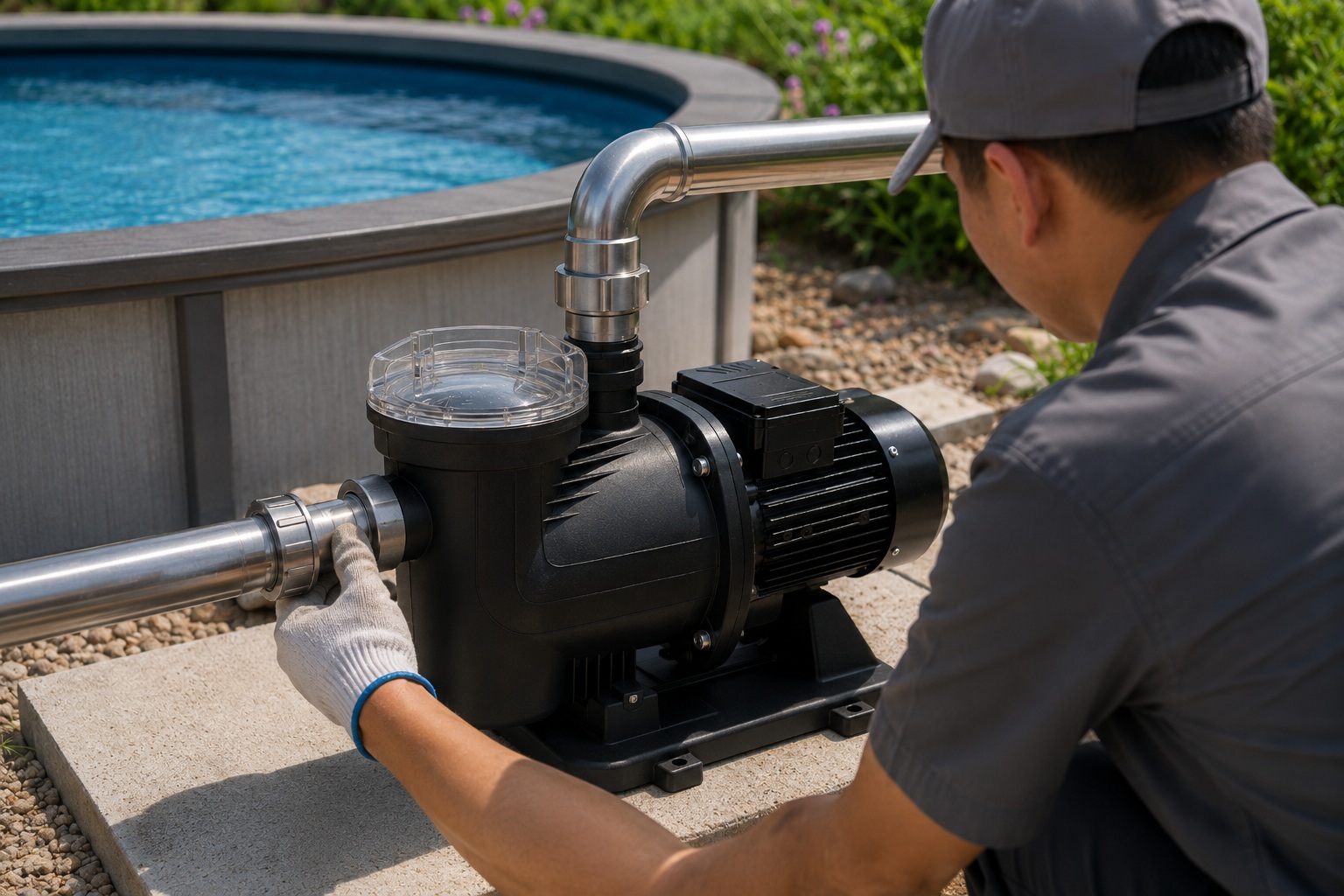
Choosing the right pump involves more than just looking at a horsepower rating.
It's a balance of your pool's volume, your plumbing system, and your energy-saving goals.
Let's explore the key factors to ensure your pool stays crystal clear without draining your wallet.
This guide will walk you through everything you need to know.
Step 1: Calculate Your Pool's Required Flow Rate
Is your pool water consistently cloudy despite running the pump?
The problem might be an incorrect flow rate, which fails to circulate water effectively.
This leads to poor filtration and chemical imbalances.
First, calculate your pool's minimum flow rate by dividing its total volume (30,000 gallons) by the desired turnover time in minutes. For an 8-hour turnover (480 minutes), your pump needs to move at least 62.5 gallons per minute (GPM) to properly filter the water.
Your pool's health depends entirely on water circulation.
The pump's job is to move the entire volume of pool water through the filter within a specific timeframe, known as the "turnover rate."
This process removes debris, distributes chemicals, and prevents algae growth.
Without an adequate flow rate, you're fighting a losing battle for clean water.
Let's break down how to determine the precise flow rate your 30,000-gallon pool needs.
Understanding Turnover Time
Turnover time is the total time it takes for your pump and filter system to circulate the entire volume of your pool's water once.
For residential pools, the industry standard is an 8-hour turnover.
However, this can vary based on usage.
A heavily used pool may benefit from a faster 6-hour turnover, while a rarely used pool might be fine with a 10-hour cycle.
A shorter turnover means a higher required flow rate.
Calculating Minimum Flow Rate
The calculation is straightforward.
You need two pieces of information: your pool volume in gallons and your desired turnover time in hours.
First, convert the turnover time to minutes.
- 8 hours = 8 x 60 = 480 minutes
- 10 hours = 10 x 60 = 600 minutes
Next, use this formula: Pool Volume (Gallons) / Turnover Time (Minutes) = Minimum Flow Rate (GPM)
Let's apply this to your 30,000-gallon pool.
| Pool Size | Desired Turnover | Calculation | Minimum Flow Rate |
|---|---|---|---|
| 30,000 Gallons | 8 Hours (480 mins) | 30,000 / 480 | 62.5 GPM |
| 30,000 Gallons | 10 Hours (600 mins) | 30,000 / 600 | 50 GPM |
Based on this, your target should be a pump capable of delivering at least 62.5 GPM to maintain a healthy pool.
This number is your foundational requirement.
Step 2: Determine Your System's Maximum Flow Rate
Have you ever installed a powerful new pump only to find it's noisy and inefficient?
This happens when the pump is too strong for your plumbing and filter.
It creates excessive pressure, straining equipment and reducing its lifespan.
Check your plumbing and filter specifications to find the maximum flow rate your system can handle. For example, a 1.5-inch PVC pipe has a maximum flow of about 42 GPM, while a 2-inch pipe allows up to 73 GPM. Your pump’s flow rate must not exceed these limits.
A pump can only move as much water as the system's narrowest point allows.
Think of it like trying to force a river through a garden hose.
Pushing more water than your pipes and filter can handle leads to high backpressure, also known as "head."
This not only hinders performance but can cause serious damage to your equipment over time.
Before buying a pump, you must identify your system's bottleneck.
This ensures you choose a pump that operates within a safe and efficient range.
Sizing Your Plumbing
The diameter of your pool's PVC pipes is the first limiting factor.
A larger pipe diameter allows for a higher flow rate with less resistance.
Most residential in-ground pools use either 1.5-inch or 2-inch pipes.
Here are the generally accepted maximum flow rates to maintain proper water velocity (under 7 feet per second).
| Pipe Diameter | Maximum Flow Rate (GPM) |
|---|---|
| 1.5-inch PVC Pipe | 42 GPM |
| 2-inch PVC Pipe | 73 GPM |
| 2.5-inch PVC Pipe | 120 GPM |
If your 30,000-gallon pool has 1.5-inch plumbing, a pump producing 62.5 GPM would be severely mismatched and inefficient.
In that scenario, you would need to plan for a longer turnover time or consider upgrading the plumbing.
With 2-inch pipes, a 62.5 GPM flow rate is perfectly suitable.
Checking Your Filter's Capacity
Your pool filter also has a specific design flow rate that should not be exceeded.
Forcing too much water through a filter reduces its effectiveness and can damage the internal components, such as filter grids or cartridges.
Always check the manufacturer's label or manual for the maximum flow rate.
Here are some typical maximums for different filter types and sizes.
| Filter Type | Surface Area | Maximum Flow Rate (GPM) |
|---|---|---|
| Sand Filter | 3.1 sq. ft. (24" diameter) | 60 GPM |
| Cartridge Filter | 300 sq. ft. | 112 GPM |
| D.E. Filter | 48 sq. ft. | 96 GPM |
Finding Your True Maximum Flow Rate
Your system's overall maximum flow rate is determined by the lowest maximum of all its components.
- Example 1: You have 2-inch plumbing (max 73 GPM) and a D.E. filter rated for 96 GPM. Your system's maximum flow rate is 73 GPM.
- Example 2: You have 2-inch plumbing (max 73 GPM) and a sand filter rated for 60 GPM. Your system's maximum flow rate is 60 GPM.
For a 30,000-gallon pool needing 62.5 GPM, the system in Example 2 would be slightly undersized.
Step 3: Choose the Right Type of Pool Pump
Are you tired of skyrocketing electricity bills every summer just to keep your pool clean?
Conventional single-speed pumps run at full power all the time.
This wastes a significant amount of energy and money, especially during simple filtration cycles.
For a 30,000-gallon pool, a variable-speed pump is the most cost-effective choice. It allows you to run at a low speed for daily filtration—matching your target 62.5 GPM—and ramp up to higher speeds only when needed for cleaning or water features, saving up to 90% on energy costs.
Pump technology has evolved significantly.
Gone are the days when a noisy, energy-guzzling single-speed pump was the only option.
Today, you can choose a pump that perfectly matches your pool's needs for any task, from gentle filtering to powerful vacuuming.
The initial investment in modern pumps is higher, but the long-term energy savings create a compelling return on investment.
Let's compare the different types to see why variable-speed models are the clear winner for larger pools.
Types of Pool Pumps
There are three main categories of pool pumps available for residential use.
- Single-Speed Pumps: These are the traditional workhorses. They operate at one fixed, high speed. They are cheap to buy but are the least energy-efficient and are being phased out by regulations in many areas.
- Dual-Speed Pumps: These pumps offer two settings: high and low. You can use the low speed for general filtration and switch to high speed for vacuuming or running a spa. They offer better energy efficiency than single-speed models but lack the fine-tuning of a variable-speed pump.
- Variable-Speed Pumps (VSPs): These are the most advanced and efficient pumps. They use a permanent magnet motor, similar to those in electric cars, and can be programmed to run at a wide range of precise speeds. This allows you to dial in the exact flow rate needed, dramatically reducing energy consumption.
Why Variable-Speed Pumps Excel
The secret to a VSP's efficiency lies in the pump affinity law.
This law states that if you halve the pump's speed, you reduce the energy consumption by a factor of eight.
Running a pump at half speed uses only 1/8th of the power.
This means running your pump at a lower speed for a longer period is exponentially cheaper than running it at a high speed for a shorter period.
For your 30,000-gallon pool, you could run a VSP at the exact low speed needed to achieve 62.5 GPM for 8 hours.
This would consume far less electricity than a single-speed pump running at 100+ GPM for only 4-5 hours.
| Pump Type | Speed Options | Energy Efficiency | Initial Cost | Best For |
|---|---|---|---|---|
| Single-Speed | One High Speed | Low | Low | Small, simple pools (under 15,000 gal) |
| Dual-Speed | High & Low | Medium | Medium | Medium-sized pools (15,000-25,000 gal) |
| Variable-Speed | Fully Adjustable | Very High | High | All pools, especially 20,000+ gal |
The U.S. Department of Energy now requires most new or replacement pool pumps to meet minimum energy-efficiency standards, making VSPs the default choice for most installations.
Go a Step Further: The Solar Pool Pump Advantage
Even with an efficient variable-speed pump, you are still tied to the electrical grid.
This means fluctuating energy prices and a significant carbon footprint.
What if you could eliminate your pool's electricity cost entirely?
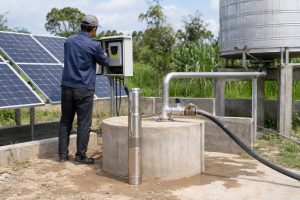
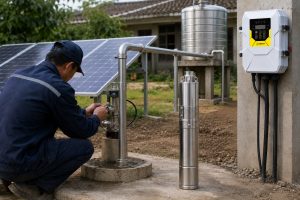
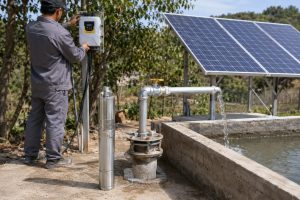
A solar-powered pool pump uses free energy from the sun to circulate your water. These systems use highly efficient DC brushless motors, which are even more durable than AC motors. This not only cuts your annual electricity bill by hundreds of dollars but also creates a truly sustainable pool.
A solar pool pump represents the next leap in pool efficiency and sustainability.
By powering your pump directly from photovoltaic (PV) panels, you operate completely off-grid during the sunniest parts of the day—precisely when pools are used most.
The technology is robust, with DC brushless motors offering lifespans 6 to 10 times longer than traditional brushed motors.
The financial and environmental benefits are too significant to ignore.
Calculating the Return on Investment (ROI)
The main question with any solar investment is the payback period.
Let's compare the lifetime cost of a traditional grid-tied pump with a solar pump system for your 30,000-gallon pool.
First, let's establish the cost of running a 1.5 HP variable-speed AC pump.
While efficient, let's assume it consumes an average of 1,000 watts (1 kW) when running.
- Daily Energy Use: 1 kW x 8 hours = 8 kWh
- Daily Cost (at $0.16/kWh): 8 kWh x $0.16 = $1.28
- Annual Cost: $1.28 x 365 days = $467.20
Now, let's look at the initial investment for a solar pump system.
- Two 400-watt PV panels: $450
- Solar-compatible DC Pool Pump: $400
- Controller, Cabling, & Timer: $150
- Total Initial Investment: $1,000
The payback calculation is simple.
- Payback Period: $1,000 (Investment) / $467.20 (Annual Savings) = 2.14 years
After just over two years, the system has paid for itself.
Given that solar panels have a performance warranty of 25 years and brushless DC motors can last over 20,000 hours (nearly a decade of seasonal use), the long-term savings are substantial.
The Power of an Efficient DC Motor
The core of a solar pump's advantage is its motor.
Brushless DC (BLDC) permanent magnet motors are the pinnacle of pump technology.
- Efficiency: BLDC motors can exceed 90% efficiency, compared to 75-85% for typical AC motors. This means more water is moved per watt of power generated.
- Durability: With no brushes to wear out, these motors have an exceptionally long service life and require minimal maintenance.
- Compact Design: They are often smaller and lighter than their AC counterparts, simplifying installation.
When paired with an intelligent MPPT (Maximum Power Point Tracking) controller, the system constantly optimizes the power drawn from the solar panels.
This ensures the pump operates effectively even in lower light conditions, maximizing your daily run time.
Some advanced systems even offer AC/DC hybrid controllers.
These allow the pump to run on solar power when available and automatically switch to grid power on cloudy days or at night, ensuring your pool is always filtered without interruption.
Conclusion
Sizing a pool pump correctly saves energy and extends equipment life.
A solar pump offers the ultimate solution, eliminating grid-dependency for a truly sustainable pool.
FAQs
What is the best size pump for a 30,000-gallon pool?
The best pump is a variable-speed model with a flow rate between 62.5 and 75 GPM. This allows for an efficient 8-hour turnover without straining your equipment.
Can a pool pump be too big?
Yes. An oversized pump will struggle against the resistance of your plumbing and filter, a condition called high head pressure. This wastes energy and can damage your equipment.
How many hours a day should I run my 30,000-gallon pool pump?
You should run the pump long enough to complete at least one full turnover, which is typically 8 hours for a residential pool.
Does a bigger pool pump use more electricity?
Yes, a pump with a higher horsepower and flow rate will generally consume more electricity, especially if it is a single-speed model that always runs at maximum power.
How do I calculate the GPM of my pool pump?
You can estimate GPM using a flow meter or by calculating it based on the turnover time. Divide your pool's volume in gallons by the turnover time in minutes.
What is better, a 1 HP or 1.5 HP pool pump?
It depends on the required flow rate, not horsepower. Choose a pump based on the GPM needed for your pool's volume and plumbing, as a modern 1 HP VSP can outperform an old 1.5 HP single-speed.
How much does it cost to run a pool pump for 24 hours?
Running a 1.5 HP single-speed pump (approx. 1.5 kW) for 24 hours at $0.16/kWh would cost about $5.76 per day. A variable-speed pump running on low would cost significantly less.
Is it cheaper to run a pool pump at night?
This depends on your electricity plan. If you have time-of-use rates with cheaper electricity overnight, it can be more affordable. Otherwise, running it during the day is often preferred.