Running a pool is expensive.
You worry about electricity bills and constant maintenance, making your backyard oasis feel more like a burden than a blessing.
Yes, you can and should run your pool pump with a solar cover on.
A solar cover reduces debris, meaning the pump runs for fewer hours.
This extends the pump's lifespan and saves you money on electricity while maintaining a clean pool.
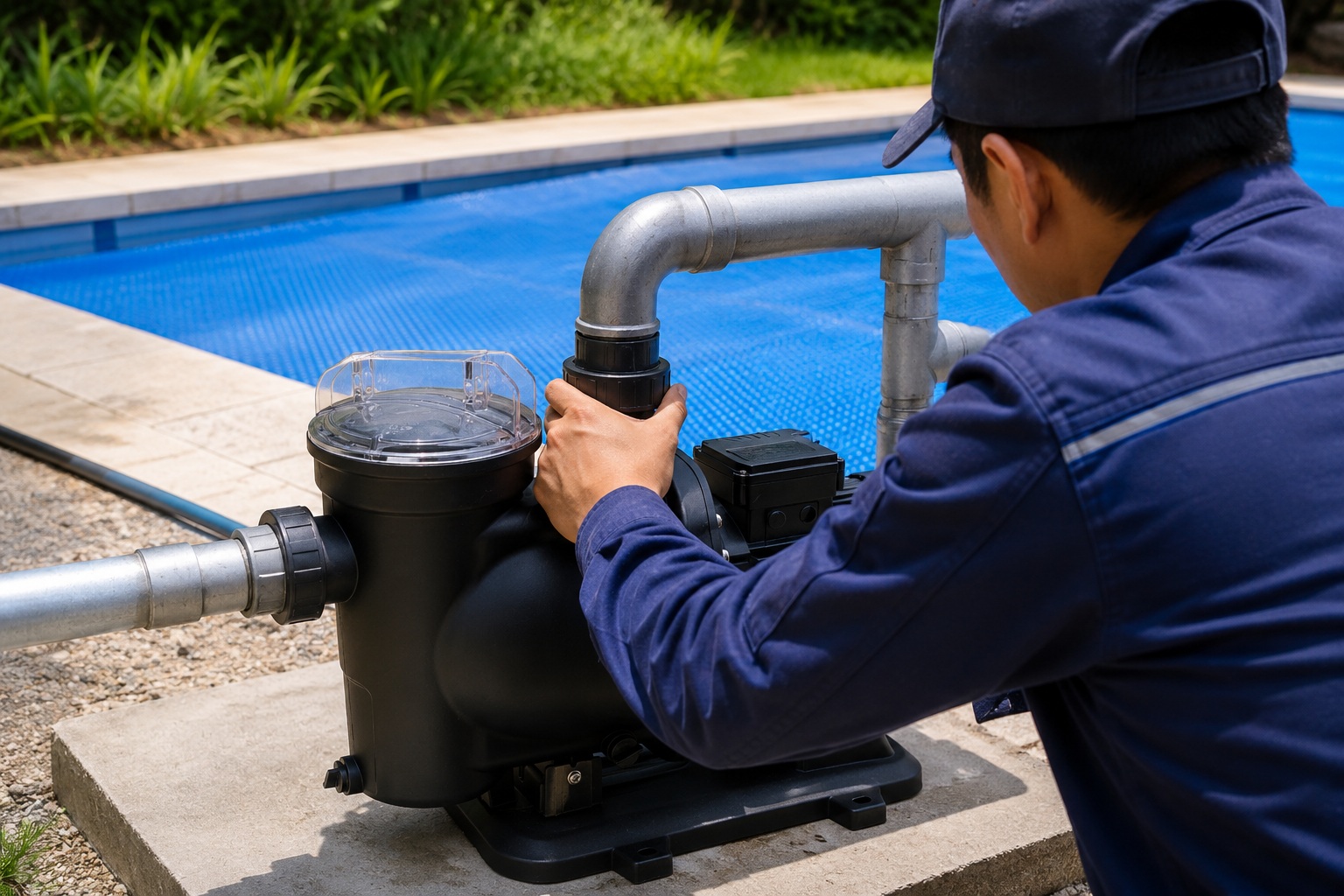
Using a solar cover and a pump together is a great first step toward an efficient pool.
It keeps the water clean and warm, saving energy.
But what if you could take that efficiency to the next level?
Many are now looking at the source of the power itself.
Let's explore how solar technology is completely changing pool maintenance, starting with the heart of the system: the pump.
Product Review: Does a DIY Solar Pool Pump Make Sense?
Thinking about cutting your pool's energy costs is smart.
But imported DIY solar pumps have mixed reviews, making you wonder if the savings are worth the potential hassle.
A DIY solar pool pump can be a game-changer, offering quiet, powerful, and free operation from sunlight.
However, they often lack good customer support and can suffer from technical glitches that may shorten their lifespan if not addressed.
When you walk into a typical pool supply store, you will likely find they know very little about solar-powered pool pumps.
This is a strange market gap.
The technology isn't just theory; it's a practical and powerful application for solar panels.
A direct current (DC) brushless motor, the kind found in these pumps, should theoretically last 20,000 to 30,000 hours.
That’s 6 to 10 times longer than the 2,000 to 5,000-hour lifespan of a traditional brushed motor pump.
The main problem seems to be that most available units are imported with little U.S.
or local market support, and many online reviews report failures after just a few months.
So, what’s going on?
The "Cycling Glitch" Problem
The most common complaint about these pumps is premature failure.
This is often a sign of excessive stress on the motor.
After installing and observing one of these pumps, a major design flaw becomes apparent.
The pump controller responds almost instantly to sunlight variations.
On a partly cloudy day, the pump might run for 5 seconds, shut off for 20 seconds as a cloud passes, and then start again.
This rapid on-off cycling places immense strain on the motor and its electronic components.
It’s like constantly flooring the gas and then slamming on the brakes in your car.
This issue is likely the primary reason for the pump's short lifespan in many negative reviews.
A simple workaround involves using an external digital timer to shut off the pump in the late afternoon when sunlight becomes inconsistent, preventing the damaging cycling.
What Should a Manufacturer Do?
This technology has huge potential.
For a quality manufacturer to enter and dominate this space, they would only need to make a few key improvements.
- Standardize the Price: Prices are all over the place.
You can find a 500-watt pump for around $350, while a seemingly similar model costs nearly $1,000.
This inconsistency confuses customers and prevents the market from stabilizing.
A clear price point based on features and quality is needed. - Provide Clear Instructions: The installation manuals for these pumps are famously poor.
They often feature confusing diagrams and lack troubleshooting help.
Hiring a competent technical writer to create clear, step-by-step guides in plain English would dramatically improve the customer experience. - Fix the Cycling Glitch: This is the most critical fix.
The on-off cycling issue must be solved at the source.
Integrating a smarter circuit board into the controller with a "soft" transition logic would prevent motor burnout.
This small engineering change would instantly make the products more reliable and justify their investment.
What's the Payback on a Solar Pool Pump?
High electricity bills from your old pool pump drain your budget.
You want to switch to a solar solution but need to know if the upfront cost is truly worth it.
The financial payback for a solar pool pump system is surprisingly fast, often around 3.5 years.
Considering the long lifespan of solar panels, the long-term savings are substantial, making it a wise and environmentally friendly investment for any pool owner.
Let's break down the return on investment (ROI) by comparing the costs of a traditional AC pump to a new solar-powered DC pump system.
Calculating this helps clarify just how quickly the savings add up.
The primary saving comes from eliminating the electricity cost for running the pump, as it will run entirely on free energy from the sun.
We will use average figures for this calculation, but you can substitute your local electricity rate and equipment costs for a more personal estimate.
Initial Investment Breakdown
First, let's tally the upfront costs for a typical DIY solar pump setup.
This includes the pump itself, the solar panels to power it, and the necessary wiring.
While minor costs like fasteners and plumbing are not included here, this gives a solid baseline.
| Item | Quantity | Cost Per Item | Total Cost |
|---|---|---|---|
| 400-watt PV panels | 2 | $220 | $440 |
| DC Pool Pump (500W) | 1 | $341 | $341 |
| Circuit Shut off/Timer | 1 | $75 | $75 |
| PV Cabling | 1 | $25 | $25 |
| Total Initial Investment | $881 |
Calculating the Savings and ROI
Now, we compare the annual running cost of an old AC pump to the $0 electricity cost of the new solar pump.
A standard 1-horsepower AC pump uses about 746 watts (0.746 kW).
- Old AC Pump - Daily Energy Use: 0.746 kW * 7 hours/day = 5.222 kWh
- Old AC Pump - Daily Cost: 5.222 kWh * $0.13/kWh (avg.
rate) = $0.679 - Old AC Pump - Annual Cost: $0.679 * 365 days = $247.84
The annual savings from switching to solar is the full $247.84 you are no longer spending.
- Payback Period: Total Initial Investment / Annual Savings
- $881 / $247.84 = 3.55 Years
A payback period of under four years is excellent for any home improvement project.
Because a brushless DC pump can last up to 20,000 hours (about 8 years of seasonal use) and the solar panels are warranteed for 25+ years, the long-term value is undeniable.
After the first pump reaches the end of its life, your only cost is a replacement pump, reducing the second payback period to just over a year.
Understanding the Core Technology: What Makes a Good Solar Pump?
You see different solar pumps on the market but don't know what to look for.
Without understanding the technology inside, you can't tell if a pump is efficient and durable or just cheap.
The heart of a high-quality solar pump is its motor.
A Brushless DC (BLDC) permanent magnet motor is the key, offering over 90% efficiency.
This technology reduces energy needs, lowers costs, and ensures a long, maintenance-free operational life.
When we talk about solar pumps, the conversation often focuses on the pump type or the solar panels.
However, the true engine of performance is the motor.
The most significant advancement in this area is the widespread adoption of Brushless DC (BLDC) permanent magnet motors.
Unlike older brushed motors that rely on physical contact to transfer power, causing friction and wear, BLDC motors use electronics.
This fundamental difference leads to massive gains in efficiency, durability, and control.
Why Brushless is Better
The innovation lies in the motor's design.
A BLDC motor uses a rotor made of powerful permanent magnets.
In high-end models, this is often a material like 40SH neodymium iron boron, known for its strong magnetic field.
An electronic controller then energizes stator coils around the rotor, creating a rotating magnetic field that spins the rotor without any physical contact.
This design has several powerful advantages.
- Superior Efficiency: BLDC motors regularly achieve efficiencies of over 90%.
Traditional AC motors or brushed DC motors often operate at 60-75% efficiency.
This means more of the sun's energy is converted into water pumping and less is wasted as heat. - Longer Lifespan: With no brushes to wear out, BLDC motors are exceptionally durable.
They can run for 20,000-30,000 hours with virtually no maintenance, compared to the 2,000-5,000 hours of a brushed motor. - Compact and Powerful: The high power density of these motors means they are smaller and lighter than traditional motors of the same output.
A modern BLDC motor can be up to 47% smaller and 39% lighter, simplifying installation and reducing material costs. - Higher Torque: They provide high starting torque, which is crucial for overcoming the initial resistance of pumping water from a deep well or pushing it through a long pipe.
The Market Impact of BLDC Motors
The strategic value of using a BLDC motor cannot be overstated.
Because the motor is so efficient, the entire system becomes more cost-effective.
You need fewer solar panels to achieve the same water flow, which directly lowers the initial investment.
This makes solar pumping solutions accessible to a wider range of users, from small-scale farmers to residential homeowners.
The motor is the core technology that makes the entire product portfolio competitive, enabling reliable water solutions for households, agriculture, and livestock in off-grid and rural areas.
Choosing the Right Pump Type for Your Needs
You know you want a solar pump, but which type is best?
With options like screw pumps and impeller pumps, choosing the wrong one means poor performance and wasted money.
Choosing the right pump depends on your specific needs for water flow and pressure (head).
Screw pumps are for low flow but high head (deep wells), while impeller pumps provide high flow at a lower head, ideal for irrigation or pools.
While the motor provides the power, the pump end does the work of moving water.
Different designs are engineered for different tasks.
The three most common types of solar pumps are the solar screw pump, the solar plastic impeller pump, and the solar stainless steel impeller pump.
Each serves a different purpose, and understanding their strengths and weaknesses is key to building an effective water system.
Whether for a deep well, a farm, or a home, your choice will be guided by your required flow rate and head (the vertical distance the water must be lifted).
Solar Screw (Helical Rotor) Pump: Low Flow, High Head
This type of pump uses a single screw-shaped rotor that turns inside a rubber stator.
As the rotor turns, cavities are formed that move water up through the pump.
This design is a type of positive displacement pump.
- Best For: Deep wells, domestic water supply, and livestock troughs where the water source is far below the ground.
It excels in lifting water from significant depths. - Advantages:
- High Head: Can pump water from wells over 100 meters deep.
- Sand Resistance: The design can handle water with a higher concentration of sand or grit without clogging or rapid wear.
- Limitations:
- Low Flow Rate: It is not designed to move large volumes of water quickly, making it unsuitable for large-scale irrigation.
Solar Plastic Impeller Pump: High Flow, General Use
This is a multi-stage centrifugal pump.
It uses a series of plastic impellers that spin at high speed to push water outward and upward through the pump body.
- Best For: Farm irrigation, garden watering, and residential water transfer where high volume is more important than extreme depth.
- Advantages:
- High Flow Rate: Delivers a large volume of water, perfect for applications needing a lot of water fast.
- Economical: Plastic impellers are cost-effective to produce, making these pumps more affordable.
- Lightweight: Easier to install and handle than their metal counterparts.
- Limitations:
- Lower Head: Not as effective for very deep wells.
- Durability: Plastic can wear out in highly abrasive (sandy) or corrosive water conditions.
Solar Stainless Steel Impeller Pump: Premium Quality, High Durability
This pump is structurally similar to the plastic impeller model but uses impellers made from SS304 or SS316 stainless steel.
The entire pump body is also typically made of stainless steel.
- Best For: Corrosive water environments (acidic or alkaline), high-end homes, and applications demanding maximum reliability and longevity.
- Advantages:
- Corrosion Resistance: Stainless steel is highly resistant to rust and chemical corrosion.
- Long Service Life: The durable materials ensure the pump will last for many years even in harsh conditions.
- Limitations:
- Higher Cost: The materials and manufacturing process make these pumps more expensive.
- Heavier Weight: The stainless steel construction makes the pump heavier and potentially more difficult to install.
| Pump Type | Best Application | Max Head | Max Flow | Sand Resistance | Cost |
|---|---|---|---|---|---|
| Screw Pump | Deep Wells, Homes | Very High | Low | Excellent | Medium |
| Plastic Impeller | Irrigation, Farms | Medium | High | Good | Low |
| Stainless Steel Impeller | Corrosive Water, Pools | High | High | Good | High |
What is an AC/DC Hybrid Solar Pump Controller?
You love the idea of free solar power for your pump.
But you're worried about cloudy days or needing to pump water at night when the sun isn't shining.
An AC/DC hybrid controller solves this problem by automatically switching between power sources.
It uses solar power when available and seamlessly switches to your home's AC grid power when sunlight is insufficient, ensuring you have water 24/7 without interruption.
The biggest limitation of a purely solar-direct system is its dependence on the sun.
While perfect for applications like pool filtration that only need to run during the day, it’s not practical for essential water supplies that must be available 24/7.
This is where AC/DC hybrid technology comes in.
An AC/DC hybrid controller is an intelligent power management system that can accept and manage power from two different sources: DC power from solar panels and AC power from the electrical grid or a generator.
How It Works: Smart Power Blending
The controller's primary goal is to maximize the use of free solar energy.
It is designed with simultaneous inputs for both AC and DC power.
Here is the logic it follows:
- Solar Priority: Whenever the sun is shining and the solar panels are generating sufficient power, the controller will run the pump using 100% DC solar energy.
The AC grid connection remains idle. - Hybrid Function: On partly cloudy days when solar energy is reduced, the controller doesn't just shut off.
Instead, it blends power.
It will draw as much power as it can from the solar panels and supplement the rest with a small amount of AC power from the grid to keep the pump running consistently.
This feature ensures you are always using the maximum available free energy. - Automatic AC Switchover: When the sun goes down or during extended periods of heavy cloud cover, the photovoltaic input will drop to zero.
The controller automatically detects this and seamlessly switches over to the AC power source.
The pump continues to run at full capacity, ensuring an uninterrupted water supply.
The Benefits of a Hybrid System
This intelligent control provides the best of both worlds.
You get the cost savings and environmental benefits of solar power without sacrificing the reliability of grid power.
This is especially critical for applications like:
- Domestic Water Supply: Ensures your home has water for showers, cooking, and drinking at any time, day or night.
- Livestock Watering: Guarantees animals have constant access to water, which is crucial for their health.
- Critical Irrigation: Allows farmers to run irrigation cycles overnight or on cloudy days to meet crop water requirements.
By combining the power of the sun with the reliability of the grid, an AC/DC hybrid system provides a worry-free, efficient, and cost-effective water pumping solution for any situation.
Conclusion
Running a pool pump with a solar cover saves energy.
Upgrading to a solar pump system with a smart controller offers even greater efficiency, reliability, and long-term financial and environmental benefits.
FAQs
Can a solar cover make my pool too hot?
In very hot climates, a solar cover can sometimes overheat the pool.
If this happens, simply remove the cover for a few hours each day to allow heat to escape.
How long should I run my pool pump with a solar cover?
With a cover reducing debris, you may only need to run your pump 2-4 hours a day.
This greatly reduces energy consumption compared to the typical 8-12 hours for an uncovered pool.
Do solar covers work on cloudy days?
Yes, solar covers still help retain heat on cloudy days.
They prevent heat loss from evaporation, which is a major factor in keeping your pool warm, regardless of direct sunlight.
Is it safe to swim with a solar cover on the pool?
No, you should never swim with a solar cover on the pool.
It is a safety hazard, and someone could become trapped underneath it.
Always remove the cover completely before swimming.
Can you use a pool cleaner with a solar cover on?
Most automatic pool cleaners can operate under a solar cover.
However, ensure the cleaner's hose has enough room to move freely and does not get tangled.
How do I clean my solar cover?
Lay the cover on a clean, flat surface and gently wash it with a soft brush and mild soap.
Rinse it thoroughly with a hose before putting it back on the pool.
Will pool chemicals damage my solar cover?
Yes, high concentrations of chemicals like chlorine can damage a solar cover.
Always remove the cover when shocking the pool or adding large amounts of chemicals, and wait for them to circulate.
Do I need to run my pump in the winter if I have a cover?
If you live in a climate where temperatures drop below freezing, yes.
You must run the pump for at least 8-10 hours to prevent the pipes from freezing and bursting.