Struggling to choose a reliable water pump?
A poor choice leads to high bills and frequent failures, turning a vital investment into a constant headache.
This guide simplifies your decision.
The best water pump brand is the one that perfectly matches your specific needs, budget, and water source. For traditional wells, Grundfos and Franklin Electric lead in reliability. For modern, off-grid applications, specialized solar pumps with high-efficiency motors offer superior performance and long-term value by eliminating energy costs.
Choosing the right well pump brand is one of the most critical decisions for any property owner.
It's the difference between a decade of trouble-free water access and a cycle of frustrating repairs and high energy bills.
The market is filled with options, from long-established giants to innovative new players.
How do you cut through the noise and find the pump that won't let you down?
This guide breaks down the top brands in the industry, comparing traditional powerhouses with the modern efficiency of solar-powered systems.
We will explore the factors that truly matter, helping you find the perfect pump not just for your well, but for your peace of mind and wallet.
What Are the Top Well Pump Brands Based on Customer Reviews and Reliability?
Choosing a well pump can feel overwhelming with so many brands on the market.
You need a pump that delivers consistent water pressure without constant worry or expensive maintenance.
The right brand choice ensures reliability and peace of mind for years.
Based on decades of field data, customer reviews, and reliability metrics, a few brands consistently rise to the top. Grundfos, Franklin Electric, Zoeller, and Myers are renowned for their durability, performance, and long-term value, making them the most trusted names in the industry for traditional electric pumps.
When you invest in a well pump, you're investing in the heart of your home's water system.
It's not a place to cut corners.
Established brands have built their reputations over decades by delivering products that last.
They stand behind their work with robust warranties and accessible customer support.
While a premium brand might have a higher initial cost, the long-term value is undeniable.
Let's dive deeper into what makes these top-tier brands the preferred choice for professionals and homeowners alike.
Grundfos: The Efficiency Pioneer
Grundfos is widely regarded as the gold standard in the pump industry.
This Danish company has been a leader in innovation for over 75 years.
Their pumps are known for superior energy efficiency, often using 10-20% less electricity than competing models.
This efficiency is not just good for the environment; it directly translates to lower utility bills over the pump's lifespan.
They primarily use premium stainless steel in their construction.
This material choice provides exceptional resistance to corrosion, a common issue in areas with hard or mineral-heavy water.
Grundfos pumps with floating impeller designs are also better at handling sand or silt, which can quickly destroy lower-quality pumps.
These features make them an ideal choice for deep wells (over 300 feet) and challenging water conditions.
Franklin Electric: The Reliability Benchmark
Franklin Electric is an American company with a legendary reputation for reliability.
They are the world's largest manufacturer of submersible motors, the engines that power the majority of high-quality well pumps.
Their motors are so dependable that many other top pump brands use them in their own systems.
When you buy a Franklin Electric pump, you're getting a system where the pump end and motor are perfectly matched for trouble-free operation.
They offer a comprehensive product line that provides excellent value.
While they may be slightly less energy-efficient than the top-tier Grundfos models in some specific applications, their incredible track record for longevity and the wide availability of parts and service make them a smart, go-to choice for most residential wells.
Zoeller and Myers: The Durability Duo
Zoeller and Myers have carved out a niche by focusing on exceptional durability and user-friendly design.
Zoeller is famous for its rugged, all-cast-iron construction.
This heavy-duty build ensures their pumps can withstand harsh conditions and operate reliably for years with minimal maintenance.
They are a favorite for sump, sewage, and effluent applications where toughness is non-negotiable.
Myers, now part of the Pentair family, offers a great balance of quality and value.
Their pumps are known for being easy to install and providing excellent water pressure.
Both brands have listened to customer feedback, creating products that are not only tough but also practical for everyday use.
| Brand | Best For | Typical Lifespan | Price Range | Key Feature |
|---|---|---|---|---|
| Grundfos | Deep Wells & Efficiency | 15-25 years | $$$ | Superior energy efficiency (saves 10-20%) |
| Franklin Electric | All-Around Reliability | 15-25 years | $$-$$$ | Industry-leading motor durability |
| Goulds (Xylem) | High-Flow & Agriculture | 12-20 years | $$ | Heavy-duty construction for high volume |
| Zoeller/Myers | Durability & Value | 12-18 years | $$ | Robust build and easy installation |
| Flotec | Budget Applications | 8-12 years | $ | Accessible price for standard needs |
Why Are Solar Pumps Becoming the Best Choice for Many?
Tired of being tied to the grid and facing rising electricity costs?
Power outages can leave you without water, and running power to a remote well can be prohibitively expensive.
A solar water pump offers complete energy independence and long-term savings.
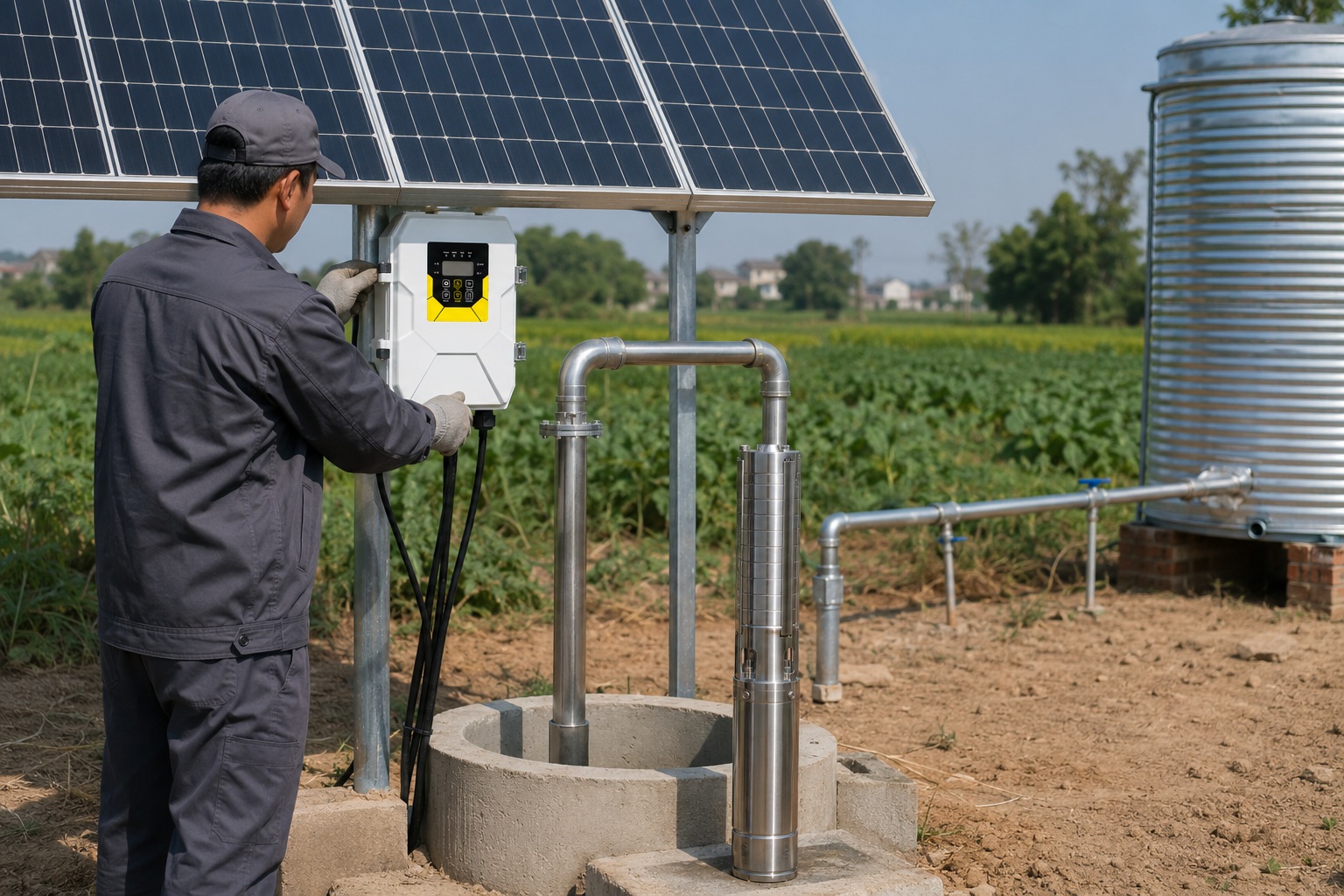
Solar water pumps have emerged as the best solution for off-grid and remote water needs.
They provide a reliable water supply powered by free, abundant solar energy, eliminating electricity bills and offering an environmentally friendly alternative that operates silently and requires minimal maintenance.
The global shift towards sustainable energy has transformed the water pump industry.
With growing demand for clean energy solutions, solar water pumps are no longer a niche product.
They have become essential equipment in regions across Africa, the Americas, Australia, and Asia.
The ability to operate entirely independent of a power grid makes them invaluable for agriculture, livestock, and domestic water supply in rural and remote areas.
Let's explore the powerful advantages that are making solar pumps the go-to choice for savvy property owners worldwide.
The Power of Grid Independence
The most compelling advantage of a solar pump is freedom.
You are no longer dependent on the utility company.
This means your water supply is immune to power outages, blackouts, or brownouts.
For farms, ranches, and remote homes, this reliability is not just a convenience; it's a necessity.
Furthermore, the cost of extending power lines to a remote well site can be astronomical, often running into tens of thousands of dollars.
A solar pump system can be installed anywhere the sun shines, for a fraction of that cost, providing a much faster return on investment.
Eco-Friendly Water Solutions
Solar pumps operate with a zero carbon footprint.
They produce no emissions and rely on a completely renewable energy source.
This aligns with a global movement towards more sustainable living and responsible resource management.
By choosing a solar pump, you are making a positive impact on the environment.
They also operate with near-silent performance, eliminating the noise pollution associated with gas or diesel-powered generators, which are often used in off-grid scenarios.
This creates a more peaceful environment for both people and livestock.
Long-Term Cost Savings Analysis
While the initial investment in a solar pump system can be higher than a conventional pump, the long-term savings are substantial.
The "fuel" is free.
Once the system is installed, your operational energy cost is zero.
Let's compare a traditional 1 HP pump with a solar equivalent.
A 1 HP pump running 6 hours a day can consume over 1,600 kWh of electricity per year.
At an average cost of $0.17 per kWh, that's nearly $275 per year, every year.
Over the 20-year lifespan of the system, that's $5,500 in electricity costs alone, not accounting for inflation or rising energy prices.
The solar pump saves you all of that money, meaning the system pays for itself in just a few years.
| Feature | Conventional Electric Pump | Solar Water Pump |
|---|---|---|
| Energy Cost | Ongoing, variable cost ($200-$500+/year) | $0 after installation |
| Grid Dependency | 100% Dependent (vulnerable to outages) | 0% Dependent (works anywhere) |
| Installation | Requires existing power line | Can be installed anywhere |
| Environmental Impact | Carbon emissions from power generation | Zero carbon emissions |
| Maintenance | Standard pump maintenance | Minimal (panels/pump) |
| ROI | Immediate expense, no return | Pays for itself in 3-7 years |
How Do You Choose the Right Solar Deep Well Pump?
You're sold on solar, but which pump is right for you?
Choosing the wrong type of solar pump for your well depth and water needs can lead to poor performance or premature failure.
You need a solution tailored to your specific application.
The right solar pump is chosen from a portfolio of options.
A screw pump is best for low flow and very deep wells.
A plastic impeller pump is ideal for high flow in general conditions.
A stainless steel impeller pump excels in corrosive water, ensuring longevity and reliability.
A one-size-fits-all approach doesn't work in the world of water pumps.
The geology of your land, the depth of your well, the quality of your water, and your daily water requirements all play a crucial role in determining the ideal pump.
A well-designed solar pump portfolio offers specialized solutions for these diverse needs.
Instead of a single "best" pump, it provides a range of tools, each perfected for a specific job.
This ensures you get the most efficient, durable, and cost-effective solution, whether you're providing water for a single home or irrigating acres of farmland.
Let's break down the three most popular and effective types of solar deep well pumps.
Solar Screw Pump: For Deep Wells and High Head
The solar screw pump is a type of progressing cavity pump.
It operates using a single helical rotor (the screw) turning inside a double helical stator (the rubber housing).
This mechanism traps and pushes "pockets" of water upward.
The key characteristic is its ability to generate very high pressure, or head, with a relatively low flow rate.
This makes it perfect for deep wells where water needs to be lifted hundreds of feet to the surface.
Its design is also inherently more resistant to sand and sediment than centrifugal pumps, making it a robust choice for wells with less-than-perfect water quality, common in parts of Africa and Latin America.
It's the go-to pump for domestic water supply and livestock watering from deep sources.
Solar Plastic Impeller Pump: For High Flow and General Use
This is a multi-stage centrifugal pump.
It uses a series of stacked impellers that spin at high speed, flinging water outwards and upwards through the pump housing.
Each stage adds more pressure, lifting the water higher.
The use of durable, engineered plastic for the impellers makes these pumps lightweight, economical, and surprisingly wear-resistant, especially against fine sand.
They are designed to deliver high flow rates at medium head, making them ideal for applications like farm irrigation, pasture water supply, and filling storage tanks quickly.
Their balance of high performance and affordability has made them widely popular for agricultural use in the Americas and Africa.
Solar Stainless Steel Impeller Pump: For Durability and Corrosive Water
This pump operates on the same centrifugal principle as the plastic impeller model, but its key components are upgraded to a higher grade of material.
Both the impellers and the pump housing are constructed from SS304 stainless steel.
This provides superior resistance to corrosion and abrasion.
It is specifically designed for challenging water environments, such as those with acidic or alkaline properties.
These conditions are found in coastal areas, regions with specific soil compositions like parts of Australia, or where water quality is a concern.
While the initial cost is higher, its exceptional durability ensures a longer service life and higher reliability in these harsh conditions, making it the premium choice for high-end homes, ranches, and critical applications.
| Pump Type | Flow Rate | Head (Lift) | Best Application | Sand Resistance | Cost |
|---|---|---|---|---|---|
| Solar Screw Pump | Low | Very High | Deep wells, domestic use, livestock | Excellent | $$ |
| Plastic Impeller Pump | High | Medium | Farm irrigation, filling tanks | Good (for fine sand) | $ |
| SS Impeller Pump | High | Medium-High | Corrosive water, high-end homes | Good | $$$ |
What Truly Drives Pump Performance and Efficiency?
You've chosen the right pump type, but what powers it?
The motor is the engine of your pump, and a weak or inefficient motor will waste energy and deliver poor performance.
It's a mistake to overlook this critical component.
The true driver of performance is an advanced Brushless DC (BLDC) permanent magnet motor paired with an intelligent controller. This combination delivers over 90% efficiency, maximizing water output from every watt of solar energy and ensuring long-term, maintenance-free reliability.
The pump itself—whether it's a screw or centrifugal design—is only half of the equation.
The motor and controller are the brain and heart of the entire system.
Their quality and technology determine the system's overall efficiency, reliability, and lifespan.
In the competitive world of solar pumps, the most significant advancements are happening in motor and control technology.
Understanding these components is key to appreciating the true value and performance difference between an average pump and a great one.
It's this core technology that reduces the number of solar panels needed, simplifies installation, and ultimately delivers more water for your money.
The BLDC Motor Advantage: More Power, Less Energy
At the core of all three leading solar pump types is the BLDC permanent magnet brushless motor.
This is a major leap forward from older, less efficient motor designs.
BLDC motors use powerful permanent magnets (often 40SH neodymium iron boron) on the rotor, eliminating the need for energy-wasting electrical windings found in traditional motors.
This design achieves operating efficiencies exceeding 90%.
A conventional AC motor might only be 60-70% efficient, meaning 30-40% of the energy is lost as heat.
This superior efficiency means a BLDC motor can do the same amount of work with significantly less power.
As a result, you need fewer solar panels to run the pump, which lowers the total system cost.
The design is also more compact and lighter—often up to 47% smaller and 39% lighter—making installation easier and less costly.
Finally, with no brushes to wear out, they are virtually maintenance-free and have a much longer service life.
Intelligent Control: Maximizing Every Drop of Sun and Power
An advanced motor needs an advanced controller.
The system is managed by an MPPT (Maximum Power Point Tracking) controller.
This intelligent device constantly adjusts the pump's electrical load to extract the maximum possible power from the solar panels as sunlight conditions change throughout the day.
It ensures the pump starts earlier in the morning, runs faster in full sun, and continues to operate longer into the evening, maximizing daily water output by up to 30% compared to a simple controller.
Furthermore, leading manufacturers have developed AC/DC hybrid controllers.
These smart devices can be connected to solar panels and an AC power source (grid or generator) simultaneously.
The controller automatically prioritizes free solar power.
If the sun isn't enough, it will seamlessly blend in AC power to maintain pump operation.
When the sun goes down, it can switch entirely to AC power, guaranteeing a worry-free, 24/7 water supply.
| Motor/Controller Feature | Impact on Performance and Value |
|---|---|
| BLDC Motor (>90% Efficiency) | Reduces solar panel requirement by 20-30%, lowering initial system cost. |
| MPPT Control | Increases daily water output by up to 30% by optimizing solar energy use. |
| Permanent Magnet Rotor | Creates higher torque for better startup in low light and handling tough loads. |
| Brushless Design | Eliminates maintenance for brushes and extends motor lifespan significantly. |
| AC/DC Hybrid Functionality | Guarantees 24/7 water supply by automatically switching between solar and grid/generator power. |
Conclusion
The best water pump is a complete system.
It combines the right pump type for your well, a high-efficiency motor, and an intelligent controller to ensure reliable, cost-effective water delivery.
Frequently Asked Questions
How long should a good water pump last?
A premium brand well pump, like a Grundfos or Franklin Electric, should last 15 to 25 years with proper installation and maintenance. Budget models may only last 8 to 12 years.
Is a more expensive water pump worth it?
Yes. A more expensive pump from a reputable brand typically offers higher efficiency, a longer lifespan, and better reliability. It saves money over time through lower energy bills and fewer repairs.
Can I use a solar pump for my whole house?
Absolutely. A properly sized solar pump system with a pressure tank and controller can provide all the water and pressure needed for a modern home, completely off-grid.
What is the most reliable type of well pump?
Submersible pumps are generally the most reliable for deep wells. They are protected from the elements and are more efficient because they push water up rather than pulling it.
What size well pump do I need for my house?
A typical 3-bedroom home requires a pump that can deliver 10-15 gallons per minute (GPM). The required horsepower (HP) depends on this flow rate and your well's depth.
How much does it cost to replace a well pump?
The cost to replace a well pump varies by depth and region. The pump itself can cost $800-$2,500, with total installed costs typically ranging from $1,500 to $4,000.
What's better, a 2-wire or 3-wire well pump?
A 3-wire pump is generally better for serviceability. It has a separate control box at the surface, making diagnostics and replacement of starting components easier and cheaper than a 2-wire pump.
Do solar pumps work on cloudy days?
Yes, but at reduced performance. They can still pump water in overcast conditions, just at a slower rate. Systems with AC/DC hybrid controllers or battery storage can provide full power anytime.