Struggling to find reliable, cost-effective water solutions for off-grid areas?
You need a pump that works anywhere, anytime.
The most effective solar pump depends entirely on the specific application. For deep wells with low flow needs, a solar screw pump is best. For high-volume farm irrigation, a plastic impeller pump is ideal. In corrosive water, a stainless steel impeller pump is the only long-term solution.
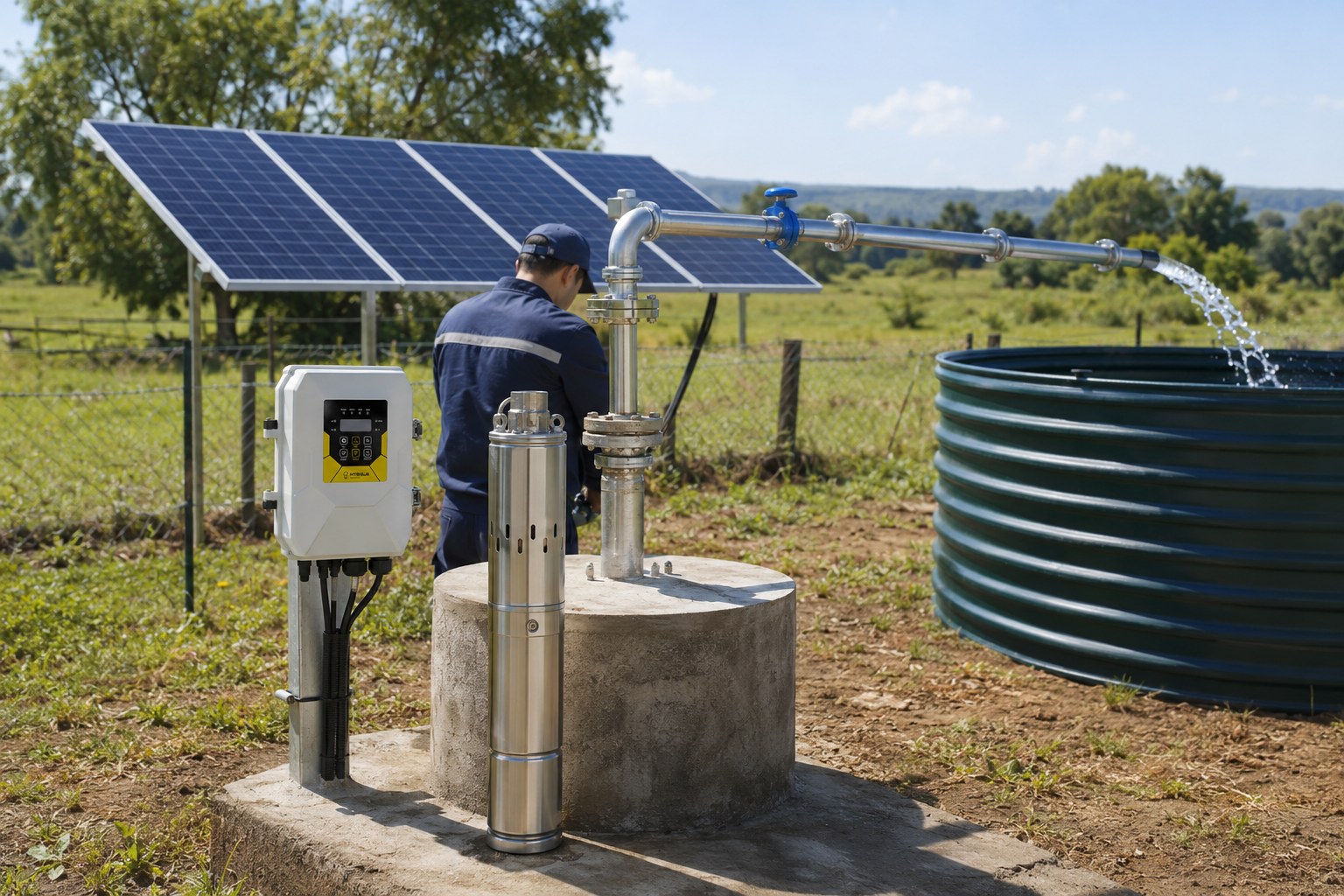
Choosing the right solar water pump isn't about finding a single "best" product.
It's about building a competitive product portfolio that meets the diverse needs of your customers, from small-scale domestic use to large-scale agriculture.
The global demand for clean energy and sustainable water solutions is soaring.
Solar water pumps are now essential in regions like Africa, the Americas, Australia, and Asia.
They offer grid independence, environmental benefits, and long-term cost savings.
Understanding the key differences between pump types, and the motor that drives them, is crucial for you as a distributor.
This guide will break down the most popular and effective solar deep well pumps to help you build a winning strategy for your market.
The Solar Screw Pump: Your High-Head Specialist
Do your customers need to lift water from extremely deep wells but find traditional pumps can't deliver the pressure?
This is a common problem in regions with low water tables.
For high-head, low-flow applications, the solar screw pump is the most effective choice. Its unique design allows it to push water from incredible depths, making it perfect for deep wells, domestic water supply, and livestock watering in remote areas.
A solar screw pump operates on the principle of a progressing cavity.
It uses a single-helix stainless steel rotor (the screw) that turns eccentrically inside a double-helix rubber stator.
This motion creates a series of sealed cavities that progress along the pump's axis, pushing the water upwards under high pressure.
This mechanism is what allows it to achieve a very high head, or vertical lift, even with a relatively low flow rate.
Key Applications and Target Markets
The unique capabilities of the solar screw pump make it ideal for specific scenarios.
- Domestic Water Supply: In rural or off-grid homes where the water source is a deep borehole, this pump can reliably supply water for daily needs.
- Livestock Drinking Water: For ranches and pastoral farms, a screw pump can lift water from deep underground to fill troughs, ensuring animals are hydrated.
- Small-Scale Irrigation: It can be used for drip irrigation systems where high pressure is needed but the overall volume of water is not massive.
These pumps are particularly valuable in electricity-scarce regions.
Markets in Africa and Latin America, where deep wells are common and grid access is unreliable, represent a significant opportunity for distributors carrying these models.
Advantages vs. Limitations
Understanding the trade-offs is key to positioning this pump correctly.
Its main advantage is the ability to handle very deep wells, often exceeding the capabilities of centrifugal pumps.
Furthermore, its design is highly resistant to sand and other abrasives in the water, giving it a longer service life in harsh water conditions compared to many other pump types.
The primary limitation is its flow rate.
It is not designed for applications requiring large volumes of water, such as flood irrigation for large farms.
| Feature | Solar Screw Pump | Multi-Stage Centrifugal Pumps |
|---|---|---|
| Optimal Use Case | Low Flow, High Head | High Flow, Medium Head |
| Max Head (Typical) | Up to 300+ meters | 50 - 150 meters |
| Flow Rate (Typical) | 0.5 - 4 m³/hour | 5 - 20 m³/hour |
| Sand Resistance | Excellent | Fair to Good |
| Best Application | Deep wells, Homes | Farm Irrigation, Ranches |
As a distributor, you can confidently recommend the solar screw pump as a tough, reliable solution for customers facing the challenge of deep water sources.
It effectively fills a critical niche in any comprehensive water pump portfolio.
The Solar Plastic Impeller Pump: The High-Flow Workhorse
Are your agricultural clients demanding ever-increasing volumes of water for their farms and pastures?
They need a pump that delivers high flow without breaking the bank.
When high water output is the priority, the solar plastic impeller pump is the most effective and economical solution. This multi-stage centrifugal pump delivers high flow at a medium head, making it the workhorse for farm irrigation and commercial water supply.
This pump uses a series of impellers and diffusers stacked on a single shaft.
As the motor spins the shaft, each impeller adds pressure to the water, pushing it through the next stage.
The use of a durable, engineered plastic for the impellers is a key design choice.
This material offers a fantastic balance of performance, wear resistance, and cost.
It's a common misconception that "plastic" means "low quality".
In this application, the high-grade polymer impellers are specifically designed to be highly resistant to abrasion from fine sand, a common issue in agricultural wells.
Key Applications and Target Markets
The high-flow characteristics of this pump make it a perfect fit for water-intensive operations.
- Farm Irrigation: This is the primary application, where the pump can supply enough water for sprinklers or flood irrigation systems covering large areas.
- Pasture Water Supply: For large ranches, these pumps can quickly fill large tanks and reservoirs to water hundreds of animals.
- Home and Community Gardens: They are also suitable for larger residential or community gardening projects that need more water than a screw pump can provide.
These pumps see widespread use in the agricultural heartlands of Africa and the Americas.
Any market with a strong agricultural sector is a prime target for a distributor looking to sell high volumes.
Advantages vs. Limitations
The benefits of the plastic impeller pump are clear.
Its primary advantage is the high volume of water it can move, often 5 to 10 times more than a screw pump of a similar power rating.
It is also lightweight and significantly more economical than its stainless steel counterparts, lowering the barrier to entry for many customers.
However, it's not the right choice for every situation.
While resistant to fine sand, it is less durable in highly corrosive water environments.
The plastic components may degrade in water with very high or low pH levels.
Its head is also generally limited to medium-depth wells, making it unsuitable for the very deep boreholes that screw pumps excel in.
| Feature | Solar Plastic Impeller Pump | Solar Stainless Steel Impeller Pump |
|---|---|---|
| Impeller Material | Engineered Polymer Plastic | SS304 Stainless Steel |
| Primary Advantage | Cost-Effective, High Flow | Corrosion Resistance, Durability |
| Sand Resistance | Excellent (for fine sand) | Good |
| Cost | $ | $$$ |
| Weight | Lighter | Heavier |
| Ideal Water | Neutral pH, moderate depth | Acidic, alkaline, or high-salinity |
For distributors, the solar plastic impeller pump is a high-volume, bread-and-butter product.
It meets the needs of the largest segment of the agricultural market, offering a powerful combination of performance and value.
The Solar Stainless Steel Impeller Pump: The Premium Durability Option
Do you have customers in areas with "bad water" that corrodes and destroys standard pumps in just a few years?
They need a solution that is built to last, no matter what's in the water.
*In corrosive or chemically aggressive water environments, the solar stainless steel impeller pump is unequivocally the most effective and reliable choice. Its full stainless steel construction offers unmatched corrosion resistance, ensuring a long service life and premium performance.
This pump operates on the same multi-stage centrifugal principle as the plastic impeller model.
The critical difference is the material.
This premium model utilizes an SS304 stainless steel impeller, diffuser, and pump body.
SS304 is a specific grade of stainless steel known for its excellent resistance to a wide range of atmospheric, chemical, and acidic or alkaline conditions.
This robust construction means the pump can operate reliably for years in water that would quickly degrade or destroy pumps made from lesser materials.
It's a long-term investment in reliability.
Key Applications and Target Markets
This pump is a problem-solver for niche but valuable markets.
- Corrosive Water Conditions: This includes water with high salinity, high acidity (low pH), or high alkalinity (high pH).
- Specific Geographical Regions: It is ideal for alkaline soil regions in Australia, parts of the Americas with unique mineral content in the groundwater, and certain coastal areas.
- High-End Applications: It is the preferred choice for high-end homes, premium ranches, and commercial operations where water supply reliability is non-negotiable and the cost of failure is high.
For a distributor, offering this pump demonstrates a commitment to quality and the ability to serve the most demanding segments of the market.
Advantages vs. Limitations
The standout advantage is its superior durability and corrosion resistance.
This translates to a much longer service life and higher reliability, reducing long-term maintenance and replacement costs for the end user.
It offers the same high-flow, medium-to-high head performance as other centrifugal pumps.
The main trade-offs are cost and weight.
The use of stainless steel makes these pumps significantly more expensive and heavier than their plastic impeller counterparts.
This higher initial cost positions them as a premium product, targeting customers who prioritize long-term value and reliability over upfront price.
| Material | Corrosion Resistance | Cost Index | Application Suitability |
|---|---|---|---|
| Engineered Plastic | Low | 1.0x | Neutral pH, low-salinity water |
| Cast Iron | Moderate | 1.5x | General use, can rust over time |
| SS304 Stainless Steel | High | 2.5x | Acidic, alkaline, or saline water |
Adding the stainless steel impeller pump to your portfolio allows you to cater to high-value customers and solve problems that your competitors cannot.
It's a mark of a truly comprehensive and professional offering.
The BLDC Motor: The High-Efficiency Heart of the System
Are your customers complaining about the high cost of solar panels needed to run their water pumps?
The pump itself is only half the story; the motor's efficiency changes everything.
The true effectiveness of any solar pump is determined by its motor. A high-efficiency Brushless DC (BLDC) permanent magnet motor is the core of a competitive system, capable of reducing solar panel requirements by up to 30% and dramatically lowering total system cost.
All three pump types—screw, plastic impeller, and stainless steel impeller—are at their best when driven by a BLDC permanent magnet motor.
Unlike older brushed motors that are inefficient and require maintenance, BLDC motors are a technological leap forward.
Their secret lies in their design.
They use powerful permanent magnets on the rotor, often made from high-grade 40SH neodymium iron boron.
Electronic controllers precisely manage the flow of electricity to the stator windings, creating a rotating magnetic field that spins the rotor with minimal energy loss.
The Technical and Market Advantages
This advanced technology offers quantifiable benefits that give distributors a powerful sales message.
- Extreme Efficiency: BLDC motors regularly achieve efficiencies exceeding 90%. Traditional AC or brushed DC motors often operate at 60-75% efficiency. This 15-30% efficiency gain is massive. It means more water is pumped for every watt of solar power generated.
- Reduced System Cost: A motor that is 30% more efficient requires roughly 30% fewer solar panels to do the same amount of work. Since solar panels are a major part of the total system cost, this provides a huge, direct cost saving for the end user.
- Compact and Powerful Design: These motors deliver higher torque in a smaller package. They are often up to 47% smaller and 39% lighter than conventional motors of the same power output. This simplifies logistics, transportation, and installation.
- Reliability and Longevity: With no brushes to wear out, BLDC motors are virtually maintenance-free. This is a critical selling point for pumps installed in remote, hard-to-reach locations. Their long service life ensures customer satisfaction and a low total cost of ownership.
The motor is the strategic core of the pump system.
A superior pump head paired with an inefficient motor results in a poor overall system.
As a distributor, emphasizing the quality and efficiency of the motor is key to differentiating your products from cheaper, less effective alternatives.
It shifts the conversation from just the pump to the performance of the entire water solution.
The Smart Controller: Maximizing Every Drop of Sunlight
What happens on a cloudy day, or at night, when your customer still needs water?
A basic solar pump system simply stops working, but a modern system adapts.
The most effective solar pump systems are made complete by an intelligent controller. An MPPT controller maximizes energy from the sun, while an AC/DC hybrid controller guarantees a 24/7 water supply by seamlessly switching to grid or generator power when needed.
The controller is the brain of the solar pumping system.
It manages the power from the solar panels and delivers it to the motor in the most efficient way possible.
Two key technologies make modern controllers incredibly effective.
Maximum Power Point Tracking (MPPT)
Solar panels have a unique operating point (a specific voltage and current) where they produce the maximum amount of power.
This "maximum power point" changes continuously throughout the day based on sunlight intensity, temperature, and shading.
An MPPT controller constantly tracks this moving target and adjusts the electrical load on the panels to ensure they are always operating at peak efficiency.
A system with an MPPT controller can harvest up to 30% more power from the same solar array compared to a system without one.
This means the pump can start earlier in the morning, run later in the evening, and perform better during overcast conditions.
AC/DC Hybrid Functionality
The biggest limitation of a DC-only solar pump is that it only works when the sun is out.
An AC/DC hybrid controller solves this problem permanently.
It's designed with inputs for both DC power from solar panels and AC power from the grid or a generator.
The controller's logic is brilliantly simple:
- Prioritize Solar: When there is sufficient sunlight, the controller automatically uses the free power from the photovoltaic panels.
- Hybrid Blending: When solar power is not enough to meet the demand (e.g., on a cloudy day), the controller can blend in AC power to make up the difference, maximizing the use of free solar energy.
- Automatic Switchover: When there is no solar input at all (e.g., at night), it automatically switches over to the AC power source.
This ensures a completely worry-free, 24-hour water supply.
For distributors, offering an AC/DC hybrid option is a massive value-add.
It transforms the solar pump from a daytime-only device into a complete, reliable, and versatile water management solution that works for any customer in any situation.
Conclusion
The most effective power pump is a complete, intelligently designed system—the right pump type, a high-efficiency motor, and a smart controller—that is perfectly matched to your customer's needs.
FAQs
How many solar panels do I need for a water pump?
This depends on the pump's power rating (in watts), the well depth, and your location's daily sunlight hours. A professional supplier can calculate the exact number for you.
Can a solar water pump work without a battery?
Yes, most modern solar pump systems are direct-drive and do not require batteries. They pump water when the sun is shining and store the water in a tank.
How deep can a solar pump pull water from?
This varies by pump type. Solar screw pumps can lift water from over 300 meters, while centrifugal pumps are typically used for depths up to 150 meters.
What is the lifespan of a solar water pump?
A quality solar pump system can last for many years. The solar panels are often warrantied for 25 years, and a brushless motor can last for over 10 years with minimal maintenance.
Can solar pumps run at night?
A standard solar pump cannot run at night. However, an AC/DC hybrid system can automatically switch to grid or generator power to ensure a 24/7 water supply.
What maintenance do solar water pumps require?
Solar pump systems are very low-maintenance. The main tasks are to periodically clean the solar panels and check the pump system for any visible issues, but the BLDC motors are maintenance-free.
What is the difference between a submersible and a surface solar pump?
A submersible pump is placed directly in the water source (like a well or borehole). A surface pump is located on land and pulls water from a shallow source like a pond or river.