Struggling to find a reliable solar water pump for your off-grid project?
You're not alone.
Choosing the wrong one can lead to costly failures and water shortages.
The best solar water pump company depends on your specific needs. Global leaders like Grundfos and Lorentz are top picks for reliability and deep wells, while Shakti Pumps dominates in markets like India with affordable solutions for agriculture. For budget-conscious projects, brands like Hober offer solid performance.
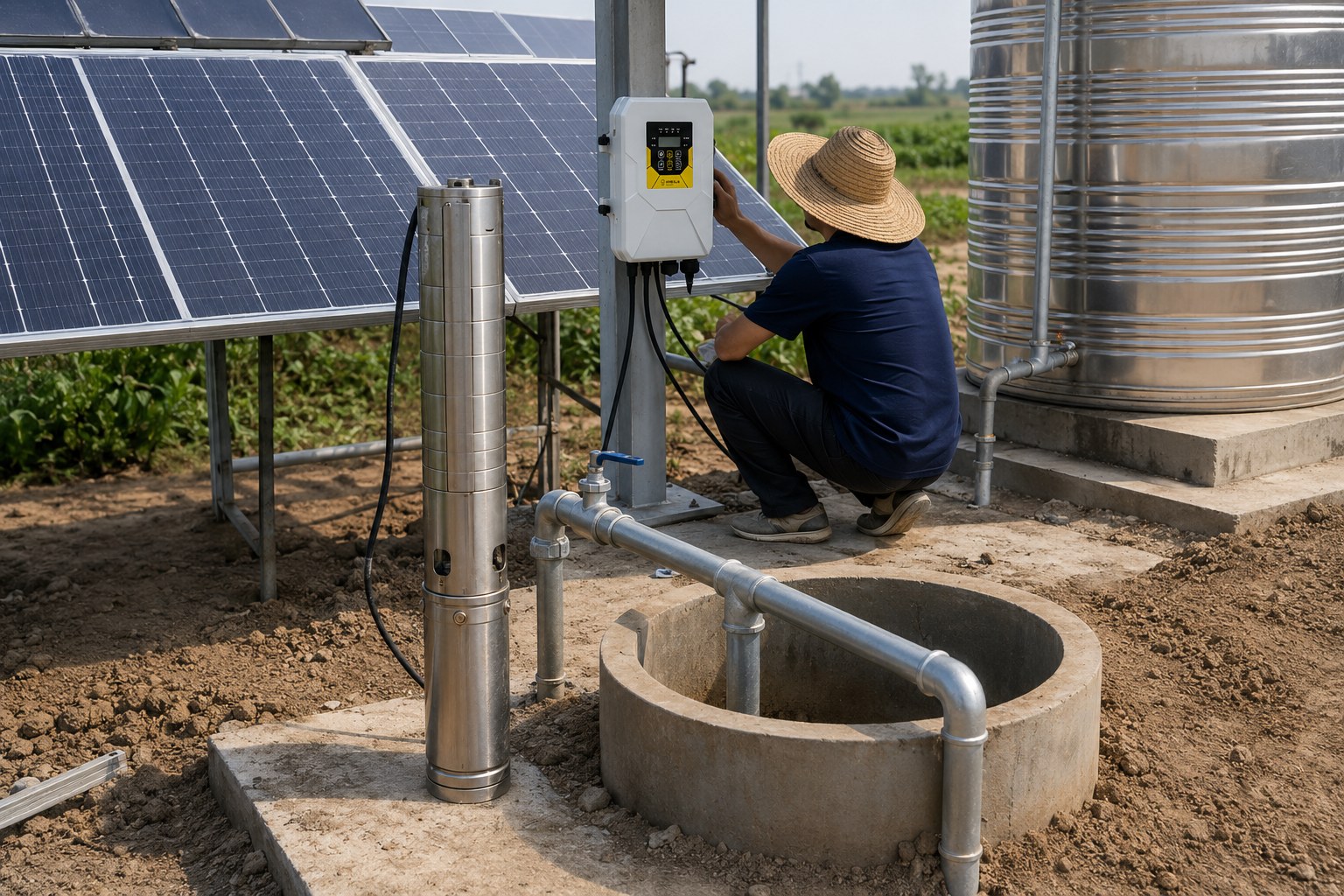
I've worked with countless solar pump systems on farms and for community projects.
I've seen the good, the bad, and the unreliable.
Choosing the right brand isn't just about the pump itself; it's about matching the technology to your water source, your budget, and your long-term goals.
Keep reading to find the perfect solar water pump solution for your project, broken down by reliability, cost, and best-use cases.
Which Company is Best for Solar Water Pumps?
Choosing a solar water pump feels overwhelming with so many options available.
I’ve seen farms struggle with poor choices that lead to crop loss and downtime.
Which brand truly delivers the best performance for your money?
For global projects, Grundfos and Lorentz are the top-tier choices, known for their exceptional engineering and longevity. RPS Solar Pumps and Franklin Electric are highly regarded in the U.S. market, particularly for agricultural use. Meanwhile, brands like Hober and Difful provide excellent value for budget-focused projects.
I’ve broken down the top brands based on reliability, cost, and suitability to help you find the perfect match.
These brands stand out for their consistent performance and strong support networks.
However, the "best" company for you will depend entirely on your project's scale, your well's depth, and your budget.
A pump that is perfect for a small ranch in Texas might not be the right fit for a deep borewell in rural Africa.
Why These Brands Stand Out
I’ve worked with solar pumps on small farms and large community projects, and reliability is everything.
You can't afford to have a pump fail when it's your only water source.
-
Grundfos: Their SQFlex series is a legend in the industry.
I've seen these pumps last over 15 years with minimal maintenance.
They are the go-to for deep borewell irrigation, effortlessly handling depths greater than 200 meters.
Their initial cost is higher, but the total cost of ownership is often lower due to their incredible durability. -
Lorentz: This German brand is synonymous with advanced solar technology.
Their systems are specifically designed for remote, off-grid areas, making them a favorite for NGOs and community water projects.
Their controllers are some of the most sophisticated on the market, maximizing water output even on cloudy days. -
RPS Solar Pumps: They have carved out a niche with user-friendly, all-in-one kits.
These are particularly popular with U.S. farmers and ranchers who prefer a DIY installation.
Their customer support is excellent, guiding users through every step of the process. -
Franklin Electric: A name trusted in the pump industry for decades, their solar offerings are built with the same focus on durability.
Their systems are robust, reliable, and found on farms across the globe.
Here’s a quick comparison to put things in perspective:
| Brand | Strength | Best For | Typical Lifespan |
|---|---|---|---|
| Grundfos | Long-lasting submersible pumps | Deep borewell irrigation | 15+ years |
| Lorentz | Advanced solar tech & controllers | Community & agricultural projects | 12-15 years |
| RPS Solar Pumps | Easy-to-install kits | U.S. farms and ranches | 10-12 years |
| Franklin Electric | Reliable, robust performance | Global agricultural use | 12-15 years |
Each of these brands brings something unique to the table.
Your final choice will hinge on your specific project requirements, location, and access to service.
What is the Most Reliable Solar Pump?
Reliability can make or break a solar pump project, especially in remote areas.
A pump failure can leave a community without drinking water or a farm without irrigation.
So, which pumps can you truly count on when it matters most?
Globally, Grundfos SQFlex and Lorentz pumps are considered the most reliable, with lifespans often exceeding 15 years. They are built for long-term, mission-critical applications. For projects with tighter budgets, Chinese manufacturers like Hober and Difful offer surprisingly durable pumps that deliver solid performance for 8-10 years.
Reliability isn’t just about how long the pump lasts; it’s also about the availability of service and spare parts.
A 20-year pump is useless if you can't get a replacement part in your country.
This is where the true cost and value proposition become clear.
Breaking Down Reliability
From my experience, the definition of "reliable" changes based on the project's needs.
Tier 1: Mission-Critical Reliability
-
Grundfos SQFlex: These pumps are my first choice for deep wells where failure is not an option.
They are built like tanks and can operate for years without intervention.
With a global service network, you can get support almost anywhere.
Their upfront cost is high, but they represent a long-term investment in water security. -
Lorentz: These systems are engineered for efficiency and resilience in off-grid settings.
Their advanced controllers can protect the pump from dry running and voltage fluctuations, significantly extending its life.
Their support network is particularly strong in Africa and Asia, regions that heavily rely on solar pumping.
Tier 2: Value-Driven Reliability
- Hober & Difful: These leading Chinese brands have changed the game for NGOs and budget-conscious distributors.
I've seen their pumps deployed in numerous rural initiatives, and they are surprisingly durable.
While they may not last 15+ years, an 8-10 year lifespan at a fraction of the cost of premium brands presents an incredible value proposition.
Their reliability comes from proven designs and large-scale manufacturing that has ironed out common failure points.
Here’s how they stack up on key reliability metrics:
| Brand | Lifespan | Service Availability | Best For |
|---|---|---|---|
| Grundfos | 15+ years | Global network | Deep wells, long-term projects |
| Lorentz | 12-15 years | Strong in remote areas | Community water systems |
| Hober | 8-10 years | Regional support networks | Budget-conscious NGO projects |
| Difful | 8-10 years | Distributor-led support | Rural initiatives, small farms |
Ultimately, the most reliable pump is one that fits your project's timeline and has accessible support.
For a multi-decade community water project, Grundfos is the clear winner.
For a 5-year agricultural aid project, a Hober pump might be the smarter financial choice.
Which Solar Water Pump is Best for Agriculture?
Farming demands specific water solutions based on crop type and water source.
I've seen farmers double their yields by choosing the right pump, and I've seen others lose crops due to a poor match.
So, which pump is truly best for agricultural needs?
For agriculture, the best pump depends on the water source. Submersible pumps from brands like Grundfos and Shakti are ideal for deep borewells. Surface pumps from RPS Solar Pumps and Franklin Electric are perfect for drawing water from rivers, ponds, or shallow wells.
The key is to match the pump technology to your farm's unique geography.
A submersible pump is designed to push water up from great depths, while a surface pump is designed to pull water from a nearby source.
Using the wrong type will lead to inefficiency, premature failure, and inadequate water for your crops.
Matching Pumps to Farming Needs
Let's dig into the specifics.
The first question I always ask a farmer is, "Where does your water come from?"
Submersible Pumps for Deep Wells
If your water is more than 8 meters (about 25 feet) below the ground, you need a submersible pump.
These are long, slender pumps designed to be lowered directly into a borewell.
- Use Case: Large-scale irrigation for field crops like corn, wheat, or alfalfa, where water needs to be lifted from deep aquifers.
- Top Brands: Grundfos, Shakti Pumps, and Lorentz are leaders here.
Grundfos excels in extreme depths, while Shakti offers an incredible balance of performance and affordability, especially with government subsidies in markets like India. - Key Metric: Total Dynamic Head (TDH). This is the total height the pump must lift the water, including the depth of the well and any elevation to the fields. A pump like the Grundfos SQFlex can handle heads over 250 meters.
Surface Pumps for Shallow Sources
If you have a river, pond, canal, or shallow well, a surface pump is the most efficient and cost-effective option.
These pumps sit on the ground and use a hose to pull water from the source.
- Use Case: Drip irrigation for vegetable gardens, watering small pastures, or moving water from a holding tank to the fields.
- Top Brands: RPS Solar Pumps and Franklin Electric offer excellent surface pump kits.
They are easier to install and maintain than submersible pumps because all components are accessible above ground. - Key Metric: Suction Lift. A surface pump can typically only "suck" water up from a maximum depth of about 7-8 meters due to atmospheric pressure.
Here's a simple guide to help you decide:
| Pump Type | Best Brands | Water Source | Best Use Case |
|---|---|---|---|
| Submersible | Grundfos, Shakti, Lorentz | Deep borewells (>8m deep) | Large-scale field irrigation |
| Surface | RPS, Franklin Electric | Rivers, ponds, shallow wells | Small farms, drip irrigation |
Choosing the right type of pump is the most critical decision for any agricultural solar water project.
It directly impacts water availability, energy consumption, and the long-term profitability of your farm.
A Closer Look at Pump Types: The Core Technology
Beyond brand names, the real performance of a solar pump comes from its core technology.
Understanding the different pump mechanisms is crucial for distributors and end-users to select the right product.
This is where you can find a competitive edge.
The three most effective solar deep well pump technologies are screw pumps, plastic impeller centrifugal pumps, and stainless steel impeller centrifugal pumps. Each is designed for a specific combination of flow rate, pressure (head), and water conditions, offering a complete portfolio for diverse market needs.
As someone who works with pump design, I can tell you that the choice between these types is fundamental.
It's not about which is "better" overall, but which is precisely engineered for the job at hand.
A screw pump in a high-flow application will fail to deliver, just as a centrifugal pump might struggle in a very deep, sandy well.
Solar Screw Pump: Low Flow, High Head
- How it Works: This is a progressing cavity pump.
It uses a single helical stainless steel rotor spinning inside a rubber stator.
As it rotates, it creates sealed cavities that "push" water upwards.
This mechanism is incredibly effective at creating high pressure. - Performance: They are the undisputed champions of high head.
I've seen these pumps efficiently lift water from wells over 200 meters deep.
However, their flow rate is comparatively low, typically in the range of 1-5 cubic meters per hour. - Best Applications: Domestic water supply for off-grid homes, livestock drinking water in remote pastures, and small-scale, high-lift irrigation.
They are ideal for the deep, narrow borewells often found in parts of Africa and Latin America. - Key Advantage: Excellent sand resistance.
The gentle pushing action is less susceptible to abrasion from sand and grit compared to high-speed impellers, giving them a durability advantage of up to 30% in sandy conditions.
Solar Plastic Impeller Pump: High Flow, Wear-Resistant
- How it Works: This is a multi-stage centrifugal pump.
It uses a series of stacked impellers that spin at high speed.
Each stage adds pressure, and the design allows for a much higher volume of water to pass through.
The use of engineered plastic for the impellers makes them lightweight and highly resistant to abrasion from fine sand. - Performance: These are the workhorses for agriculture.
They deliver high flow rates—often exceeding 20 cubic meters per hour—at medium heads (up to 100-150 meters). - Best Applications: Farm irrigation, filling large water storage tanks, and pasture water supply for large herds.
Their balance of cost and performance makes them popular in agricultural regions of the Americas and Africa. - Key Advantage: High flow and cost-effectiveness.
The plastic impeller design provides about 80% of the performance of a stainless steel version but at roughly 60% of the cost, making it perfect for large-scale projects.
Solar Stainless Steel Impeller Pump: Premium and Corrosion-Resistant
- How it Works: Functionally identical to the plastic impeller pump, but every component in contact with water—the impellers, diffusers, and pump body—is made from SS304 or SS316 stainless steel.
- Performance: High flow rates and medium-to-high head capabilities, similar to the plastic version, but with unparalleled durability.
- Best Applications: Corrosive water environments, such as areas with acidic or alkaline water.
This is critical for regions with specific geological conditions, like the alkaline soils in parts of Australia or coastal areas with saltwater intrusion risk.
They are also the choice for high-end homes and commercial operations where water quality and system longevity are paramount. - Key Advantage: Corrosion resistance and long service life.
In water with a pH outside the 6.5-8.5 range, a stainless steel pump can last 3-5 times longer than a plastic or cast iron equivalent.
| Pump Type | Best For | Flow Rate | Head (Pressure) | Sand Resistance |
|---|---|---|---|---|
| Screw Pump | Deep wells, Homes | Low | Very High | Excellent |
| Plastic Impeller | Farm Irrigation | High | Medium | Very Good |
| Stainless Steel Impeller | Corrosive Water | High | Medium-High | Good |
The Engine Behind the Pump: Why BLDC Motors Dominate
A pump is only as good as its motor.
In the world of solar pumps, one technology has completely changed the game: the Brushless DC (BLDC) permanent magnet motor.
It is the core of modern pump efficiency.
High-efficiency BLDC permanent magnet motors are the driving force behind the best solar pumps, boasting efficiencies over 90%. This core technology dramatically reduces energy consumption, allowing pumps to run on fewer solar panels, lowering overall system cost and simplifying installation.
For a distributor like my typical customer, Andrew in Australia, understanding this is key.
When he's comparing two pumps with similar flow rates, the one with the superior motor is the better long-term investment for his clients.
It's not just a component; it's the heart of the system's value proposition.
The Technical Advantage of BLDC Motors
Why are these motors so superior to older DC or AC motor technologies for solar applications?
-
Extreme Efficiency: Traditional motors might operate at 60-70% efficiency.
A high-quality BLDC motor, using powerful neodymium iron boron permanent magnets, can exceed 92% efficiency.
This means more of the precious solar energy is converted into water pumping and less is wasted as heat. -
Compact and Lightweight: The efficient design means the motor can be much smaller.
Compared to an equivalent AC motor, a BLDC motor can be up to 47% smaller and 39% lighter.
This makes installation far easier, especially when lowering a pump hundreds of feet into a well.
A lighter pump requires less manpower and equipment to install, a direct cost saving. -
High Torque and Wide Speed Range: BLDC motors provide consistent torque across a wide range of speeds.
This allows the pump's controller to precisely match the motor speed to the available sunlight, starting earlier in the morning and running later in the evening, maximizing daily water output by up to 25%. -
Maintenance-Free and Long Life: As the name "brushless" implies, there are no brushes to wear out.
This eliminates the most common failure point in traditional DC motors, leading to a maintenance-free design with a lifespan that can exceed 20,000 hours of operation.
The Market Value of BLDC Technology
For end-users and distributors, these technical advantages translate directly into financial benefits.
| Feature | Technical Advantage | Customer Benefit |
|---|---|---|
| >90% Efficiency | Less energy wasted | Reduces solar panel requirement by 15-20%; lowers initial cost. |
| Compact/Lightweight | Up to 47% smaller | Easier, cheaper, and safer installation. |
| Wide Speed Range | Tracks solar power optimally | More water pumped per day; better performance in low light. |
| Brushless Design | No wearing parts | Zero maintenance; long service life and higher reliability. |
The strategic role of the motor cannot be overstated.
It is the single greatest determinant of the overall efficiency and long-term competitiveness of a solar water pump system.
When you choose a pump, you're not just buying steel or plastic; you're buying the performance of its motor.
Maximizing Uptime: The Role of Intelligent Controllers
A great pump and an efficient motor are two parts of the puzzle.
The third, and equally crucial, part is the brain of the operation: the pump controller.
It's what unlocks the full potential of the system and protects your investment.
Modern solar pumps use intelligent MPPT (Maximum Power Point Tracking) controllers to maximize solar energy utilization by up to 30%. The most advanced controllers also offer hybrid AC/DC functionality, ensuring a 24/7 water supply by automatically switching to grid or generator power during cloudy days or at night.
For a customer who needs water around the clock, this isn't a luxury; it's a necessity.
Standard solar pumps stop when the sun goes down.
This is a major limitation for households, critical livestock operations, or any application that cannot tolerate interruptions.
The solution is an intelligent, hybrid power system.
How Intelligent Controllers Work
At its core, a solar pump controller does two things: it optimizes power and protects the pump.
-
MPPT - Maximum Power Point Tracking: This is the magic behind modern solar efficiency.
The controller constantly adjusts the electrical load on the solar panels to find the "sweet spot" where they produce the absolute maximum amount of power.
Compared to a simple direct connection, MPPT can boost the amount of water pumped per day by 20-30%, especially during periods of low or changing light. -
Pump Protection: The controller is also the pump's bodyguard.
It monitors for dangerous conditions and will shut the pump down to prevent damage.
Key protections include:- Dry Run Protection: Senses if the well runs out of water and stops the motor from burning out.
- Over/Under Voltage Protection: Protects the motor from unstable power from the solar array.
- Overload Protection: Prevents the motor from being damaged if it gets jammed or overworked.
The AC/DC Hybrid Advantage
This is where the most advanced controllers truly shine.
A hybrid controller has two power inputs: one for DC power from the solar panels and one for AC power from the grid or a generator.
-
Automatic Switching: The controller is smart enough to prioritize free solar energy.
When sunlight is sufficient, it powers the pump using 100% solar. -
Hybrid Boosting: If it's a partly cloudy day and the solar power isn't quite enough to run the pump at the desired speed, the controller can blend in just enough AC power to make up the difference, maximizing the use of every available watt of solar.
-
Seamless Takeover: When the sun sets or during extended periods of bad weather, the controller automatically switches over to the AC power source.
The pump continues to run without any interruption.
This hybrid functionality completely transforms a solar pump from a daytime-only device into a 24/7, ultra-reliable water solution.
It provides the best of both worlds: the cost-free, eco-friendly operation of solar, backed by the absolute dependability of grid power.
For anyone in an off-grid or rural area, this guarantees worry-free water use, day and night.
Conclusion
Choosing the best solar pump means looking beyond the brand name.
It requires matching the right pump technology—screw or impeller—and motor efficiency to your specific water needs and environment.
FAQs
Q. How deep will a solar water pump work?
A solar pump's depth capability depends on its type.
Screw pumps can work in very deep wells, often exceeding 200 meters (650 feet), while centrifugal pumps are typically used for wells up to 150 meters.
Q. How much do solar pumps cost?
Costs vary widely, from a few hundred dollars for small surface pumps to over $5,000 for high-capacity deep well systems.
The final price depends on the pump, motor, controller, and the number of solar panels required.
Q. How do I install a solar-powered pump?
Installation involves placing the solar panels, mounting the controller, and lowering the pump into the well or water source.
While some smaller kits are DIY-friendly, deep well submersible pumps often require professional installation.
Q. Do solar pumps work on cloudy days?
Yes, but at reduced performance.
Systems with MPPT controllers can still produce water in low light.
For continuous operation, a hybrid AC/DC controller that can switch to grid or generator power is the best solution.
Q. How long do solar water pumps last?
A quality solar pump system can last for many years.
The solar panels are typically warranted for 25 years, a brushless motor can last 10-15 years, and the pump itself can last 8-15 years depending on water conditions.
Q. What maintenance does a solar water pump require?
The system is very low-maintenance.
You should clean the solar panels periodically.
Brushless motors require no maintenance, and the pump itself only needs occasional checks depending on the manufacturer's recommendations.
Q. Can a solar pump fill a large tank?
Absolutely.
Many systems are designed to pump water to a storage tank during the day.
The stored water can then be used anytime via gravity, providing a reliable water supply 24/7.