Struggling with unreliable water access in off-grid areas?
The thought of complex pump maintenance can be daunting.
But the right solar pump system nearly eliminates these worries entirely.
Solar pumps require very little maintenance.
The most common tasks are cleaning the solar panels and checking electrical connections.
More importantly, choosing the correct pump type for your specific water conditions is the best way to prevent future repairs and ensure a long service life.
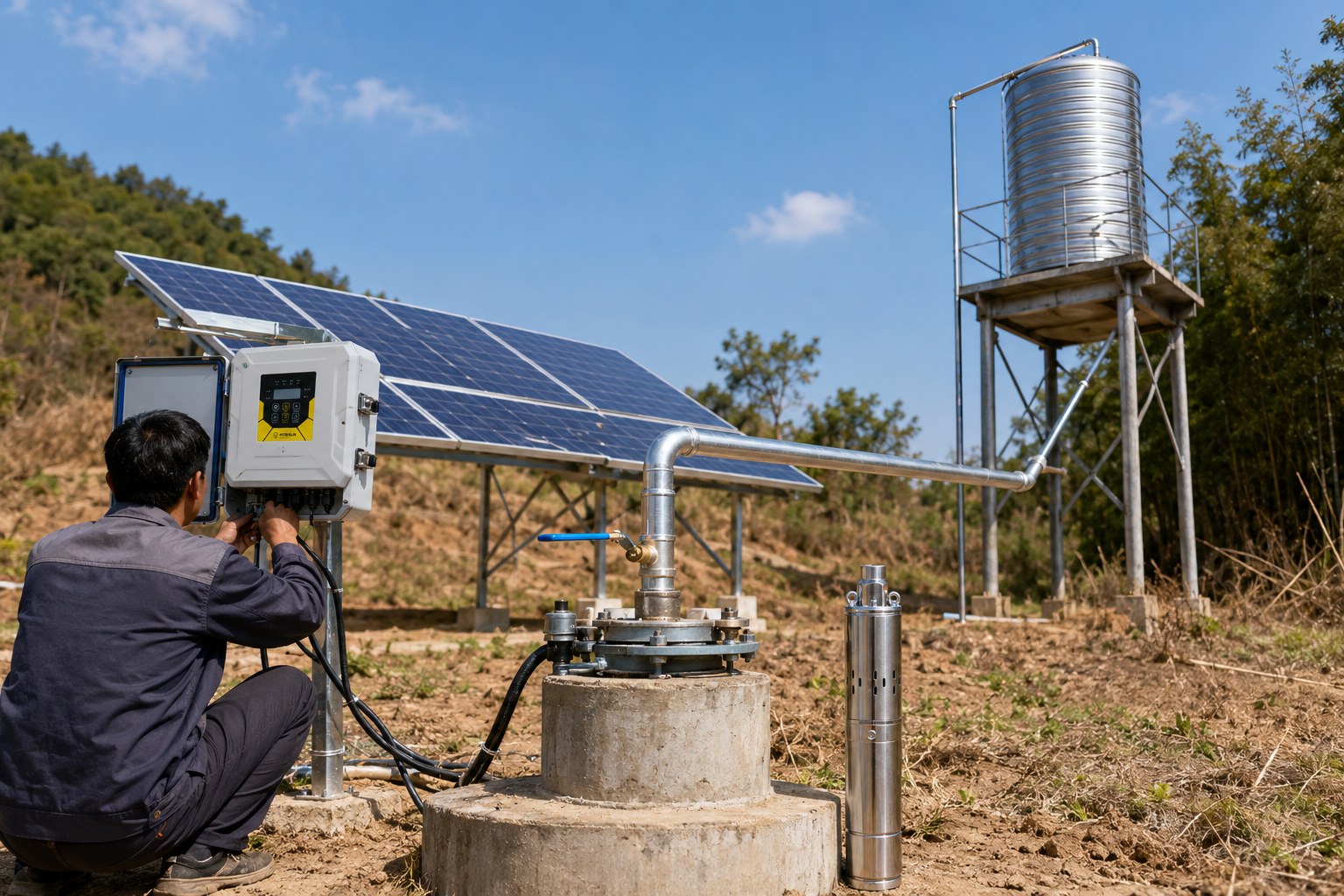
By understanding the different types of solar pumps and their core components, you can see why they are known for their reliability and ease of ownership.
It's less about constant repairs and more about a smart initial investment.
Let's explore how selecting the right pump for your needs is the first and most critical step in creating a low-maintenance water solution.
This guide will break down the options, helping you make an informed choice that saves you time, money, and effort for years to come.
The Role of Solar Screw Pumps in Low-Maintenance Operations
Do you need to lift water from a very deep well?
Are you worried that sand and sediment will quickly destroy your pump?
A solar screw pump offers a robust solution designed for exactly these tough conditions.
A solar screw pump is exceptionally low-maintenance, especially in wells with high sand content.
Its unique design, which uses a rotating screw, is highly resistant to abrasion.
This inherent durability means far fewer clogs and significantly less internal wear over its lifespan.
A solar screw pump's durability comes from its clever design.
It doesn't use impellers, which can wear down or clog with debris.
Instead, it features a single stainless steel helical rotor (the screw) that turns inside a rubber stator.
As the screw rotates, it creates sealed cavities of water that are pushed progressively up towards the outlet.
This gentle "pushing" action is much less susceptible to damage from abrasive particles than the high-speed spinning of a centrifugal pump.
How This Design Reduces Maintenance
The primary advantage is its exceptional sand resistance.
While a standard pump might fail after just a few months in sandy water, a screw pump is built to handle it.
The rubber stator provides a tight seal but also has enough flexibility to allow small particles to pass through without causing catastrophic damage.
This makes it the ideal choice for new or unstable wells in regions like Africa and Latin America, where water quality can be unpredictable.
Matching the Pump to the Job for Maximum Lifespan
These pumps excel at producing high pressure, or "head."
This means they can push water up from very deep wells, often exceeding 200 meters.
However, they are designed for low flow rates, typically in the range of 1 to 5 cubic meters per hour.
This makes them perfect for domestic water supply, filling livestock troughs, or small-scale drip irrigation.
Using a screw pump for a high-flow application like flood irrigation would be inefficient and could lead to premature wear, defeating its low-maintenance purpose.
Maintenance and Performance Comparison
| Feature | Solar Screw Pump | Standard Centrifugal Pump | Maintenance Implication |
|---|---|---|---|
| Sand Handling | Excellent | Poor to Fair | Screw pumps last significantly longer in sandy water, reducing replacement frequency by up to 80%. |
| Primary Application | High Head, Low Flow | Low Head, High Flow | Using the wrong pump leads to inefficiency and strain, increasing maintenance needs. |
| Key Wear Parts | Rubber Stator | Impellers, Diffusers | Stators are designed for long life with abrasives; impellers are not and wear quickly. |
| Maintenance Need | Very Low | Moderate to High | Fewer internal parts and a robust design mean minimal scheduled maintenance for screw pumps. |
Choosing a solar screw pump for the right environment is a proactive maintenance decision.
It ensures you have a reliable water source for years with minimal intervention.
Understanding the Maintenance Needs of Plastic Impeller Pumps
Do you need to move large volumes of water for your farm or garden?
Is keeping the initial investment low a top priority for you?
A solar plastic impeller pump is a cost-effective choice, but it's important to understand its specific characteristics.
These pumps require some monitoring, especially in water containing fine sand.
The engineered plastic impellers are designed to be wear-resistant.
However, over time, they may need inspection or replacement to maintain peak flow and efficiency, especially in abrasive conditions.
Solar plastic impeller pumps are a type of multi-stage centrifugal pump.
This means they have a series of impellers and diffusers stacked together.
Each stage adds more pressure, allowing the pump to move water more effectively than a single-impeller pump.
Their main strength is delivering a high flow of water at a medium head, making them perfect for agricultural irrigation and large-scale water transfer in places like the Americas and Africa.
The Trade-off: High Flow vs. Durability
The key to this pump's performance is its plastic impeller.
These components are lightweight and economical to produce, which keeps the overall cost of the pump down.
Modern engineering plastics offer excellent resistance to wear from fine sand.
They are a significant improvement over older, simpler pump designs.
However, they are not invincible.
In environments with highly abrasive particles or corrosive water, their lifespan will be shorter than that of a metal pump.
The advantage is that replacing a plastic impeller stack is often simpler and more affordable than servicing a heavier, all-metal pump.
Proactive Maintenance for a Longer Life
The maintenance for this pump is about awareness of its limitations.
- Monitor Performance: A noticeable drop in water flow or pressure is the first sign of impeller wear. This indicates it might be time for an inspection.
- Avoid Harsh Conditions: These pumps are not recommended for deep wells with very high head requirements or for water that is acidic or highly alkaline. Using them in such conditions will accelerate wear and lead to frequent maintenance.
- Consider a Pre-filter: If your water source has a lot of sediment, installing a simple pre-filter or intake screen can dramatically extend the life of the impellers.
Cost and Durability Comparison
| Feature | Plastic Impeller Pump | Stainless Steel Impeller Pump | Maintenance Implication |
|---|---|---|---|
| Initial Cost | Low | High | Plastic offers a lower entry cost, but may have higher long-term costs in harsh conditions. |
| Weight | Light | Heavy | Lighter weight makes installation and service easier and less costly. |
| Corrosion Resistance | Fair | Excellent | Plastic is not suitable for acidic water, leading to rapid failure and replacement. |
| Wear in Fine Sand | Good | Excellent | Plastic provides good value, but stainless steel offers up to 2-3 times the lifespan in abrasive water. |
A plastic impeller pump is a fantastic, low-maintenance choice for the right application—specifically, high-flow irrigation with relatively clean water.
Understanding its operational limits is the key to enjoying its economic benefits.
Why Stainless Steel Impeller Pumps Are a Premium, Low-Maintenance Choice
Is your local water supply acidic, alkaline, or slightly corrosive?
Are you tired of replacing equipment that can't handle your water quality?
A stainless steel impeller pump is a long-term investment in durability and peace of mind.
Pumps with stainless steel impellers require the least maintenance in challenging water environments.
The SS304 stainless steel construction provides superior resistance to both corrosion and abrasion.
This robust build ensures an exceptionally long service life with very few required interventions.
This pump is the premium option in the solar deep well pump portfolio.
Its entire "wet end"—the pump body, impellers, and diffusers—is constructed from SS304 grade stainless steel.
This material is specifically chosen for its ability to withstand chemical corrosion from acidic or alkaline water.
This is a common issue in the alkaline soil regions of Australia and in certain agricultural areas of the Americas.
While a plastic or cast iron pump would degrade quickly, a stainless steel pump thrives.
The Total Cost of Ownership Advantage
While the initial purchase price of a stainless steel pump is higher, its total cost of ownership is often much lower in the right application.
Consider a scenario with slightly acidic water:
- A plastic impeller pump might cost 30% less upfront but may need to be replaced every 3-4 years.
- A stainless steel impeller pump has a higher initial cost but can easily last 10-15 years or more in the same conditions.
Over a decade, the stainless steel pump proves to be the more economical choice, saving you the cost and hassle of multiple replacements.
This high reliability is why they are chosen for high-end homes, critical livestock operations, and valuable agricultural ventures.
Maintenance: Built to Be Forgotten
The primary maintenance advantage is its inherent toughness.
- Corrosion Resistance: It eliminates the worry of pump degradation due to water chemistry.
- Abrasion Resistance: Stainless steel is harder than plastic, offering better resistance to wear from sand and silt, which maintains pump efficiency for longer.
Even with this durability, simple checks of electrical connections and monitoring output are wise.
However, the need for internal service due to wear or corrosion is dramatically reduced.
Application and Maintenance Guide
| Water Condition | Recommended Pump | Expected Maintenance Level | Rationale |
|---|---|---|---|
| Deep & Sandy | Solar Screw Pump | Very Low | Design is optimized for abrasives and high head. |
| High Flow & Clean | Plastic Impeller Pump | Low | Economical and efficient for non-corrosive, high-volume needs. |
| Corrosive / Alkaline | Stainless Steel Impeller | Very Low | Material is specifically chosen to resist chemical degradation and wear. |
For those with challenging water, a stainless steel impeller pump isn't a luxury.
It is the most logical and cost-effective choice for a truly low-maintenance, long-term water solution.
The Heart of the System: The Maintenance-Free BLDC Motor
The pump itself handles the water, but the motor is the engine that drives everything.
What if the most critical, hard-working part of your system required virtually no maintenance at all?
This is the reality with modern Brushless DC (BLDC) motors.
The BLDC permanent magnet motor used in modern solar pumps is designed to be maintenance-free.
Its brushless technology eliminates the most common point of failure in traditional motors: the brushes.
This single innovation is a primary reason for the system's outstanding long-term reliability.
At the core of all three pump types—screw, plastic impeller, and stainless steel impeller—is a high-efficiency BLDC permanent magnet motor.
This is not just an incremental improvement; it's a technological leap forward.
Traditional DC motors use carbon brushes to transfer power to the rotor.
These brushes physically rub against the commutator, creating friction, heat, and dust.
They are a wear-and-tear item that must be inspected and replaced periodically.
The "Brushless" Maintenance Revolution
A BLDC motor works differently.
It uses an electronic controller to switch the direction of the magnetic field, causing the rotor to spin.
There are no physical brushes.
This has profound implications for maintenance:
- No Parts to Replace: The most common failure point is completely eliminated.
- Increased Lifespan: With no friction from brushes, the motor's lifespan is limited only by its high-quality bearings, often lasting over a decade.
- Higher Reliability: Fewer moving parts means fewer things can go wrong.
How High Efficiency Reduces Wear and Tear
These motors boast efficiencies exceeding 90%.
A traditional motor might only be 60-75% efficient.
This extra efficiency means that more of the sun's energy is converted into pumping power, not wasted as heat.
A motor that runs cooler is under less thermal stress.
Less stress on components like windings and magnets leads to a longer, more reliable operational life.
This efficiency also has a direct financial benefit. A 90% efficient motor requires fewer solar panels to do the same amount of work as a 75% efficient motor, reducing the total system cost by 15-20%.
Advanced Design for a Smaller, Lighter System
These motors are also impressively compact.
By using powerful 40SH neodymium iron boron permanent magnets, they generate high torque in a small package.
Compared to older motor designs, a modern BLDC motor can be up to 47% smaller and 39% lighter.
This doesn't just make shipping cheaper.
It makes installation and any potential servicing of the pump end much easier, as the entire unit is less bulky and heavy to handle.
| Feature | BLDC Motor | Traditional Brushed Motor | Maintenance Implication |
|---|---|---|---|
| Maintenance | None (Brushless) | Regular Brush Replacement | Eliminates the number one service requirement of DC motors. |
| Efficiency | >90% | 60-75% | Runs cooler, reducing wear and lowering solar panel costs. |
| Lifespan | Very Long (10+ years) | Medium (3-5 years) | Significantly reduces the likelihood of costly motor replacement. |
| Size / Weight | Compact / Light | Bulky / Heavy | Simplifies system installation and handling. |
The BLDC motor is the unsung hero of the low-maintenance solar pump.
It provides the reliable, efficient, and long-lasting power that makes the entire system a "set and forget" solution.
Advanced Controllers: Smart Maintenance and 24/7 Operation
What if your pump system could protect itself from damage and even run on cloudy days?
Modern controllers act as the brain of the system.
They make operation simpler and provide a layer of automated, preventative maintenance.
Smart controllers with MPPT technology maximize solar energy use, which reduces strain on the motor.
They also offer protective features like dry-run prevention.
Advanced hybrid AC/DC models even allow for 24/7 operation by automatically switching power sources
The controller is a vital component that sits between the solar panels and the pump motor.
Its job is to manage the power, but its role in system longevity and maintenance is often underestimated.
A high-quality controller performs several tasks that actively protect your investment.
How MPPT Acts as Automated Maintenance
MPPT stands for Maximum Power Point Tracking.
In simple terms, it constantly adjusts the electrical load to extract the absolute maximum amount of power available from the solar panels, no matter the conditions.
On a bright, sunny day, this is less critical.
But in the early morning, late evening, or on an overcast day, it's a game-changer.
It ensures the motor receives stable, optimized power.
This prevents the motor from stalling or running inefficiently in low light, which can cause excess heat and strain on the windings.
MPPT is a form of continuous, electronic maintenance that reduces wear on the motor.
The Ultimate Convenience: The AC/DC Hybrid Controller
A major limitation of traditional solar pumps is that they only work when the sun is shining.
This can be a significant "maintenance" headache if you need water at night or during extended cloudy periods.
The solution is a hybrid AC/DC controller.
This innovative device has inputs for both DC power from solar panels and AC power from the grid or a generator.
It is designed to be fully automatic:
- Solar Priority: When there is sufficient sunlight, the controller powers the pump exclusively with free solar energy.
- Hybrid Function: If solar power drops (e.g., due to a passing cloud), it intelligently blends in just enough AC power to keep the pump running at the desired speed, maximizing the use of solar energy.
- Automatic Switchover: When there is no solar input at all (e.g., at night), it seamlessly switches to the AC power source.
This ensures you have a worry-free water supply 24 hours a day without ever having to flip a switch.
Protective Features That Prevent Costly Repairs
Modern controllers also include a suite of protective functions that prevent the most common causes of pump failure.
| Controller Feature | How It Prevents Maintenance |
|---|---|
| Dry-Run Protection | A sensor detects if the well has run dry and shuts off the pump, preventing it from overheating and destroying itself. |
| Over-Voltage Protection | Protects the motor from voltage spikes from the solar array, safeguarding the electronics. |
| Fault Diagnostics | Error codes on the display help you quickly identify a problem (e.g., low water, voltage issue), simplifying troubleshooting. |
The controller isn't just an on/off switch.
It's a sophisticated management system that optimizes performance, protects the pump and motor, and provides unparalleled convenience, all of which contribute to a lower-maintenance experience.
Conclusion
The best maintenance strategy is prevention.
Choosing the right pump, powered by an efficient BLDC motor and a smart controller, is key to a reliable, long-lasting, and worry-free water solution.
FAQs
How often should I clean my solar panels for a water pump?
Clean your panels 2 to 4 times a year, or whenever they are visibly dirty. Dust and debris can reduce power output by over 20%.
Can a solar pump run without a battery?
Yes, most modern solar pump systems are designed to run directly from solar panels during the day, which simplifies the system and reduces maintenance.
How long do solar water pumps last?
A quality solar pump can last 10-15 years or more. The BLDC motor often has a very long lifespan, with the pump end being the main serviceable part.
What happens to a solar pump on cloudy days?
Output will be reduced. However, systems with MPPT controllers can still pump water effectively in light overcast conditions. Hybrid controllers can supplement with AC power.
Do solar pumps work at night?
Not with solar power alone. To run at night, you need a system with batteries or a hybrid AC/DC controller connected to the grid or a generator.
How deep can a solar pump go?
This depends on the pump type. Solar screw pumps are designed for high head and can pump from depths of 200 meters (over 650 feet) or more.
Is a solar water pump worth it?
Yes, for off-grid locations, they are highly cost-effective. They have no fuel costs, require minimal maintenance, and provide energy independence for your water supply.
Can solar pumps handle sandy water?
Yes, specifically solar screw pumps. Their design uses a rotor and stator that is highly resistant to abrasion from sand, making them ideal for new or sandy wells.