Struggling with low water pressure and thinking a bigger pump is the only answer?
That powerful upgrade might be costing you more than just the purchase price.
The better pump isn't about horsepower; it's about matching the pump's flow rate and pressure to your specific needs.
A well-chosen 1 HP pump is often more efficient and cost-effective than an oversized 1.5 HP pump for many common residential, agricultural, and pool applications.
Choosing a water pump can feel overwhelming.
Many people fall into the trap of thinking "bigger is better."
They assume a 1.5 HP pump will automatically solve their water pressure problems better than a 1 HP model.
However, this focus on horsepower is a common and costly mistake.
The truth is, the right pump is the one that is perfectly balanced for your unique system.
It's about finding the sweet spot of performance, efficiency, and longevity.
Let's dive into why looking beyond horsepower will help you select the perfect pump and save you money in the long run.
Why Horsepower is a Misleading Metric
Confused by pump ratings and technical jargon?
Choosing a pump based on horsepower alone often leads to poor performance, high energy bills, and premature failure.
Horsepower only measures the motor's power consumption, not its water-moving capability.
Two pumps with the exact same 1 HP rating can have vastly different flow rates and pressure outputs due to their internal hydraulic design.
To truly understand why horsepower is a flawed primary metric, we need to look deeper into what a pump is designed to do.
A pump's job is to move a certain volume of water (flow) against a certain amount of resistance (pressure or head).
Horsepower is simply the energy input required to do that work.
The efficiency of the pump's hydraulic design—the shape and size of its impellers—determines how effectively that input energy is converted into water movement.
A poorly designed, inefficient pump might require 1.5 HP to do the same work that a highly efficient, well-designed pump can achieve with only 1 HP.
Focusing only on the HP rating is like judging a car's performance solely by its engine size, ignoring its transmission, aerodynamics, and weight.
What is Horsepower Really Measuring?
Horsepower (HP) is a unit of power.
It quantifies the rate at which a motor can perform work.
In the context of a water pump, it tells you the power consumption of the electric motor attached to the pump.
It does not, however, tell you anything about the pump's hydraulic performance.
The actual output—the combination of flow and pressure—is determined by the pump end, which includes the volute (casing) and the impeller.
A more efficient pump end can produce more flow and pressure using the same amount of horsepower, resulting in lower energy costs.
The Tale of Two Pumps: A Practical Comparison
Let's consider a real-world scenario.
Imagine you are looking at two different 1 HP submersible well pumps.
One is a "High-Head" model, and the other is a "High-Flow" model.
They both use a 1 HP motor, but their performance is radically different.
| Pump Model | Horsepower (HP) | Max Flow (GPM) | Max Head (Feet) | Best Application |
|---|---|---|---|---|
| 1 HP High-Head | 1 | 15 GPM | 350 ft | Deep wells, high-elevation pumping |
| 1 HP High-Flow | 1 | 30 GPM | 175 ft | Shallow wells, irrigation, high-volume transfer |
As the table shows, if you need to pump water from a 300-foot-deep well, the "High-Flow" model would fail completely, as it can't generate enough pressure.
Conversely, if you need 30 GPM for an irrigation system from a shallow well, the "High-Head" model would provide insufficient flow and operate inefficiently.
Both are 1 HP, but only one is right for each job.
How Impeller Design Changes Everything
The impeller is the heart of a centrifugal pump.
It's a rotating component with vanes that grabs the water and flings it outward using centrifugal force.
The design of the impeller dictates the pump's performance curve.
- High-Head Impellers: These typically have a larger diameter and narrower passages. They are designed to increase the velocity of the water more significantly, which translates into higher pressure (head).
- High-Flow Impellers: These have wider passages and are designed to move a larger volume of water with each rotation, prioritizing flow rate over pressure.
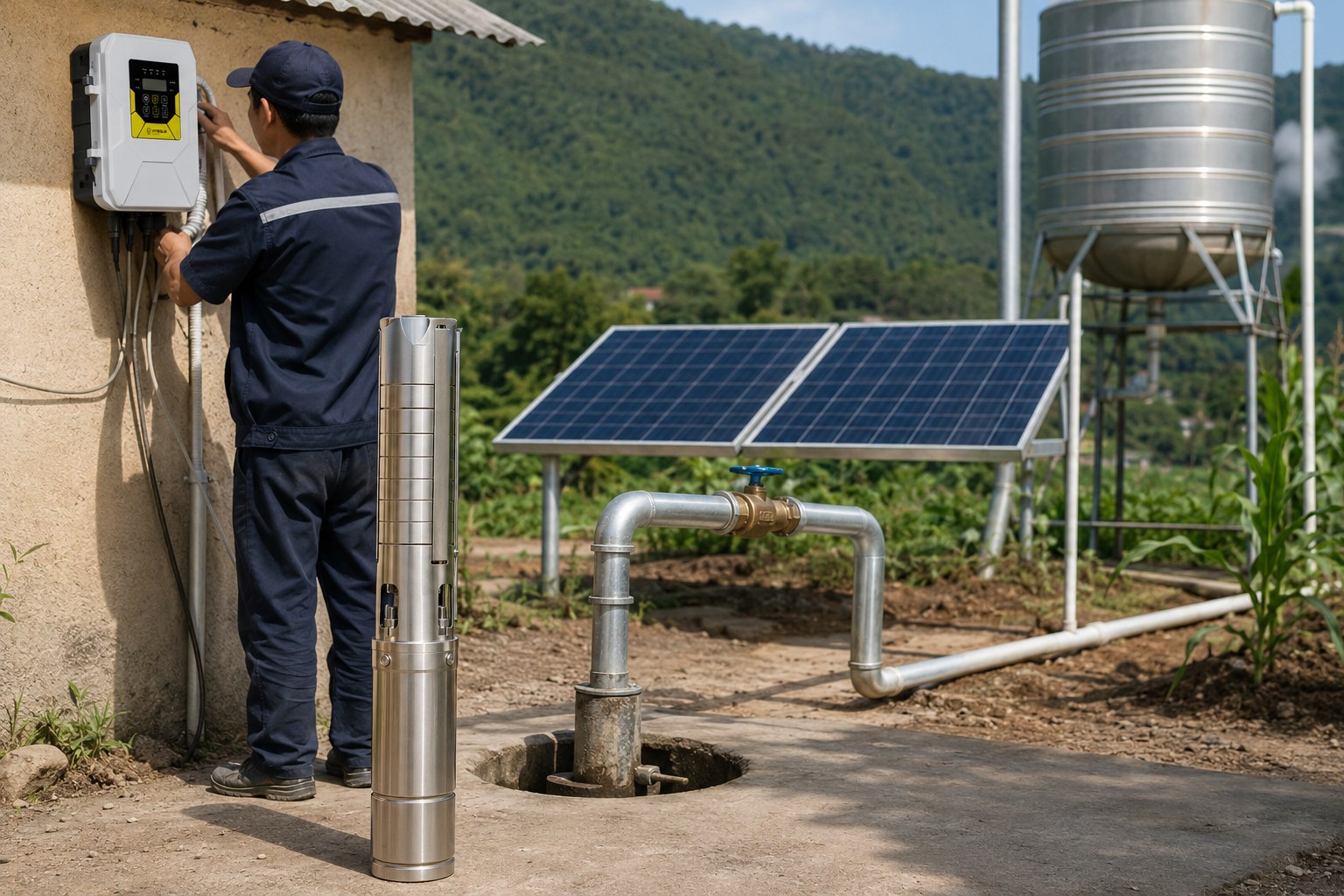
- Specialty Designs: Other pump types, like screw pumps, don't use a centrifugal impeller at all. A solar screw pump uses a helical rotor inside a rubber stator. This design creates very high pressure (high head) but with a relatively low flow rate, making it perfect for very deep wells where volume is less of a priority.
This is why a product portfolio must contain different pump types—like screw pumps, plastic impeller pumps, and stainless steel impeller pumps—to meet diverse market needs.
Each one is engineered for a different balance of flow and head, proving that horsepower is only a small part of the story.
Understanding Your System's Needs: Flow and Head
Is your pump constantly running, or does your shower sputter when a faucet is turned on?
These are classic signs of a mismatch between your pump and your system's actual requirements.
To size a pump correctly, you must calculate two key figures: the required Flow Rate in Gallons Per Minute (GPM) for your needs, and the Total Dynamic Head (TDH) the pump must overcome.
Before you can even look at a pump, you need to become an expert on your own water system.
Choosing a pump without first calculating your flow and head requirements is pure guesswork.
It's like buying a car without knowing if you'll be hauling lumber or driving on a racetrack.
The first step is to determine your peak water demand, which dictates the flow rate your pump needs to deliver.
The second, more technical step, is to calculate the total pressure the pump has to work against, which is known as Total Dynamic Head.
Only when you have these two numbers—your "design point"—can you begin to find a pump that will operate efficiently and reliably for years to come.
Getting this right prevents both oversizing and undersizing, the two most common and costly pumping mistakes.
Calculating Your Required Flow Rate (GPM)
Flow rate is the volume of water you need your pump to deliver in a given amount of time, measured in Gallons Per Minute (GPM).
To estimate your peak household demand, you count the number of water-using fixtures and appliances and add up their typical flow rates.
A good rule of thumb is to assume you will be using several fixtures at once during peak times (e.g., morning showers while the dishwasher is running).
Here is a table of average fixture flow rates:
| Fixture / Appliance | Average GPM |
|---|---|
| Faucet (Kitchen/Bath) | 1.0 - 1.5 GPM |
| Shower | 2.0 - 2.5 GPM |
| Toilet | 1.5 GPM |
| Dishwasher | 1.5 GPM |
| Washing Machine | 2.0 GPM |
| Outdoor Spigot / Hose | 2.5 - 5.0 GPM |
A typical family home might require a pump capable of delivering 10-12 GPM to ensure adequate pressure when multiple fixtures are active.
For agricultural irrigation, the calculation would be based on the number and type of sprinklers or drip lines.
What is Total Dynamic Head (TDH)?
Total Dynamic Head (TDH) is the total equivalent pressure that a pump must work against to move water from its source to its destination.
It's measured in feet and is the sum of three components:
- Static Head: This is the total vertical distance (in feet) you need to lift the water. For a well, it's the distance from the pumping water level in the well to the highest point of discharge (e.g., your pressure tank).
- Pressure Head: This is the desired water pressure at the destination, converted into feet of head. Water pressure is typically measured in PSI (Pounds per Square Inch). To convert, use the formula: 1 PSI = 2.31 feet of head. If you want 50 PSI at your home, you need to add (50 x 2.31) = 115.5 feet of pressure head to your calculation.
- Friction Loss: As water moves through pipes and fittings, it creates friction, which the pump must overcome. This loss depends on the flow rate, pipe diameter, and pipe length. Faster flow or narrower pipes create significantly more friction. This value can be estimated using friction loss charts, and for a typical home, it might add 20-40 feet of head to the total.
The formula is: TDH = Static Head + Pressure Head + Friction Loss.
A Sizing Example
Let's use an example from one of the source documents.
Betty wants to pump water from her well, which is 300 feet deep.
The water will go to a storage tank on a hill that is 200 feet above the wellhead.
Her well can produce 5 GPM.
Let's calculate her required head:
- Static Head: 300 ft (well depth) + 200 ft (hill elevation) = 500 feet.
- Pressure Head: Since she is pumping to an open tank, the required pressure at the outlet is 0 PSI.
- Friction Loss: Let's estimate friction loss at 25 feet for this example.
Her TDH = 500 ft + 0 ft + 25 ft = 525 feet.
Betty needs a pump that can deliver 5 GPM at 525 feet of TDH.
This is her design point.
She can now look for a pump that performs efficiently at this specific point, regardless of its horsepower rating.
How to Read a Pump Performance Curve
Do you feel like you're just guessing when selecting a pump model?
There's a scientific tool provided by manufacturers that eliminates the guesswork and guarantees you choose the optimal pump.
A pump curve is a chart that shows a pump's exact performance, plotting its flow rate (GPM) against the pressure (Head) it can generate.
It's the single most important tool for perfect pump selection.
Once you've calculated your design point (e.g., 10 GPM at 400 feet of TDH), the next step is to find a pump that can meet this demand.
This is where you stop looking at horsepower and start looking at pump curves.
Every reputable pump manufacturer provides detailed performance curves for each of their models.
This chart is your roadmap to an efficient and long-lasting system.
Ignoring the pump curve is like navigating without a map; you might eventually get there, but you'll waste a lot of energy and risk getting lost.
Learning to read this simple chart empowers you to make an informed decision, ensuring the pump you purchase is not just powerful, but perfectly suited for the work it needs to do.
It allows you to compare different models on a level playing field, focusing on actual performance rather than a misleading HP number.
The Anatomy of a Pump Curve
A pump curve is a simple graph with two axes.
- The horizontal axis (X-axis) represents the Flow Rate, typically in Gallons Per Minute (GPM). Flow increases as you move from left to right.
- The vertical axis (Y-axis) represents the Head, or pressure, typically in feet. Pressure increases as you move from bottom to top.
The curve itself shows the inverse relationship between flow and pressure for that specific pump.
At the far left of the curve (zero flow), the head is at its maximum.
This is called the "shut-off head."
As you allow more water to flow (moving right along the curve), the amount of pressure the pump can generate decreases.
This relationship is fundamental to all centrifugal pumps.
Finding the Best Efficiency Point (BEP)
Superimposed on the pump curve, you will often find efficiency lines or a shaded region.
This indicates the pump's Best Efficiency Point (BEP).
The BEP is the point on the curve where the pump is operating most efficiently, converting the highest percentage of motor energy into water movement.
Operating a pump at or near its BEP is crucial.
- Energy Savings: Running at the BEP can reduce energy consumption by up to 30% compared to running at the far ends of the curve.
- Longevity: Pumps operating away from their BEP experience more vibration, radial thrust on the shaft, and bearing wear. Staying within the BEP window can extend the pump's operational life by 50% or more.
- Reliability: A pump running efficiently is a pump running smoothly, with less noise and a lower risk of cavitation or overheating.
Reputable manufacturers often highlight the preferred operating range, which is typically within 70-120% of the BEP flow rate.
Applying Your Design Point to the Curve
Now, let's put it all together.
You take your calculated design point (your required GPM and TDH) and plot it on the pump curve graph.
Find your required GPM on the horizontal axis and your required TDH on the vertical axis.
The point where these two lines intersect is your system's requirement.
The goal is to find a pump where this intersection point falls directly on its performance curve, and ideally, within the BEP range.
Let's use the example from the source documents: a well system requires roughly 15 GPM between 400 and 600 feet of TDH.
- A 2 HP pump is considered. On its curve, it struggles to reach 400 feet of head at 15 GPM. It's undersized.
- A 5 HP pump is considered. It can easily provide the flow and pressure, but the design point falls far to the left of its BEP. It is severely oversized, inefficient, and expensive.
- A 3 HP pump is considered. Its curve passes directly through the required design point (15 GPM at ~500 ft), and this point is located squarely inside the pump's BEP zone.
In this case, the 3 HP pump is the perfect choice. It is neither the biggest nor the smallest, but it is the right one.
This demonstrates that a methodical selection process is far superior to the "bigger is better" mentality.
The Real-World Cost of Oversizing: 1 HP vs. 1.5 HP
That powerful 1.5 HP pump seems like a great investment for "extra peace of mind," but it could be silently draining your wallet and destroying your equipment.
An oversized 1.5 HP pump often causes "short cycling," a condition that can lead to 2-3 times more energy use, excessive wear, and potential motor burnout.
In many residential systems, a properly matched 1 HP pump delivers better, more reliable performance.
The temptation to oversize a pump is understandable.
Customers often think that buying a more powerful pump than they need is a form of insurance, ensuring they will always have enough water pressure.
However, in the world of hydraulics, this logic is completely backward.
Oversizing a pump is one of the most common and damaging mistakes in water system design.
It doesn't lead to better performance; it leads to a cascade of problems that increase operating costs and shorten the lifespan of your entire system, including the pump, the pressure tank, and the pressure switch.
Understanding these hidden costs will make you think twice before automatically reaching for that 1.5 HP box.
The Problem of Short-Cycling
In a typical well system, the pump's job is to fill a pressure tank.
The air in the tank becomes compressed, and when you open a tap, this compressed air pushes water out.
The pump only turns on when the pressure in the tank drops below a set point (e.g., 40 PSI) and turns off when it reaches a high set point (e.g., 60 PSI).
An oversized pump, like a 1.5 HP model in a system designed for 1 HP, moves water much faster than the system was designed for.
It will fill the pressure tank extremely quickly, causing it to hit the 60 PSI cutoff pressure in a matter of seconds.
As soon as a small amount of water is used, the pressure drops, and the pump kicks on again.
This rapid on-off-on-off behavior is called short-cycling.
Each start-up draws a large inrush of electric current, generating significant heat in the motor windings.
Frequent starting prevents the motor from cooling down properly, which can lead to thermal overload and eventual motor failure.
It's the equivalent of constantly flooring the accelerator and then slamming on the brakes in your car—it causes massive strain on every component.
Energy Consumption Comparison
Short-cycling doesn't just damage your pump; it devastates your electricity bill.
A pump motor is least efficient during startup.
An oversized pump that starts and stops 100 times a day will use far more energy than a correctly sized pump that runs for longer, smoother cycles 20 times a day.
Let's compare a correctly sized 1 HP pump with an oversized 1.5 HP pump for a typical household.
| Metric | Correctly Sized 1 HP Pump | Oversized 1.5 HP Pump | Difference |
|---|---|---|---|
| Power Rating | 0.75 kW | 1.12 kW | +50% |
| Daily Run Cycles | 20 cycles | 100+ cycles | +400% |
| Total Daily Run Time | 3 hours | 2 hours (inefficient bursts) | - |
| Daily Energy Use | 2.25 kWh | ~3.0 kWh (incl. startup spikes) | +33% |
| Annual Energy Cost (@ $0.15/kWh) | $123 | $164 | +$41/year |
While $41 per year may not seem like a lot, this calculation doesn't fully account for the massive energy spikes during startup.
Real-world studies have shown that short-cycling can increase energy consumption by 50-100% or more.
Over the 10-year life of a pump, an oversized model could easily cost you an extra $500-$1000 in electricity alone, completely negating any perceived savings on the initial purchase.
When is 1.5 HP Actually Necessary?
This isn't to say a 1.5 HP pump is never the right choice.
There are absolutely applications where its power is required.
A 1.5 HP or larger pump might be the correct, energy-efficient choice for:
- Very Deep Wells: Lifting water from depths of 400 feet or more requires significant power.
- High-Volume Irrigation: Running multiple large sprinkler heads for agricultural use demands both high flow and high pressure.
- Large Homes with High Demand: A large estate with multiple bathrooms, a pool, and extensive landscaping may have a peak demand that genuinely requires a 1.5 HP pump.
- Long Pumping Distances: Pumping water over hundreds or thousands of feet horizontally creates significant friction loss that must be overcome.
The key takeaway is that the need for a 1.5 HP pump is determined by calculation, not by assumption.
If your system's design point (TDH and GPM) lands on the BEP of a 1.5 HP pump's curve, then it is the correct and most efficient choice for the job.
The Future of Pumping: Efficiency Beyond Horsepower
Are you still thinking about pumps in terms of old-school horsepower?
Modern technology has fundamentally shifted the focus from raw power to something far more important: intelligent efficiency.
Modern pumps with Brushless DC (BLDC) permanent magnet motors can achieve efficiencies over 90%.
This means a 1 HP BLDC pump can easily outperform a less efficient, traditional 1.5 HP pump while using significantly less energy.
The conversation about 1 HP versus 1.5 HP is becoming obsolete.
The real revolution in the pump industry is happening at the motor and control level.
Innovations in motor technology and intelligent controllers are making it possible to achieve superior performance with less power, less energy, and greater reliability.
This is especially true in the world of solar pumping, where every watt of energy is precious.
For distributors and installers, understanding these technologies is key to offering a competitive advantage.
For end-users, it means a future of lower electricity bills, longer-lasting equipment, and a more reliable water supply, whether on or off the grid.
The BLDC Motor Advantage
At the heart of this revolution is the Brushless DC (BLDC) permanent magnet motor.
Unlike traditional AC induction motors, BLDC motors use powerful rare-earth magnets (like neodymium iron boron) on the rotor, eliminating the need for energy-wasting electrical windings.
This design offers a host of benefits:
- Extreme Efficiency: BLDC motors can exceed 90% efficiency, whereas traditional AC motors often operate in the 60-75% range. This means more of your electricity (from solar panels or the grid) is converted into useful work.
- Higher Power Density: Because they are more efficient, BLDC motors can be much smaller and lighter for the same power output. A modern BLDC motor can be up to 47% smaller and 39% lighter than a traditional motor with the same horsepower rating.
- High Torque: They provide high starting torque, which is excellent for getting water moving from a standstill, and they maintain efficiency across a wide range of speeds.
- Maintenance-Free: With no brushes to wear out, they are incredibly reliable and have a very long service life.
This technology means a modern 1 HP pump powered by a BLDC motor can deliver the performance of an older 1.5 HP pump, making the horsepower rating even less relevant.
The Role of Intelligent Controllers (MPPT)
The "brains" of a modern pumping system is its controller.
For solar pumps, this is typically an MPPT (Maximum Power Point Tracking) controller.
The MPPT controller constantly monitors the output of the solar panels and the load from the pump motor.
It adjusts the electrical parameters in real-time to ensure the maximum amount of power is extracted from the panels at all times, regardless of sunlight conditions.
This can boost the total water output of a solar pumping system by up to 30% over a day compared to a system without MPPT.
Advanced controllers also offer hybrid functionality.
AC/DC hybrid controllers can be connected to both solar panels and an AC power source (grid or generator) simultaneously.
The controller will prioritize free solar energy, but if sunlight is insufficient (e.g., on a cloudy day or at night), it can automatically blend in or switch over to AC power.
This ensures a worry-free, 24/7 water supply.
A Complete System Approach
The most competitive and effective water solutions today are viewed as a complete, integrated system.
It's no longer about just selling a pump.
It's about providing a solution tailored to the specific application.
A truly optimized system consists of three key parts:
- The High-Efficiency Motor: The BLDC motor is the powerhouse, determining the overall efficiency.
- The Intelligent Controller: The MPPT or AC/DC controller is the brain, maximizing energy use and providing reliability.
- The Application-Specific Pump End: The hydraulic pump end must be chosen for the job. Is the water deep? Use a high-head screw pump. Is high volume needed for irrigation? Use a high-flow centrifugal impeller pump. Is the water corrosive? Use a stainless steel impeller pump.
By combining these three elements correctly, you create a system that delivers exactly the water needed, using the least amount of energy, for the longest possible time.
This is the future of pumping—a future defined by intelligence and efficiency, not just brute horsepower.
Conclusion
Ultimately, the best pump is not the one with the highest horsepower.
It is the one whose performance curve perfectly matches your system's calculated flow and head requirements, ensuring maximum efficiency, reliability, and long-term cost savings for your specific application.
FAQs
Will a higher HP pump increase water pressure?
Not necessarily. Pressure is determined by the pump's head rating and your system's pressure switch settings, not just horsepower. Oversizing can actually cause pressure fluctuations.
What happens if my well pump is too big?
An oversized pump will short-cycle, leading to rapid wear on the motor, higher energy bills, and potential premature failure of the pump and pressure tank.
How do I calculate the GPM I need for my house?
Count your water fixtures and add up their flow rates. A common rule of thumb is to plan for 10-12 GPM for an average-sized home to handle peak usage.
Can I replace a 1 HP pump with a 1.5 HP pump?
You can, but it is often a mistake unless you have calculated that your system requires the higher performance and your electrical wiring and pressure tank can support it.
What is the difference between a 1 HP and 1.5 HP pool pump?
For pools, a 1.5 HP pump moves more water per minute. However, it can be too powerful for smaller filters, leading to poor filtration and potential damage.
How many GPM does a 1 HP well pump produce?
It varies widely based on design. A 1 HP high-flow pump might produce 30 GPM at low pressure, while a 1 HP high-head pump might only produce 10 GPM at high pressure.
What size well pump do I need for a 200 ft well?
For a 200-foot well, a ¾ HP or 1 HP pump is often suitable, but the final choice depends on your required flow rate (GPM) and desired household pressure.
What size of pump do I need to lift water 500 feet?
Lifting water 500 feet requires a high-head deep well pump, typically in the 1.5 HP to 3 HP range, depending on the required flow rate and pipe friction.