Choosing a water pump feels overwhelming.
A bad choice means costly repairs and water shortages.
You need a brand and a technology you can trust for consistent performance.
The most reliable water pump brand ultimately depends on your specific application and water conditions. While brands like Grundfos and Franklin Electric are renowned for their overall quality and durability in general applications, true reliability comes from matching advanced motor technology and correct pump materials to your specific needs.
This guide will break down the top brands, compare their key features, and reveal the crucial factors beyond the brand name that truly determine a pump's reliability and long-term value.
We will explore the market leaders, dive into the critical components that define a quality pump, and explain how modern technology is changing what "reliability" means.
Whether you are sourcing for residential, agricultural, or industrial needs, understanding these details is key to making a smart investment.
Top Well Pump Brands Based on Customer Reviews and Reliability
Finding a pump that won't fail is a top priority for any property owner.
A pump failure can lead to no water, crop damage, or a flooded basement.
Investing in a proven brand minimizes risk and ensures peace of mind.
Based on decades of field data and customer feedback, top-tier brands like Grundfos, Franklin Electric, and Goulds consistently deliver superior reliability. These manufacturers have built their reputations on robust engineering, quality materials, and long-term performance, making them a safe bet for demanding applications.
Choosing a top brand is more than just buying a name; it's investing in decades of engineering, research, and field-tested performance.
The difference between a premium pump and a budget alternative often becomes clear during the first power surge, a period of high demand, or after years of contact with mineral-heavy water.
Top-tier brands invest heavily in materials and design to handle these challenges.
Brand Performance Overview
When we analyze the market, a few names consistently rise to the top for their specific strengths.
This isn't about one brand being "the best" but about which brand is best for a particular job.
| Brand | Best For | Typical Lifespan | Price Range |
|---|---|---|---|
| Grundfos | Deep wells, energy efficiency | 15-25 years | $$$-$$$$ |
| Franklin Electric | All-around reliability, serviceability | 15-25 years | $$-$$$ |
| Goulds (Xylem) | Heavy-duty, high flow rates | 12-20 years | $$ |
| Pentair (Myers) | Good value with quality | 12-18 years | $$ |
| Zoeller | Durability, sump/sewage pumps | 15-25 years | $$-$$$ |
Material Quality: Stainless Steel vs. Cast Iron
The materials used in a pump are a primary indicator of its potential lifespan.
For submersible pumps, the choice is often between stainless steel and cast iron.
Stainless steel offers superior corrosion resistance, making it ideal for water with high mineral content, acidity, or salinity.
This can extend a pump's life by over 30% in harsh water conditions compared to lower-grade materials.
Cast iron, while heavier and very durable in neutral water, can be susceptible to rust and corrosion over time.
Brands like Grundfos often favor stainless steel for their premium lines, while Zoeller is famous for its heavy-duty, all-cast-iron construction in sump pumps, where weight and durability are paramount.
Energy Efficiency and Long-Term Costs
A pump's initial purchase price is only part of its total cost.
Over a 15-year lifespan, the electricity a pump consumes can cost significantly more than the pump itself.
Premium brands like Grundfos and Franklin Electric invest heavily in R&D to create more efficient motors and hydraulic designs.
A pump that is 15% more energy-efficient can save hundreds of dollars in electricity costs over its lifetime, effectively paying back its higher initial cost and then some.
Variable speed drives (VSDs), often found in higher-end models, can further reduce energy consumption by up to 50% by matching the pump's speed to the real-time water demand.
Critical Factors to Consider When Selecting a Well Pump Brand
Choosing a pump based on brand alone is a mistake.
Without matching the pump to your specific well and water needs, even the best brand can fail prematurely.
You need to analyze your system's requirements first.
Before looking at brands, you must know your well's depth, required flow rate (GPM), and water quality. Matching these specifications to the pump's capabilities is the single most important step in ensuring long-term reliability and efficiency for your water system.
A successful pump installation is a science.
It involves balancing four key variables: the well's ability to produce water, the home or farm's demand for water, the vertical and horizontal distance the water must travel, and the characteristics of the water itself.
Ignoring any of these factors can lead to an undersized pump that can't meet demand or an oversized pump that wastes energy and puts stress on your well and plumbing.
Matching Horsepower and Flow Rate (GPM)
The heart of pump selection is sizing it correctly.
Horsepower (HP) and Gallons Per Minute (GPM) are the primary metrics.
A common mistake is to buy a pump that is too powerful, thinking it will provide better pressure.
This "oversizing" leads to rapid cycling (turning on and off frequently), which drastically shortens the motor's life and wastes electricity.
Here are some general guidelines:
| Application | Typical GPM | Recommended HP |
|---|---|---|
| Small Home (1-2 Baths) | 5-10 GPM | 1/2 - 3/4 HP |
| Average Home (2-3 Baths) | 10-15 GPM | 3/4 - 1 HP |
| Large Home (3+ Baths) | 15-20 GPM | 1 - 1.5 HP |
| Home + Small Irrigation | 20-30 GPM | 1.5 - 2 HP |
| Large-Scale Agriculture | 30+ GPM | 2+ HP |
Understanding Your Well's Characteristics
Your well dictates the type of pump you need.
A 100-foot-deep well in sandy soil has vastly different requirements than a 600-foot-deep well drilled into rock.
Well Depth: This determines the 'head' pressure the pump must overcome. Deeper wells require pumps with more stages or higher horsepower to lift water to the surface.
Water Quality: Does your water have sand, silt, or high mineral content? Sandy water can destroy a standard pump's impellers quickly. In this case, a pump with floating stack impellers or a screw-type design is far more reliable. Mineral-heavy or corrosive water demands stainless steel components to prevent premature failure.
Well Production Rate: This is the amount of water your well can sustainably provide. You must never install a pump that can pump water faster than the well can replenish itself. Doing so can cause the pump to run dry, leading to overheating and catastrophic motor failure.
Beyond the Brand: The Core Technologies Driving Reliability
Relying on brand names is not enough.
The real secret to reliability lies in the pump's core technology.
Don't get left behind by outdated pump designs that are inefficient and prone to failure.
The most reliable systems are built on high-efficiency motors and application-specific pump ends. Modern Brushless DC (BLDC) motors and specialized impellers designed for different water conditions offer up to 40% greater efficiency and a longer lifespan than generic, off-the-shelf solutions.
In the B2B market, where distributors and importers supply pumps for thousands of different end-users, focusing on the underlying technology provides a crucial competitive advantage.
Rather than just selling a brand, you can offer a tailored solution.
This approach demonstrates expertise and builds trust, showing your customers that you are providing them with the most efficient and durable solution for their specific environment, whether it's a deep well in Africa or a high-salinity environment in Australia.
The Engine of the Pump: The BLDC Permanent Magnet Motor
The motor is the heart of any water pump.
Traditional AC induction motors are being replaced by far superior technology.
The Brushless DC (BLDC) permanent magnet motor is a game-changer for pump reliability and efficiency.
These motors use powerful rare-earth magnets (like Neodymium Iron Boron) to generate torque.
Because there are no "brushes" to wear out, they are virtually maintenance-free and have a significantly longer operational life.
Key advantages of a BLDC motor include:
- High Efficiency: BLDC motors can achieve efficiencies exceeding 90%, compared to 50-70% for many conventional motors. This translates directly to lower energy consumption.
- Compact and Lightweight: With no bulky windings, a BLDC motor can be up to 47% smaller and 39% lighter than a traditional motor of the same power output. This simplifies installation and reduces shipping costs.
- Reduced Solar Panel Requirement: For solar pumps, the high efficiency of a BLDC motor means you can achieve the same water output with fewer solar panels, reducing the total system cost by 15-25%.
Matching Pump Type to Water Conditions
There is no "one-size-fits-all" pump.
The pump end—the part that actually moves the water—must be matched to the water quality and application requirements.
Choosing the wrong type can lead to rapid wear, clogging, and failure.
| Pump Type | Best For | Key Advantage | Limitation |
|---|---|---|---|
| Solar Screw Pump | Low Flow, High Head (Deep Wells) | Excellent sand handling; can operate in harsh water | Lower overall flow rate; not for high-volume irrigation |
| Solar Plastic Impeller | High Flow, Medium Head | Economical, lightweight, good wear resistance in fine sand | Not ideal for highly corrosive water or extreme depths |
| Solar Stainless Steel Impeller | High Flow, Medium-to-High Head | Superior corrosion resistance, longest life in harsh water | Higher initial cost and weight |
For a distributor, having a portfolio with all three types is essential.
You can provide a cost-effective plastic impeller pump for a farm in the Americas, a sand-resistant screw pump for a village well in Africa, and a premium stainless steel impeller pump for an alkaline soil region in Australia.
This flexibility allows you to meet any customer's need with the most reliable solution.
The Rise of Smart and Hybrid Pumping Solutions
The most reliable pumps are not just strong; they're smart.
Old pumps just turn on and off, wasting energy and causing wear.
Modern pumps use intelligent controllers to optimize performance and protect the system.
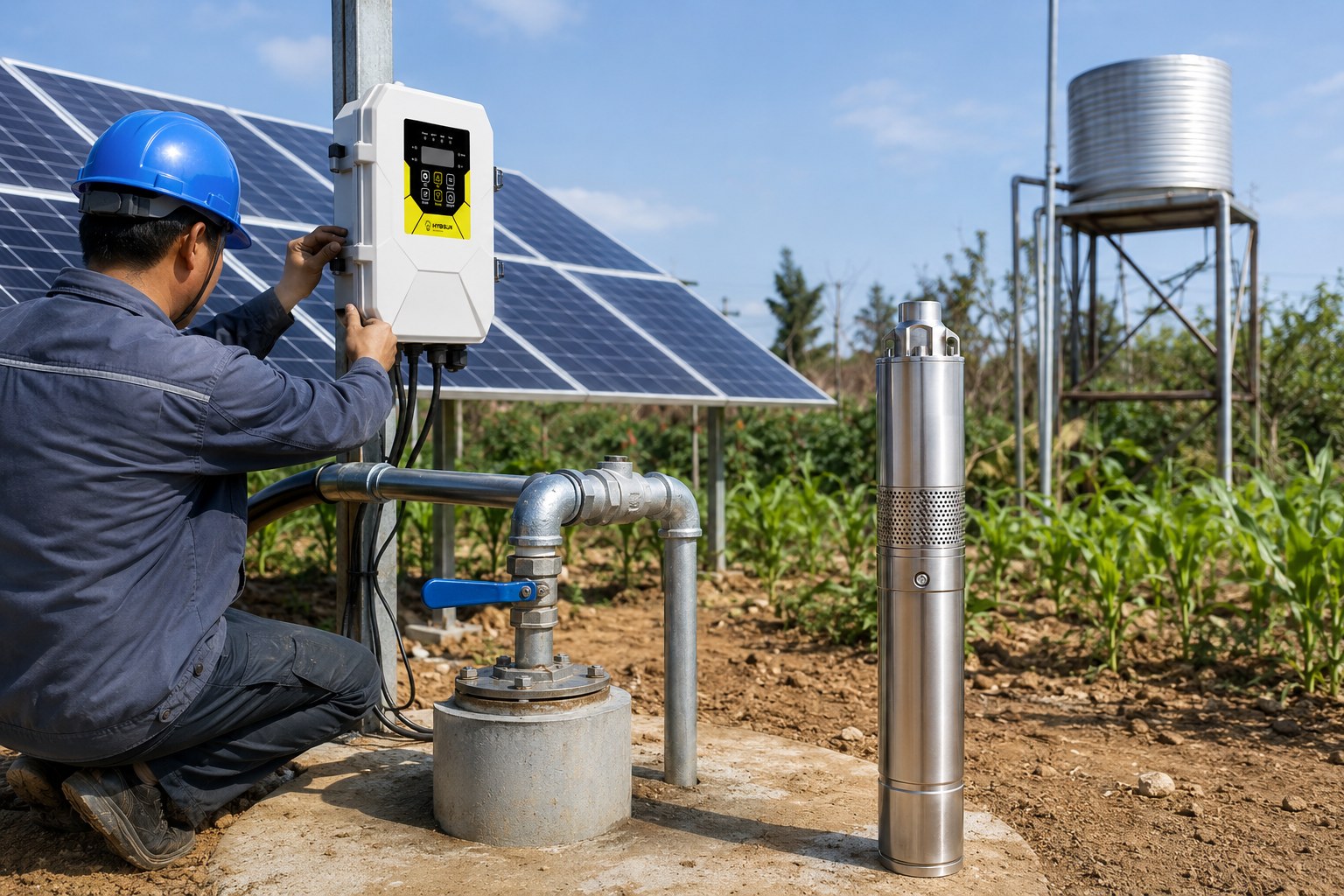
Modern water pump systems integrate smart controllers, like MPPT for solar and AC/DC hybrid technology, to maximize efficiency and ensure a 24/7 water supply. These systems can increase energy utilization by up to 30% and automatically switch power sources, defining a new standard for reliability.
For importers and distributors, offering smart and hybrid systems is a major value-add.
It moves the conversation from price per unit to long-term value, energy savings, and operational security.
These advanced features protect the end-user's investment and reduce service calls, which benefits everyone in the supply chain.
A system that can intelligently manage its own power source and protect itself from damage is inherently more reliable than a simple "dumb" pump.
What is an MPPT Controller?
For solar water pumps, the controller is as important as the pump itself.
A Maximum Power Point Tracking (MPPT) controller is a sophisticated electronic brain.
It constantly monitors the voltage and current from the solar panels and adjusts the electrical load to maximize the power drawn from them.
On a cloudy day or in the early morning, an MPPT controller can boost the energy harvested from the panels by up to 30% compared to a simple controller.
This means more water pumped over the course of a day and the ability to operate under less-than-ideal sunlight conditions.
It makes the entire solar pumping system more robust, efficient, and reliable.
The AC/DC Hybrid Advantage
What happens when the sun isn't shining, or you need to pump water at night?
This is the biggest limitation of traditional DC-only solar pumps.
Modern AC/DC hybrid controllers solve this problem completely.
These controllers are designed with inputs for both solar (DC) power and grid/generator (AC) power.
The system automatically prioritizes solar power when available.
If solar power is insufficient, the controller can blend it with AC power to ensure the pump keeps running.
When there is no solar input at all, it seamlessly switches to the AC power source.
This guarantees a worry-free, 24-hour water supply, which is the ultimate definition of reliability for critical applications in homes, farms, and communities.
Conclusion
The most reliable pump brand is not just a name.
It is a combination of quality components, the right technology for the job, and intelligent control systems that protect the investment.
Frequently Asked Questions
What is the most reliable well pump?
Grundfos and Franklin Electric are top choices for reliability, but matching the pump's materials and motor to your specific well conditions is more critical than brand alone.
How long do well pumps last by brand?
Premium brands like Grundfos or Franklin Electric can last 15-25 years. Mid-tier brands last 12-20 years, while budget options may only last 8-12 years.
Is Grundfos better than Franklin Electric?
Both are excellent. Grundfos often leads in energy efficiency for deep wells, while Franklin Electric is known for outstanding all-around reliability and value.
What is the best quality well pressure tank?
Amtrol and WaterWorker are top brands for pressure tanks. They offer durable construction and reliable bladder systems with strong 5-7 year warranties.
Are smart water pumps worth it?
Yes. Smart pumps with features like VSDs and remote monitoring can cut energy costs by up to 50% and provide diagnostic data that prevents costly failures.
What brand is best for agricultural water pumping?
For agriculture, brands known for high-flow and durability like Goulds, Franklin Electric, and Davey are excellent choices, especially models designed for continuous operation.
What makes a water pump energy efficient?
High-efficiency BLDC motors, advanced hydraulic design (impellers and casing), and variable speed drives (VSDs) that match output to demand are key factors for efficiency.
Should I buy the cheapest pump?
No. A cheap pump often costs more long-term due to higher energy bills, frequent repairs, and a shorter lifespan, making it a poor investment.