Your well pump is failing, leaving you with low pressure or no water at all.
You're facing the stress of unexpected breakdowns and the potential for expensive emergency repairs.
The most common submersible pump problems include electrical failures like a tripped breaker or faulty pressure switch, mechanical issues like a waterlogged pressure tank causing rapid on-off cycling, and performance degradation such as low pressure from worn impellers or leaks in the system. Diagnosing these issues early is key.
Understanding the warning signs your pump gives you is the first step toward a solution.
These systems rarely fail without notice.
Weird noises, sputtering faucets, or a sudden jump in your electric bill are all cries for help from your well system.
By learning to interpret these signals, you can catch small problems before they escalate into a complete shutdown that leaves your home dry.
This guide breaks down the most frequent issues, explains what they mean, and helps you know when to call a professional.
Let's explore the symptoms and solutions to keep your water flowing smoothly.
Why Won't My Pump Start At All?
You turn on the tap, and nothing happens—just silence.
The initial panic of having no water can be overwhelming, making you imagine the worst-case scenario and a massive repair bill.
A pump that won't start is most often due to a simple electrical issue. Over 40% of these cases are solved by checking for a tripped circuit breaker. If that's not the problem, it could be a failed pressure switch, a faulty control box, or a burned-out motor.
The First and Easiest Check: The Circuit Breaker
Before you do anything else, find your home's electrical panel.
Look for a breaker labeled "Well Pump" or similar.
A tripped breaker will be in the 'off' position or stuck in the middle.
Firmly switch it back to the 'on' position.
Try this only once.
If the breaker trips again immediately, it signals a deeper electrical problem, like a short circuit or a seized motor that is drawing too much current.
In this case, turn the breaker off and call a professional immediately to avoid fire risk or further damage.
This simple check costs nothing and can restore your water in seconds if it's the only issue.
The Pressure Switch: The Brain of the Operation
The pressure switch is a small, typically gray box mounted on the plumbing near your pressure tank.
It's responsible for telling the pump when to turn on (at the cut-in pressure) and when to turn off (at the cut-out pressure).
When it fails, the pump gets no signal to start.
- Symptoms of Failure: You hear no "click" when the water pressure drops to zero. You might see visible corrosion on the electrical contacts inside the switch cover or signs of moisture damage.
- Why it Fails: Contacts can become corroded over time, preventing electricity from flowing. The internal mechanism can wear out and get stuck, or insects and debris can physically jam it.
- What to Do: A professional can test the switch for continuity and voltage. Replacement is a common and relatively inexpensive repair, typically costing between $250 and $500.
The Control Box: For Submersible Pumps Only
If you have a 3-wire submersible pump, you will have a control box mounted on a wall, usually near the pressure tank.
This box contains crucial components like capacitors and relays that help start and run the pump motor.
| Failure Symptom | Likely Cause | Professional Action | Estimated Cost |
|---|---|---|---|
| Burning smell or visible scorch marks | Overheated or blown capacitor/relay | Component testing and control box replacement | $400 - $900 |
| Humming noise but pump won't start | Failed start capacitor | Capacitor testing and replacement | $350 - $700 |
| Pump works intermittently | Faulty relay | Relay testing and replacement | $300 - $600 |
These components are essential for the motor's operation and are common failure points, especially after a power surge or lightning strike.
Due to the high voltage (240V), troubleshooting and replacing a control box should only be performed by a qualified technician.
Is Your Pump Running Non-Stop or Giving Weak Pressure?
Your shower feels more like a drizzle, and you can hear the constant hum of the pump in the background.
Your electricity bill is creeping up, but your water pressure is heading down.
Low pressure is often caused by a failing or waterlogged pressure tank, worn pump impellers that can no longer build sufficient pressure, or clogs in the system. A pump that runs continuously points to a major leak, a stuck pressure switch, or a pump that has worn down to the point it can't reach its shut-off pressure.
The Problem with Short-Cycling
Short-cycling is when your pump turns on and off very frequently, sometimes every 30-60 seconds, even when no water is being used.
This is one of the most damaging problems for a well pump.
The primary cause is almost always a failed pressure tank.
The tank has an internal air bladder that creates a cushion of pressure, allowing the system to deliver water without the pump having to run for every small demand.
When this bladder fails or loses its air charge, the tank becomes "waterlogged."
Without the air cushion, any drop in pressure immediately triggers the pump, causing the rapid cycling that dramatically shortens the life of the pump motor and pressure switch.
A waterlogged tank can increase pump energy consumption by over 50% and reduce the pump's lifespan from 10-15 years to just 2-3 years.
Diagnosing the Pressure Tank
You can perform a simple test on your pressure tank.
Gently tap on the top and bottom of the tank with your knuckles.
The top should sound hollow (where the air is), and the bottom should sound solid (where the water is).
If the entire tank sounds solid, it is likely waterlogged.
Another sign is a pressure gauge that fluctuates wildly whenever the pump runs.
Replacing a pressure tank is a common repair, costing between $600 and $1,400, but it prevents the much higher cost of replacing a prematurely burned-out pump.
The Slow Decline: Worn Impellers and Clogged Screens
If your water pressure has been gradually decreasing over months or years, the issue may be inside the pump itself.
The impellers are the spinning discs that push the water up the well pipe.
Over time, especially in wells with sand or sediment, these impellers wear down.
A worn pump can still run, but it can't generate the force needed to produce strong pressure.
This also explains why a pump might run continuously—it's trying to reach the "cut-out" pressure setting but physically can't, so it never shuts off.
| Symptom | Possible Cause | Solution |
|---|---|---|
| Gradually decreasing pressure over years | Worn pump impellers | Pump replacement |
| Sudden drop in pressure | Clogged intake screen | Pull and clean pump/screen |
| Low pressure at all faucets | Partially closed valve or clog | Inspect all valves; professional line check |
A professional can perform a flow test to determine if the pump is performing to its specifications.
If the pump is significantly worn, replacement is the only long-term solution, with costs ranging from $1,500 to $4,500.
What Do Sputtering Faucets and Strange Noises Mean?
Your water flow is interrupted by violent bursts of air, and strange grinding or clicking noises are coming from your well.
These are not symptoms to ignore; they are urgent warnings of serious problems.
Sputtering faucets indicate air is entering the system, most commonly from a water level in the well dropping below the pump's intake, a cracked drop pipe, or a leak in the plumbing. Strange noises are direct indicators of mechanical or electrical distress that require immediate attention to prevent catastrophic failure.
Decoding the Sounds of Pump Failure
Unusual noises are your pump's way of telling you exactly what's wrong, if you know how to listen.
Ignoring these sounds can lead to a minor repair turning into a total system replacement.
| Sound | Likely Cause | Urgency & Action |
|---|---|---|
| Grinding or Screeching | Worn motor bearings; sand in impellers. | CRITICAL. Turn pump off at the breaker immediately to prevent seizure. Call for emergency service. |
| Rapid Clicking | Pressure switch cycling on/off rapidly; chattering electrical relay. | HIGH. Indicates severe short-cycling. Check pressure tank, but professional diagnosis is needed. |
| Loud Humming | Seized motor shaft or failed start capacitor. The motor is trying but failing to turn. | CRITICAL. Turn off immediately due to fire risk from overheating. Call a professional. |
| Banging / Hammering | "Water hammer" from a failing check valve or loose pipes. | MODERATE. Can cause pipe damage over time. Needs inspection. |
These noises are never normal.
Documenting when they occur and what they sound like will help a technician diagnose the problem much faster.
A pump running dry due to a low water level can be destroyed in under 5 minutes from overheating, making a grinding sound your final warning.
The Problem with Air and Sediment
Sputtering faucets are more than just an annoyance; they signal a breach in your sealed water system.
The most common causes are:
- Low Well Water Level: During a drought or period of heavy use, the water table can drop below your pump's intake, causing it to suck in air instead of water. This is extremely dangerous for the pump.
- Cracked Drop Pipe: The pipe that connects your submersible pump to the surface can develop cracks, allowing air to be drawn in and water to leak back into the well.
- Failed Foot Valve (Jet Pumps): In shallower wells with jet pumps, a failed foot valve allows the pump to lose its prime, introducing air into the system.
Similarly, if your water suddenly becomes cloudy, sandy, or muddy, it's a sign that something has changed down in the well.
This could be due to a failing pump screen, a pump that is set too high or low in the well, or deterioration of the well casing itself.
This sediment is highly abrasive and will quickly destroy pump impellers and clog your home's plumbing fixtures and appliances.
A professional may need to use a downhole camera to inspect the well and determine the source of the sediment.
Could a Modern Solar Pump Prevent These Issues?
You're tired of dealing with grid-dependent pumps, high electricity bills, and complex electrical failures.
What if there was a more efficient, self-reliant, and durable solution for your water needs?
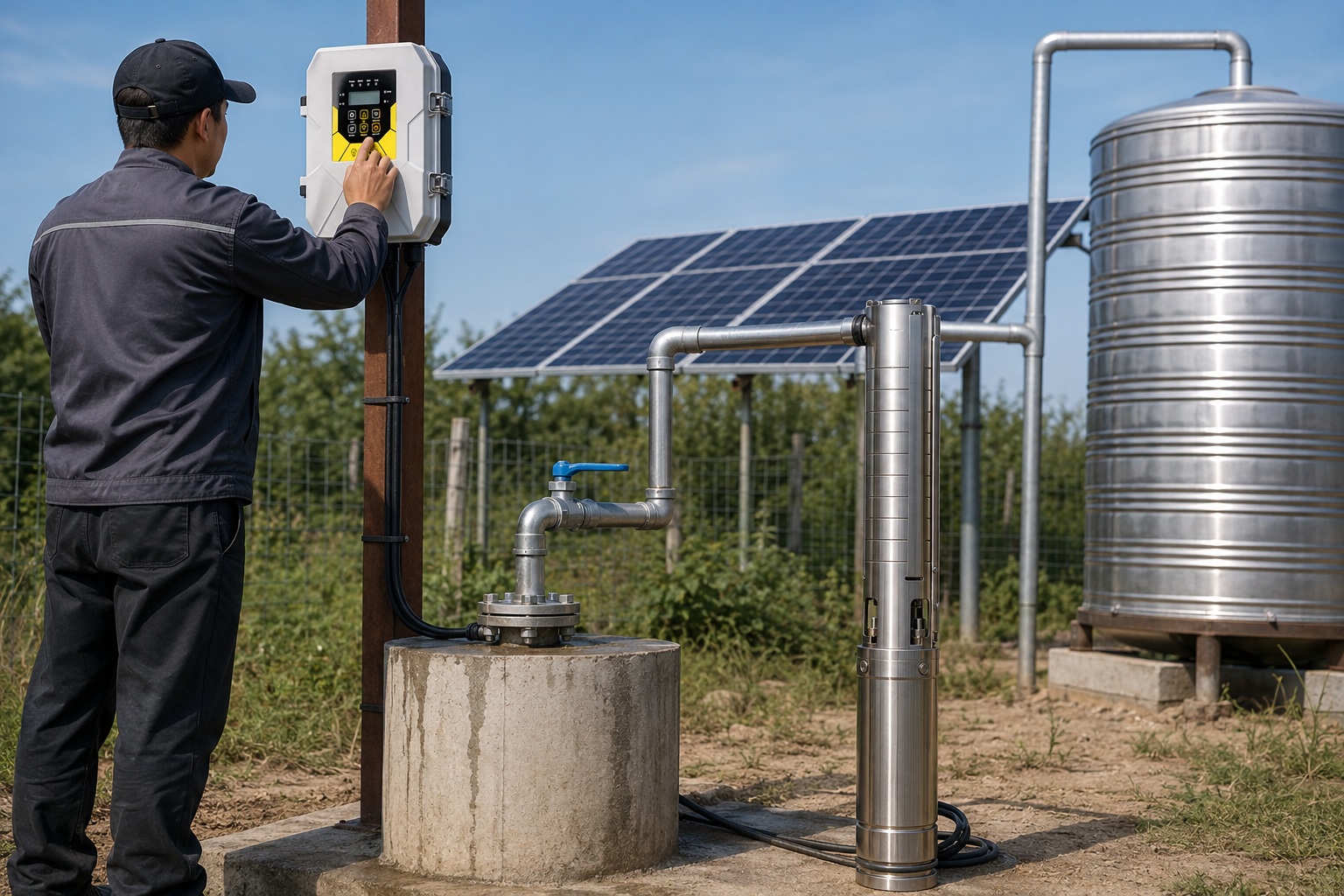
Modern solar-powered submersible pumps offer a robust alternative, engineered to minimize many common pump problems. By using high-efficiency DC motors and intelligent controllers, they reduce operating costs, simplify installation, and are built for durability in demanding off-grid environments, directly addressing issues like high electric bills and complex electrical failures.
The Heart of the System: The BLDC Motor
The biggest leap forward in solar pumps is the use of Brushless DC (BLDC) permanent magnet motors.
This is a significant upgrade from the standard AC motors found in most conventional well pumps.
| Feature | Conventional AC Motor | High-Efficiency BLDC Motor | Advantage |
|---|---|---|---|
| Efficiency | 60% - 75% | Over 90% | Reduces solar panel requirement by up to 25%; lower operating cost. |
| Lifespan | Good | Excellent | No brushes to wear out, resulting in a longer, maintenance-free service life. |
| Size & Weight | Standard | Up to 47% smaller, 39% lighter | Easier installation, especially in deep wells. |
| Control | On/Off via pressure switch | Variable speed via MPPT controller | Optimizes water flow based on available sunlight; soft starts reduce wear. |
This superior efficiency means that for the same amount of water, a solar pump requires fewer solar panels, lowering the initial system cost.
The motor's design eliminates common failure points like brushes and start capacitors, making the entire system more reliable.
Choosing the Right Solar Pump for the Job
Solar pump systems are not one-size-fits-all.
The technology has evolved to provide specialized solutions for different water conditions.
- Solar Screw Pump: This design excels in very deep wells where high pressure (head) is needed but flow rates can be lower. It is exceptionally resistant to sand and ideal for domestic water supply or livestock watering in harsh environments.
- Solar Plastic Impeller Pump: For applications needing high flow rates at medium head, like farm irrigation or filling large tanks, this pump is an economical and wear-resistant choice. Its durable plastic impellers handle fine sand well.
- Solar Stainless Steel Impeller Pump: In areas with corrosive, acidic, or alkaline water, this premium pump is the best solution. The full stainless steel construction ensures maximum durability and a long service life, protecting your investment.
The Advantage of Hybrid Technology
A common concern with solar power is what happens on cloudy days or at night.
Modern solar pump controllers have solved this problem with AC/DC hybrid capability.
These smart controllers can accept power from both the solar panels and the AC grid (or a generator).
The system prioritizes free solar energy whenever it's available.
If sunlight fades, the controller can blend in AC power or switch over to it completely, ensuring you have uninterrupted access to water 24/7 without any manual intervention.
This offers the best of both worlds: the cost savings of solar with the reliability of the grid.
Conclusion
Understanding your submersible pump's symptoms is key to preventing costly failures.
Regular monitoring and proactive maintenance, guided by professional expertise, ensure your water system remains reliable for years to come.
FAQs
How do I know if my well pump is failing?
Signs include low water pressure, sputtering faucets, the pump cycling frequently, strange noises, or a sudden increase in your electric bill.
What is the first thing to check when your well pump stops working?
Always check the dedicated circuit breaker in your electrical panel first.
A simple reset might be all that's needed.
How long should a submersible well pump last?
A quality submersible pump typically lasts 10 to 15 years, while a pressure tank lasts 10-15 years.
Proper maintenance can extend this lifespan.
Why does my well pump keep kicking on and off?
This is called short-cycling and is most often caused by a failed or waterlogged pressure tank that has lost its air cushion.
How much does it cost to fix a well pump?
Repairs can range from $250 for a pressure switch to over $4,500 for a full pump and motor replacement in a deep well.
Can I replace a well pump myself?
No, this is not a DIY job.
It involves high-voltage electricity and specialized equipment to pull the pump from the well, requiring a licensed professional.
What causes a well pump to lose pressure?
Common causes include a waterlogged pressure tank, a leak in the system, worn-out pump impellers, or a clog in the pipes or filters.
What happens if a submersible pump runs dry?
Running dry is catastrophic.
Without water for lubrication and cooling, the pump motor can overheat and burn out in as little as 5-10 minutes.