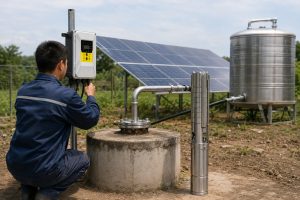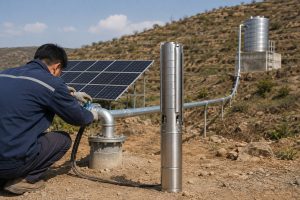
Your off-grid property needs water, but the grid is too far or expensive.
A solar-powered water pump is the answer, but choosing the right one is hard.
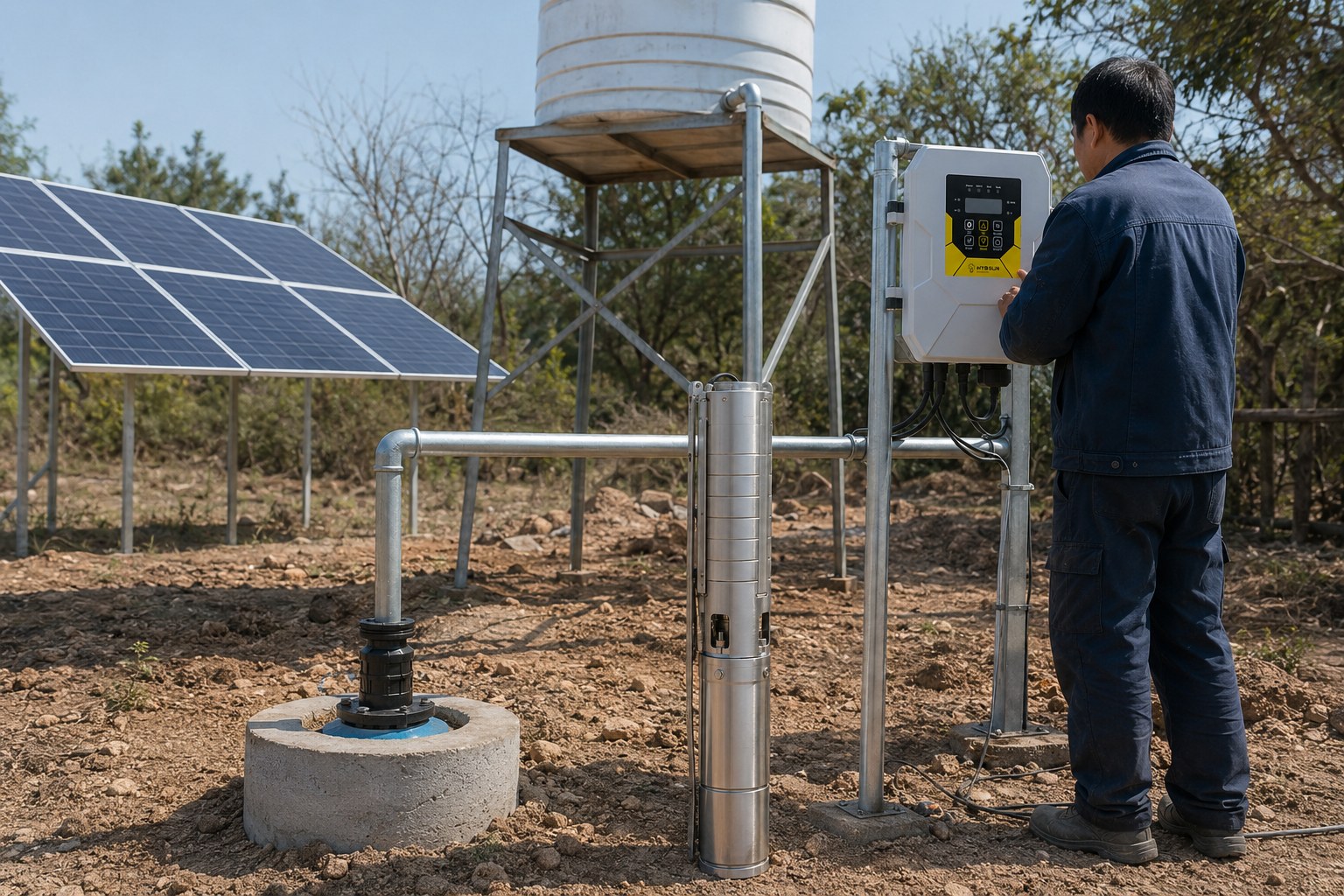
The best solar-powered water pump is a complete system matched to your specific needs.
This includes the correct pump type for your water source, a high-efficiency motor to save on panel costs, and an intelligent controller to maximize performance and ensure reliability.
Finding the perfect pump can feel overwhelming.
You see terms like GPH, max head, submersible, and BLDC motor.
What do they all mean?
This guide will break down everything you need to know.
We will explore the different types of pumps available.
We will compare their performance metrics.
And we will reveal the core technology that separates a good pump from a great one.
By the end, you will be able to confidently select the ideal solar water pump system for your home, farm, or business.
What to Consider When Choosing a Solar-Powered Water Pump?
You need a reliable water source, but you're off-grid.
Traditional pumps are not an option.
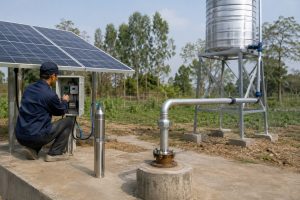
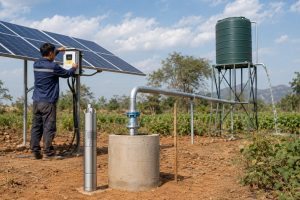
A solar water pump is the perfect solution for sustainable, independent water access.
The best solar water pump is not a single product.
It is a system tailored to your specific application, considering water depth, required flow rate, and water quality to ensure maximum efficiency and longevity.
Choosing the right solar pump system is a critical decision.
A mismatch between the pump and the application can lead to poor performance, increased costs, and premature failure.
To make an informed choice, you must understand the fundamental factors that define a pump's capabilities and suitability.
This involves looking beyond the initial price tag and evaluating the technical specifications that will determine its real-world performance.
Let's explore these key considerations in detail.
Types of Solar-Powered Water Pumps
The first major choice is between a surface pump and a submersible pump.
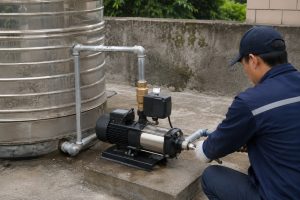
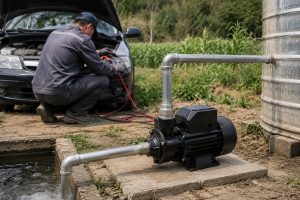
A surface pump sits on the ground next to the water source.
It pulls water through an inlet hose.
These pumps are excellent for moving water from shallow sources like ponds, streams, or storage tanks.
They are often used for garden irrigation or transferring water between tanks.
However, their suction lift is limited, typically to around 20 feet, making them unsuitable for deep wells.
A submersible pump is placed directly inside the water source.
It works by pushing water up to the surface, rather than pulling it.
This design makes them far more efficient for deep applications.
They are the standard choice for pulling water from deep wells for homes, livestock, and large-scale agriculture.
Because they are submerged, they are also self-priming and tend to run more quietly.
| Pump Type | Placement | Best For | Max Suction/Lift |
|---|---|---|---|
| Surface Pump | At water level, on dry land | Shallow ponds, tanks, irrigation | ~20 feet suction lift |
| Submersible Pump | Fully submerged in the well or pond | Deep wells, off-grid homes, ranches | 650+ feet of head |
Max Vertical Head
Max vertical head, or "max lift," is the highest elevation a pump can move water vertically.
This is one of the most critical specifications for a well pump.
It is measured from the water level in the well to the discharge point at the surface.
For example, if your well water is 100 feet down and your storage tank is on a 10-foot stand, you need a total head of at least 110 feet.
Always choose a pump with a max head that is at least 10-20% greater than your calculated requirement.
This provides a safety margin and accounts for friction loss in the pipes.
Failing to account for total head will result in low pressure or no water flow at all.
Max Flow Rate
Max flow rate measures the volume of water a pump can move in a given time.
It is usually expressed in gallons per hour (GPH) or gallons per minute (GPM).
The required flow rate depends entirely on your application.
A small fountain might only need 60 GPH.
A drip irrigation system for a garden could require 200 GPH.
Supplying water for a large livestock operation could demand over 2,000 GPH (or ~35 GPM).
It is important to note that the flow rate is not constant.
It decreases as the pumping height (head) increases.
A pump's performance curve chart shows its exact flow rate at various head levels, which is essential for proper system sizing.
A Deep Dive into Submersible Pump Technologies
You have a deep well, but which submersible pump is right for you?
The water might be sandy or corrosive.
You need a pump that will last for years without issues.
The best submersible pump depends on your well's depth, water quality, and flow needs.
Solar screw pumps excel at high head, plastic impeller pumps offer high flow, and stainless steel models provide ultimate durability in harsh water.
Choosing the right submersible pump technology is the key to a long-lasting, efficient water system.
The internal design of the pump dictates its performance characteristics.
A pump designed for clear water may fail quickly in a sandy well.
A pump built for low flow will not meet the demands of large-scale irrigation.
Let's break down the three most popular types of solar deep well pumps to understand their unique strengths and ideal applications.
This will help you match the right technology to your specific water challenge.
The Solar Screw Pump: Low Flow, High Head Champion
This pump uses a unique progressing cavity design.
It features a single helical screw (rotor) that turns inside a flexible rubber housing (stator).
As the screw rotates, it forms a series of sealed cavities that move water steadily up the pipe.
This compression-based mechanism is highly effective at creating pressure.
As a result, screw pumps can achieve very high head, easily pushing water from wells over 500 feet deep.
However, this design limits the volume of water moved with each rotation.
The flow rate is therefore relatively low, typically under 15 GPM.
One of its biggest advantages is its incredible tolerance for sand and sediment.
The flexible stator can pass small particles without damage, making it up to 50% more resistant to abrasion than centrifugal pumps.
- Ideal Applications: Deep domestic wells, livestock drinking water, and high-lift, low-volume irrigation.
- Key Advantage: Exceptional high-head capability and sand resistance.
The Solar Plastic Impeller Pump: The High-Flow Workhorse
This is a multi-stage centrifugal pump.
It uses a stack of rotating impellers to move water.
Each impeller and diffuser stage adds pressure to the water, pushing it higher.
These pumps are engineered to deliver high volumes of water at a medium head.
The impellers are made from durable, wear-resistant engineering plastics.
This material choice makes the pump lightweight and more economical.
It also provides excellent resistance to abrasion from fine sand.
This makes them a popular and cost-effective choice for many agricultural and residential applications.
They can achieve flow rates exceeding 40 GPM, making them perfect for filling large tanks or running irrigation systems.
Their limitation is in highly corrosive water or extremely deep wells, where metal components offer better long-term durability.
- Ideal Applications: Farm irrigation, pasture water supply, and residential water systems with medium-depth wells.
- Key Advantage: High flow rate, good sand resistance, and excellent value.
The Solar Stainless Steel Impeller Pump: The Premium Durability Option
This pump is also a multi-stage centrifugal pump, similar to the plastic impeller model.
The critical difference is its construction.
The impellers, pump body, and other key components are made from high-grade SS304 or SS316 stainless steel.
This provides superior resistance to corrosion, abrasion, and wear.
It is the ultimate choice for challenging water conditions, such as acidic or alkaline water.
This type of water is often found in mineral-rich regions or areas with specific soil types.
The stainless steel construction ensures a significantly longer service life, often lasting 30-50% longer than other pump types in corrosive environments.
While the initial cost is higher, its reliability and longevity make it a wise investment for high-end homes, critical commercial operations, and any application where water quality is a concern.
- Ideal Applications: Corrosive water environments, high-end homes and ranches, and critical water supply.
- Key Advantage: Unmatched corrosion resistance and long-term durability.
| Pump Technology | Max Head | Max Flow | Sand Resistance | Best For |
|---|---|---|---|---|
| Solar Screw Pump | Very High | Low | Excellent | Deep wells (>300 ft), domestic use |
| Plastic Impeller Pump | Medium | High | Good | Farm irrigation, ranches, value-focused |
| Stainless Steel Impeller | Medium-High | High | Good | Corrosive water, high-end applications |
The Engine of the System: Why the Motor Matters Most
Your solar pump system isn't delivering.
You might need more solar panels, which adds cost and complexity.
What if the problem isn't the panels, but the pump's motor itself?
The motor is the heart of your pump.
A high-efficiency BLDC motor can reduce your solar panel needs by over 25%, saving costs, simplifying installation, and boosting overall performance.
The type of pump is important, but the motor that drives it is the true engine of the system.
An inefficient motor wastes precious solar energy as heat, meaning you need more solar panels to pump the same amount of water.
This increases the system's cost, size, and installation complexity.
Modern solar pumps have moved away from older, inefficient motor designs.
The industry standard for performance is now the Brushless DC (BLDC) permanent magnet motor.
Understanding this core technology is essential to appreciating the true value and competitiveness of a modern solar pump system.
The Power of a BLDC Motor
A Brushless DC (BLDC) motor is a major leap forward in motor technology.
Unlike older brushed motors, they do not have brushes that wear out and create friction.
Instead, they use an electronic controller to switch the motor's phases, creating rotation.
The rotor itself is made from high-strength permanent magnets, often neodymium iron boron.
This design has several profound advantages.
It eliminates the components that are most likely to fail.
It dramatically reduces energy loss from friction.
This results in a motor that is more efficient, more reliable, and has a much longer service life.
The Efficiency Advantage
Efficiency is where BLDC motors truly shine.
A modern BLDC motor can achieve an electrical-to-mechanical conversion efficiency of over 90%.
In contrast, a traditional brushed DC motor might only be 60-75% efficient.
This 15-30% efficiency gap is huge in the world of solar power.
It means that for every 100 watts of solar energy delivered to the motor, a BLDC motor converts 90+ watts into pumping power, while a brushed motor might only convert 70 watts.
The remaining energy is simply lost as heat.
This high efficiency means you get more water pumped per watt of solar power, every single day.
Market Value of High Efficiency
The technical advantages of a BLDC motor translate directly into market value for distributors and end-users.
- Reduced System Cost: A more efficient motor requires less power. This means a smaller, less expensive solar panel array is needed to achieve the same water output, reducing the total system cost by 15% or more.
- Compact & Lightweight: BLDC motors are significantly more compact and lighter than older motors with the same power output. A BLDC-powered pump can be up to 47% smaller and 39% lighter, making shipping, handling, and installation much easier and cheaper.
- High Reliability: With no brushes to wear out, BLDC motors are virtually maintenance-free and are designed for a service life exceeding 10 years. This reduces callbacks and increases customer satisfaction.
| Feature | BLDC Permanent Magnet Motor | Standard Brushed DC Motor |
|---|---|---|
| Efficiency | > 90% | 60% - 75% |
| Maintenance | None (maintenance-free) | Brushes require periodic replacement |
| Lifespan | Very Long (>10 years) | Shorter (limited by brush life) |
| Size & Weight | Compact and lightweight | Bulky and heavy for same power |
| System Cost | Lower overall (fewer panels) | Higher overall (more panels needed) |
Beyond the Pump: System Components for Reliability
The sun isn't always shining brightly.
You worry about cloudy days or needing water at night.
Will your water supply be unreliable?
A complete solar pump system includes intelligent controllers to maximize reliability.
An MPPT controller can boost daily water output by 30%, and an AC/DC hybrid controller can guarantee a 24/7 water supply.
A high-quality pump and motor are the foundation of your system, but the electronic controller is the brain.
The controller manages the flow of power from the solar panels to the pump motor.
It also provides critical protection features.
Early solar pump systems were simple on/off devices that only worked well in perfect, direct sunlight.
Modern systems use sophisticated controllers to optimize performance in all conditions and even provide backup power options, ensuring you have water whenever you need it.
Let's examine the two most important controller technologies.
The MPPT Controller: Maximizing Your Sunshine
MPPT stands for Maximum Power Point Tracking.
An MPPT controller is an intelligent DC-to-DC converter.
It constantly monitors the voltage and current from the solar panels.
It then adjusts the electrical load to ensure the panels are always operating at their "maximum power point."
This is the ideal voltage at which the panel produces the most possible power.
The output of a solar panel changes constantly with sunlight intensity, temperature, and shading.
Without an MPPT controller, the system can't adapt to these changes, leading to significant power loss.
By constantly optimizing the power transfer, an MPPT controller can increase the total daily water volume by up to 30% compared to a system without one.
It also enables the pump to start earlier in the morning and run later in the afternoon, extending the daily pumping window.
Battery Backup: Storing Power for a Rainy Day
For some applications, having water only when the sun is shining is not enough.
If you need water overnight or during extended cloudy periods, a battery backup system is the solution.
In this setup, solar panels charge a battery bank during the day.
The pump then draws power from the batteries as needed.
This provides a truly independent and continuous water supply.
These systems require an additional component called a charge controller.
The charge controller sits between the solar panels and the batteries.
Its job is to manage the charging process to prevent the batteries from being overcharged or overly depleted, which can cause damage and shorten their lifespan.
While this adds cost and complexity, it offers the ultimate in off-grid water security.
The AC/DC Hybrid Solution: The Best of Both Worlds
The most advanced systems offer an AC/DC hybrid solution.
This is designed for critical applications where a 24/7 water supply is non-negotiable.
The hybrid controller has inputs for both DC power from solar panels and AC power from the grid or a generator.
The controller's intelligent logic always prioritizes using the free power from the sun.
It will run the pump entirely on solar whenever possible.
If the solar power is insufficient due to heavy clouds, the controller will automatically blend in just enough AC power to meet the pump's needs.
If there is no solar input at all, like at night, it will automatically switch to run fully on AC power.
This ensures you have uninterrupted water access while maximizing the use of renewable energy and minimizing electricity costs.
Conclusion
The best solar pump is a tailored system.
It balances the right pump type, a high-efficiency motor, and smart controls.
This ensures a reliable, cost-effective water solution for any need.
FAQs
How deep will a solar water pump work?
This depends on the pump model.
Some submersible pumps are designed for shallow wells under 100 feet, while specialized high-head pumps, like screw pumps, can operate effectively in wells over 650 feet deep.
How much water can a solar pump move?
Flow rates vary widely by pump type.
Small fountain pumps might move 60 GPH, while large agricultural submersible pumps can deliver over 40 GPM (2400 GPH) for irrigation or livestock.
Do solar water pumps work on cloudy days?
Yes, but at reduced performance.
Systems with MPPT controllers are optimized to work in low-light conditions.
For continuous operation, a battery backup or an AC/DC hybrid system is recommended.
How long do solar water pumps last?
A quality system with a brushless motor can last over 10 years.
The solar panels themselves often have a warranty of 25 years.
Longevity depends on the pump type and water conditions.
Do solar pumps need batteries?
Not always.
Many systems are designed to pump water into a storage tank during the day, eliminating the need for batteries.
Batteries are only required if you need to pump water on demand at night or during cloudy weather.
Can a solar pump run a sprinkler?
Yes, if the system is sized correctly.
To run sprinklers, the pump must provide sufficient pressure (PSI) and flow rate (GPM).
You must match the pump's performance curve to the sprinkler's requirements.
How many solar panels do I need for a water pump?
This depends on the pump motor's wattage and your location's daily sun hours.
A small 100-watt pump might only need one or two panels, while a large 1500-watt agricultural pump could require a much larger array.