Winter's icy grip threatens your pond's delicate balance.
A single pump failure can lead to costly damage and endanger your fish.
Yes, you should run your pond pump in winter, especially if you have fish. Continuous circulation is vital for oxygenation, preventing toxic gas buildup, and stopping the pond surface from completely freezing over. However, you must adjust the pump's placement and ensure it's rated for cold weather operation.
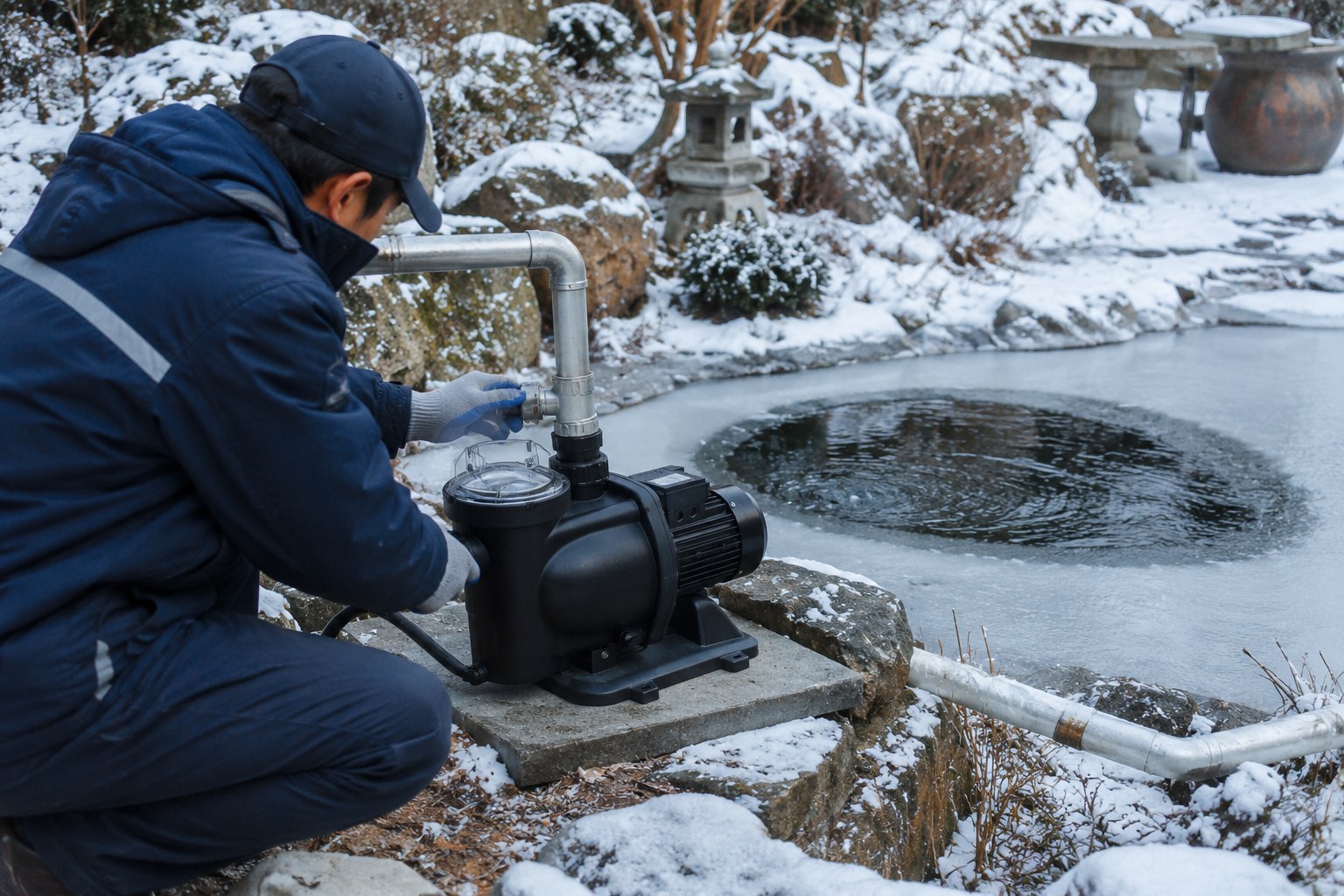
Deciding whether to run or store your pump is the most critical winter decision for any pond owner.
The choice you make has a direct impact on fish survival, equipment longevity, and your energy bills.
Understanding how cold weather affects your pump is the first step toward protecting your entire pond ecosystem.
This guide will walk you through the risks, benefits, and best practices for winter pump management.
How Pond Pumps Actually Behave in Cold Weather?
You assume your pump works the same year-round.
But cold water forces your pump's motor to work much harder.
This increases the risk of failure when your pond needs protection most.
In cold weather, water's viscosity increases, making the pump motor strain by up to 30%. Seals harden and become brittle, leading to leaks and pressure loss. Overall efficiency drops, and pumps not designed for winter can fail without warning, jeopardizing your pond's inhabitants.
The Science of Water Viscosity and Pump Strain
As water temperature drops towards freezing, its molecules move slower and pack closer together.
This makes the water physically "thicker" or more viscous.
For your pump, this means it has to exert significantly more force to move the same volume of water.
A pump motor that runs smoothly in summer can experience a load increase of 20-30% in near-freezing water.
This additional strain can lead to overheating, even in cold weather, and dramatically shortens the motor's lifespan.
| Temperature | Water Viscosity (mPa·s) | Impact on Pump |
|---|---|---|
| 20°C (68°F) | 1.002 | Normal Operation |
| 10°C (50°F) | 1.307 | ~30% Increased Resistance |
| 4°C (39°F) | 1.567 | ~56% Increased Resistance |
| 0°C (32°F) | 1.792 | ~79% Increased Resistance |
Seal Degradation in Freezing Temperatures
The seals and gaskets in your pond pump are typically made from rubber or flexible polymers.
These materials are designed to be pliable to create a watertight seal.
However, cold temperatures cause these materials to lose their elasticity and become hard and brittle.
A seal that could flex easily at 25°C might lose up to 50% of its flexibility at 0°C.
This hardening prevents the seal from compensating for pressure changes or vibrations, making leaks far more common.
Once a seal fails, water can enter the motor housing, causing catastrophic electrical failure.
The Impact on Filtration Efficiency
Your pond's health depends on effective filtration, which in turn depends on consistent water flow.
When your pump's flow rate is reduced by the combined effects of thick water and potential ice blockages, your filter suffers.
A 30% reduction in flow means 30% less water is being cleaned of ammonia and debris.
The beneficial bacteria in your biological filter receive less oxygen and food, causing their population to crash.
This can reduce your filter's overall effectiveness by more than 50%, allowing toxins to build up just when your fish are most vulnerable.
The Biggest Winter Risks to Your Pond Pump
An idle pump isn't just quiet.
It's a potential time bomb.
Internal freezing can crack vital components, leading to catastrophic failure without any warning.
The greatest winter risks are physical damage from ice expansion, which can crack housings and impellers, and electrical failure from moisture condensation. Ice expansion exerts enough pressure to split pump casings, while condensation can short-circuit motors and trip breakers unexpectedly.
The Destructive Power of Ice Expansion
Water has a unique property: it expands when it freezes.
When water turns to ice, its volume increases by approximately 9%.
If water is trapped inside your pump's housing, pipes, or impeller chamber, this expansion exerts immense force.
The pressure can easily exceed 30,000 pounds per square inch (PSI), far beyond the tensile strength of the PVC, ABS plastic, or even cast metal used in many pumps.
This is why winter failures are often so sudden and severe.
A pump can appear fine one day and have a completely split casing the next morning after a hard freeze.
This damage is almost always irreparable, requiring a full pump replacement.
Electrical Hazards: Condensation and Shorts
Winter brings constant temperature fluctuations.
A relatively mild, sunny day can be followed by a bitterly cold night.
This cycle causes condensation to form inside the pump's motor housing and electrical connection boxes.
Moisture is the enemy of any electrical component.
It can corrode connections, degrade wire insulation, and ultimately cause a short circuit.
In fact, the risk of a ground fault circuit interrupter (GFCI) tripping increases by over 60% in damp, cold conditions.
A tripped breaker may seem like a minor annoyance, but if it happens overnight and goes unnoticed, the lack of circulation can be fatal for your pond.
Overheating from Restricted Flow
It sounds like a paradox, but a pump can easily overheat in freezing weather.
Most submersible pumps rely on the surrounding water for cooling.
The water flowing through the pump carries heat away from the motor.
If the pump's intake or outlet becomes blocked by ice, slush, or debris, the flow of water stops.
Without this cooling medium, the motor's temperature will quickly rise.
The motor continues to try to spin, drawing power and generating heat, but with nowhere for that heat to go.
This can lead to melted internal components and a completely burned-out motor, even while the pump is surrounded by ice-cold water.
Should you leave a pond pump on all the time for fish?
You see your fish are dormant and assume they are fine.
But without water circulation, toxic gases are building up under the ice.
This creates a lethal, invisible trap they cannot escape.
Yes, you must leave the pump on 24/7 if you have fish. It is their life support system. It ensures constant oxygen exchange, prevents the deadly buildup of ammonia and other gases, and maintains a hole in the ice for their survival.
The Critical Role of Gas Exchange
Even though your fish are less active in winter, they are still respiring, producing carbon dioxide (CO2).
At the same time, any decaying organic matter at the bottom of the pond (leaves, leftover food) is releasing harmful gases like ammonia and hydrogen sulfide.
In a healthy pond, these gases escape at the surface, and fresh oxygen enters the water.
When a pond freezes over completely, it becomes a sealed container.
Harmful gases get trapped, and oxygen levels plummet.
Running a pump, even at a reduced flow, creates enough water movement to keep a small area of the surface ice-free.
This hole is a vital lifeline, allowing toxic gases to vent and life-giving oxygen to dissolve into the water.
A completely sealed pond can see oxygen levels drop below the critical 5 mg/L survival threshold in just 48-72 hours.
Preventing Thermal Stratification Disruption
Ponds naturally form thermal layers in the winter.
The water at the very bottom is often the warmest, typically around 4°C (39°F), because water is densest at this temperature.
Your fish instinctively gather in this deeper, warmer zone to conserve energy and survive the cold.
A common and dangerous mistake is leaving the pump on the bottom of the pond.
This will draw the warmest water from the bottom and circulate it to the freezing surface, effectively super-chilling the entire water column.
This disrupts the natural thermal refuge for your fish and can reduce survival rates by as much as 75%.
The correct strategy is to reposition your pump.
| Pond Depth | Recommended Winter Pump Placement | Purpose |
|---|---|---|
| < 3 feet (Shallow) | Raise pump 12 inches off the bottom | Circulate surface without chilling the entire pond |
| 3-5 feet (Medium) | Place pump on a shelf or block, 18-24 inches below the surface | Maintain gas exchange while preserving the warm bottom layer |
| > 5 feet (Deep) | Place pump in the middle of the water column | Ensure adequate surface movement without disturbing the deep thermal refuge |
By moving the pump up, you circulate the upper and middle layers of water, ensuring oxygenation and an ice-free hole, while leaving the warmer, still water at the bottom undisturbed for your fish.
How Winter Impacts Energy Consumption and Pump Efficiency?
Your winter electricity bill is already a concern.
An inefficient pump struggling against the cold is a hidden energy hog.
It costs you more money for less performance every hour it runs.
Winter conditions dramatically increase energy consumption. The combination of colder, thicker water and potential ice friction can force a pump to work 20-40% harder. This means your pump uses significantly more electricity while producing less water flow, resulting in higher bills and poor efficiency.
Quantifying the Efficiency Loss
The relationship between motor load, energy use (in watts), and water flow (in gallons per hour or GPH) is direct.
In winter, the increased load from viscous water forces the motor to draw more power to maintain its rotational speed.
However, even with this increased power draw, the resistance is so great that the actual volume of water moved decreases.
Consider a typical 100-watt asynchronous pond pump:
- In Summer (20°C water): It might draw 100 watts and produce 3,000 GPH of flow.
- In Winter (2°C water): The same pump might draw 125 watts (a 25% increase) but only produce 2,200 GPH of flow (a 27% decrease).
You are paying 25% more for electricity to get 27% less performance.
This inefficiency is a hidden cost that adds up over the entire winter season.
The Advantage of Modern Motor Technology
This is where advancements in pump design make a significant difference.
Many conventional pumps use older, less efficient AC asynchronous motors, which often have an efficiency rating of only 50-70%.
This means up to half the electricity they consume is wasted as heat, not used for moving water.
In contrast, modern high-efficiency pumps utilize Brushless DC (BLDC) permanent magnet motors.
These motors are engineered for peak performance, with efficiencies often exceeding 90%.
The core of this technology is a rotor made with powerful permanent magnets, which eliminates the energy loss associated with energizing a traditional rotor.
Even under the increased load of cold-water pumping, a BLDC motor maintains its high efficiency, translating directly into energy savings.
A pump with a BLDC motor might see its energy consumption increase by only 5-10% in winter, compared to the 25-40% increase seen in older designs.
Smart Controllers for Optimal Performance
The smartest pumping systems pair high-efficiency motors with intelligent controllers.
For solar-powered pumps, this is often an MPPT (Maximum Power Point Tracking) controller.
This device constantly analyzes the power available from the solar panels and the load on the pump motor.
It then adjusts the pump's operating parameters (voltage and current) to find the "sweet spot" that maximizes water output for the available energy.
In winter, when sunlight may be weaker, an MPPT controller can improve the total daily water output by up to 30% compared to a system without one.
For grid-powered pumps, similar variable frequency drive (VFD) controllers can adjust the pump's speed based on need, reducing power consumption during periods of lower demand and preventing motor stalls from ice blockages.
Storing Your Pump For The Winter
You've decided to turn your pump off for the winter.
Just pulling it out and tossing it in the shed is a costly mistake.
That's a recipe for a cracked, seized, and useless pump come springtime.
If you choose not to run your pump, you must store it correctly. Flush it with clean water, dry it out completely, or submerge it in a bucket of water in a frost-free area. Proper storage prevents seals from drying out and cracking and stops moisture from causing internal damage.
The Dry Storage Method
This method is effective if you have a warm, dry place for storage.
Proper execution is key to preventing damage.
- Step 1: Flush Thoroughly. Run the pump in a bucket of clean, fresh water for several minutes to flush out any pond sludge, algae, or debris.
- Step 2: Drain Completely. This is the most critical step. Tilt the pump at various angles to drain all water from the housing and impeller chamber. Use a shop vacuum or pressurized air to blow out any residual water trapped inside. Remember, any water left behind can freeze and crack the pump.
- Step 3: Clean and Dry. Wipe down the exterior of the pump and the power cord.
- Step 4: Store Properly. Place the pump in a dry, temperature-controlled location like a basement or heated garage. Avoid areas with high humidity or extreme temperature swings. Storing it in its original box can help keep it clean and protected.
The Wet Storage Method
Many professionals prefer this method because it keeps the seals and O-rings lubricated, preventing them from drying out, shrinking, and cracking over the winter.
A dry seal is far more likely to fail upon startup in the spring.
- Step 1: Flush Thoroughly. Just as with dry storage, clean the pump by running it in fresh water.
- Step 2: Submerge for Storage. Place the pump in a bucket or tub.
- Step 3: Fill with Water. Fill the container with clean water until the pump is completely submerged. Adding a small amount of pond water treatment can help prevent stagnation.
- Step 4: Store in a Frost-Free Location. The absolute most important part of this method is to store the container in a location where the water will not freeze, such as a basement. A frozen bucket will damage the pump just as surely as leaving it in the pond.
Pre-Season Restart Checklist
When spring arrives, don't just toss the pump back in the pond.
Following a quick checklist can prevent immediate failure and ensure a long service life.
| Check | Action | Why It's Important |
|---|---|---|
| Impeller | Try to spin the impeller by hand. It should move with slight resistance. | Ensures the impeller and mechanical seal are not seized from storage. |
| Lubricating Oil | For oil-filled pumps, check and change the oil. It should be clear, not milky. | Milky oil indicates a seal failure and the presence of water, which requires repair before use. |
| Power Cord | Carefully inspect the entire length of the power cord for any cracks, nicks, or brittleness. | A damaged cord is an extreme electrical hazard and must be replaced. |
| Insulation | (For professionals) Check motor insulation resistance with a megohmmeter. It should be >20 MΩ. | Confirms no moisture has compromised the motor's electrical windings. |
Choosing the Right Pump for Year-Round Performance
Using a cheap, summer-only pump in the winter is a risky gamble.
The wrong materials can corrode, wear out, or crack.
This leaves your pond's ecosystem vulnerable when it is most fragile.
The best pump is one engineered for your specific environment. Key factors include water depth, sand content, and corrosiveness. Pumps with stainless steel screws, wear-resistant impellers, or corrosion-proof bodies offer far superior reliability and performance for year-round operation.
For Deep Water Sources and High Head
For applications requiring water to be lifted from significant depths, a standard centrifugal pump can struggle.
This is where a solar screw pump, also known as a progressing cavity pump, excels.
This design uses a rotating stainless-steel screw (rotor) inside a rubber housing (stator).
As the screw turns, it creates sealed cavities of water that are pushed progressively upwards.
This mechanism generates very high pressure, or head, making it ideal for deep wells or pushing water long distances.
While their flow rate is generally lower than centrifugal pumps, their ability to handle sand and silt without significant wear makes them exceptionally durable in less-than-perfect water conditions.
For High Flow and General Agricultural Use
When the priority is moving a large volume of water for applications like farm irrigation or filling large ponds, a multi-stage centrifugal pump is often the best choice.
Models equipped with high-quality plastic impellers offer a fantastic balance of performance and value.
These impellers are engineered from durable, wear-resistant polymers that can handle water with fine sand content better than many metal alternatives.
They are lightweight and more economical, making them a popular choice for large-scale agricultural and domestic water supply projects.
Their limitation is in highly corrosive water or extreme deep-well applications, where more robust materials are needed.
For Harsh, Corrosive, and Premium Applications
In environments with acidic or alkaline water, or in coastal areas with saltwater intrusion, standard pumps can fail in a matter of months.
For these demanding conditions, a pump constructed with premium materials is not a luxury; it's a necessity.
A solar stainless steel impeller pump is the ultimate solution for durability.
These pumps feature impellers, diffusers, and sometimes the entire pump body crafted from high-grade SS304 or even SS316 stainless steel.
This material offers exceptional resistance to corrosion, rust, and abrasion, ensuring a long and reliable service life in the harshest water conditions.
While the initial cost is higher, their longevity and reliability provide a superior long-term return on investment for high-value applications.
| Pump Type | Best Application | Flow Rate | Pumping Height (Head) | Sand Resistance | Primary Advantage |
|---|---|---|---|---|---|
| Screw Pump | Deep wells, domestic water | Low | Very High | Excellent | High pressure, durable |
| Plastic Impeller Pump | Farm irrigation, high volume | High | Medium | Good | High flow, economical |
| Stainless Steel Impeller Pump | Corrosive water, premium homes | High | Medium-High | Moderate | Ultimate corrosion resistance |
Conclusion
Preparing your pond pump for winter is not an optional task; it is an essential one.
Proper preparation and the right equipment will protect your investment, your pond's ecosystem, and your peace of mind.
FAQs
1. How do I keep my pond pump from freezing?
Use a pond de-icer near the pump, ensure constant water circulation, and raise the pump off the pond floor to avoid the coldest water near the surface.
2. Should I turn my pond filter off in winter?
No, if you are running your pump, you should also run your filter. It helps maintain water quality, though its biological activity will be greatly reduced in the cold.
3. What temperature should I turn my pond pump off?
There is no set temperature. The decision depends on pond depth and fish load. If you have fish, it's safer to keep the pump running with proper placement.
4. Do pond pumps use a lot of electricity?
It varies widely. Modern, energy-efficient pumps with BLDC motors use significantly less power than older, larger models. A small pump may use as little as 25 watts.
5. Can a pond pump be too powerful for a pond?
Yes. A pump that is too powerful can create excessive turbulence, disturbing fish and plants. It's important to match the pump's flow rate to the pond's volume.
6. How do I keep a hole in my pond ice without a heater?
Running a pond aerator or positioning your pump's outlet near the surface is very effective. The constant water movement will prevent a small area from freezing over.