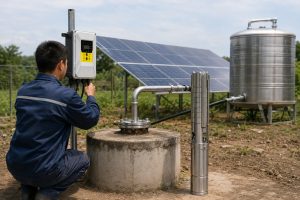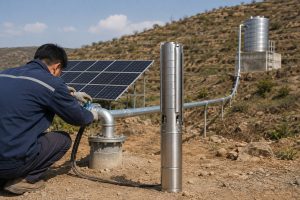
Struggling to get water from a deep well without reliable grid power?
The cost and complexity of traditional solutions can be overwhelming.
Solar pumps provide a powerful, independent, and cost-effective answer to this challenge.
A solar water pump's lifting height, known as "head," varies significantly based on its design. Surface pumps manage small lifts, while specialized submersible solar pumps can push water from depths exceeding 200 meters (656 feet), making them suitable for even the deepest wells.
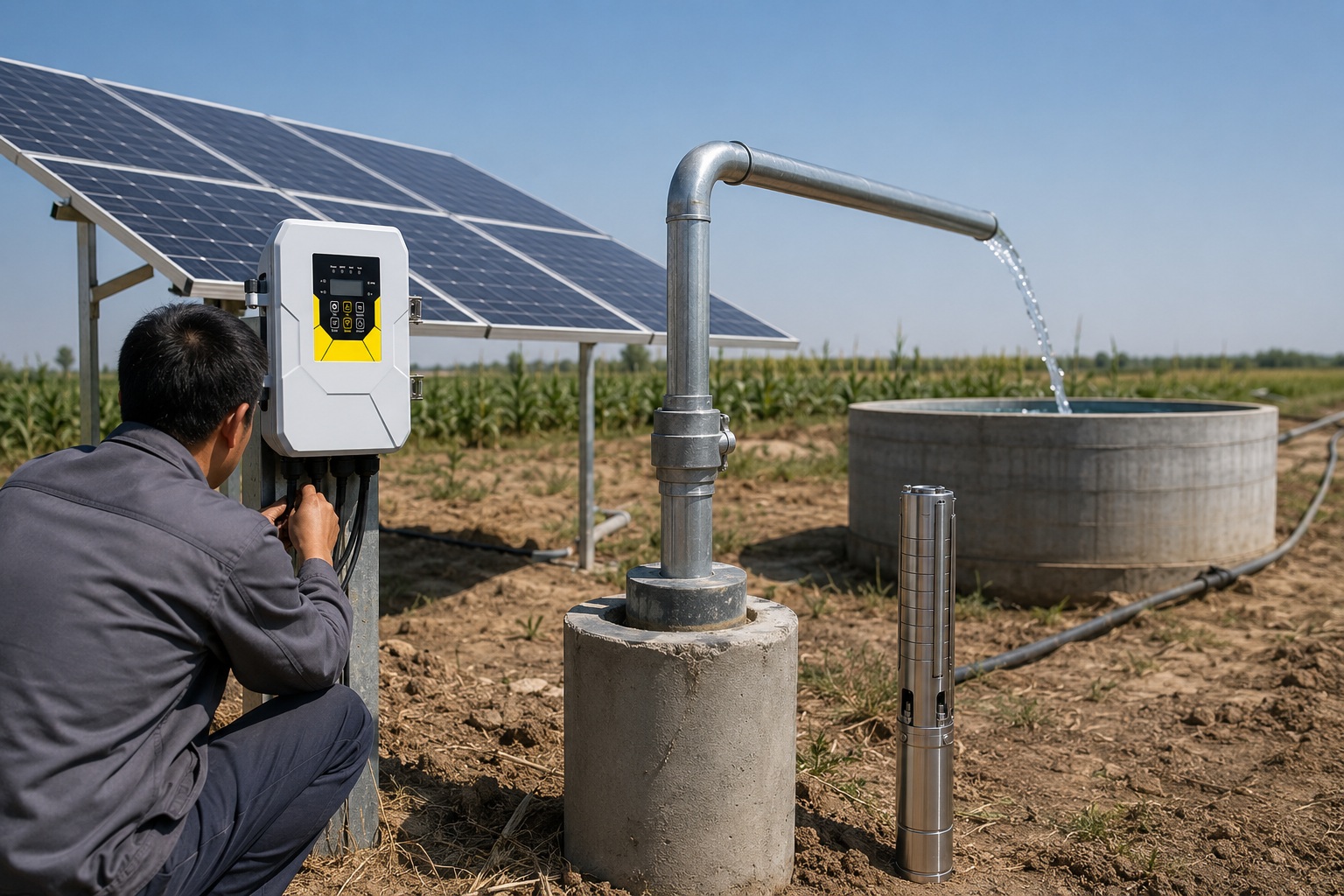
Understanding a pump's maximum lift is just the beginning.
To truly select the right system for your needs, whether for a home, farm, or entire community, you need to look closer.
The type of pump, the efficiency of its motor, and the overall system design all play critical roles.
Let's dive into the factors that determine exactly how high a solar pump can move water, ensuring you make an informed decision for a reliable water supply.
Understanding Pumping Head and Flow
Choosing the wrong pump leads to weak water pressure or, even worse, no water at all.
This is a frustrating and expensive mistake to fix.
Understanding the relationship between "head" and "flow" is the first step to preventing this.
Total Dynamic Head (TDH) is the total effective height a pump must overcome. It includes the vertical lift from the water source to the outlet, plus pressure losses from pipe friction. A pump's power creates a trade-off between its lifting height (head) and its water volume (flow).
The performance of any pump is defined by its ability to move a certain volume of water against a certain amount of pressure or height.
This relationship is not linear and is crucial for proper system design.
A pump that excels at lifting water 150 meters high will not be the same pump that delivers hundreds of liters per minute for surface irrigation.
Grasping these core concepts ensures you match the pump's capabilities to your specific application, avoiding underperformance and wasted investment.
Deconstructing "Total Dynamic Head" (TDH)
TDH is the most critical number in pump selection.
It's the total work the pump has to do.
It is composed of two main components: Static Head and Friction Head.
-
Static Head: This is the simple vertical distance from the surface of the water source (e.g., the water level in your well) to the highest point of the delivery pipe (e.g., the inlet of your storage tank).
-
Friction Head: Water moving through pipes creates friction, which the pump must overcome. This resistance is equivalent to adding extra vertical lift. It increases with pipe length, higher flow rates, and smaller pipe diameters. Using fittings like elbows and valves also adds to friction head.
For example, pumping 40 liters per minute (LPM) through 100 meters of 1-inch pipe might add 5 meters to your TDH.
Pumping the same flow through a 3/4-inch pipe could add over 15 meters to your TDH, demanding significantly more power.
The Inseparable Link: Head vs. Flow
Every pump has a performance curve that illustrates its capabilities.
This curve shows an inverse relationship between head and flow.
-
At its maximum head (also known as the "shut-off head"), the pump produces the highest pressure, but the water flow drops to zero.
-
At its maximum flow, the pump is moving the largest volume of water, but it can only do so against minimal head or pressure.
Your goal is to select a pump that operates efficiently in the middle of its curve, delivering your required flow rate at your calculated TDH.
| Application | Static Head | Required Flow | Best Pump Characteristic |
|---|---|---|---|
| Deep Well for a Home | 90 meters | 25 LPM | High Head, Low Flow |
| Livestock Watering | 40 meters | 50 LPM | Medium Head, Medium Flow |
| Field Irrigation | 15 meters | 200 LPM | Low Head, High Flow |
Converting Pressure to Head
If your system includes a pressure tank or requires pressurized output for sprinklers, this pressure must be converted into an equivalent head and added to your TDH.
The conversion is straightforward.
Every 1 PSI of pressure is equivalent to lifting water 2.31 feet, or 0.704 meters.
So, pressurizing a tank to 40 PSI is the same as adding another 28 meters (40 PSI x 0.704) of head for the pump to overcome.
This is why a pump rated for 100 meters of lift might only be suitable for a 70-meter well if it's also feeding a pressure tank.
Types of Solar Pumps and Their Lift Capabilities
You have a deep well, but which solar pump can actually reach the water?
The options can be confusing and lead to the wrong choice.
Let's clarify which pump is right for your depth and water needs.
Solar pumps are mainly categorized by their mechanism. Screw pumps (positive displacement) excel at very high head (over 150m) with lower flow. Centrifugal pumps, using either plastic or stainless steel impellers, deliver much higher flow rates but at low-to-medium heads (typically up to 120m).
The pump's internal design directly dictates its performance profile.
There is no single "best" pump; there is only the best pump for a specific application.
Choosing the correct type is the foundation of a reliable and efficient solar water system.
A screw pump might be the only viable option for a 180-meter-deep borehole, but it would be a poor choice for flood irrigation.
Conversely, a high-flow centrifugal pump would fail to lift water from that same deep borehole.
Let's break down the three most popular types of solar deep-well pumps.
Solar Screw Pumps: The Deep Well Specialist
This pump type is a form of positive displacement pump.
It uses a single helical rotor (a stainless steel screw) that rotates inside a resilient stator (a rubber housing).
As the screw turns, it forms a series of sealed cavities that move progressively up the pump, pushing the water ahead of them.
This mechanism allows it to build immense pressure.
-
Performance: Screw pumps are defined by their ability to generate very high head, often exceeding 200 meters (656 feet). Their flow rate, however, is relatively low, typically in the range of 10 to 40 liters per minute.
-
Applications: They are the ideal solution for deep well domestic water supply, remote livestock watering troughs, and small-scale, high-pressure drip irrigation.
-
Key Advantage: Their design makes them exceptionally resistant to abrasion from sand and sediment. They can often handle water with up to 5% sand content without rapid wear, a condition that would destroy a centrifugal pump.
Solar Centrifugal Pumps (Plastic Impeller): The High-Flow Workhorse
These are multi-stage pumps.
They feature a series of impellers stacked on a single shaft.
As water enters, each impeller spins at high speed, using centrifugal force to throw the water outward and into the next stage at a higher pressure.
Each stage adds to the total head.
-
Performance: Plastic impeller pumps are designed for high flow rates, easily delivering 50 to 200+ liters per minute. Their head is typically in the low-to-medium range, usually maxing out around 80 meters (262 feet).
-
Applications: They are perfect for farm irrigation, filling ponds and large storage tanks, and general-purpose water transfer where volume is more important than extreme pressure.
-
Key Advantage: Pumps with engineered plastic impellers are lightweight, highly cost-effective, and offer excellent wear resistance against fine sand, making them a versatile choice for many agricultural regions.
Solar Centrifugal Pumps (Stainless Steel Impeller): The Durable Performer
This pump operates on the same multi-stage centrifugal principle as the plastic impeller model.
The key difference is the material.
It utilizes impellers, diffusers, and often the pump body made from SS304 or SS316 stainless steel.
This construction is specifically for challenging water conditions.
-
Performance: They offer high flow rates similar to plastic impeller models but can often achieve higher heads, reaching up to 120 meters (394 feet) or more.
-
Applications: They are essential in areas with corrosive water (acidic or alkaline pH), for high-end residential systems where longevity is paramount, and in any application demanding maximum reliability.
-
Key Advantage: The stainless steel construction provides superior resistance to corrosion and abrasion, leading to a significantly longer service life. In mildly corrosive water, a stainless steel impeller can outlast a plastic one by over 30%.
| Pump Type | Maximum Head (Approx.) | Typical Flow Rate | Key Advantage |
|---|---|---|---|
| Solar Screw Pump | >200 m (656 ft) | Low (10-40 LPM) | Extreme Depth & Sand Resistance |
| Plastic Impeller Pump | ~80 m (262 ft) | High (50-200+ LPM) | High Flow & Cost-Effective |
| Stainless Steel Impeller Pump | ~120 m (394 ft) | High (50-200+ LPM) | Durability & Corrosion Resistance |
The Engine Behind the Lift: BLDC Motors and Controllers
A great pump is useless without an efficient motor to drive it.
Using an inefficient motor is like trying to fill a bucket with a hole in it; you waste precious solar power.
The right motor and controller are the core components that unlock a pump's full potential.
Modern solar pumps are powered by high-efficiency Brushless DC (BLDC) permanent magnet motors, which convert over 90% of electrical energy into mechanical power. They are paired with MPPT controllers that optimize the solar panel output, boosting daily water delivery by up to 50%.
The true "magic" of a solar pumping system lies in the synergy between its motor and its electronic brain, the controller.
This combination determines how effectively the system harvests and uses the sun's energy.
An advanced motor and controller can mean the difference between having water only on perfectly sunny days and having a reliable supply from dawn until dusk, even under cloud cover.
It’s this technological core that reduces the number of solar panels needed and lowers the overall system cost.
Why BLDC Motors are the Industry Standard
Brushless DC (BLDC) motors have revolutionized solar pumping for several key reasons.
-
Extreme Efficiency: BLDC motors consistently achieve efficiencies above 90%. In contrast, older brushed DC motors or standard AC motors might operate at 60-75% efficiency. This 15-30% efficiency gain means you can pump the same amount of water with significantly fewer solar panels, directly reducing upfront costs by up to 25%.
-
High Power Density: They utilize powerful permanent magnets (like neodymium iron boron) to generate high torque in a compact size. A BLDC motor can be up to 40% smaller and lighter than a traditional motor of equivalent power, which dramatically simplifies well installation.
-
Unmatched Reliability: The "brushless" design means there are no physical brushes to wear out, arc, or require replacement. This results in a virtually maintenance-free motor with a service life that often exceeds 10 years of continuous operation.
The Smart Brain: The MPPT Controller
The controller is far more than a simple on/off switch.
High-quality systems use a Maximum Power Point Tracking (MPPT) controller.
It acts like a sophisticated automatic transmission between the solar panels and the pump motor.
-
Function: Solar panels produce their maximum power at a specific voltage and current. This "maximum power point" changes constantly with sunlight intensity. The MPPT controller continuously adjusts the electrical load to ensure the panels are always operating at this peak efficiency point.
-
Benefit: By optimizing the power harvest, an MPPT controller allows the pump to start earlier in the morning, run later in the evening, and continue pumping during overcast conditions. This can increase the total volume of water pumped per day by 25% to 50% compared to a system without MPPT.
Advanced Control for 24/7 Water Security
The most advanced controllers offer hybrid functionality.
They are designed with inputs for both DC (solar) and AC (grid or generator) power.
The controller prioritizes using the free energy from the sun.
If sunlight fades due to heavy clouds or nightfall, the controller can automatically blend in or switch entirely to the AC power source.
This ensures a completely uninterrupted water supply, providing the best of both worlds: the cost savings of solar and the 24/7 reliability of the grid.
System Design: Optimizing Your Pumping Height
You know the pump's potential, but a poor setup can cripple its performance.
Incorrect installation wastes energy, reduces water flow, and shortens the pump's lifespan.
Proper system design is just as crucial as selecting the right pump model.
To optimize performance, a submersible pump should be set just below the well's lowest expected water level (the "drawdown" level), not at the bottom. Using correctly sized, low-friction pipe and a large pressure tank will significantly reduce energy consumption and improve system longevity.
Getting the most out of your investment goes beyond the pump itself.
The physical layout of your water system—from the depth of the pump to the diameter of your pipes—has a massive impact on efficiency and reliability.
A well-designed system will deliver more water with less power, saving you money and ensuring a consistent supply for years to come.
Thoughtful planning during the installation phase prevents costly and difficult adjustments later.
The Critical Decision: Setting Pump Depth
Installers accustomed to powerful AC pumps often place them near the bottom of the well.
This is a mistake with many DC solar pumps.
-
The Problem with Excessive Depth: Positive displacement pumps (like screw pumps) experience increased internal stress from high submergence pressure, which can reduce their operational lifespan. Furthermore, every extra meter of depth requires longer, thicker, and more expensive electrical cable to mitigate voltage drop.
-
The Optimal Strategy: For a well with a strong, consistent water supply, the pump should be set just 5 to 10 feet (1.5 to 3 meters) below the static (non-pumping) water level. For wells with a lower yield, you must first determine the "drawdown" level—the level the water drops to during pumping—and set the pump safely below that point to prevent it from sucking air. A driller's log or a pump test can provide this crucial data.
Pipe Sizing: Why Smaller Can Be Better
Another common mistake is using oversized pipe.
While it seems intuitive that a larger pipe would be better, it's often detrimental for low-flow DC solar pumps.
-
Velocity for Cleaning: A smaller diameter pipe (e.g., 3/4-inch) forces the water to flow at a higher velocity. This speed is essential for carrying sand and sediment up and out of the system. In a large 1.25-inch pipe, the slow-moving water allows sand to settle, accumulate, and cause abrasive damage to the pump.
-
Weight and Ease of Installation: Water is heavy. A 100-foot section of 1-inch pipe holds about 33 pounds (15 kg) of water, while a 1/2-inch pipe holds only 8.3 pounds (3.8 kg). Using smaller polyethylene pipe makes it possible for one or two people to install and service the pump by hand, without special equipment.
The Role of a Pressure Tank
For domestic water systems, a pressure tank is not just an accessory; it's a key component for efficiency.
-
Function: A pressure tank stores a reserve of water under pressure. When you open a faucet, this stored water is used first. The pump only turns on after a significant volume of water (e.g., 30 gallons from an 80-gallon tank) has been used.
-
Benefits: This dramatically reduces pump "cycling" (frequent starting and stopping), which is the biggest consumer of energy and a major cause of wear on the motor and switch.
-
Optimization: Use the largest pressure tank your budget and space allow. Set the pressure switch to the lowest practical range (e.g., 20-40 PSI instead of 40-60 PSI). Lower pressure means less "head" for the pump to work against, increasing its flow rate and further reducing energy consumption.
Conclusion
A solar pump's lift height depends on the pump type, motor efficiency, and total system design.
Choosing the right combination ensures a reliable, efficient, and long-lasting off-grid water solution.
FAQs
How many solar panels do I need for a water pump?
This depends on the pump's power rating and your location's sunlight.
A small 100W pump might need two 100W panels, while a 1500W pump could require ten 300W panels.
Can a solar water pump work at night?
Only if the system includes batteries for energy storage or a hybrid controller connected to an AC power source like the grid or a generator.
Direct solar systems only pump during daylight.
What is the life of a solar water pump?
A well-maintained system can last over 10 years.
The brushless motor often has a 10+ year lifespan, while pump ends may need servicing after 3-5 years depending on water quality.
Can solar pumps run without batteries?
Yes, most modern solar pumping systems are "solar-direct" and do not use batteries.
They pump water into a storage tank during the day for use at any time.
How deep can a 1hp solar pump lift water?
A 1 horsepower (approx. 750W) pump's lift depends on its type.
A centrifugal model might lift 150 GPM to 50 feet, while a screw pump model could lift 10 GPM to over 400 feet.
Do solar water pumps need a lot of sun?
They work best in full sun, but systems with MPPT controllers can still pump water effectively on overcast days or in low light, just at a reduced flow rate.
What happens if a solar pump runs dry?
Many modern solar pumps have run-dry protection.
Sensors in the well or logic in the controller will shut the pump off to prevent damage if the water level drops too low.
How do you size a solar water pump?
Sizing requires calculating your daily water need (gallons/day) and your Total Dynamic Head (TDH).
These two numbers allow you to select a pump and solar array to meet your requirements.