Struggling to understand pump specifications?
Confusing terms like P1 and P2 can make choosing the right equipment a challenge, leading to inefficient systems and wasted energy.
P1 is the total electrical power a pump motor draws from the source.
P2 is the mechanical power the motor delivers to the pump's shaft.
The difference between P1 and P2 represents the motor's energy loss, with the P2/P1 ratio defining its efficiency.
Understanding these power ratings is more than just technical jargon.
It's the key to unlocking a pump's true performance and operational cost.
Knowing the difference between the electricity you pay for (related to P1) and the work your pump actually does (related to P2) empowers you to make smarter, more efficient choices.
This is especially critical in off-grid applications like solar pumping, where every watt of power is precious.
Let's explore how these concepts apply to the core components of modern water systems.
The Core of Efficiency: Understanding BLDC Permanent Magnet Motors
Your pump motor is wasting energy and money.
Traditional motors often convert a significant portion of electricity into heat instead of power, inflating your operational costs.
The heart of an efficient pump is its motor.
A Brushless DC (BLDC) permanent magnet motor directly impacts the P1 to P2 conversion, achieving efficiencies over 90%, drastically reducing energy consumption and system costs.
A motor's primary job is to convert electrical energy (P1) into mechanical energy (P2).
The measure of how well it does this is called motor efficiency.
A higher efficiency means less energy is wasted as heat, and more power is available to drive the pump.
This is where BLDC permanent magnet motors create a significant advantage.
How BLDC Motors Maximize P2 from P1
BLDC motors eliminate the friction and energy loss associated with the "brushes" found in conventional motors.
By using powerful permanent magnets, like neodymium iron boron, they generate a stronger magnetic field with less electrical input.
This leads to a much better P1 to P2 power conversion ratio.
For example, if a 1000-watt (P1) traditional motor has an efficiency of 75%, it only delivers 750 watts of mechanical power (P2).
A BLDC motor with 92% efficiency would deliver 920 watts (P2) from the same 1000-watt input, a performance increase of over 22%.
Technical and Market Advantages
The high efficiency of BLDC motors has a cascading effect on the entire system.
Because they convert power so effectively, they require less input power (P1) to achieve the same shaft power (P2).
In solar-powered systems, this is a game-changer.
It means you can achieve your water pumping goals with a smaller, less expensive solar panel array.
This reduction in hardware can lower the initial system cost by 15-25%.
| Feature | Traditional Brushed Motor | BLDC Permanent Magnet Motor | Impact on P1/P2 |
|---|---|---|---|
| Efficiency | 60-75% | >90% | More P2 output for the same P1 input. |
| Rotor Design | Wound Copper | 40SH Neodymium Iron Boron | Higher torque, less energy to rotate. |
| Size & Weight | Larger & Heavier | Up to 47% smaller, 39% lighter | Simpler installation and logistics. |
| Maintenance | Requires brush replacement | Maintenance-free | Lower long-term operational cost. |
Ultimately, a motor with high P1-to-P2 conversion efficiency is the foundation of an economical and reliable pumping system.
It not only saves energy but also reduces capital expenditure and simplifies installation, making it the strategic core of modern pump technology.
Low Flow, High Head: The Solar Screw Pump in Action
Need to pump water from a very deep well?
Many pumps lose pressure and efficiency when faced with extreme depths, failing to deliver water where you need it most.
The solar screw pump is a specialized solution for high-head, low-flow applications.
It uses a progressive cavity design to efficiently move water from deep wells, making it ideal for domestic water supply and livestock watering in remote areas.
The screw pump, also known as a progressing cavity pump, operates differently from common centrifugal pumps.
It uses a helical stainless steel rotor spinning inside a rubber stator.
This action creates sealed cavities that move "progressively" up toward the outlet, pushing the water ahead of them.
This mechanism is exceptionally effective at generating high pressure, which is needed to overcome the high head (vertical lift) of deep wells.
P1 and P2 in High-Head Environments
For a screw pump, the relationship between P1 and P2 is all about maintaining performance under pressure.
The required shaft power (P2) is largely determined by the head.
As the well depth increases, the motor must provide more torque to turn the rotor against the immense weight of the water column.
A highly efficient BLDC motor is crucial here.
It can deliver the high, consistent torque needed without drawing excessive electrical power (P1).
Performance Metrics and Applications
Let's compare how a screw pump performs in its ideal scenario.
Imagine a well that is 150 meters deep.
A standard centrifugal pump might struggle to produce any flow at all, its efficiency dropping near zero.
A screw pump, however, is designed for this.
While its flow rate might be modest—perhaps 1,000 liters per hour—it maintains high operational efficiency.
It can handle water with higher sand content, a common issue in boreholes that can quickly destroy other pump types.
| Parameter | Screw Pump | Centrifugal Pump (similar power) | Analysis |
|---|---|---|---|
| Optimal Head | 80m - 200m+ | 20m - 80m | Screw pumps excel at high-lift applications. |
| Optimal Flow | Low (e.g., 0.5 - 2 m³/h) | High (e.g., 3 - 10 m³/h) | Specialized for pressure, not volume. |
| Sand Resistance | Excellent | Poor to Fair | The design passes solids without damage. |
| Typical Use | Deep well domestic supply, livestock | Farm irrigation, reservoir transfer | Matches application to pump strengths. |
This makes the screw pump a perfect fit for off-grid homes, remote villages, and livestock stations in regions like Africa and Latin America.
Even with a limited power supply from solar panels, the pump's efficient use of energy (P1) ensures a reliable supply of life-sustaining water from depths others can't reach.
Its primary limitation is its low flow rate, making it unsuitable for large-scale irrigation.
High Flow, High Wear-Resistance: The Solar Plastic Impeller Pump
Need to move a lot of water without a big budget?
Many high-flow pumps are either expensive or wear out quickly from sand and sediment, leading to costly replacements.
The solar plastic impeller pump is a multi-stage centrifugal pump that delivers high flow rates at a competitive price.
Its durable plastic impellers offer excellent resistance to fine sand, making it perfect for farm irrigation and general water supply.
This pump type is the workhorse of many solar water systems.
It uses a series of stacked impellers and diffusers.
Each stage adds pressure to the water, increasing the total head it can achieve.
The key innovation here is the use of engineered plastic for the impellers.
This material is not only cost-effective but also remarkably resilient against the abrasive action of fine sand, a common cause of pump failure.
Balancing Flow, Efficiency, and Cost
The design of a plastic impeller pump focuses on maximizing flow rate (cubic meters per hour) for a given power input (P1).
The efficiency curve of these pumps is typically centered around medium head and high flow conditions.
The motor's shaft power (P2) is used to spin the impeller stack at high speed, flinging water outwards with centrifugal force.
Because the impellers are lightweight, the motor requires less energy to start up and maintain speed, contributing to overall system efficiency.
Application Sweet Spot
These pumps are the go-to solution for applications where volume is more important than extreme pressure.
This includes irrigating small to medium-sized farms, watering pastures, and filling reservoirs.
Their high wear-resistance makes them particularly valuable in areas with sandy soil or river water sources, common in Africa and the Americas.
Let's consider a practical example: an 8-acre farm needs to be irrigated.
A screw pump's low flow would be inadequate.
However, a plastic impeller pump could deliver 8,000 liters per hour, easily meeting the demand.
| Feature | Plastic Impeller Pump | Stainless Steel Impeller Pump | Analysis |
|---|---|---|---|
| Cost | Economical | Premium | Plastic offers a lower entry cost. |
| Weight | Lightweight | Heavier | Easier handling and installation. |
| Fine Sand Resistance | Excellent | Good | Plastic can be more resilient to abrasion. |
| Corrosion Resistance | Good | Excellent | Stainless steel is superior for corrosive water. |
The main trade-off is durability in harsh water chemistries.
While excellent against sand, the plastic components may not last as long as stainless steel in highly acidic or alkaline water.
They are best suited for moderate depths and non-corrosive wells, providing a powerful and economical solution for agricultural and residential needs.
Premium and Corrosion-Resistant: The Solar Stainless Steel Impeller Pump
Is your well water aggressive or corrosive?
Standard pumps can quickly degrade in acidic or alkaline water, leading to frequent failures, contamination, and expensive replacements.
The solar stainless steel impeller pump is a premium solution for harsh water environments.
Built with SS304 stainless steel, it offers superior corrosion resistance, high durability, and reliable performance for high-value applications.
This pump is engineered for longevity and reliability where water quality is a challenge.
Every component that touches water, including the impellers, diffusers, and the pump body itself, is made from high-grade stainless steel (typically SS304 or SS316).
This construction prevents rust and degradation from water with high or low pH, high salinity, or other chemical impurities.
It ensures the water remains pure and the pump's service life is maximized.
The Power Dynamics of a Premium Build
From a power perspective, the stainless steel impeller pump operates on the same centrifugal principle as its plastic counterpart.
However, the materials and precision manufacturing can lead to enhanced hydraulic efficiency.
The smooth, rigid surfaces of the steel impellers can be shaped into more complex, efficient geometries, potentially improving the conversion of shaft power (P2) into water movement.
While the heavier impellers may require slightly more torque to get started, their stable, vibration-free operation at high speeds ensures efficient energy transfer.
The focus is on long-term, reliable performance, justifying a higher initial power draw (P1) for a pump that won't fail prematurely.
Where Uncompromising Quality is Required
These pumps are specified for applications where failure is not an option or where water quality is paramount.
This includes providing drinking water for high-end homes and resorts, supplying water in coastal regions with saltwater intrusion risk, or irrigating in areas with alkaline soil, such as parts of Australia and the Americas.
For a premium cattle ranch, ensuring a constant supply of clean, non-corrosive water is an asset.
The higher investment in a stainless steel pump is easily justified by avoiding downtime and potential harm to livestock.
| Parameter | Stainless Steel Impeller | Plastic Impeller | Analysis |
|---|---|---|---|
| Corrosion Resistance | Excellent | Good | SS304 is the superior choice for acidic/alkaline water. |
| Service Life | Very Long | Moderate to Long | Built to last in challenging conditions. |
| Initial Cost | Higher (approx. 30-50% more) | Lower | An investment in long-term reliability. |
| Target Market | High-end residential, special agriculture | General agriculture, standard residential | Matches the product to the application's value. |
The main limitation of the stainless steel impeller pump is its higher cost and weight.
It represents a higher-tier investment targeted at a niche segment of the market that prioritizes durability, reliability, and water purity over initial purchase price.
Beyond the Pump: The Role of Intelligent Controllers
Are you getting the most out of your solar panels?
Simply connecting panels to a pump leads to poor performance on cloudy days and a complete shutdown at non-peak hours.
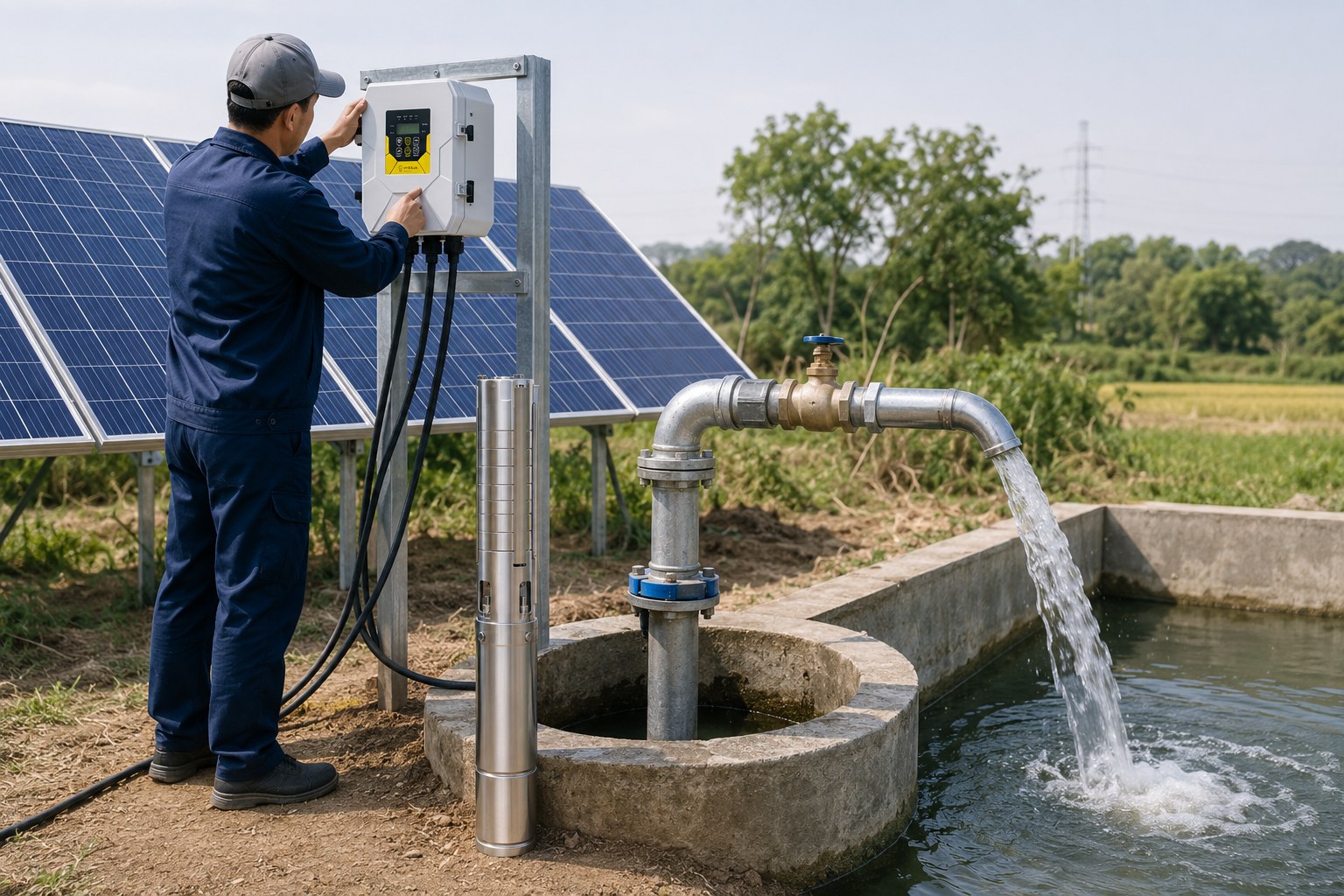
An intelligent MPPT controller is the brain of the solar pump system.
It optimizes the power from the solar panels to the motor, maximizing water output by up to 30% and enabling advanced features like hybrid power input.
A solar pump system's performance isn't just about the pump or the motor; it's about how they work together.
The controller manages the crucial link between the power source (P1 input) and the motor.
A standard controller might just turn the pump on or off.
An intelligent controller featuring Maximum Power Point Tracking (MPPT) continuously adjusts the electrical load to ensure the solar panels are always operating at their peak efficiency, regardless of sunlight intensity.
Maximizing the P1 Input
Solar panels have a non-linear output curve; their voltage and current change constantly with the sun's angle and cloud cover.
MPPT technology finds the "sweet spot"—the perfect combination of voltage and current—that extracts the absolute maximum power (P1) from the panels at any given moment.
This means the pump can start earlier in the morning, run longer into the evening, and continue to operate at reduced speed on overcast days.
This intelligence can boost the total daily water volume by as much as 30% compared to a system without MPPT.
Hybrid Functionality for 24/7 Operation
The most advanced controllers take this a step further with hybrid capabilities.
They are designed with inputs for both DC power (from solar panels) and AC power (from the grid or a generator).
This creates a seamless, worry-free water supply.
- Solar Priority: The controller will always prioritize using the free energy from the solar panels.
- Hybrid Blending: When solar power is insufficient (e.g., a cloudy spell), the controller can blend in AC power to maintain pump speed, maximizing the use of solar energy before fully switching.
- Automatic Switchover: When solar power is unavailable (e.g., at night), the controller automatically switches to the AC source to ensure the pump can run 24/7.
This technology transforms a solar pump from a daytime-only device into a reliable, all-hours utility.
It ensures that for critical applications like household water or livestock, water is always available, powered by the most economical source at any time.
The controller effectively manages the system's total P1, optimizing both cost and availability.
Conclusion
Understanding P1 and P2 is key to pump efficiency.
This knowledge, combined with the right pump type and an intelligent controller, ensures a powerful, cost-effective, and reliable water solution.
FAQs
What is P1 and P2 motor power?
P1 is the electrical input power the motor consumes.
P2 is the mechanical output power the motor delivers to the pump shaft after internal energy losses.
What is the formula for P1 and P2?
There isn't a single formula for them, as they are measured values.
However, their relationship defines motor efficiency: Efficiency (%) = (P2 / P1) * 100.
Is P1 input or output?
P1 is the electrical power input to the motor.
It represents the energy consumption you pay for from the grid or generate with solar panels.
What is P3 in a pump?
P3 is the hydraulic power, which is the actual work done on the water.
It's calculated from the flow rate and pressure (head) the pump produces.
How do you calculate pump efficiency from P1 and P2?
You calculate motor efficiency with P1 and P2.
The pump's own hydraulic efficiency is calculated as (P3 / P2), representing how well it converts shaft power into water movement.
What is a good pump efficiency rating?
For the total system (wire-to-water), over 50% is considered good.
High-efficiency systems with BLDC motors and optimized pumps can exceed 65-70% overall efficiency.
Why is motor efficiency important?
Higher motor efficiency means less wasted electricity (lower P1 for the same P2).
This reduces operating costs, and in solar systems, it lowers the required number of panels.