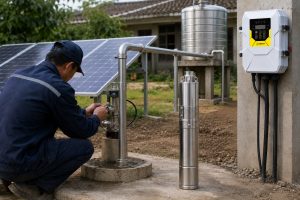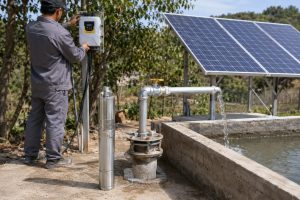
Struggling with unreliable water access in off-grid areas?
The high cost and unavailability of grid power make traditional pumping impossible.
Solar water pumps offer a green, cost-effective, and dependable solution.
**Solar water pumps are primarily categorized by their motor type: DC (Direct Current) and AC (Alternating Current).
DC pumps run directly from solar panels, while AC pumps use an inverter.
Each type offers distinct advantages for various applications, from small homes to large-scale agriculture.**
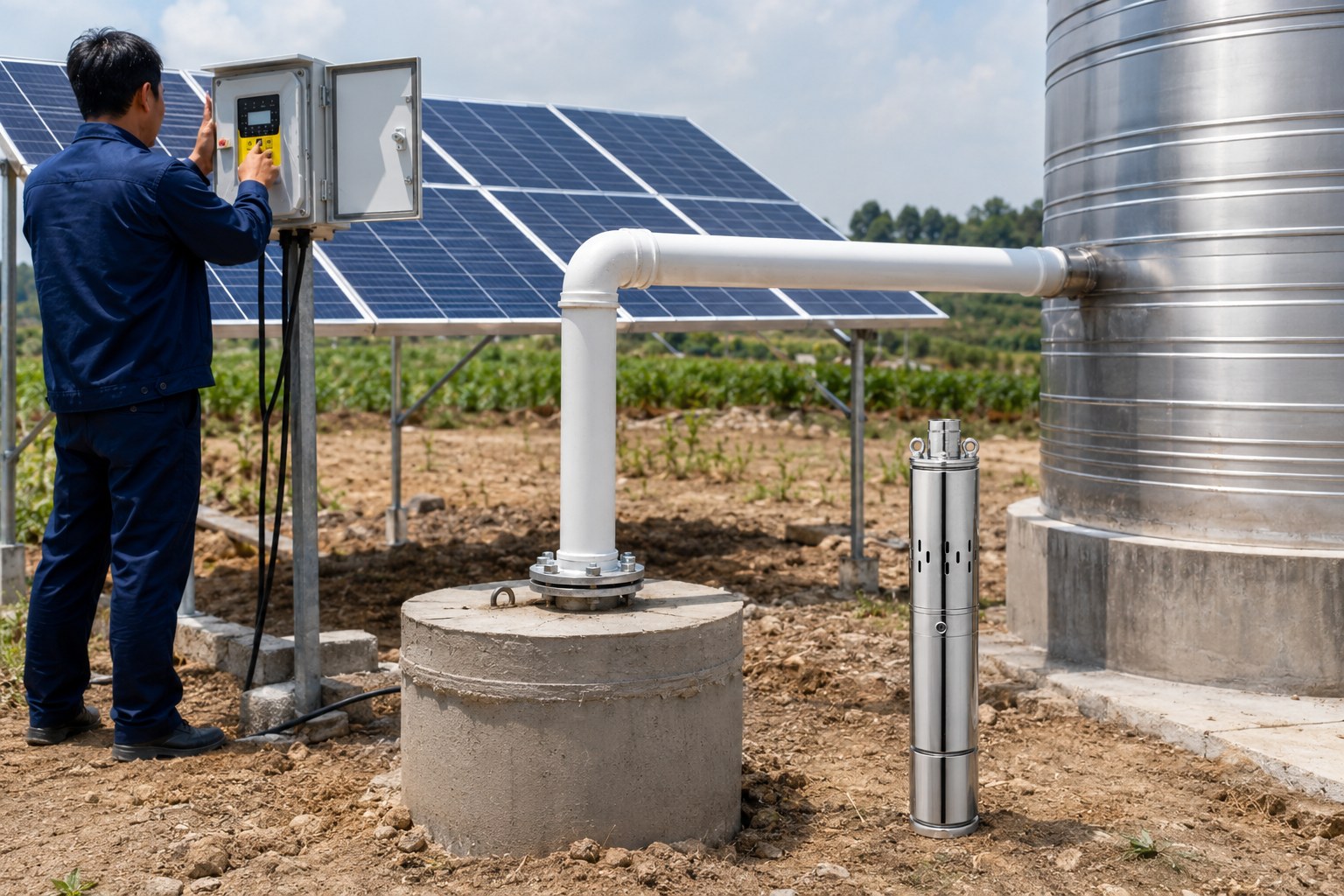
Understanding the core differences between these pump types is the first step toward selecting a reliable and efficient water solution.
You need a system that matches your specific water source, output requirements, and environmental conditions.
This guide will break down the crucial details of each pump type.
We will explore their mechanics, ideal applications, and the technology that powers them.
This will help you make an informed decision for your home, farm, or business.
What are the types of DC solar water pumps?
**Need a versatile pump for a specific deep-well application?
DC solar pumps come in several designs, each tailored to different flow rates and water depths, like screw or impeller pumps.
Your choice depends on your well's depth, required water volume, and water quality.
This ensures optimal performance and a longer system lifespan.**
DC solar pumps are the backbone of off-grid water systems.
Their efficiency comes from running directly on the power generated by solar panels, without the energy loss associated with an inverter.
However, not all DC pumps are created equal.
The pump head mechanism is the key differentiator, directly impacting performance.
The three most popular types are solar screw pumps, plastic impeller pumps, and stainless steel impeller pumps.
Let's examine how each one works.
Solar Screw Pump: High Head Specialist
Solar screw pumps, also known as progressive cavity pumps, are engineered for high-head, low-flow applications.
They operate using a single helix-shaped stainless steel rotor that rotates inside a double-helix rubber stator.
This motion creates sealed cavities that move water upward with each turn.
This compression-based mechanism allows the pump to generate immense pressure, pushing water from very deep wells.
It makes them an ideal choice for domestic water supply, livestock watering troughs, and small-scale drip irrigation in regions where groundwater levels are low.
| Feature | Solar Screw Pump |
|---|---|
| Pumping Mechanism | Positive Displacement (Screw) |
| Best For | High Head, Low Flow |
| Typical Head Range | Up to 200 meters (650 feet) |
| Typical Flow Rate | 0.5 - 3 m³/hour |
| Sand Resistance | Excellent (Can handle >5% sand content) |
| Ideal Application | Deep domestic wells, livestock watering |
A key advantage is their exceptional sand resistance.
The rubber stator can flex to allow sand particles to pass without causing significant wear, outperforming centrifugal pumps in silty or sandy wells.
Their main limitation is the lower flow rate, which makes them less suitable for large-scale agricultural irrigation that demands high water volume.
Solar Plastic Impeller Pump: High Flow Workhorse
This pump is a multi-stage centrifugal pump.
It uses a series of durable, wear-resistant plastic impellers stacked vertically.
As the motor spins, each impeller draws water in and pushes it to the next stage at a higher pressure.
This compounding effect allows the pump to deliver a very high flow rate at a moderate head.
It is perfect for applications demanding large water volumes, such as farm irrigation, pasture management, and residential community water supplies.
| Feature | Solar Plastic Impeller Pump |
|---|---|
| Pumping Mechanism | Multi-stage Centrifugal |
| Best For | High Flow, Medium Head |
| Typical Head Range | 40 - 120 meters (130 - 390 feet) |
| Typical Flow Rate | 3 - 15 m³/hour |
| Sand Resistance | Good (Handles fine sand effectively) |
| Ideal Application | Farm irrigation, large gardens |
These pumps offer a fantastic balance of performance and cost.
The use of engineered plastic impellers makes them lightweight and more economical than their stainless steel counterparts.
They also show excellent resistance to fine sand, thanks to the durable material composition.
However, in highly corrosive water (acidic or alkaline) or extremely deep wells where pressure is immense, their durability may be compromised compared to stainless steel models.
Solar Stainless Steel Impeller Pump: The Premium Choice
For the most demanding environments, the solar stainless steel impeller pump is the ultimate solution.
This model uses impellers and a pump body crafted from high-grade SS304 or SS316 stainless steel.
Like the plastic version, it is a multi-stage centrifugal pump designed for high flow rates.
Its primary advantage is superior corrosion resistance.
It is specifically built to handle acidic or alkaline water conditions, making it indispensable in areas with aggressive water or alkaline soil.
| Feature | Solar Stainless Steel Impeller Pump |
|---|---|
| Pumping Mechanism | Multi-stage Centrifugal |
| Best For | High Flow, High Corrosion Resistance |
| Typical Head Range | 50 - 150 meters (165 - 490 feet) |
| Typical Flow Rate | 3 - 18 m³/hour |
| Corrosion Resistance | Excellent (SS304/SS316) |
| Ideal Application | Saline/brackish water, high-end homes |
This pump is favored for high-end residential water systems, commercial operations, and in regions like Australia or parts of the Americas where water quality can be harsh.
The robust construction ensures a longer service life and higher reliability under challenging conditions.
The main trade-offs are its higher initial cost and increased weight, positioning it as a premium option for specialized markets.
What motor is best for solar pumps?
**Wondering what makes a solar pump truly efficient?
The motor is the heart of the system.
A high-efficiency motor maximizes the electricity from your solar panels, delivering more water with less power.
It directly translates to lower costs and better performance.
The Brushless DC (BLDC) permanent magnet motor is the industry-leading technology, offering unmatched efficiency.**
While the pump head (screw or impeller) determines how water is moved, the motor dictates how efficiently solar energy is converted into mechanical force.
For solar applications, where every watt counts, motor efficiency is paramount.
An inefficient motor requires more solar panels to do the same amount of work, significantly increasing the system's overall cost and footprint.
This is why the choice of motor technology is a critical factor for both distributors and end-users.
It forms the core of a competitive solar pump system.
BLDC Permanent Magnet Motor: The Core of Efficiency
Modern, high-performance solar water pumps all rely on Brushless DC (BLDC) permanent magnet motors.
Unlike traditional brushed motors that suffer from friction and wear, BLDC motors use electronic commutation, resulting in dramatically higher efficiency and a longer lifespan.
These motors achieve efficiencies exceeding 90%, compared to the 60-75% efficiency of conventional AC or brushed DC motors.
This means over 90% of the solar energy delivered to the motor is converted into rotational power to drive the pump.
| Motor Type | Typical Efficiency | Maintenance | Lifespan |
|---|---|---|---|
| BLDC Permanent Magnet | >90% | None | Long |
| Conventional AC Motor | 65-80% | Low | Moderate |
| Brushed DC Motor | 60-75% | High (Brush Replacement) | Short |
Key Technical Advantages
The superior performance of BLDC motors comes from their advanced design.
-
High-Strength Magnets: The rotor is constructed from high-energy permanent magnets, often neodymium iron boron (NdFeB). These magnets generate a powerful magnetic field, producing high torque with less electrical input.
-
Compact and Lightweight Design: The high power density allows for a much smaller and lighter motor. A BLDC motor can be up to 47% smaller and 39% lighter than a traditional motor with the same power output. This simplifies installation, especially in deep wells, and reduces shipping costs.
-
Maintenance-Free Operation: With no brushes to wear out, these motors are virtually maintenance-free. This is a crucial advantage for pumps installed in remote, hard-to-access locations.
-
Wider Operating Range: BLDC motors maintain high efficiency across a wide range of speeds and loads. This allows them to work effectively even during periods of low sunlight, starting earlier in the day and stopping later.
Market Value for Distributors and Users
The adoption of BLDC motors creates significant market value.
For distributors, it means offering a technologically superior product.
The high efficiency reduces the number of solar panels needed by up to 25%, lowering the total system cost and making your offering more competitive.
For end-users, the benefits are clear: more water pumped per day, lower initial investment, and a reliable, long-lasting system with zero maintenance headaches.
Ultimately, the BLDC motor is the strategic component that elevates a solar pump from a simple device to a highly efficient and economically viable water solution.
How do I choose a pump controller?
**Are you getting the most out of your solar panels?
A smart pump controller is the brain of your system, ensuring every ray of sun is used effectively.
It optimizes power, protects your pump from damage, and can even switch to backup power sources.
Without it, you are losing water and risking your investment.**
A solar water pump system is more than just a pump and panels.
The controller is a vital component that manages the entire operation.
Its primary job is to match the power output of the solar panels to the pump's motor, a process managed through a technology called Maximum Power Point Tracking (MPPT).
An advanced controller can increase the water output of your system by up to 30% compared to a system without one.
It ensures the pump operates at its most efficient speed under varying sunlight conditions.
Furthermore, it provides critical protection features that safeguard your investment.
Maximum Power Point Tracking (MPPT)
Solar panels have a specific voltage and current at which they produce the most power—the "maximum power point."
This point changes throughout the day with the intensity of sunlight and temperature.
An MPPT controller continuously tracks this point and adjusts the electrical load to extract the maximum available power from the solar array at all times.
- Morning/Evening/Cloudy Days: The controller lowers the pump's speed to match the reduced power, ensuring it can still pump water instead of shutting down completely.
- Midday/Full Sun: The controller allows the pump to run at full speed, maximizing water output when solar energy is abundant.
Without MPPT, the pump motor connects directly to the panels.
This creates a power mismatch that forces the panels to operate inefficiently, drastically reducing the total water pumped.
Essential Protection Functions
A quality solar pump controller does more than just optimize power; it also protects the system from common electrical and operational faults.
| Protection Feature | Function | Benefit |
|---|---|---|
| Dry Run Protection | Senses a lack of water and stops the pump | Prevents motor burnout and pump damage |
| Over-Voltage/Under-Voltage | Shuts down if panel voltage is too high or low | Protects motor electronics from damage |
| Reverse Polarity Protection | Prevents damage if solar panels are wired incorrectly | Saves the controller and pump from instant failure |
| Overload/Overheat Protection | Monitors motor current and temperature | Prevents the motor from overheating and burning out |
These built-in safeguards are essential for creating a durable and reliable system, especially in remote areas where repairs are difficult and costly.
AC/DC Hybrid Controllers: The Best of Both Worlds
For applications requiring 24/7 water availability, an AC/DC hybrid controller is the ultimate solution.
This innovative controller is designed with dual power inputs, allowing it to connect to both solar panels (DC) and the electrical grid or a generator (AC) simultaneously.
The controller's intelligent logic prioritizes solar power by default.
When sunlight is sufficient, the system runs entirely on free solar energy.
If clouds roll in and solar power decreases, the controller automatically blends in AC power to maintain the required pump speed, maximizing the use of available solar energy.
When there's no solar input, like at night, it seamlessly switches over to the AC source.
This ensures a continuous, uninterrupted water supply, making it perfect for critical applications in homes, farms, and businesses without compromising on energy savings.
It provides worry-free water access around the clock.
Conclusion
This product portfolio meets diverse water needs.
It offers flexible solutions for deep wells, large farms, and harsh water environments.
The true advantage lies in combining a specific pump head with a high-efficiency BLDC motor and a smart controller.
Frequently Asked Questions
1. What is the difference between a solar pump and an electric pump?
A solar pump uses energy from the sun to operate, making it ideal for off-grid locations. An electric pump relies on grid electricity, which can be costly or unavailable in remote areas.
2. How does a solar water pump work?
Photovoltaic (PV) panels convert sunlight into DC electricity. A controller optimizes this power and sends it to a motor, which drives a pump to lift water from a source like a well or river.
3. What are the two main types of solar water pumps?
The two primary types are submersible pumps, which operate underwater in wells, and surface pumps, which are placed near a water source like a pond or tank. They are further classified by their motor (AC/DC).
4. How long do solar water pumps last?
A well-maintained solar water pump system can last for 20 years or more. The solar panels have a lifespan of over 25 years, while the pump and motor typically last 10-15 years before needing service.
5. Can solar pumps work at night or on cloudy days?
Solar pumps work best in full sun. On cloudy days, output is reduced. For nighttime operation, systems can be designed with battery storage or an AC/DC hybrid controller connected to a generator or grid power.
6. What size solar water pump do I need?
Sizing depends on your daily water requirement, the total vertical lift (head), and your location's solar irradiation. A professional can calculate the right pump, motor, and solar array size for your needs.
7. What is a solar pump controller?
A solar pump controller is an electronic device that regulates the electricity from the solar panels to the pump. It uses MPPT technology to maximize power and protects the pump from issues like dry running and voltage spikes.
8. Are solar water pumps expensive?
The initial investment can be higher than for a conventional pump. However, with zero fuel costs and low maintenance, solar pumps offer significant long-term savings and often have a payback period of just a few years.