Struggling with water access after sunset?
Your farm or home depends on a steady water supply, but your solar pump stops when the sun goes down.
Yes, solar-powered water pumps can work at night, but not directly from solar panels.
They require an energy storage system, like batteries, or a hybrid power solution, such as an AC/DC controller connected to the grid or a generator, to provide the necessary electricity after dark./p>
Understanding how a solar pump can provide water 24/7 is crucial for anyone living off-grid or in areas with unreliable power.
The solution isn't just about the pump itself; it's about the entire system designed around it.
While a standard setup works only during daylight, several advanced configurations make nighttime operation a reliable reality.
Let's explore the technologies and strategies that turn a daytime-only device into a round-the-clock water solution.
We will break down battery storage, hybrid systems, and even simple gravity-fed methods to help you design a system that meets your specific needs.
The Core of Nighttime Operation: How Do Solar Pumps Really Work?
Confused by how a "solar" pump functions without sunlight?
The system seems simple, but what happens when clouds block the sun or night falls?
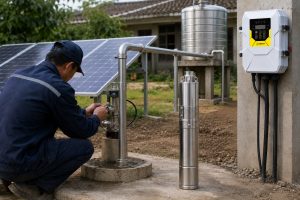
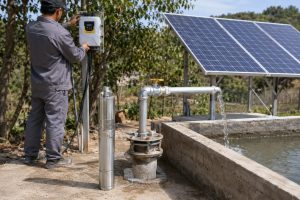
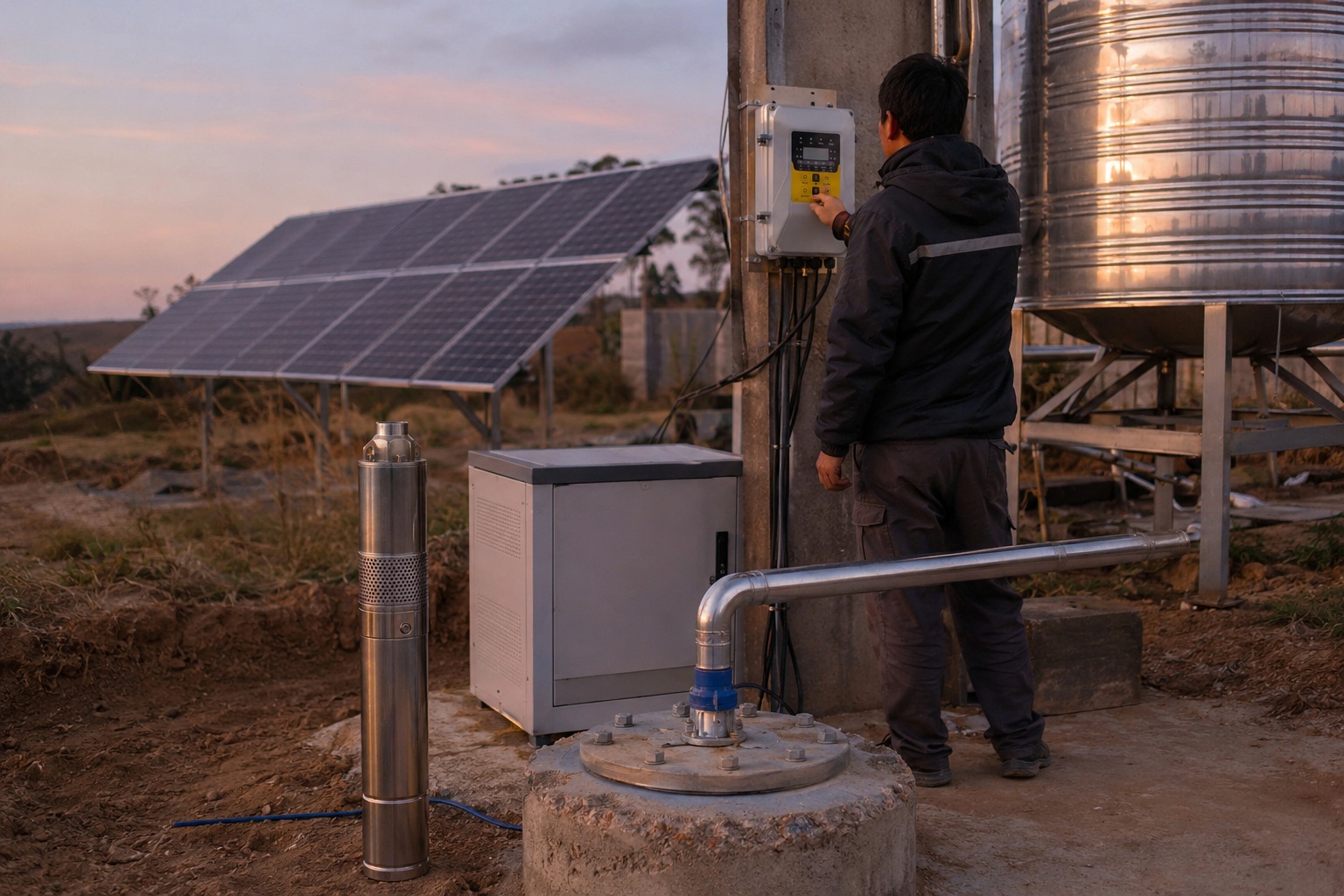
A solar pump system works by using photovoltaic (PV) panels to convert sunlight into direct current (DC) electricity.
This power runs the pump's motor.
During the day, the pump can either store energy in batteries or, more commonly, pump water into an elevated storage tank for nighttime use./p>
To truly grasp nighttime operation, you must first understand the fundamental components and principles at play during the day.
A solar water pumping system is more than just a pump and a panel.
It’s an integrated setup where each component plays a vital role in efficiency and reliability.
The process begins with the solar panels, which are the system's power plant.
These panels are made of photovoltaic cells that create electricity when exposed to sunlight—a phenomenon known as the photovoltaic effect.
This initial energy is in the form of Direct Current (DC).
The amount of power generated depends directly on the intensity of sunlight, meaning peak production occurs around noon on a clear day.
This variable power supply is managed by a crucial component: the pump controller.
The Brains of the Operation: The MPPT Controller
The controller is the intelligent heart of the system.
Modern controllers use Maximum Power Point Tracking (MPPT) technology.
This technology is a game-changer, increasing the system's efficiency by up to 30%.
It constantly adjusts the electrical load to find the optimal balance between voltage and current, ensuring the motor receives the maximum possible power from the panels, even in low-light conditions like early mornings or overcast days.
The controller also protects the pump motor from damage by regulating voltage and preventing it from running dry.
The Heart of the System: The Pump and Motor
The electricity from the controller powers the pump's motor, which is the component that does the actual work of moving water.
Most modern solar pumps use a Brushless DC (BLDC) permanent magnet motor.
These motors are highly efficient, often exceeding 90% efficiency, compared to the 60-75% efficiency of standard AC motors.
This high efficiency means you need fewer solar panels to achieve the same water output, significantly reducing the initial system cost by 15-25%.
The pump itself can be one of several types, each designed for different conditions.
| Feature | Brushless DC (BLDC) Motor | Standard AC Motor |
|---|---|---|
| Efficiency | > 90% | 60-75% |
| Power Source | Native DC (from solar panels) | AC (requires inverter) |
| Maintenance | Minimal (no brushes to replace) | Regular (brushes wear out) |
| Lifespan | 10+ years | 5-10 years |
| Complexity | Simple wiring, no inverter needed | Requires an inverter for solar |
Understanding these daytime fundamentals is the key to unlocking nighttime use.
The energy generated and the water pumped during sunny hours are the resources you will leverage when the sun is gone.
Solution 1: Storing Water, Not Electricity
Worried about the high cost and complexity of battery systems?
There's a simpler, more durable way to get water at night without storing a single watt of electricity.
The most cost-effective and reliable method for nighttime water access is to use solar power during the day to pump water into a large, elevated storage tank.
Gravity then provides pressurized water on demand, 24/7, without the need for batteries or nighttime power consumption./p>
This approach is the epitome of simple, effective engineering and is the go-to solution for thousands of off-grid homesteads and agricultural operations worldwide.
Instead of dealing with the complexities of electrical energy storage, you store the end product: water.
The concept is straightforward.
During peak sunlight hours, your solar pump works at maximum capacity.
All the water it moves is directed into a storage tank, often made of durable polyethylene and placed on a tower or a natural high point on your property.
A 10-foot (3-meter) elevation provides approximately 4.3 PSI of pressure, which is sufficient for basic irrigation and household use.
For higher pressure, you increase the height.
Calculating Your Storage Needs
To design an effective system, you must first determine your daily water consumption.
An average person uses 80-100 gallons (300-380 liters) per day for all needs.
A small farm might require several thousand gallons for irrigation and livestock.
Let's compare the costs of a gravity-fed system versus a battery-backed system for a household needing 400 gallons per day.
| System Component | Gravity-Fed System | Battery-Backed System |
|---|---|---|
| Solar Pump System | $1,500 | $1,500 |
| Storage | 2,500 Gallon Tank: $1,200 | 400Ah Battery Bank: $2,000 |
| Controller | Standard MPPT Controller | Hybrid/Charge Controller: $400 |
| Maintenance | Minimal (tank cleaning) | High (battery replacement every 3-5 years) |
| Total Initial Cost | $2,700 | $3,900 |
| 5-Year Cost | ~$2,700 | ~$5,900 (with one battery replacement) |
As the table shows, the gravity-fed system is over 45% cheaper over five years and far more reliable.
There are no batteries to degrade, no complex electronics to fail, and no ongoing replacement costs.
System Design Considerations
- Tank Size: Your tank should hold at least 2-3 days' worth of water. This provides a buffer for cloudy days when the pump's output is reduced. A 2,600-gallon tank is a popular starting point for small homesteads.
- Pump Sizing: The pump must be powerful enough to fill the tank during the 5-6 peak sun hours of the day. If your daily need is 1,200 gallons, you need a pump that can deliver at least 200 gallons per hour (1,200 gallons / 6 hours).
- Float Switch: An automatic float switch installed in the tank is essential. It turns the pump off when the tank is full to prevent overflow and turns it back on when the water level drops, automating the entire process.
This method completely decouples your water availability from real-time sunlight.
By harnessing solar power when it's most abundant, you create a robust, low-maintenance, and highly economical system that ensures water is always ready at the turn of a tap, day or night.
Solution 2: Storing Electricity with Batteries
Need high-pressure water at night for specific applications?
Sometimes gravity-fed systems don't provide enough pressure for sprinklers or modern appliances.
For high-pressure nighttime water needs, a battery-backed solar pump system is the solution.
During the day, solar panels power the pump and simultaneously charge a deep-cycle battery bank.
At night, the batteries provide the electricity to run the pump on demand./p>
While more complex and costly than water storage, a battery system offers the flexibility to run your pump anytime, maintaining the same high pressure you get during the day.
This is ideal for situations where an elevated tank is impractical or when you need to power other 12V or 24V devices in a remote location, like a pump house.
The system architecture changes significantly with the addition of batteries.
You'll need a different type of controller, known as a solar charge controller, which manages the flow of energy from the panels to both the batteries and the pump.
Its primary job is to protect the batteries from overcharging and deep discharging, which can drastically shorten their lifespan.
Key Components of a Battery System
- Deep-Cycle Batteries: Unlike car batteries, which are designed for short, powerful bursts, deep-cycle batteries are built to provide a steady amount of power over a long period. Lead-acid batteries are a cost-effective choice, but Lithium Iron Phosphate (LiFePO4) batteries offer a longer lifespan (over 3,000 cycles vs. 500 cycles) and higher efficiency, though at a higher initial cost of about 40-60%.
- Solar Charge Controller: An MPPT charge controller is still the best choice here, as it maximizes charging efficiency. It ensures the batteries receive the optimal voltage and current throughout the charging stages (bulk, absorption, float).
- Pressure Tank: An accumulator or pressure tank is crucial in a battery-powered system. It stores a small amount of pressurized water. This prevents the pump from cycling on and off every time you open a faucet for a short time, which drastically reduces wear on the pump motor and conserves battery power. A 20-gallon pressure tank can reduce pump cycles by over 90% for small water uses.
Sizing Your Battery Bank
Sizing the battery bank is the most critical step.
First, determine the pump's power consumption.
A typical 12V, 3.5 GPM RV-style pump draws about 8 amps.
If you need to run it for 1 hour at night, that's 8 Amp-hours (Ah) of energy.
To preserve battery health, you should only discharge lead-acid batteries to 50% of their capacity.
This means for 8Ah of use, you need at least 16Ah of storage.
Factoring in a buffer for cloudy days, a 100Ah battery is a common and safe starting point for most small-scale systems.
| Battery Type | Lifespan (Cycles) | Depth of Discharge (DoD) | Upfront Cost (per kWh) | Lifetime Cost (per kWh) |
|---|---|---|---|---|
| Flooded Lead-Acid | 500-1000 | 50% | $150 | $0.25 |
| LiFePO4 | 3000-7000 | 80-90% | $400 | $0.08 |
While the initial investment is higher, a battery-backed system provides unparalleled flexibility for high-pressure, on-demand water and can serve as a central power hub for other small, off-grid needs.
Solution 3: The Best of Both Worlds with Hybrid Systems
Is your water demand critical?
What happens during long stretches of cloudy weather when solar alone isn't enough, even with batteries?
A hybrid AC/DC solar pump system ensures 100% uptime by automatically switching between solar power and an AC source like the grid or a generator.
This provides ultimate reliability, guaranteeing water access 24/7, regardless of weather conditions./p>
This advanced solution is designed for mission-critical applications where a lack of water is not an option.
It's perfect for large-scale agriculture, community water supplies, or high-end homes that have access to a secondary power source.
The core of this system is a specialized hybrid controller or inverter.
This intelligent device constantly monitors the power available from the solar panels.
When sunlight is abundant, the system runs exclusively on free solar energy.
As clouds reduce solar output, or as night falls, the controller seamlessly supplements or switches over to the connected AC power source.
Some advanced controllers can even blend power, using all available solar energy first and only drawing the remaining required power from the AC source, maximizing your savings.
How Hybrid Controllers Work
A hybrid controller functions as a sophisticated power manager.
It has two main power inputs: one for the DC electricity from the solar panels and one for the 120V or 240V AC power from the grid or a generator.
The controller prioritizes solar power by default.
It only engages the AC input when the DC voltage from the panels drops below a preset threshold needed to operate the pump effectively.
The switchover is instantaneous and automatic, so you experience no interruption in your water supply.
Designing a Hybrid System
- AC/DC Pump or Inverter: You can use a dedicated AC/DC hybrid pump that is designed to accept both power types. Alternatively, you can use a standard DC solar pump and a hybrid inverter that converts AC power to the appropriate DC voltage for the pump. The first option is often more streamlined and efficient.
- Power Blending vs. Switching: Controllers with power-blending capabilities are superior. For example, if your pump requires 1,000 watts to run and your panels are only producing 600 watts due to cloud cover, a blending controller will draw the remaining 400 watts from the grid. A simple switching controller would abandon the 600 watts of free solar power and switch to 100% grid power, costing you more.
- Cost-Benefit Analysis: The initial cost of a hybrid controller is about 20-30% higher than a standard MPPT controller. However, the benefits of uninterrupted water supply and the elimination of a large, expensive battery bank often make it a more economical choice in the long run, especially for high-demand users.
| Feature | Battery-Backed System | Hybrid AC/DC System |
|---|---|---|
| Reliability | Dependent on sun & battery state | Near 100%, weather-independent |
| Upfront Cost | High (due to batteries) | Moderate (controller cost) |
| Maintenance | High (battery care/replacement) | Very Low |
| Operating Cost | Very Low (solar only) | Low (uses AC only when needed) |
| Best For | Medium demand, no grid access | High/Critical demand, with grid/generator |
A hybrid system offers the ultimate peace of mind.
It combines the eco-friendly, cost-saving benefits of solar with the unwavering reliability of a conventional power source, making it the premier choice for serious water users.
Choosing the Right Pump for Your System
Does your well run deep or is your water sandy?
Choosing the wrong pump type can lead to low pressure, frequent clogs, and premature failure, wasting your investment.
The pump is the heart of your system, and selecting the right type—screw, centrifugal impeller, or stainless steel—is critical.
Each is engineered for specific conditions like well depth, flow rate requirements, and water quality, directly impacting overall performance and longevity./p>
While the power system determines when you can pump, the pump itself determines how well you can pump.
All three major types of solar pumps are typically powered by the same highly efficient BLDC motors, but their internal mechanics are vastly different.
Understanding these differences is key to matching the pump to your unique water source and needs.
Pump Type 1: Solar Screw Pump
A solar screw pump, also known as a progressing cavity pump, operates using a helical stainless steel rotor spinning inside a rubber stator.
This design acts like an Archimedes' screw, pushing "pockets" of water upward with each rotation.
- Best For: Deep wells (high head) with lower flow rate requirements.
- Performance: Excels at creating high pressure, making it ideal for pushing water up from depths greater than 300 feet (90 meters).
- Advantage: It has excellent resistance to sand and grit, as the rubber stator can flex to pass small particles without damage. This makes it a durable choice for wells with less-than-perfect water quality.
Pump Type 2: Solar Centrifugal Impeller Pump
This is the most common type for moderate depths and higher flow rates.
It uses a series of stacked impellers (either plastic or stainless steel) that spin at high speed.
Water is drawn into the center of the first impeller and thrown outward by centrifugal force into the next stage, gaining pressure with each step.
- Best For: High-flow applications like farm irrigation or supplying multiple households from wells of moderate depth (100-300 feet).
- Plastic Impellers: A very cost-effective option with good wear resistance against fine sand. They are lightweight and reduce the overall cost of the pump.
- Stainless Steel Impellers: The premium choice. They offer superior durability and are highly resistant to corrosion from acidic or alkaline water. They provide the longest service life, especially in harsh water environments.
Performance and Application Comparison
| Pump Type | Best Application | Max Head (Pressure) | Max Flow Rate | Sand Resistance |
|---|---|---|---|---|
| Solar Screw Pump | Deep wells, domestic use | Very High (>500 ft) | Low | Excellent |
| Plastic Impeller | Farm irrigation, medium wells | Medium (100-300 ft) | High | Good |
| Stainless Steel Impeller | Corrosive water, high-end use | High (150-400 ft) | Very High | Fair to Good |
Choosing the right pump avoids inefficiency and costly replacements.
A screw pump in a shallow, high-flow application would be inefficient and slow.
A plastic impeller pump in a very deep or corrosive well would fail prematurely.
By analyzing your well depth, required flow rate, and water quality, you can select a pump that delivers reliable, efficient performance for years to come.
Conclusion
A solar pump can reliably work at night.
Success depends on a well-designed system using water storage, batteries, or a hybrid controller to overcome the absence of sunlight.
FAQs
Can a solar water pump work on cloudy days?
Yes, solar pumps can work on cloudy days, but their output will be reduced. Modern pumps with MPPT controllers maximize efficiency in low-light conditions to continue pumping, albeit at a slower rate.
How many solar panels do I need to run a water pump?
The number of panels depends on the pump's power rating (watts) and your location's daily sun hours. A typical 300-watt pump may require two to three 150-watt panels to run effectively.
Do I need a battery for a solar water pump?
A battery is not required if you pump water into a storage tank for later use. Batteries are only necessary if you need to run the pump on-demand at night or during non-sunny periods.
How long do solar water pumps last?
A quality solar water pump system can last 15-20 years. The solar panels are rated for 25+ years, while the pump motor typically lasts over 10 years with minimal maintenance.
What size solar pump do I need?
Pump size depends on your daily water requirement, the total vertical lift (head), and the gallons per minute (GPM) you need. A professional sizing calculation is recommended for accuracy.
Can I use a solar pump for my house?
Yes, solar pumps are an excellent solution for supplying water to a house, especially in off-grid locations. A system with a pressure tank can provide pressurized water suitable for all household needs.
How deep can a solar pump go?
Solar pumps can draw water from significant depths. Solar screw pumps are designed for very deep wells, capable of lifting water from over 500 feet (150+ meters).
Is a solar water pump worth it?
For off-grid locations or areas with high electricity costs, a solar water pump is a highly cost-effective investment. It has very low operating costs and provides water independence and reliability.